A review of findings from a recent resilience study of former child - - PowerPoint PPT Presentation

a review of findings from a recent resilience study
SMART_READER_LITE
LIVE PREVIEW

A review of findings from a recent resilience study of former child - - PowerPoint PPT Presentation

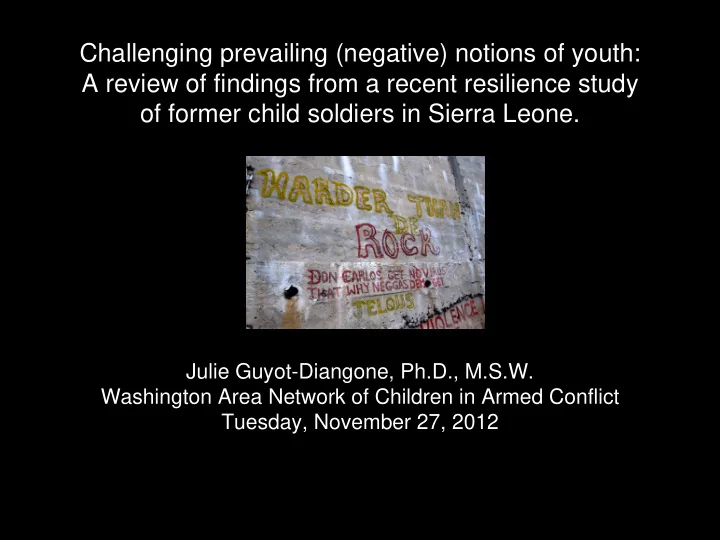
Challenging prevailing (negative) notions of youth: A review of findings from a recent resilience study of former child soldiers in Sierra Leone. Julie Guyot-Diangone, Ph.D., M.S.W. Washington Area Network of Children in Armed Conflict Tuesday,


slide-1
SLIDE 1

Challenging prevailing (negative) notions of youth: A review of findings from a recent resilience study

  • f former child soldiers in Sierra Leone.

Julie Guyot-Diangone, Ph.D., M.S.W. Washington Area Network of Children in Armed Conflict Tuesday, November 27, 2012

slide-2
SLIDE 2

Defining “Resilience”

An innate ability or characteristic (Garmezy, 1993) Brought about by adversity (Strumpfer, 2002) Based on environmental resources and access (Ungar, 2011) Linked to the ability to influence the environment (Wessells, 2005) Competence (Masten, 1989; McAdam-Crisp, 2006) Exists on a continuum, not absolutes (Fergus & Zimmerman, 2005) Tied to ideology or cultural values (Barber, 1999)

slide-3
SLIDE 3

Overview

  • Purpose
  • Introduction to the study
  • Screening instrumentation
  • Youth enclaves, examining

“community”

  • The Elder Brother

phenomenon

slide-4
SLIDE 4

Purpose of the study

  • To challenge depictions of wholesale brokenness of a

generation of Africans

  • A response to “youth bulge” discourse and

Afropessimism

  • Shift focus from formal resettlement programs to self-

settlement strategies

  • Place former combatants at the center of their

experience

slide-5
SLIDE 5

Theoretical Framework: A starting point of understandings and perspectives

  • Youth as social category and construction

(Evans-Pritchard, 1940; Stainton Rogers, 1989; UNCRC, 1989)

  • Resilience and the child soldier (Alvis Palma, 2009;

Boyden & Mann, 2000; Garmezy, 1993; Masten, 1994, 2001; McAdam-Crisp, 2006; Rutter, 1987)

  • Nestedness: Ecological theory (Boothby, 1996;

Bronfenbrenner, 1979, 1989; Earls & Carlson, 2001; Germain, 1973, 1976, 1978, 1985, 1991; Wessells, 2002)

  • Social role and community (re)integration

(Biddle, 1979; Wessells & Jonah, 2006; Williamson, 2006)

slide-6
SLIDE 6
  • NGO representatives:
  • PeaceLinks; Save the Children; Don Bosco; AUCAYD; Talking Drum
  • Youth/Former combatants:
  • Abdul Sesay; Abdul Sesay; Abubakar Ibrahim Turay; Abu Jaward; Alex Davis; Alias

Be Yourself; Alumamy L. Bangura; Alussane Bangura; Amara K. Momoh; Bockarie Philip - Daddy Boc; Bockarie Sesay; Cisco; Ernest; Fanta; Hannah Banday; IBK & Saidu; Ibrahim Sory Bangura; Idrissa; Jibu Lion; Joseph Kamara - J Black; Junior Musa Sesay; Kalie Conteh; Komrabai; Lahai Jibao; Lamin Kalokoh; Lansana Juana; Mabinty Mansary; Mahmoud Makeni; Musa; Paul Moiwo; Paul Turay; Prefect Abdulai Karuga; Saidu Toronka; Shaqwan; Suliaman Conteh; Suluku.

  • Family members:
  • Umara Koroma; Musa Kamara; Agnes Boima; Patricia Braima; Saidu Bundu
slide-7
SLIDE 7

The excluded

  • Former SBU member, current university student whose

anxiety rating regarding post-graduation opportunities precluded his participation in the study. [extreme anxiety]

  • Female resident of King Gimmy who subsisted by way of

a series of very temporary boyfriends. [depressive affect]

  • Two “family member” participants who presented as

suicidal, with significant food and housing issues. [linked to services]

slide-8
SLIDE 8

Psychological Measures

Why used: To meet minimal definition of resilience - absence of pathology. To ensure that only appropriate participants included. Do No Harm. Measurable. Opportunity for cross comparison. How problemmatic: Cultural incongruency, individualistic, “universality,” embedded assumptions, translating concepts, box-check responses, uni-directional

slide-9
SLIDE 9

Sample Questions

The HAM-A (Hamilton Anxiety Scale). “difficulty in falling asleep, broken sleep, unsatisfying sleep and fatigue on waking” The CES-D (Center for Epidemiologic Studies Depression) scale. “Are you lonely?” “I felt that everything I did was an effort” “Experienced loss of appetite” The PTSD Checklist Civilian version (PCL-C) “Avoid activities or situations because they remind you of a stressful experience from the past?” “Being ‘super alert’ or watchful on guard”

slide-10
SLIDE 10

HAM-A: Anxiety

  • Vast majority of participants

did not rate

  • Sleep issues related to the

physical environment

  • Moderate tension noted in

interviewees who were on break from their work day

slide-11
SLIDE 11

CES-D: Depression

  • Examples of cultural incongruities
  • The term “lonely”
  • Item 16: “I enjoy life.”
  • Rephrasing question about appetite
  • Item 7: “I felt that everything I did was

an effort.”

slide-12
SLIDE 12
slide-13
SLIDE 13

PCL-C: PTSD

  • Item 7: “Avoid activities
  • r situations because

they remind you of a stressful experience from the past?”

  • Item 16: “Being ‘super

alert’ or watchful on guard”

slide-14
SLIDE 14

Major Findings of the Study

  • Resilience: striving, thriving, surviving; re-

evaluating indicators and definitions

  • Environment: livelihoods; self-organized

youth enclaves

  • Family of choice vs biological family
  • Economic communities of youth -- car

wash, hair saloon [sic], Okada riders, etc.

  • Role: elder brother, an enduring cultural

resource

slide-15
SLIDE 15

Defining “Community”

Select Interview Settings: Lumley Car Wash King Gimmy Progressive Youth Hair Saloon [sic]

  • Youth enclaves
  • Family of choice
  • Community

network

  • Under-recognized

and under- researched

slide-16
SLIDE 16

Youth-only communities

Discourse typically framed with youth at the margins of adult- led, municipality-based community structures. Highly-organized, self-policing, mutual aid, social support networks comprised solely of youth exist. The benefits of brotherhood, belonging, apprenticeship, collective effort, and joining family of choice is apparent, and may serve as a protective factor. Prevailing assumption that these are the product of “community” rejection, not that youth themselves reject a return to those settings and demands.

slide-17
SLIDE 17

The social cost of reintegration

  • Removed from decision-making (Utas, 2005)
  • Return to “the bottom of the social hierarchy” (Shepler, 2005)
  • Stripped of moral and political agency (Boyden, 2003; Hart, 2006)
  • Relinquish voice as condition of integration
  • Loss of social status and prestige (Tefferi, 2003)
  • Competencies not recognized
  • Social role does not extend beyond household threshold
slide-18
SLIDE 18

Car Wash

Elected officials Chairman Secretary General Posted rules Financial dues Municipal link (land) Community membership

slide-19
SLIDE 19

King Gimmy

Cooperative business enterprises Family of choice Shared resources Posted rules Social support

slide-20
SLIDE 20

Hair Saloon

Leadership Apprenticeship Engagement Livelihood Shared belief system

slide-21
SLIDE 21

“Big Boy Pikin”: Elder Brothers

Firstborn Eldest boy (nevermind

  • lder sisters)

Eldest of mother’s children (polygamy) Eldest of surviving children

slide-22
SLIDE 22

What does it mean to be an elder brother?

  • Oh it means a lot! If you’re an older brother you have to fix a lot of responsibility...They

expect much from you. Support. Financially. For the parents. The children. Everything.

  • [Juana, Hill Station]
  • My role in the family as the oldest son is to take care of my siblings. To look after them

when our parents are not around. [Now] It has move[d] from that place to a higher responsibility, where I do take care of my younger ones, especially my younger brothers. And to take care of their school expenses.

  • [Komrabai, Freetown]
  • I have a big role to play, never mind I'm a disabled [person], I'm the elder one in family,

and now only two of us are alive. Even though I'm a disabled [person], if I have little from anything, I will share with my mother. That is why I tried very hard to become a builder with all my disability, and it is difficult for as a disabled [person], but that is what I do to earn my living. I tried hard to even forced myself to become a builder to be able to handle my family affairs.

  • [Bockarie Philip aka Daddy Bock, Grafton]
slide-23
SLIDE 23

Assets: Being an Elder Brother

Received more family resources (i.e. schooling, parental attention) Expectations of leadership at the earliest age Accustom to decision-making and independence Recognition of status among peers

slide-24
SLIDE 24

Role expectations

  • I am the only man after God that the family is looking up to.

[Alimamy L-Bangura, Circular Road]

  • They were expecting me to do something beneficial, not to go on the street

like what I have done.

  • [Ibrahim Sory Bangura, Lumley]
  • To support them, they expect me to support to them, but how I can support

them when something is not there except my little and nothing I'm dregging at times, and I'm the one to responsible for myself back and then I think of them

  • ver there back you see, my burden is high. They are expecting me to support

them but when there is no money...

  • [Suliaman Conteh, Lumley]
slide-25
SLIDE 25

Understanding livelihoods.

  • I differ from them because I learnt a trade that will enhance me to take care of my

brothers and sisters.

  • [Abu Bakar Imbrahim Turay, Makeni]
  • What was really important to me was to learn a trade since I didn’t go to school so that I

would be in a position to assist my younger ones.

  • [Kalie, King Gimmy]
  • In my family most of them learned very well....I learned hair dressing....I learned

hairdressing and am having something bit by bit or encouraging. So, I thank God for

  • that. I am doing people’s hair. They are paying me bit by bit, so I thank God for that and

so am better than they do....I am able to do something for myself. Some are unable to do something for themself. They just sit down like that. Some are blind. They are not seeing. Some ear have problem. They are not hearing from far no longer. With me am better than they do a little bit because I learned something. I am managing my life and my sister.

  • [Fanta, Bo]
slide-26
SLIDE 26

Small Group Exercise

  • How would this information alter

approaches to the work you do with youth of similar circumstance?

  • What are some of the strengths and

limitations, obstacles and opportunities in taking a new approach?

  • Question three: Let’s create this one

together before breaking into groups.

slide-27
SLIDE 27

Implications

  • Research - shift from trauma to capacity; more inclusive vision of

stakeholding groups

  • Policy - broad educational funding, not predicated on ex-combatant

status; and, youth enclave links to micro-enterprise, not individual (mass) vocational training

  • Practice - not individualistic approaches
  • Social Work Education - increased participation of social workers in

this area; focus on critique of instruments

slide-28
SLIDE 28

Recommendations for future research

  • Youth-inclusive research strategies
  • Youth members, research teams (Denov, 2008)
  • Funding and capacity-building for youth-led NGOs, like

AUCAYD, PeaceLinks, and Mind to Change.

  • Direct mentoring and microfinance education to youth

communities centered around economic enterprises.

  • Increased attention to under-researched populations, such as

disabled veterans, mothers of combatants, the “naughty” youngsters.

slide-29
SLIDE 29

Thank you!

julieguyot-diangone@hotmail.com

There is currently a display of photos from this fieldwork period on display at Busboys & Poets in Hyattsville---all proceeds from the sale of photographs go directly back to Freetown. A February “artist talk” is also scheduled that will focus on depictions of African youth.