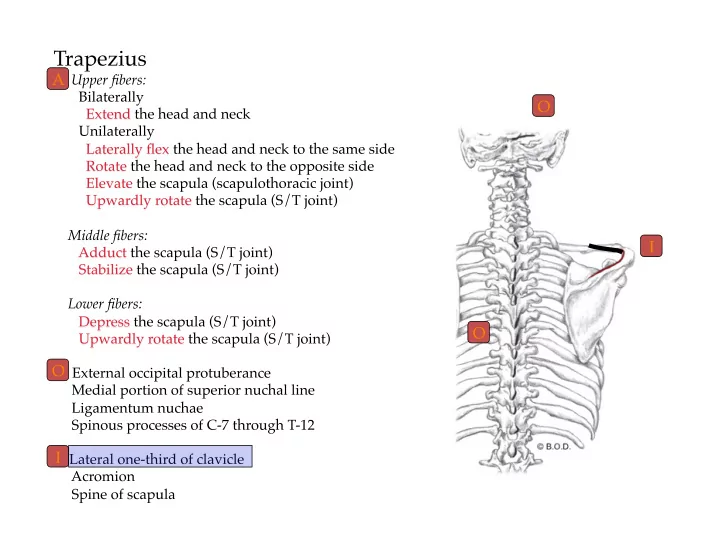
A O I O O I A O I O I A O I O O I - - PowerPoint PPT Presentation

a o i o o i a o i o i a o i o o i
SMART_READER_LITE
LIVE PREVIEW

A O I O O I A O I O I A O I O O I - - PowerPoint PPT Presentation

A O I O O I A O I O I A O I O O I A O I O O I A O I Posterior View Latissimus dorsi Trail Guide, Page 71 Latissimus dorsi is a


slide-1
SLIDE 1

O A I O O I

slide-2
SLIDE 2

O A I O I

slide-3
SLIDE 3

O A I O O I

slide-4
SLIDE 4

O A I O O I

slide-5
SLIDE 5

O A I

Posterior View

slide-6
SLIDE 6

Latissimus dorsi

Trail Guide, Page 71

Latissimus dorsi is a broad, thin, superficial muscle of the low back. The name means “widest of the back”. This image only shows the right side, but the full muscle is bilateral. Bilateral Having two sides. The abbreviation is Lat.

Posterior View

slide-7
SLIDE 7

Teres major is called “lat’s little helper” because they are complete synergists. Synergist Muscle that aids movement by contracting at the same time as the prime movers. Although the teres major and teres minor share the same first name, they rotate the arm in opposite directions. What actions are performed by the lats and teres major?

Posterior View

Teres major

Trail Guide, Page 71

slide-8
SLIDE 8

Actions of the lats and teres major

Glenohumeral extension Glenohumeral adduction Glenohumeral medial rotation Posterior View Posterior View

slide-9
SLIDE 9

O A I

Posterolateral View

slide-10
SLIDE 10

O A I

Posterolateral View

slide-11
SLIDE 11

O A I

Posterolateral View

slide-12
SLIDE 12

O A I

Posterior View

slide-13
SLIDE 13

O A I

Posterior View

slide-14
SLIDE 14

O A I

Posterior View

slide-15
SLIDE 15

O A I

Posterolateral View

slide-16
SLIDE 16

O A I

Posterior View

slide-17
SLIDE 17

O A I

Posterior View

slide-18
SLIDE 18

O A I

Posterior View

slide-19
SLIDE 19

O A I

Posterior View

slide-20
SLIDE 20

O A I

Posterior View

slide-21
SLIDE 21

O A I

Posterior View

slide-22
SLIDE 22

O A I

Posterior View

  • Anterior View
slide-23
SLIDE 23

O A I

Posterior View

  • Anterior View
slide-24
SLIDE 24

O A I

Posterior View

  • Anterior View
slide-25
SLIDE 25

Bony Landmarks of the Humerus

Trail Guide, page 50

Intertubercular groove Crest of the lesser tubercle Crest of the greater tubercle Greater tubercle Lesser tubercle Head of the humerus Deltoid tuberosity

Anterior View

slide-26
SLIDE 26

Venn diagram

(common details graph)

Latissimus dorsi

Origins: Thoracic spinous processes Last 3-4 ribs Thoracolumbar aponeurosis Posterior iliac crest Actions: G/H extension G/H adduction G/H medial rotation Origin: Inferior angle

  • f scapula

Insertion: Proximal, anterior humerus

Teres major

Origins: Lower one-third of lateral border of the scapula

slide-27
SLIDE 27

O A I

Posterior View

slide-28
SLIDE 28

Rhomboid Major and Minor

Trail Guide, Page 82

The rhomboids are named for their geometric shape. A rhombus is a parallelogram with oblique angles and only the

  • pposite sides are of equal

length. They are located between the scapula and the vertebral column. When do you use your rhomboids?

Posterior View Posterior View

slide-29
SLIDE 29

Actions of the rhomboids

Scapulothoracic elevation Scapulothoracic downward rotation Scapulothoracic adduction Rhomboid major

  • Posterior View
  • Rhomboid minor
  • Posterior View