- . "[a]ny search or analysis of t he data archive shall . . . - - PDF document

a ny search or analysis of t he data archive shall occur
SMART_READER_LITE
LIVE PREVIEW

- . "[a]ny search or analysis of t he data archive shall . . . - - PDF document

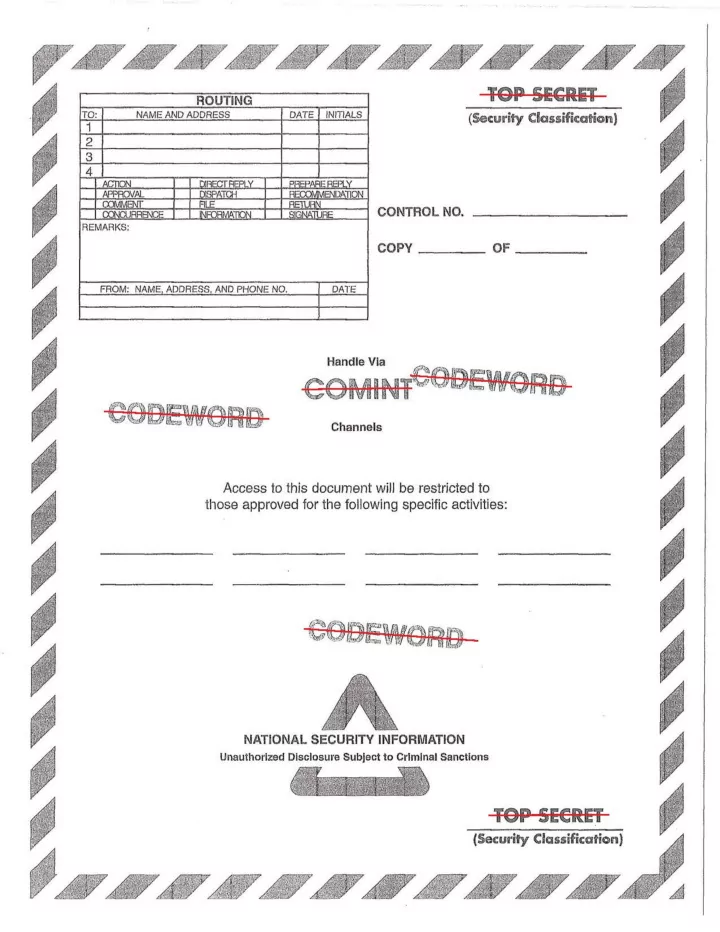
TOP SECRET ROUTING TO: INITIALS NAME AND ADDRESS DATE (Security Classifacaticn) 1 2 3 4 DIRECT REPLY :REPLY ACTlON APPROVAL DISPATQ-1 ENDAllON CXJMVIENT ALE A N CONTROL NO. . INFOAivV!.llON CONCURRENCE S JRE REMARKS: COPY


slide-1
SLIDE 1

ROUTING

TOP SECRET

TO: NAME AND ADDRESS DATE INITIALS

1

(Security Classifacaticn)

2 3 4

ACTlON DIRECT REPLY

:REPLY APPROVAL

DISPATQ-1

ENDAllON

CXJMVIENT

ALE A N CONCURRENCE . INFOAivV!.llON

JRE

CONTROL NO.

REMARKS:

COPY ---- OF----

FROM: NAME ADDRESS AND PHONE NO. DATE

Channels

Access to this document will be restricted to those approved for the following specific activities: NATIONAL SECURITY INFORMATION

Unauthot•ized Disclosure Subject to Criminal Sanctions

TOP SECRET

(Security Classification)

slide-2
SLIDE 2

TOl' SECRE'I'HCOl\'flNTHNOFOR1(HMR NSA REPORT TO THE FOREIGN INTELLIGENCE SURVEILLANCE COURT

(DR 06-05) (TSHSllfNV)

('PS // SI//HF )

The National Security Agency (NSA)

submits this report as required by the May 24, 2006 Order

  • f the Foreign Intelligence Surveillance Court (FISC),

Docket Number BR 06-05, which authorized NSA to acquire

certain tangible things in connection with investigations to protect against international terrorism concerning

  • pursuant to the Foreign Intelligence Surveillance

Act, as amended (the "Act"), 50 U.S.C.

§ 1861.

BACKGROUND (U) ('f'S// SI / / NF ) On May 24, 2006, the FISC issued an

Order authorizing NSA to acquir·e

"call detail records" maintained by in connection with investigations to protect against international terrorism requires that any application to renew or reinstate the authority shall include a report describing (i) the queries that have been made since this Order was grantedi (ii) the

manner in which NSA applied the procedures set forth in subparagraph A (which describes the access control and the

1

( ~S/

/

SI / NF

)

"Call detail records," or "telephony metadata," were defined in NSA's declaration, and similarly in the Court's Order, to include comprehensive communications routing information, including but not limited to session identifying information (e.g., originating and terminating telephone number, communications device identifier, etc.), trunk identifier, and time and duration of call, but not to include the substantive content of any communication, as defined by 18 U.S.C. § 2510(8), or the name, address, or financial information of a subscriber

  • r customer.

'FOP SBCRETh'COMIP.fTh'NOFOR?WMR 1

slide-3
SLIDE 3

TOP SECR:ET/ICOMINT/INOFORN//MR

standard for querying the data); and (iii) any proposed

changes in

call-detail records would be

received

See Docket Number BR 06-05 at

9(para. 4.1). This report addr esses the period between May

24, 2 006 and August 2, 2006, a cut-off date .

that was selected in order to allow for the gathering of data and

composition of the report; the next report wi.J.l address a

period beginning with August 3, 2006.

Because the cut-off

date is prior to the date of thE-~ Court's August 8, 2006

Amended Order in this matter, this report does not discuss NSA's activities under that Amended Order.

(T£ / / f. I/~

)

ROLE OF DATA INTEGRITY ANALYSTS {e ) (TS // SI//NF ) As an initial matter, NSA wants to

clarify the fact that a small team of analysts who have

access to the data acquired pursuant to the Order do not engage in call- chaining analysis for the purpose of discovering terrorist su~pects

and disseminating

information to other appropriate elements of the

Gover.nment; rather, thei:r:· function is to support such

efforts by continually assuring the quality, accuracy and

utility of the information received.

Because these

analysts access the acquired data before it is archived into the analytic database, and do not conduct the

  • perational analysis that has been detailed for the Court

in accordance with the standard provided by the Court, NSA believes it important to highlight with particularity their role in the analytic process.

(rpg,tgi//l?JF ) The successful use of the call-detail

records acquired under the Order is made possible in part through the efforts of a small team of "data integrityu analysts. This team- currently consisting of four

2

slide-4
SLIDE 4

individuals - has access to -- and does access - - the data acquired under the Order before it is archived into the database used by intelligence analysts to carry out their counter terrorism mission.

The data integrity analysts work with the

roviding the data to NSA and with the data itself to ensure NSA understands what data it is receiving, how the fields of data are arran contained in them, how they are used by the and similar issues concerning the delivery of the data to NSA.

These analysts alsO write software that facilitates the normalizq.tion and archiving of the incoming data into the

NSA analytic database, review the incoming records for

problems and ire~ularities, and general~ ensure the

quality of the data archived for operational purposes.

'rhese individuals are expert in the data itself, rather than in drawing conclusions about individuals based on the

data.

('3?0//S I //'NF ) The data integrity analysts do not query

the archived data to perform intelligence analysis, but

their role in supporting that analysis is a crucial one. 2

These data integrity analysts have been train.ed by NSA management and by the NSA Office of General Counsel in the

appropriate handling of the data, the purpose for and conditions under which NSA receives it, and the limitations

and conditions on its storage and use. The Government's

filings seekirtg renewal of the Order make specific

reference to the unique role of the data integrity analysis

team.

~

('PS//SI//NF) Indeed, it was through the efforts and attention of the

data integrity analysts that the presence of credit card information in

a small percentage of the records, discussed below, became known to NSA management.

TOl) SECRET//COMINTtJNOFOlllih'MR 3

slide-5
SLIDE 5

TOP SECRETI/COMlNT/-/NOFORNt/M:Jl

CALL DETAIL RECORDS ACQUIRED PURSUANT TO THE COURT'S ORDER, AND REPORTABLE ISSUES CONCERNING THEM

( ~

}

a.

The Records ..

J~Ql

(TS// SI// WV ) Pursuant to the Court's Order, NSA was

authorized to acquire call detail records from~

companies, and during t.his reporting period acquired such

records from

('PS// SI //NF) In all cases, the records consist of

numerous data fields that provide information about

telephone calls, but do not contain the content of any

calls as defined in 18 U.S.C. 2510(8}.

The fields of data

in the records contain information such as the telephone

number of the device initiating the call, the telephone number of the device that was called, the date and duration

  • f the call, the identifiers assigned to the communications

trunks that carried the call, whether a call originated or

It is 06-

TOP ~ECRETt/COMINTt.tNOFORNitM

R

4

slide-6
SLIDE 6

TOll SECRETh'COMINTh1NOFORNt/MR

('f'S//SI//PlF ) Often, numerous fields within a call

detail record contain no information.

Some fields

contained in a call detail record, such as the field indicating the called number, almost al Other fields, such as the field indicating

  • nly contain data when the field is relevant to the

in this case when the call

The number of fields in a

record varies depending on which company provided it and

which set of the company/s records it belongs toi

accordingly, the nu~Jer

  • f fields in a record varies from

('±'8//SI//NF } One field NSA has found particularly

field and that field.

This field is sometimes blank/ but sometimes contains a Nevertheless, out of an abundance of caution, the current

application specifically seeks authority to obtain and use

TOI' SECRETh'COMIJNT//WOFORWf/MR 5

slide-7
SLIDE 7

TOP 8ECRET/

/C Ol\41NT

/ /NOFORN

I~

m b .

Reportable Issues During This Period{U)

(€ ) Before elaborating on its application of the

standard used to conduct searches of the archived call

detail records, NSA wishes to bring to the Court's

.attention two i ssues that arose during the initial period

the Order was in effect.

( ~

£

/SI/NF

)

NSA averred in its Declaration in support

  • f the Government's application for tangible things that

the term "call detail records" would not include the substantive content of any communication, as defined by 18

u.s .c. § 2510(8}, or the name, address, or financial

information of a subscriber or customer .

The Court's Order

adopted similar language to des-

cribe the limits of its authorization.

Docket Number BR 06-05 at 2 (para . 2).

{'f'S//SI//':NF) A very small percentage of the call

detail records did, however, contain a 16-digit credit card

number in those cases when the caller selected a credit

card as the payment method for the call. In addition, some records contained proper names - in some cases just a first

name, and in some a first and a last name - when the

calling party sought to place a collect call.

('PS//SI//'NF} While NSA OGC advised that it believes

that the restrictions contained in .the Court's Order were not designed to prevent NSA from receiving the particular

information discussed below in the context it was received, the credit card numbers are at least arguably financial information, 4 and the names are clearly names.

NSA

4

('fS//SI//NF} Upon notification of the facts surrounding the inclusion

  • f the credit cards numbers as described, the NSA OGC advised that it

was not persuaded that the inclusion Qf the 16-digit string of numbers

in these records was unauthorized under the Order's terms.

NSA OGC

  • pined that a credit card number, standing alone, does not indicate.

TOl> 8ECRETNCOMINT/INOFORNI/MR

6

slide-8
SLIDE 8

TOP SEGRET//COMINT,l,LNOllOJlJ)WMR

describes below the conditions surrounding its receipt of

this information, the steps taken to eradicate it, and the

current status of the records with respect to such information.

1 .

cr·edi

t card numbers in certain reco;r:ds

(T£ // £I/£WR')

(-5 )

( ~

6

/SI/ NF

)

A very small percentage of the records

NSA acquired between !Vlay 24 and August 2 - approximately

0.001% -contained credit card numbers in one of the

fields.

NSA did not make use of this information in any

way. Upon recognizing that this information could be

considered financial information, NSA management directed

that softvJare be written immediately to suppress - or mask

  • the digits in the archived data whenever a 16-digit

string of numbers appeared in the relevant field.

This was accomplished on J·une 19, · ensuring that NSA analysts querying the archived data could neither see the credit card information nor make use of it in their analysis.

('±'6// SI/ O lF ) At

initiated contact with

representatives to request that the stop sending information 1n the relevant data field whenever the contents of the field consisted of a 16-

anything about the financial situation, purchasing habits, payment record, or any other such private information concerning a customer or subscriber.

NSA OGC believes it is this type of private information

about the finances of U.S. persons that the Court sought to protect in

its Order, rather than the mechanism used to pay for a particular

telephone call. Nonetheless, NSA OGC recognizes there exists a respectable argument that a credit card number is financial information, and also recognizes that such information could be used to derive more private information about an individual; therefore, NSA OGC believes it imperative to bring the issue to the Court's attention.

As

is set out above, NSA never did any analysis or took any other action

with respect to the credit card nwnbers, and rendered the credit card

numbers inaccessible to operational analysts 26 days after the Order was signed.

TOI• SECRETt/COMINT,l/NOFOR.~/M

R

7

slide-9
SLIDE 9

TOP SSCR"gTJ/COMINT/tNOFORJN:,',Ll).iR

digit number.

On LTuly 10·,- stopped providing· the

16-digit string

NSA and

1111 continue to take steps aimed at terminating the

delivery to NSA of similar informatio~.

5

Again, however, · the NSA analyst:s conducting searches of the

archived data have not had credit card numbers available to

them since June 19, 2006. M?reover, no record exists of any analyst having made any use of the credit card numbers, and no NSA methods would have called upon them to do so. 2. Pr

er addition, a field

which is normally blank, in a small number of instances contained a proper name. This occurred even less frequently than the 0.001% frequency with which

credit card numbers appeared, evidently when the calling party so.ught to place a collect call.

When the field

contained a proper name, it was sometimes a first name

  • nly, and sometimes both a first and last name.

{T£//SI//NF ) Achieving this without endangering the operation .is somewhat complicat.ed. NSA data integrity analysts (discussed above)

have written ~oftware

that helps load the call detail records into the

NSA database used to search the archived data.

Part of that software's function is to "recognize" a field for what it is, and treat it accordingly in organizing the data for use.

NSA cannot simply ask the

company to summarily eliminate the field without a likely disruption of

its operations, for two reasons: first, as discussed above, with

respect to the vast majority of call detail records, the field does not contain credit card information, and does contain useful information that permits the association of previouslyunassociated individuals;·

second, because NSA data integrity analysts have written software that

moves the information acquired pursuant to the Order into the database

in which the archived data is searched, and because that software "recognizes" a particular number of fields and the contents of each with respect to the different types of records, the precipitous elimination of a field would likely disrupt the functioning of the

system, treating data from one field as though it were data from another field.

As was stated above, however, NSA analysts conducting

searches of the archived data do not have access to the credit card information, and have never made use of it. TOP £ECRETh'COMINT//JNOFOR..'U/MR

  • '

8

slide-10
SLIDE 10

TOP SECitETh'COMUHN:NOF

' OR.~/-/M

R

( ~

6 / 61 /

NF

)

As was the case with respect to credit

card information, when NSA recognized that it was receiving proper names in a small number of records and that this fact was significant .under the Order, it took immediate steps along· two paths: at the direction of management, software was implemented on June 19 to suppress from view the proper names that appeared in the ar.·chived data queried

by the ai1alysts, and NSA officials worked with

  • fficials to curtail delivery of such information.

On July

9, procedures were implemented that precluded completely

the delivery of proper names in the records provided to NSA. NSA no longer receives proper names from

  • and

the proper names it did receive have been

masked from the view of analysts.

NSA never received

similar information from

THE S'!'ANDARD SET OUT IN THE COUR'!'' S ORDER {U) {6 / /61//PlF)

'l'he standard set out by the Court for the

purpose of querying data acquired pursuant to the

authorization and referred to for purposes of the required report is as follows: "[a]ny search or analysis of t he data archive shall

  • ccur only after a parti
  • . .

.

. .. - -....

  • .

..

....

More specifically, access to

the archived data sha

  • ccur only when NSA has

identified a known telephone number for which, based

  • n the factual and practical considerations of

everyday life on which reasonable and prudent persons

act, there are facts giving rise to a reasonable articulable provided, however, that a telephone number believed to be used by a U.S. person

TQJ> RIGCRET//COMINTt/NOFORNt/MR 9

slide-11
SLIDE 11

'f'OP SECRE'f7'COMIN'f/-/P~OFOR:f

(17'

Mf:t

shall not be regarded as associated with

  • n

basis of act are protected by the First

Amendment to the Constitution."

See Docket Number BR 06-05 at 5 (para 4.A).

NSA ACTIVITIES UNDER THE AUTHORITY GRANTED BY THE COURT"S MAY 24 1 2006 ORDER ('±'S//SI//NF) (Tg,t,tgi/ / :WF )

The Court's Order instructed the NSA

Office of General Counsel to brief analysts with respect to the authorization granted by the Order, and the limited circumstances in which queries of the archive are permitted, as well as other procedures and restrictions regarding the retrieval, storage and dissemination of the archived data. See BR 06-05 at 6 (para 4.C). a.

OGC

Brief ing~

(':PS // .91 /nJFl During this period~

NSA' s OGC conducted

forma l briefings at three different sessions, at least one

  • f which was attended by every analyst authorized to query

the archived data, as well as each the seven individuals authorized to approve queries of the archived data.

These

briefings consisted of descriptions of the retrieval, storage and.dissemination procedures and restrictions included in the Court's Order, as well as a description of ·the standard applicable to the processing of information in the archive and legal advice concerning its application. In addition to the scheduled formal briefings, NSA's OGC also provided frequent advice and counsel on these and similar topics t.hroughout the period to analysts applying the standard and to members of management responsible for

approving requests to query the archived data.

(Tg ,t,t gi //:WF ) In addition, as NSA makes clear above and

in its application for renewal and accompanying

TOP ~ECRETt/COMINT

,l/NO

F O

:R.1\f/

/ j.)l4l

t

10

slide-12
SLIDE 12

TOP SJl;CRET#COMit'lTN:NOFOR:Nh'MR

declaration, a small team of "data integrityu analysts ensure the quality of t.he call detail records prior to their inclusion in the NSA analytic database.

Because they have access to the data, NSA required them to attend one of

the above briefings, and each of them has done so.

b. Procedures for Applying the Court Ordered Standard (-&)

(Ta;//£I//WV) When a number is considered as a

candidate to be a seed with which to query the archive, one

  • f the designated approval authorities examines whatever

supporting documentation is included with the :r·equest with

an eye towards deciding whether, based on the factual and

practical considerations of everyday life on which

reasonable and prudent persons act, there are facts giving

rise to a reasonable articulable suspicion that a

The application of this "reasonable

person" standard is applied using a test similar to the

"totality of the circumstances" test used by the courts.

The decision as to whether a particular telephone number

qualifies as a seed in connection with the Order is

informed by a variety of factors •that could give rise to a reasonable articulable suspicion.

Some of the factors

militating in favor of using a particular telephone number

as a seed include (but are not limited to) :

  • telephonic contact between the phone numl?er in

question and that of a person reasonably believed

TOP SECRET//COMINTh'NOFORNffl\iR

11

slide-13
SLIDE 13

'fOP S11CRE'ff/COMIJ>(' f'HNOFORNHMR:

to be a member or agent: of

  • ther direct contact, as revealed through other

SIGINT, HUMINT, or other intelligence

information, in which a. telephone number is

conveyed when that contact involves a person

reasonably believed to be a member or agent of

u

  • pen source information that .

indicates a

telephone number is used by a person who is c.

Appl::ic_:_ation of the Standard to Determine Whe~he~ a Telephone Number Qualifies as a Seed Number

under the Court's Order

( ~0

/ SI /

!W

)

1. Queries Made as a Result of Automated

Alerts(€ }

(r:P£// :;;ii //JHF) NSA has compiled through its continuous

counter-terrorism analysis, a list of telephone nu1)1bers.

that constitute an "alert list" of te1ephone numbers used

by members of 'I'his alert list serves as a body of telephone numbers employed to query the data,· as is descd.bed more fully below_

(T£ // £1 // 'NF )

Domestic numbers and foreign numbers are

treated differently with respect to the criteria for including them on the alert list.

With respect to foreign

telephone numbers, NSA receives information indicating a

tie t:o

12

slide-14
SLIDE 14

TOP 8ECRl!:TJ

/ COMI1N T,L/

:NOFORI~t/.lA4R

from a variety of sources.

Principal among these are: reporting by the FBI, CIA or NSA; open sour·ce

known to the Intelligence Community; information from a

foreign intelligence service known by the U.S. Intelligence

Community tb be reliable; and telephony contact between the

telephone of a known

d another telephone.

Each of the foreign telephone numbers t:hat. comes to the determine whether the information about it provided to NSA

satisfies the reasonable articulable suspicion standard. If so, the foreign telephone number is placed on the alert

list; if not, it is not placed on the alert list.

('f'S// GI//HF ) The process set out above applies also to

newly discovered domestic telephone numbers considered for

addition to the alert list, with the additional requirement that NSA's Office of General Counsel reviews these numbers

and affirms that the telephone number is not the focus of

the analysis based solely on activiti~s

that are protected

by the First Amendment. There are, however, two categories

  • f domestic telephone numbers that were added to the NSA

alert list prior to the date the Order took effect, and the

basis for their addition is slightly different.

(PS // SI //NF ) The first category consists of 177

domestic numbers that are currently the subject of FISC authorized electronic surveillance based on the FISC's Since these numbers were already reviewed and authorized by the Court for electronic surveillance

TOP SBCRBThiCOMil-'TThll-'TOFOa±'+hiMR by

13

slide-15
SLIDE 15

TOP SECRETH COMINTHNOFORNHMR

purposes, they were deemed approved for meta data querying without the approval of an NSA official.

('fS // SI /OH")

'I'he second category consists of 199

domestic numbers each of which was added to the NSA alert

list after coming to NSA's attention because of its direct

contact with a known forei seed number, and

subsequent NSA analysis produced a sufficient level of suspicion that NSA generated an intelligence report about the telephone number to the FBI and the CIA. NSA's OGC has not reviewed the domestic numbers on the alert list that predate the effective date of the Order, as there was no requirement to do so with respect to NSA's activities prior

to the effective date of the Order.

However, it is

important to note that these numbers are not used as seeds. Rather, with respect to this category of t

in the event of a new contact, the foreign

  • ••• • mbers,

telephone number that originally sparked NSA's interest in the domestic number would be the seed. Accordingly when conducting contact chaining as a result of an alert list

"hit'', NSA limi ts the number of hops it undertakes from the

domestic number to two. 6

(TS//SI//NF) Note that NSA could - if it chose to - conduct queries

against the original foreign seed number every day or even multiple times a day, so long as it continued to have a reasonable articulable suspicion that the foreign number was associated with-

If NSA

did so, _ every day NSA would see the contact between the foreign seed and the domestic number that is on the alert list, as 'well as all new foreign and domestic contacts.

The inclusion of these domestic numbers

  • n the alert list is merely a quicker and more efficient way of

a.chieving the same result without looking at all the domestic to domestic contacts that would be revealed if this were done. Stated another way, the system is designed to bring to the attention of NSA the fact that a telephone number about which NSA has suspicion has had

a new contact with a number overseas, but all of this is premised on

the existence of a foreign seed number that originally surfaced the domestic number in question.

Each seed number NSA uses, whether

derived from information that was on the alert list prior to the effective date of the Order or after, meets the standard set out in the Order.

TOP SECRETUCOMINTt/NOFOR.l\l'I/MR

i4
slide-16
SLIDE 16

TOP SECRET/fCOMlNTHNOFORNHMR

(TS//SI//NF ) However, in order to avoid any appearance

  • f circumventing the procedures, NSA will change its

software to bui l d the chains from the original foreign

number and remove the 199 domestic numbers described above from the alert list. While the software is being

developed, which will take approximately 45 days, NSA will continue to run the domestic numbers on the alert list as described.

('3.

'8//SI/OW) As of the last day of the reporting

period addressed herein, NSA had included a total of 3980 telephone numbers .on the alert list, which includes foreign

numbers and domestic numbers, after concl uding that each of

the foreign telephone numbers satisfied the standard set forth in the Court's May 24, 2006, and each of the domestic telephone numbers was either a FISC approved number or in

direct contact with a foreign seed that met those criteria.

('PS//SI//NF )

To summarize the alert system: every

day new contacts are automatically revealed with the 3980 telephone numbers contained on the alert list described above, which themselves are present on the alert list

either because they satisfied the reasonable articulable

suspicion standard, or because they are domestic numbers

that were either a FISC approved number or in direct

contact with a number that did so.

These automated queries

identify any new telephone contacts between the numbers on the alert list and any other number, except that domestic

numbers ¢lo not alert on domestic-to-domestic contacts. ('PS//SI//NF} During this reporting period, a combination of the alert system and queries resulting from

leads described below in paragraph two led to analysi s that resulted in the discovery of 138 new numbers that were

TOP SECRETJICOMINT//NOFORNHMR

15

slide-17
SLIDE 17

TOP S'ECJUi;Th'COMIP'lTN :NOli'ORN/fMR

tipped as leads to the FBI and the CIA as suspicious telephone numbers.

2. Queries Resulting From Leads Other Than the Automated Alert System (e )

('I'e // SI //:WF ) The other type of query that NSA

analysts run are those based upon seed telephone numbers of

which NSA became aware through means other than the automated alerting system. rrhese are telephone numbers

that NSA has learned about through other sources, such as

communications it intercepted through other authorized

surveillance activities or information provided to NSA by

  • ther elements of the U.S. Intelligence Community.

A Shift

Coordinator approves all proposed queries of the archived data prior to their taking place, applying the standard set

  • ut in the Court's Order.

If the Shift Coordinator

determines an address is known or believed to be used by a U.S. person, the query is sent to the NSA OGC. Otherwise, the Shift Coordinator authorized (or disallowed) the use of the address as a seed address based on the criteria contained in the Court's Order. 7

( ·rs / / S I / / NF ) During . this reporting period, in response

to lead information primarily from CIA, FBI and internal to .

NSA, NSA determined that 153 new telephone numbe:r:·s

satisfied the reasonable articulable suspicion and

designated them as seeds; NSA then conducted analyses of

7 ('PS//SI//NF} Analysts are well-versed in the rules governing queries

  • f the data obtained as a result of the Court's Order.

Informal discussion among the counter--terrorism analysts frequently precedes the submi

r authorization to conduct contact

chaining Accordingly, a subset 'of the

potential seed numbers is discussed among the analysts and rejected as candidates at the analyst level.

In these cases, no formal request to use the number a s a seed number is ever made.

TOP SECRET//COMINT//:NOFOR:Nh'MR

16

slide-18
SLIDE 18

TOP ~ECRET/JC0~4INTUNOliORN/JM

R

the acquired data as described in the Court's Order.

Also

during this repo:r·ting period, NSA declined to process 46 telephone numbers it had received primarily from CIA, FBI

and internal to NSA, concluding the standard had not been

satisfied.

Of the 199 numbers proposed, 108 numbers were

submitted to the NSA OGC because they were believed to be used by U.S. persons .

NSA's OGC approved 99 as seeds, and

declined to approve 9. c.

Example of Application of the Standard and

Resulting Report

( ~ }

{'f'S// SI //NF ) Analysis of information obtained pursuant

to the Court's authorization in the above-captioned matter resulted in querying the archived data using a known

telephone number that satisfied the standard set out in the Court's Order, and a subsequent report identifying multiple foreign and two US-based possible terrorist-related leads. This new information was a direct result of meta data information gathered in the area, immediately after the

raid.

An NSA Shift Cookdinator determined that, based on

the factual and practical considerations of everyday life

  • n which reasonable and prudent persons act, there existed

facts giving rise , to a reasonable articulable suspicion

TOP SECREThiCOMINTN NO'FORNh'MR

.· 17

slide-19
SLIDE 19

TOP SECRET//COMINTI/NOFOR.l\J"NMR

that this phone number was associated wit~.

The

Shift Coordinator approved querying the archived data using this number as a seed, .....

sources that prior to contact,

l

d f 1 SIGINT

his

been in contact with multiple with numbers

in the United States, Australia, Canada and the United

d l

.

.. .

  • .

.

i.e

contacts

  • btained through analysis of data authorized by this Court

through BR-06-05 to FBI, CIA, and the NCTC.

PROPOSED CHANGES IN THE WAY CALL DETAIL RECORDS WILL BE RECEIVED BY NSA ('*'S// SJ;/ / I}Ji'}

TOP 8ECRET//GOlVHNT//NOJ?ORNf/1\4R

18

slide-20
SLIDE 20

l'iU.41::St:::

'i'OP SECRET/€0MJNTNOFORN/~m

  • Aside from this, NSA anticipates no changes and

proposes no changes to the way it receives the call detail records.·

Security Agency

TOP iECR.ET/,tCO~UNt'I+.NOFORNHMR 19