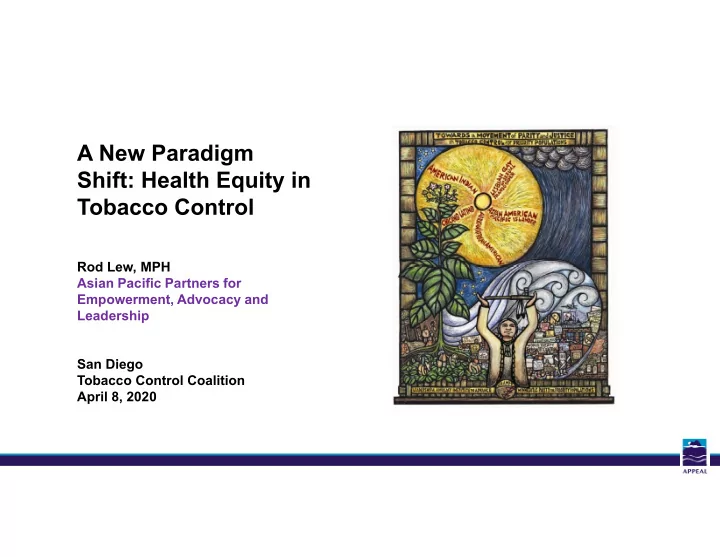
SLIDE 1 A New Paradigm Shift: Health Equity in Tobacco Control
Rod Lew, MPH Asian Pacific Partners for Empowerment, Advocacy and Leadership San Diego Tobacco Control Coalition April 8, 2020
SLIDE 2 Other Equity Collaborations
California
- ADEPT Equity Collaborative (commercial tobacco)
- CA4LessSoda Coalition (sugar‐sweetened beverages)
National
- CDC National Networks on Tobacco Control
- Phoenix Equity Group
- APHA PHEHP Health Equity Subcommittee
SLIDE 3 Objectives
- 1. Provide background history to the first paradigm shift in
tobacco control
- 2. Discuss why tobacco control needs a second paradigm shift
- n equity
- 3. Describe pathway to advancing health equity in tobacco
control
- 4. Connection between tobacco, COVID-19 and health equity
SLIDE 4
Historical View of Tobacco Control Policy Change
SLIDE 5 Successes of Policy Change
- What is a Paradigm Shift?
- Paradigm Shift from Individual Behavior Change to
Environmental Change
- The California Model- “quarter that changed the world”
- Comprehensive Smoke-free Air Policies
- Tobacco Taxes
- Media Campaign
- Unintended Consequences of Policy Change
SLIDE 7
Tobacco Disparities Still Exist
American Indian/Alaskan Native/ Native Hawaiian Pacific Islanders/LGBT higher prevalence African Americans face greatest burden of death and disability due to tobacco consumption Fastest growing populations: Asian Americans and Latinos, impacted by second hand smoke Underlying socioeconomic and political inequities including structural racism, homophobia and transphobia
SLIDE 8
Where the Story of Tobacco Begins
SLIDE 9
Slavery and the Commercialization of Tobacco
SLIDE 10 Industry Targeting of Communities of Color and LGBT Communities
Commercialization
Tobacco Industry
and Exploitation
SLIDE 11 History of Equity in Commercial Tobacco Control
- Health equity “relatively new” term in tobacco control
- California tobacco control– a pioneer in recognizing value of communities of color
and statewide ethnic networks (and nationally)
- Defunding of ethnic networks in CA
- Necessary rebuilding of community-led tobacco control from ground zero and
continuing systemic barriers (e.g. funding mechanisms)
SLIDE 12
HP2020 Definition of Health Disparities
Healthy People 2020 defines a health disparity as “a particular type of health difference that is closely linked with social, economic, and/or environmental disadvantage.”
SLIDE 13 Definitions of Health Equity
“the attainment of the highest level of health for all people” Healthy People 2020 “Health equity means that everyone has a fair and just opportunity to be as healthy as
- possible. This requires removing obstacles to health such as poverty, discrimination, and
their consequences, including powerlessness and lack of access to good jobs with fair pay, quality education and housing, safe environments, and health care.” Paula Braveman et al (Health Affairs June 2017)
SLIDE 14
Equality vs. Equity
SLIDE 15
Another View…..
SLIDE 16
Key Questions?
Where do I get the boxes? Are disparities widening? Who built the fence? What game are we watching? Can we play in the game? What is “liberation”? Freedom of choice?
SLIDE 17
Health Equity is about…
1) building community power 2) systems change within tobacco control, public health and other institutions and systems that impact inequities
SLIDE 18 Health Equity is not about…
- Designing only culturally tailored programs
- Outside entities developing strategies for marginalized
communities
- Funding communities with only short term goals in mind
- Placing solely accountability for change on marginalized
communities
SLIDE 19 Health Equity Principles
- Health equity as defined by systems change or building community power
- Address tobacco industry targeting
- Address institutional racism, homophobia and transphobia (including implicit bias,
institutional and explicit)
- Engage and empower communities of color and LGBTQs all along the spectrum of
tobacco control
- Nurture development of the next generation of community leaders
- Move tobacco control toward a Second Paradigm Shift focused on
“Health Equity as a Policy Goal”
ADEPT 2019
SLIDE 20 Health Equity as a Policy Goal? ‐ the Ultimate Systems Change
- Build on First Paradigm Shift in Tobacco Control
- Incorporates social determinants of health and impact on tobacco
- Builds capacity of communities to be set up for success in “policy
change” long term
- Addresses systemic change on multiple levels of “policy”
SLIDE 21 Redlining: San Diego in 1936
CREDIT: T‐RACES
https://www.kpbs.org/news/2018/apr/05/Redlinings‐Mark‐ On‐San‐Diego‐Persists/
SLIDE 22
What is an Equity Pathway that for Communities Can Choose? It’s not only “What” you do but “How” you do it?
SLIDE 23
SLIDE 24 Advocates Communities Coalitions Leaders Partnerships Resources Time Community Participation Community Competence Community Empowerment Prioritization and Goal- Setting Leadership Development Infrastructure Development Community Mobilization and Organizing Inputs Guiding Principles Strategic Planning Community Capacity Building Short Term and Intermediate Outcomes Long Term Outcomes Programs Cessation Prevention 4-Prong Policy Change Model Community Policy Mainstream Institution Policy Legislative Policy Corporate Policy Reduced Tobacco Use Health Parity and Health Justice
Strategic Framework for Tobacco Control among Priority Populations
Community Readiness Environment Assessment and Data
SLIDE 26 “APPEAL trainings are intense, in-depth, refreshing, and understands and embraces the diversity and cultural perspectives of the
- participants. And most of all you feel good… because for the first time
my history, cultural, and experiences -- were allowed at the table.”
- Brandie Flood, Center for Multicultural Health
Building Community Power through Leadership
SLIDE 27
LAAMPP Fellows Help Influence Passage of Minnesota Tobacco Tax
SLIDE 28
African/African American LAAMPP Fellows Helps Pass Smoke‐free Foster Care Policy in Ramsay County
SLIDE 29
SLIDE 30 Mainstream Institution Policy: Health Equity
- 1. Mandate funding of community engagement efforts among COCs and LGBTQs to be key
players in commercial tobacco control in the future (e.g through leadership programs) (state and local health depts)
- 2. Mandate “community‐friendly” funding and grant mechanism system to ensure that those
most marginalized and unreached of COCs and LGBTQs are prioritized
- 3. Mandate development of a Strategic and Implementation Health Equity Plan for CTCP with
health equity policy goals aligned with ADEPT’s health equity principles
- 4. Work with Offices of Health Equity to ensure implementation of health equity action steps
including:
- a. Institutionalize committees on best practices
- b. Reinforce implementation of CLAS Standards
- c. Institutionalize health equity agenda
- 5. Mandate the creation of an internal system that adequately ensures accountability in the
development and implementation of health equity goals with related benchmarks
SLIDE 31 Tobacco and COVID‐19 (Each and Together) Create Widening Disparities
- Smokers and vapers at greater risk
- Racist attacks against Asian Americans
- African Americans more likely to die from COVID‐19
- Impact on uninsured and underinsured
- Representation in health care industry and service industry
- “Work at home” and technology divide
SLIDE 32 Be a part of the New Paradigm Shift towards Equity in Tobacco Control
www.appealforhealth.org rodlew@appealforhealth.org
Thank You !!!