A new method for the detemination of the charge of the Top: - - PDF document

a new method for the detemination of the charge of the
SMART_READER_LITE
LIVE PREVIEW

A new method for the detemination of the charge of the Top: - - PDF document

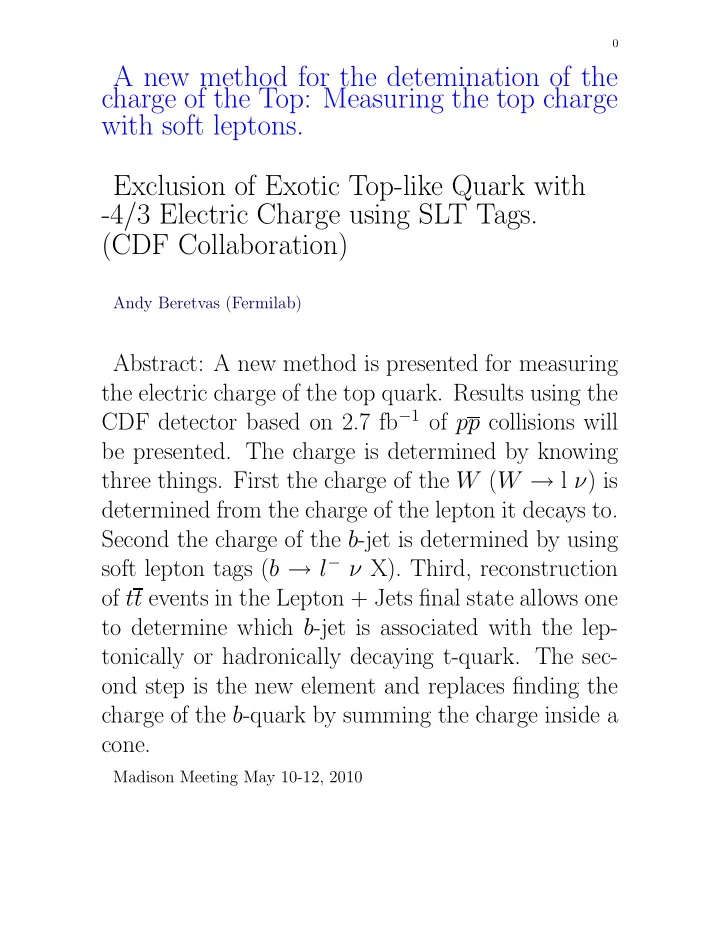
0 A new method for the detemination of the charge of the Top: Measuring the top charge with soft leptons. Exclusion of Exotic Top-like Quark with -4/3 Electric Charge using SLT Tags. (CDF Collaboration) Andy Beretvas (Fermilab) Abstract: A


slide-1
SLIDE 1

A new method for the detemination of the charge of the Top: Measuring the top charge with soft leptons. Exclusion of Exotic Top-like Quark with

  • 4/3 Electric Charge using SLT Tags.

(CDF Collaboration)

Andy Beretvas (Fermilab)

Abstract: A new method is presented for measuring the electric charge of the top quark. Results using the CDF detector based on 2.7 fb−1 of pp collisions will be presented. The charge is determined by knowing three things. First the charge of the W (W → l ν) is determined from the charge of the lepton it decays to. Second the charge of the b-jet is determined by using soft lepton tags (b → l− ν X). Third, reconstruction

  • f tt events in the Lepton + Jets final state allows one

to determine which b-jet is associated with the lep- tonically or hadronically decaying t-quark. The sec-

  • nd step is the new element and replaces finding the

charge of the b-quark by summing the charge inside a cone.

Madison Meeting May 10-12, 2010

slide-2
SLIDE 2

1

Exclusion of Exotic Top-like Quark with

  • 4/3 Electric Charge using SLT Tags.

(CDF Collaboration) Outline of Talk

  • 1. Standard Model versus Exotic Model
  • 2. Determining the Charge of the Top Quark
  • 3. Obtaining a clean sample
  • 4. Basic Statistical Elements

Npairs Puritypair Binominal Distribution

  • 5. How many pairs?
  • 6. Statistical errors α and β
  • 7. Need a Hypothesis to Test
  • 8. Results
  • 9. Conclusions

Outline Madison Meeting May 10-12, 2010

slide-3
SLIDE 3

2

  • 1. Standard Model versus Exotic Model

Basic Question for this Analysis tt → W + b W − b (SM) standard model tt → W − b W + b (XM) exotic model We use the lepton plus jet decay mode (L+J) tt → (l+ν b) (qq b) (SM) standard model tt → (l−ν b) (qq b) (XM) exotic model The leptons used are e and µ We use a kinematic fitter to tell which b is associated (paired) with the lepton

  • SM Charge of lepton is opposite to the charge of

the paired b

  • XM Charge of lepton is the same as the charge of

the paired b

Slide 2 Madison Meeting May 10-12, 2010

slide-4
SLIDE 4

3

  • 2. Determining the Charge of the Top Quark
  • Correct pairing of lepton and b

Kinematic Fitter (Purity = Pk = 76%) Kinematic Fitter = Reconstruction technique that assigns jets to their partons

  • Charge of the lepton
  • Charge of the b

Standard Method of Determining the Charge of the b The determination of the flavor of a b jet is based on jet charge calculation. The charges of tracks inside a jet (cone of radius = 0.4 in η-φ space) are summed up with weights defined by momentum amplitude of the track and the closeness of the track to the jet axis. Qjet =

|

pi. Pjet|0.5Qi

|

pi. Pjet|0.5 (1) Where pi, Qi is momentum and charge of a track associated with a jet and

  • Pjet, Qjet momentum and

charge of the jet.

Slide 3 Madison Meeting May 10-12, 2010

slide-5
SLIDE 5

4

  • Charge of the b

Puritytagger = Pt = 71% New Method of Determining the Charge of the b Semileptonic Decay Mode

  • b → l−νX
  • b → l+νX

Not easy, one needs to identify electrons embeded in jets.

  • FIG. 1: Predicted efficiency to tag an electron from semileptonic decay of HF and a hadron candidate SLTe

track in t¯ t events as a function of the track pT (a) and corrected jet ET (b). The left axis indicates the tagging efficiency for the electrons and the right axis indicates the tagging efficiency for the hadrons.

Slide 4 Madison Meeting May 10-12, 2010

slide-6
SLIDE 6

5

  • 3. Obtaining a clean Sample
  • We would like no Background
  • We get a Signal/Background = 12.5/1
  • soft lepton tag (SLT)
  • standard secondary vertex tag (SECVTX)
  • high pT leptons (pT > 20 GeV)
  • lepton must be central (| η |) < 1.
  • lepton must be isolated

(> 90% of Energy in cone of R = 0.4)

  • ET

/ > 30 GeV

  • Three or more high ET jets
  • The fourth jet can be lower (ET > 12 GeV)
  • HT > 200 GeV (Scaler sum of transverse energy of

leptons, jets and neutrinos)

  • χ2 constraint on kinematic fitter
  • Reject events containing cosmic muons
  • Reject conversion electrons
  • Reject events containing a Z
  • Reject events with more than one high pT lepton

Slide 5 Madison Meeting May 10-12, 2010

slide-7
SLIDE 7

6

  • 4. Basic Statistical Elements
  • Two Important Quantaties (Number of Events,

Purity)

  • Number of Signal Events

(I assume only one SLT in an event)

  • Purity = P =

NSM NSM+NXM

  • Purity SLT Tagger = Pt = 71%
  • Purity Kinematic Fitter = Pk = 76%
  • P = PkPt + (1. - Pk)(1. - Pt) = 61%
  • The figure of Merit for the experiment = ǫD2
  • For the SM, ǫ =

NSM Npre−tag

  • Dilution = D = 2P - 1

If you are interested in the XM model replace NSM with NXM and NXM with NSM

Slide 6 Madison Meeting May 10-12, 2010

slide-8
SLIDE 8

7

  • 5. How many pairs?
  • Branching Fraction for:

tt → Lepton + Jets(e+µ) = 29.6%

  • Pretag Acceptance = ǫpretag = 29.6%*0.21 = 6.2%
  • ǫtrigger = 0.96,

We collect events that fire an inclusive 8 GeV trigger

  • (SF = 0.92) to correct between MC and Data,

ǫDilution(Data) = SF2ǫDilution(MC) = 0.85

  • The square is because we need to correct both the lepton-jet and the

away-jet

  • Pretag Acceptance(corrected)

ǫpretag−c = 6.2% × ǫtrigger × ǫDilution = 5.1%

  • Npretag = ǫpretag−c × σ(tt) × L
  • Npretag = 5.1% × 6.7pb × 2700/pb = 922
  • ǫtag( SLT and SECVTX ) = 3.2%
  • NSLT+SECVTX = Npretagǫtag = 922 × 0.032 = 30.
  • Why is ǫ( tag SLT and SECVTX) so small ?
  • Branching Fraction(b → lνX) ≈ = 10%
  • Kinematic Fitter both b’s are tagged (χ2 < 27)
  • r both tags on the same b (χ2 < 9)
  • pT( Soft Lepton ) > 6 GeV
  • pT( Soft Muons(relative to the jet axis)) > 1.5 GeV

Slide 7 Madison Meeting May 10-12, 2010

slide-9
SLIDE 9

8

  • How many background pairs?

TABLE I:

Process pretag SM + XM Tags Diboson 73.23 ± 4.04 0.13 ± 0.01 Single Top 14.25 ± 0.83 0.24 ± 0.01 Z + Jets 63.85 ± 10.35 0.31 ± 0.06 Drell-Yan 14.08 ± 2.95 0.06 ± 0.01 QCD 198.91 ± 31.96 0.00 ± 0.43 W + LF 0.25 ± 0.04 W + bb 1.07 ± 0.29 W + cc/W + c 0.31 ± 0.07 W + Jets 1067.08 ± 149.46 (1.64 ± 0.30) Total Background 1431.41 ± 133.13 2.36 ± 0.52

  • Total sample size
  • 30. (Signal) + 2.36 (Background) ≈ 32.
  • Total Purity

0.608 (Signal) + 0.5 (Background) ≈ 0.60

Slide 8 Madison Meeting May 10-12, 2010

slide-10
SLIDE 10

9

  • 6. Statistical Errors α and β
  • Type I Errors called alpha
  • Type II Errors called beta
  • In a legal proceeding:
  • One would say the probability of an innocent person going

to jail is alpha.

  • The probability of a guilty person going free is beta
  • Clearly one wants both alpha and beta to be as small as

possible

  • http://www.intuitor.com/statistics/T1T2Errors.html
  • A pregency test:
  • If the test says a women is pregnant when she is not, this is

a type I error (alpha).

  • Type II error (beta) is when a test shows a women is not

pregnant when she is.

  • Clearly one wants both alpha and beta to be as small as

possible

These questions about statistics have been around for a long time.

  • J. Neyman and E. Pearson Phil. Trans. of the Royal
  • Soc. of London A31 289 (1933).

Slide 9 Madison Meeting May 10-12, 2010

slide-11
SLIDE 11

10

  • 7. Need a Hypothesis to Test
  • What do we need to know in order to proceed.
  • We must have a hypothesis (H0)

The person is innocent. The women is pregnant The exotic model is true.

  • We must know the probability distributions for both alter-

nativces. Probability distributions for the legal case ? Probability distributions for the medical case ? For our case it’s just the Binominal distribution (p + q)n For SM we have p = 0.6 and q = 0.4, n = 30

  • We need to set alpha before we do the experiment
  • There are four standard choices 95%, 99%, 3σ and 5σ
  • For Top charge analysis

we will choose 95% (alpha =5%) Are we proceeding correctly? Yes but, physics could be strange 50% charge 2/3 and 50% charge -4/3

Slide 10 Madison Meeting May 10-12, 2010

slide-12
SLIDE 12

11

  • H0 = The exotic Model is true

TABLE II: This table represents our understanding before doing the experiment.

Result of Test H0 true H0 false Do not reject H0 OK-1 Type I error Reject H0 Type II error OK-2

  • We plot both distributions (SM and XM), and draw a line so

that (XM) exotic distribution has 95% of its area to the left

  • f the line. The 5% to the right corresponds to alpha.
  • To determine beta we use the same line, but look at the SM
  • distribution. The area to the left of the line corresponds to

beta, the area to the right is 1 - β ( Sometimes called the power of the method.)

TABLE III: This table represents our understanding before doing the experiment.

Result of Test XM true XM false Do not reject XM 95% 5% Reject XM 28.6% 71.4%

  • If we reject the Hypothesis we will publish a 95% CL of

excluding the XM model.

  • If we do not reject the Hypothesis we will look at the alter-

native hypothesis.

Slide 11 Madison Meeting May 10-12, 2010

slide-13
SLIDE 13

12

  • 8. Results

h1

Entries 31 Mean 0.4032 RMS 0.08656

Purity 0.1 0.2 0.3 0.4 0.5 0.6 0.7 0.8 0.9 1

  • 4

10

  • 3

10

  • 2

10

  • 1

10 1

h1

Entries 31 Mean 0.4032 RMS 0.08656

3 5 7 9 11 13 15 17 19 21

Measurement CDF Preliminary

Distribution for SLT (SM black) for N = 30 and p = 0.6

  • FIG. 2: The blue line has approximately 5% of the XM curve to it’s right.
  • If we observe 17 or more SM pairs out of 30 we will

have excluded the XM model at a 95% CL.

  • We observe 19.3
  • The reason for the strange number is that we re-

constructed 45 events (SM = 29, XM = 16)

Slide 12 Madison Meeting May 10-12, 2010

slide-14
SLIDE 14

13

  • 9. Conclusions
  • Many important aspects of this analysis are not

presented in this talk (kinematic fitter, systematic errors, ...) This experiment is not symmetric we can not exclude the SM using a 95% CL, but should use 3σ

  • This presentation has simplified the analysis to

make the important points clearer

  • A Lepton + Jet sample has been analyzed corre-

sponding to 2.7 fb−1

  • The sample contains 45 SLT of which 29 are con-

sistent with the SM

  • WE are able to exclude the

exotic hypothesis (top quark charge = -4/3) at the 95% CL

  • The basic approach of dealing with well defined

random experiments is usual called the frequentist method

  • The basic statistical ideas are applicable to a large

range of problems

Conclusions Madison Meeting May 10-12, 2010

slide-15
SLIDE 15

14

Backup Slides

  • 1. More details for alpha and beta

http:/en.wikipedia.org/wiki/Type I and type II errors

  • 2. Possible Results
  • 3. Systematic Errors
  • 4. Subsamples

Backup Madison Meeting May 10-12, 2010

slide-16
SLIDE 16

15

  • 1. More details for alpha and beta.

Possible combinations

  • 1. Accept H0 when it is true ”true positive” OK-1
  • 2. Reject H0 when it is false ”true negative” OK-2
  • 3. Reject H0 when it is true ”false positive” α
  • 4. Accept H0 when it is false ”false negative” β
  • You obtain a ”true” when the results of the test agrees with the

actual conditions

TABLE IV: If we know the actual conditions

Actual Conditions H0 true H0 false Present Absent Result of Test Do not reject H0(positive) OK-1 (true positive) Type I error (false positive) Reject H0 (negative) Type II error (false negative) OK-2 (true negative)

Hypothesis H0 Person is Guilty

TABLE V: If we know the actual conditions

Actual Conditions Guilty Innocent Result of Test Guilty OK-1 (true positive) Type I error (false positive) innocent but convicted Innocent Type II error (false negative) OK-2 (true negative) guilt not detected

Backup alpha Madison Meeting May 10-12, 2010

slide-17
SLIDE 17

16

  • 2. Possible Results
  • SM will be a number between 0 and 30 for this

experiment SM ≥ 17 Exclusion of XM at 95% CL) SM ≤ 9 Exclusion of SM at the 3σ level Some thing that it’s ok to exclude the SM at 99% CL See the next two backup pages SM ≥ 10 and SM ≤ 16, no decision

  • In general there are 4 possible decisions

Exclusion of XM Exclusion of SM Exclusion of SM and XM No decision

  • Based on the Monte Carlo first decide on alpha

The systematic errors need to also be included in the MC Once alpha is determined so is beta

Slide Backup 1 Madison Meeting May 10-12, 2010

slide-18
SLIDE 18

17

  • H0 = The Standard Model is true

TABLE VI: This table represents our understanding before doing the experiment.

Result of Test H0 true H0 false Do not reject H0 OK-1 Type I error Reject H0 Type II error OK-2

  • We plot both distributions (SM and XM), and draw a line so

that (SM) exotic distribution has 99.87% of its area to the right of the line. The 0.13% ( 3σ) to the left corresponds to alpha.

  • To determine beta we use the same line, but look at the XM
  • distribution. The area to the right of the line corresponds

to beta, the area to the left is 1 - β ( Sometimes called the power of the method.)

TABLE VII: This table represents our understanding before doing the experiment.

Result of Test SM true SM false Do not reject SM 99.87% 0.13% Reject SM 82.4% 17.6%

  • If we reject the Hypothesis we will publish a 3σ exclusion of

the XM model.

Slide SLT11bup Madison Meeting May 10-12, 2010

slide-19
SLIDE 19

18

Results

h1

Entries 31 Mean 0.4032 RMS 0.08656

Purity 0.1 0.2 0.3 0.4 0.5 0.6 0.7 0.8 0.9 1

  • 4

10

  • 3

10

  • 2

10

  • 1

10 1

h1

Entries 31 Mean 0.4032 RMS 0.08656

Measurement CDF Preliminary

9 11 13 15 17 19 21 23 25

Distribution for SLT (SM black) for N = 30 and p = 0.6

  • FIG. 3: The blue line has approximately 0.13% of the SM curve to it’s right.
  • If we observe 9 or less SM pairs out of 30 we will

have excluded the SM model at the 3σ level.

  • We observe 19.3
  • The reason for the strange number is that we re-

constructed 45 events (SM = 29, XM = 16)

Backup SLT12bup Madison Meeting May 10-12, 2010

slide-20
SLIDE 20

19

  • 3. Systematic Errors

TABLE VIII:

Systematics Uncertainty in Purity (%) ISR/FSR 3.6 PYTHIA/HERWIG 2.2 Dilution Scale Factor 2.0 Jet Energy Scale 1.6 PDF’s < 1.0 Top Mass < 1.0 Cross Section 0.0 Luminosity 0.0 W + Lepton ID 0.0 SECVTX Tagger 0.0 SLT tagger’s (e , µ) 0.0 Total 4.9

  • Total sample size
  • 30. (Signal) + 2.36 (Background) ≈ 32.
  • Total Purity

0.608 (Signal) + 0.5 (Background) ≈ 0.60

Systematic Errors Madison Meeting May 10-12, 2010

slide-21
SLIDE 21

20

  • 4. Subsamples

TABLE IX: Tag configurations in various subsamples of the data, including divisions according to the primary lepton flavor, the number of b-jets, and the SLT flavor. Shown are the number of SM and XM tags as well as the total.

Subsample N NSM NXM Primary Electron 25 16 9 Primary Muon 20 13 7 1 Tagged Jet 7 4 3 ≥ 2 Tagged Jets 38 25 13 SLTe 25 15 10 SLTµ 21 15 6 ALL 45 29 16

Subsamples Madison Meeting May 10-12, 2010