
SLIDE 1
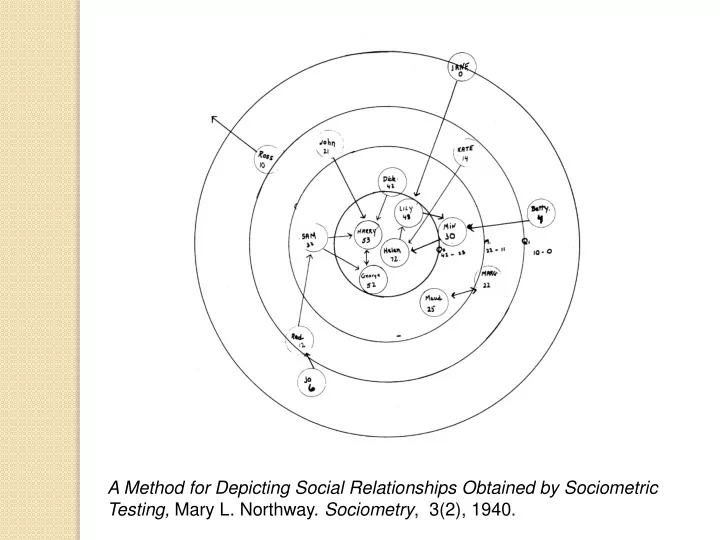
A Method for Depicting Social Relationships Obtained by Sociometric Testing, Mary L. Northway. Sociometry, 3(2), 1940.
A Method for Depicting Social Relationships Obtained by Sociometric - - PowerPoint PPT Presentation
A Method for Depicting Social Relationships Obtained by Sociometric Testing, Mary L. Northway. Sociometry , 3(2), 1940. We are taking the view that crossings We interpret this sentence as a of adjacent edges are trivial, and easily
A Method for Depicting Social Relationships Obtained by Sociometric Testing, Mary L. Northway. Sociometry, 3(2), 1940.
joint work with Radoslav Fulek Michael Pelsmajer
“We interpret this sentence as a philosophical view and not a mathematical claim.” Székely “We are taking the view that crossings
got rid of.” Tutte
“We interpret this sentence as a philosophical view and not a mathematical claim.” Székely “We are taking the view that crossings
got rid of.” Tutte
“We interpret this sentence as a philosophical view and not a mathematical claim.” Székely “We are taking the view that crossings
got rid of.” Tutte
A Method for Depicting Social Relationships Obtained by Sociometric Testing, Mary L. Northway. Sociometry, 3(2), 1940.
István Orosz. http://twistedsifter.com/2015/01/anamorphic-art-by-istvan-orosz/
from Bachmaier, Brandenburg, Forster. Radial Level Planarity Testing and Embedding in Linear Time , 2004
from Bachmaier, Brandenburg, Forster. Radial Level Planarity Testing and Embedding in Linear Time , 2004
at most one vertex per level graph is connected (potential) faces are known faces have at most two local maxima and two
any (single) edge can be made crossing-free
𝑤𝑗+1 has lower edge it doesn’t
𝑤𝑗+1 𝑄
G radial planar with rotation 𝜍 ↔ there is a radial planar drawing 𝐸 of 𝐻 with rotation 𝜍 ↔ given any radial drawing 𝐸 of 𝐻 with rotation 𝜍 there is a set of (𝑓, 𝑤)-moves and a set of 𝑓-twists in the resulting drawing 𝐸’ 𝑗𝐸′ 𝑓, 𝑔 ≡ 0 (𝑛𝑝𝑒 2) for all pairs (𝑓, 𝑔) of edges in 𝐻 given any radial drawing 𝐸 of 𝐻 with rotation 𝜍 there are x𝑓,v ∈ 0,1 , 𝑦𝑓 ∈ 0,1 , for all 𝑓 ∈ 𝐹, 𝑤 ∈ 𝑊, so that 𝑗𝐸 𝑓, 𝑔 + 𝑦𝑓,𝑔
1 + 𝑦𝑓,𝑔 2 + 𝑦𝑔,𝑓1 + 𝑦𝑔,𝑓2 + 𝑦𝑓 ≡ 0 (𝑛𝑝𝑒 2)
for all pairs (𝑓, 𝑔) of edges in 𝐻 , where 𝑦𝑓,𝑤 = 0 if 𝑓 does not overlap 𝑤 ↔ Polynomial time radial planarity algorithm, 𝑃(𝑜6) for given rotation system 𝑓 𝑤 (𝑓, 𝑤)-move 𝑓-twist
G radial planar ↔ there is a radial planar drawing 𝐸 of 𝐻 ↔ given any radial drawing 𝐸 of 𝐻 there is a set of (𝑓, 𝑤)-moves and a set of 𝑓-twists in the resulting drawing 𝐸’ 𝑗𝐸′ 𝑓, 𝑔 ≡ 0 (𝑛𝑝𝑒 2) for all independent pairs (𝑓, 𝑔) of edges in 𝐻 given any radial drawing 𝐸 of 𝐻 there are x𝑓,v ∈ 0,1 , 𝑦𝑓 ∈ 0,1 , for all 𝑓 ∈ 𝐹, 𝑤 ∈ 𝑊, so that 𝑗𝐸 𝑓, 𝑔 + 𝑦𝑓,𝑔
1 + 𝑦𝑓,𝑔 2 + 𝑦𝑔,𝑓1 + 𝑦𝑔,𝑓2 + 𝑦𝑓 ≡ 0 (𝑛𝑝𝑒 2)
for all independent pairs (𝑓, 𝑔) of edges in 𝐻, where 𝑦𝑓,𝑤 = 0 if 𝑓 does not overlap 𝑤 ↔ Polynomial time radial planarity algorithm, 𝑃(𝑜6) 𝑓 𝑤 (𝑓, 𝑤)-move 𝑓-twist
There are counterexamples for
Open