A Faith-Filled Catholic Who - Cardinal Virtues - Definitions - - - PDF document

a faith filled catholic who
SMART_READER_LITE
LIVE PREVIEW

A Faith-Filled Catholic Who - Cardinal Virtues - Definitions - - - PDF document

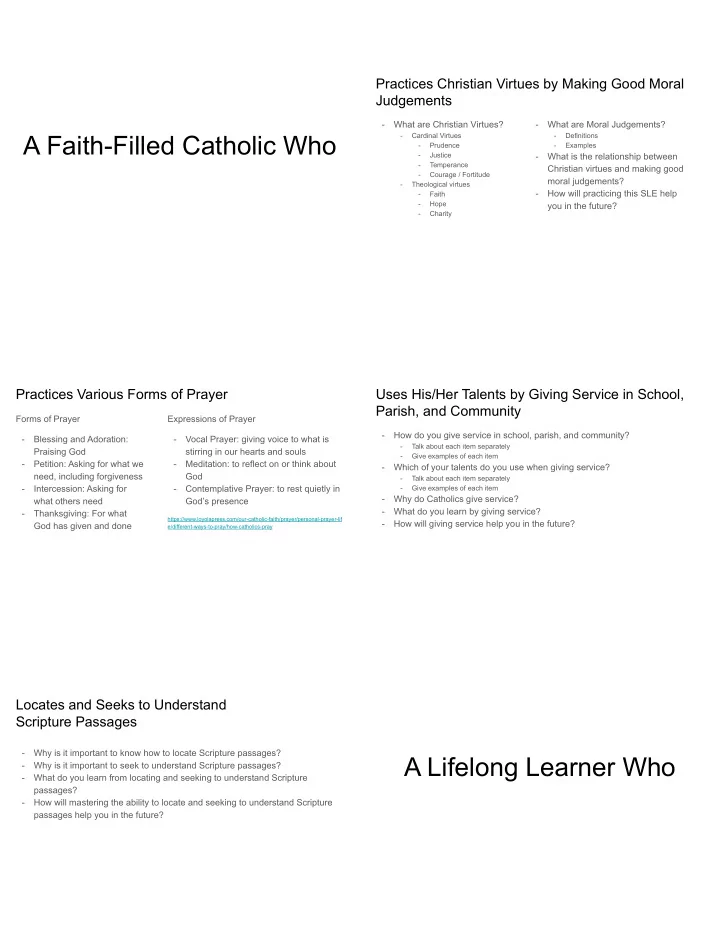
Practices Christian Virtues by Making Good Moral Judgements - What are Christian Virtues? - What are Moral Judgements? A Faith-Filled Catholic Who - Cardinal Virtues - Definitions - Prudence - Examples - Justice - What is the


slide-1
SLIDE 1

A Faith-Filled Catholic Who

Practices Christian Virtues by Making Good Moral Judgements

  • What are Christian Virtues?
  • Cardinal Virtues
  • Prudence
  • Justice
  • Temperance
  • Courage / Fortitude
  • Theological virtues
  • Faith
  • Hope
  • Charity
  • What are Moral Judgements?
  • Definitions
  • Examples
  • What is the relationship between

Christian virtues and making good moral judgements?

  • How will practicing this SLE help

you in the future?

Practices Various Forms of Prayer

Forms of Prayer

  • Blessing and Adoration:

Praising God

  • Petition: Asking for what we

need, including forgiveness

  • Intercession: Asking for

what others need

  • Thanksgiving: For what

God has given and done Expressions of Prayer

  • Vocal Prayer: giving voice to what is

stirring in our hearts and souls

  • Meditation: to reflect on or think about

God

  • Contemplative Prayer: to rest quietly in

God’s presence

https://www.loyolapress.com/our-catholic-faith/prayer/personal-prayer-lif e/different-ways-to-pray/how-catholics-pray

Uses His/Her Talents by Giving Service in School, Parish, and Community

  • How do you give service in school, parish, and community?
  • Talk about each item separately
  • Give examples of each item
  • Which of your talents do you use when giving service?
  • Talk about each item separately
  • Give examples of each item
  • Why do Catholics give service?
  • What do you learn by giving service?
  • How will giving service help you in the future?

Locates and Seeks to Understand Scripture Passages

  • Why is it important to know how to locate Scripture passages?
  • Why is it important to seek to understand Scripture passages?
  • What do you learn from locating and seeking to understand Scripture

passages?

  • How will mastering the ability to locate and seeking to understand Scripture

passages help you in the future?

A Lifelong Learner Who

slide-2
SLIDE 2

Understands the Value of Fine Arts

  • Fine Arts: Creative art

forms, whose products are to appreciated primarily or solely for their imaginative, aesthetic, or intellectual content

  • Painting, sculpture,

architecture, music, poetry, theatre, dance

  • Why is it important to understand the

value of fine arts?

  • What does it mean to value the fine arts?
  • How will valuing the fine arts help you in

the future?

  • What do fine arts teach you about
  • Yourself?
  • The artist?
  • The world?

Implements Technology to Enhance Research Projects

Technology:

  • Equipment developed from the

application of scientific

  • knowledge. (the primary

definition for our purposes)

  • The practical application of

scientific knowledge, particularly in industry and science (e.g. computer technology)

  • What are some types of

technical equipment that you interact with while doing your research? How does technology change the way you work? What are the potential hazards of technology in research?

  • What are some ways in which

you apply your scientific knowledge and research skills?

  • Why is this SLE important?
  • How will this help in the future?

Puts Forth Effort to Achieve Academic Potential

  • What does academic potential mean?
  • Academic: having to do with education
  • Potential: showing or having the capacity to become something in the future
  • Is academic potential equal in all students?
  • Can you measure your academic potential? How do you know when you have

achieved it?

  • How have your educational successes and growth been measured at STA?
  • Why is it important to put forth effort to achieve your academic potential?
  • How will this help you in the future?

Uses Critical Thinking Skills to Process Information

Critical Thinking Skills: 1. Knowledge 2. Comprehension 3. Application 4. Analysis 5. Synthesis 6. Evaluation Critical thinking is not just “thinking hard” about something! When we think critically, we use a set of practiced and acquired skills to process information.

  • What are situations in which you would need to

use critical thinking skills?

  • Why is critical thinking important?
  • How will mastering the ability to use critical

thinking skills help you in the future?

Develops Spiritually, Mentally, and Physically

  • How do you develop spiritually?
  • How do you develop mentally?
  • How do you develop physically?
  • How does being a lifelong learner help you develop spiritually, mentally, and

physically?

  • How will developing spiritually, mentally, and physically help you in the future?
  • Why is it important to continue developing in these three areas?

An Effective Communicator Who

slide-3
SLIDE 3

Expresses Clear Ideas in Written and Oral Form

  • Why should you learn to better express your thoughts in writing?
  • Why should you learn to better express your ideas in speech?
  • How are these skills important in everyday life? How have these skills been

useful on special occasions?

  • How will mastering the ability to express clear ideas in written and oral form

help you in the future?

Applies the Skills of an Active Listener

Skills of an Active Listener:

  • Be attentive
  • Ask open-ended questions
  • Ask probing questions
  • Request clarification
  • Paraphrase
  • Be attuned to and reflect feelings
  • Summarize
  • Why is it important to be an active

listener?

  • When do you need to apply the

skills of an active listener?

  • How will applying the skills of an

active listener help you in the future?

Articulates Beliefs and Opinions Respectfully and with Conviction

  • What does it mean to articulate your beliefs and opinions?
  • How and why would you do this with respect and conviction?
  • What are situations in which you have done this? What are possible scenarios

that would require the skills put forth in this sub-level SLE?

  • Why is this sub-level SLE important?
  • How will mastering the ability to articulate you beliefs and opinions

respectfully and with conviction help you in the future?

Demonstrates Manners and Etiquette Appropriately

Manners:

  • Please
  • Thank you
  • No interrupting
  • Excuse me
  • Ask permission
  • Knock on closed doors
  • Treat others with respect
  • Pretend to be interested

Etiquette:

  • Different behavior expectations

for different situations

  • Social etiquette
  • Church etiquette
  • Telephone etiquette
  • Eating etiquette
  • Classroom etiquette

Etiquette provides the form or structure within which good manners can operate.

A Responsible Individual Who

Strives to Live a Balanced Lifestyle

  • What are aspects of a balanced lifestyle?
  • How do you strive to embody a balanced lifestyle daily? Weekly? Monthly?
  • Does a balanced lifestyle look the same for everyone?
  • Why is living a balanced lifestyle important?
  • How will living a balanced lifestyle help you as you move through life?
slide-4
SLIDE 4

Respects the Diversity and Dignity of Each Human Being

  • What does respect mean in this context?
  • What does it mean to respect a person’s diversity? What does it mean to

respect a person’s dignity?

  • Why is respecting the diversity and dignity of each human being part of being

“a responsible individual?”

  • Why is this important?
  • How will respecting the diversity and dignity of each human being help you in

the future?

Accepts Challenges and Pursues Goals

  • What does it mean to accept challenges?
  • Think about challenges you’ve accepted in your life.
  • What does it mean to pursue goals?
  • Think about goals you’ve accepted in your life.
  • Why is it important to accept challenges and pursue goals?
  • What impact does accepting challenges and pursuing goals have on your life?
  • How will accepting challenges and pursuing goals help you in the future?

Analyzes Options when Making Choices

Analysis: a detailed examination of anything complex in order to understand its nature or determine its essential features: a thorough study

  • How do you analyze?
  • Identify the situation
  • Identify your options
  • Use prior knowledge to better understand your options
  • Use prior knowledge and understanding to make an informed decision
  • Why is it important to analyze your options when making choices?
  • How will developing the ability to analyze options when making choices help

you in the future?

Participates Appropriately when Working Independently and Collaboratively

  • What does it look like when you participate appropriately while working

independently? Collaboratively?

  • Why is this sub-level SLE part of being “a responsible individual?”
  • Why is is participating appropriately when working independently and

collaboratively important?

  • How will this help you in the future?