(a) DELPH-IN Minimal Recursion Semanticsderived bi-lexical - - PowerPoint PPT Presentation

a delph in minimal recursion semantics derived bi lexical
SMART_READER_LITE
LIVE PREVIEW

(a) DELPH-IN Minimal Recursion Semanticsderived bi-lexical - - PowerPoint PPT Presentation

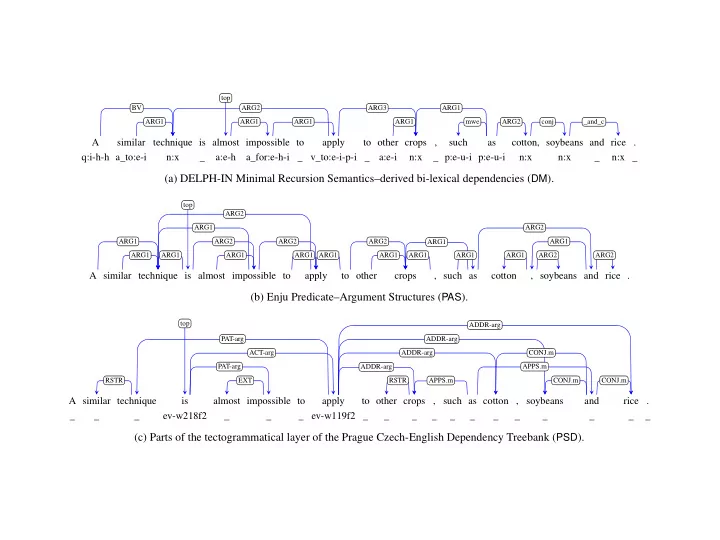
top BV ARG2 ARG3 ARG1 ARG1 ARG1 ARG1 ARG1 mwe ARG2 conj _and_c A similar technique is almost impossible to apply to other crops , such as cotton, soybeans and rice . q:i-h-h a_to:e-i n:x _ a:e-h a_for:e-h-i _ v_to:e-i-p-i _


slide-1
SLIDE 1

A similar technique is almost impossible to apply to other crops , such as cotton, soybeans and rice . q:i-h-h a_to:e-i n:x _ a:e-h a_for:e-h-i _ v_to:e-i-p-i _ a:e-i n:x _ p:e-u-i p:e-u-i n:x n:x _ n:x _

top ARG2 ARG3 ARG1 ARG2 mwe _and_c ARG1 ARG1 BV ARG1 conj ARG1

(a) DELPH-IN Minimal Recursion Semantics–derived bi-lexical dependencies (DM).

A similar technique is almost impossible to apply to other crops , such as cotton , soybeans and rice .

top ARG1 ARG2 ARG1 ARG2 ARG2 ARG1 ARG1 ARG1 ARG1 ARG1 ARG1 ARG2 ARG1 ARG2 ARG1 ARG2 ARG1 ARG1 ARG1 ARG2

(b) Enju Predicate–Argument Structures (PAS).

A similar technique is almost impossible to apply to other crops , such as cotton , soybeans and rice . _ _ _ ev-w218f2 _ _ _ ev-w119f2 _ _ _ _ _ _ _ _ _ _ _ _

RSTR PAT-arg EXT PAT-arg ACT-arg RSTR ADDR-arg ADDR-arg ADDR-arg ADDR-arg APPS.m APPS.m CONJ.m CONJ.m CONJ.m top

(c) Parts of the tectogrammatical layer of the Prague Czech-English Dependency Treebank (PSD).

slide-2
SLIDE 2

Properties of the data

EN i-d CS i-d ZH i-d EN o-o-d CS o-o-d

DM PAS PSD PSD PAS DM PAS PSD PSD

(1) # labels 59 42 91 61 32 47 41 74 64 (2) % singletons 22.97 4.38 35.76 28.91 0.11 25.40 5.84 39.11 29.04 (3) edge density 0.96 1.02 1.01 1.03 0.98 0.95 1.02 0.99 1.00 (4) %

g trees

2.30 1.22 42.19 37.66 3.49 9.68 2.38 51.43 51.49 (5) %

g projective

2.91 1.64 41.92 38.32 12.89 8.82 3.46 54.35 53.02 (6) %

g fragmented

6.55 0.23 0.69 1.17 15.22 4.71 0.65 1.73 3.50 (7) %

n reentrancies

27.44 29.36 11.42 11.80 24.96 26.14 29.36 11.46 11.44 (8) %

g topless

0.31 0.02 – 0.04 6.92 1.41 – – 0.02 (9) # top nodes 0.9969 0.9998 1.1276 1.2242 0.9308 0.9859 1.0000 1.2645 1.2771 (10) %

n non-top roots

44.91 55.98 4.35 4.73 46.65 39.89 50.93 5.27 5.31 (11) # senses 297 – 5426 – – 172 – 1208 – (12) %

n senses

13.52 – 16.77 – – 15.79 – 19.50 –

Table 1: Contrastive high-level graph statistics across target representations, languages, and domains.

slide-3
SLIDE 3

Results of SemEval-2015 Task 18

DM PAS PSD LF LF LP LR FF LF LP LR PF LF LP LR FF

TurkuG 86.81 88.29 89.52 87.09 58.39 95.58 95.94 95.21 87.99 76.57 78.24 74.97 56.85 Lisbon* 86.23 89.44 90.52 88.39 00.20 91.67 92.45 90.90 84.18 77.58 79.88 75.41 00.06 Peking 85.33 89.09 90.93 87.32 63.08 91.26 92.90 89.67 79.08 75.66 78.60 72.93 49.95 Lisbon 85.15 88.21 89.84 86.64 00.15 90.88 91.87 89.92 81.74 76.36 78.62 74.23 00.03 Riga 84.00 87.90 88.57 87.24 58.12 90.75 91.50 90.02 80.03 73.34 75.25 71.52 52.54 Turku* 83.47 86.17 87.80 84.60 54.67 90.62 91.38 89.87 80.60 73.63 76.10 71.32 53.20 Minsk 80.74 84.13 86.28 82.09 54.24 85.24 87.28 83.28 64.66 72.84 74.65 71.13 51.63 In-House* 61.61 92.80 92.85 92.75 83.79 92.03 92.07 91.99 87.24 – – – –

slide-4
SLIDE 4

Approaches of the participating systems

▶ Transform the graph into a tree, use a syntactic dependency parser, and undo the transformation on the output. ▶ Use shifu–reduce-style parsers able to directly transduce a sentence into a dependency graph. ▶ For each word, predict the predicate, its arguments and their semantic roles separately (semantic role labeling).

slide-5
SLIDE 5

Open questions

▶ What are suitable notions of grammars and automata? ▶ Can we derive efficient parsing algorithms from these? ▶ Can we exploit structural properties of dependency graphs?

slide-6
SLIDE 6

A simple parsing problem

▶ Given a sentence 𝑦, find the highest-scoring dependency graph 𝑧 in a set 𝑍(𝑦) of candidate graphs under an edge-factored model: argmax𝑧∈𝑍(𝑦) score(𝑦, 𝑧) = argmax𝑧∈𝑍(𝑦) ∑𝑓∈𝑧 𝑥 · score(𝑦, 𝑓) ▶ If 𝑍(𝑦) is the set of all directed acyclic graphs over the words in 𝑦 then this problem is intractable (Maximum Acyclic Subgraph). ▶ If 𝑍(𝑦) is restricted to noncrossing graphs (no two edges cross each other) then the problem can be solved in time 𝑃(|𝑦|3).