a , b y i a x i b 2 . min (2) 2. Some Useful Asymptotic - - PowerPoint PPT Presentation

a b
SMART_READER_LITE
LIVE PREVIEW

a , b y i a x i b 2 . min (2) 2. Some Useful Asymptotic - - PowerPoint PPT Presentation

A Course in Applied Econometrics 1 . Reminders About Means , Medians , and Quantiles Lecture 17 : Quantile Methods Linear Population Model, where is K 1: y x u . (1) Jeff Wooldridge IRP Lectures, UW Madison, August


slide-1
SLIDE 1

A Course in Applied Econometrics Lecture 17: Quantile Methods Jeff Wooldridge IRP Lectures, UW Madison, August 2008

  • 1. Reminders About Means, Medians, and Quantiles
  • 2. Some Useful Asymptotic Results
  • 3. Quantile Regression with Endogenous Explanatory Variables
  • 4. Quantile Regression for Panel Data
  • 5. Quantile Methods for “Censored” Data

1

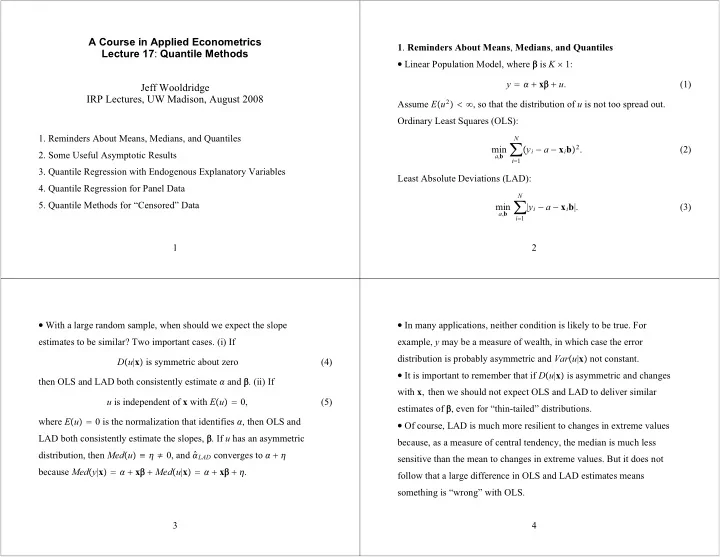
  • 1. Reminders About Means, Medians, and Quantiles

Linear Population Model, where is K 1:

y x u. (1) Assume Eu2 , so that the distribution of u is not too spread out. Ordinary Least Squares (OLS): min

a,b i1 N

yi a xib2. (2) Least Absolute Deviations (LAD): min

a,b i1 N

|yi a xib|. (3) 2

With a large random sample, when should we expect the slope

estimates to be similar? Two important cases. (i) If Du|x is symmetric about zero (4) then OLS and LAD both consistently estimate and . (ii) If u is independent of x with Eu 0, (5) where Eu 0 is the normalization that identifies , then OLS and LAD both consistently estimate the slopes, . If u has an asymmetric distribution, then Medu 0, and LAD converges to because Medy|x x Medu|x x . 3

In many applications, neither condition is likely to be true. For

example, y may be a measure of wealth, in which case the error distribution is probably asymmetric and Varu|x not constant.

It is important to remember that if Du|x is asymmetric and changes

with x, then we should not expect OLS and LAD to deliver similar estimates of , even for “thin-tailed” distributions.

Of course, LAD is much more resilient to changes in extreme values

because, as a measure of central tendency, the median is much less sensitive than the mean to changes in extreme values. But it does not follow that a large difference in OLS and LAD estimates means something is “wrong” with OLS. 4

slide-2
SLIDE 2

Advantage for median over mean: median passes through monotonic

  • functions. If logy x u and Medu|x 0, then

Medy|x expMedlogy|x exp x. By contrast, we cannot generally find Ey|x exp xEexpu|x.

But expectation has useful properties that the median does not:

linearity and the law of iterated expectations. If yi ai xibi (6) and ai,bi is independent of xi, then Eyi|xi Eai|xi xiEbi|xi xi, (7) where Eai and Ebi. OLS is consistent for and . 5

What can we add so that LAD estimates something of interest in (7)?

If ui is a vector, then its distribution conditional on xi is centrally symmetric if Dui|xi Dui|xi,which implies that, if gi is any vector function of xi, Dgi

ui|xi has a univariate distribution that is

symmetric about zero. This implies Eui|xi 0.

Write

yi xi ai xibi . (8) If ci ai,bi given xi is centrally symmetric then LAD applied to the usual model yi xi ui consistently estimates and . 6

For 0 1, q is the th quantile of yi if Pyi q and

Pyi q 1 .

Let covariates affect quantiles. Under linearity,

Quantyi|xi xi. (9) Under (9), consistent estimators of and are obtained by minimizing the “check” function: min

,K i1 N

cyi xi, (10) where cu 1u 0 1 1u 0|u| 1u 0u and 1 is the “indicator function.” 7

  • 2. Some Useful Asymptotic Results

What Happens if the Quantile Function is Misspecified?

Property of OLS: if and are the plims from the OLS regression

yi on 1,xi then these provide the smallest mean squared error approximation to Ey|x x in that , solve min

, Ex x2.

(11) Under restrictive assumptions on distribution of x, j

can be equal to or

proportionl to average partial effects. 8

slide-3
SLIDE 3

Linear quantile formulation has been viewed by several authors as an

  • approximation. Recently, Angrist, Chernozhukov, and Fernandez-Val

(2006) characterized the probability limit of the quantile regression

  • estimator. Absorb the intercept into x and let be the solution to the

population quantile regression problem. ACF show that solves min

  • Ewx,qx x2,

(12) where the weight function wx, is wx,

1

1 ufy|xux 1 uqx|xdu. (13) 9 Computing Standard Errors

For given , write

yi xi ui, Quantui|xi 0, (14) and let be the quantile estimator. Define quantile residuals ûi yi xi . Generally, N is asymptotically normal with asymptotic variance A1BA1,where A Efu0|xixi

xi

(15) and B 1 Exi

xi.

(16) 10

If the quantile function is actually linear, a consistent estimator of B

is B 1 N1

i1 N

xi

xi

. (17) Generally, a consistent estimator of A is (Powell (1991)) Â 2NhN1

i1 N

1|ûi| hNxi

xi,

(18) where hN 0 is a nonrandom sequence shrinking to zero as N with N hN . For example, hN aN1/3 for any a 0. Might use a smoothed version so that all residuals contribute. 11

If ui and xi are independent,

Avar N 1 fu02 Exi

xi1,

(19) and Avar is estimated as Avar 1 f u02 N1

i1 N

xi

xi 1

, (20) where, say, f u0 is the histogram estimator f u0 2NhN1

i1 N

1|ûi| hN. (21) Estimate in (20) is commonly reported (by, say, Stata). 12

slide-4
SLIDE 4

If the quantile function is misspecified, the “robust” form based on

(20), is not valid. In the generalized linear models literature, distinction between “fully robust” variance estimator (mean correctly specified) and a “semi-robust” estimator (mean might be misspecified).

For quantile regression, a fully robust variance requires a different

estimator of B. Kim and White (2002) and Angrist, Chernozhukov, and Fernández-Val (2006) show B N1

i1 N

1ûi 02xi

xi

(22) is consistent, and then Avar Â

1B

Â

1 with  given by (18).

13

Hahn (1995, 1997) shows that the nonparametric bootstrap and the

Bayesian bootstrap generally provide consistent estimates of the fully robust variance without claims about the conditional quantile being

  • correct. Bootstrap does not provide “asymptotic refinements” for

testing and confidence intervals.

ACF provide the covariance function for the process

  • : 1 for some 0, which can be used to test

hypotheses jointly across multiple quantiles (including all quantiles at

  • nce).

Example using Abadie (2003). These are nonrobust standard errors.

nettfa is net total financial assets. 14

Dependent Variable: nettfa Explanatory Variable Mean (OLS) .25 Quantile Median (LAD) .75 Quantile inc .783 .0713 .324 .798 .104 .0072 .012 .025 age 1.568 .0336 .244 1.386 1.076 .0955 .146 .287 age2 .0284 .0004 .0048 .0242 .0138 .0011 .0017 .0034 e401k 6.837 1.281 2.598 4.460 2.173 .263 .404 .801 N 2,017 2,017 2,017 2,017

15

  • 3. Quantile Regression with Endogenous Explanatory Variables

Suppose

y1 z11 1y2 u1, (23) where z is exogenous and y2 is endogenous – whatever that means in the context of quantile regression.

Amemiya’s (1982) two-stage LAD estimator: reduced form for y2,

y2 z2 v2. (24) First step applies OLS or LAD to (24), and gets fitted values, yi2 zi

  • 2. These are inserted for yi2 to give LAD of yi1 on zi1,i2.

2SLAD relies on symmetry of the composite error 1v2 u1 given z. 16

slide-5
SLIDE 5

If Du1,v2|z is centrally symmetric, can use a control function

  • approach. Write

u1 1v2 e1, (25) where e1 given z would have a symmetric distribution. Get LAD residuals v i2 yi2 zi 2 and do LAD of yi1 on zi1,yi2,v

  • i2. Use t test on

v i2 to test null that y2 is exogenous.

Interpretation of LAD in context of omitted variables is difficult

unless lots of symmetry assumed. 17

Abadie, Angrist, and Imbens (2002) consider binary endogenous

treatment, say D, and binary instrumental variable, say Z. The potential

  • utcomes are Yd, d 0,1 – that is, without treatment and with

treatment, respectively. The counterfactuals for treatment are Dz, z 0,1. Observed are X,Z,D 1 ZD0 ZD1, and Y 1 DY0 DY1. AAI study treatment effects for compliers, that is, the (unobserved) subpopulation with D1 D0. 18

Assumptions:

Y1,Y0,D1,D0 independent of Z conditional on X (26) 0 PZ 1|X 1 (27) PD1 1|X PD0 1|X (28) PD1 D0|X 1. (29) Under these assumptions, treatment is unconfounded for compliers: DY0,Y1|D,X,D1 D0 DY0,Y1|X,D1 D0 (30) and treatment effects can be defined based on DY|X,D,D1 D0. 19

AAI focus on quantile treatment effects (Abadie looks at other

distributional features): QuantY|X,D,D1 D0 D X. (31) (This results in estimated differences for the quantiles of Y1 and Y0, not the quantile of the difference Y1 Y0.

If the dummy variable C 1D1 D0 could be observed, problem

would be straightforward. Would like to use linear quantile estimation for the subpopulation C 1 because the parameters solve min

, EC gY,X,D,,

(32) where gY,X,D,, cY D X is the check function. 20

slide-6
SLIDE 6

Instead, can solve

min

, EU gY,X,D,,,

(33) where U Y,X,D and U PC 1|U. AAI show vU 1 D1 vU 1 X 1 DvU X , (34) where vU PZ 1|U, and X PZ 1|X, which can both be estimated using observed data.

Two-step estimator solves

min

, i1 N

1 vUi 0 vUicYi Di Xi. (35) 21

  • 4. Quantile Regression for Panel Data

Without unobserved effects, QR easy on panel data:

Quantyit|xit xit, t 1,...,T. (36) Pooled QR, but account for serial correlation in sit xit

1yit xit 0 1 1yit xit 0.

Use “cluster robust” variance matrix estimate: B N1

i1 N

  • t1

T

  • r1

T

sit sir

  • (37)

22 Â 2NhN1

i1 N

  • t1

T

1|ûit| hNxit

xit.

(38)

Explicitly allowing unobserved effects is harder.

Quantyit|xi,ci Quantyit|xit,ci xit ci. (39)

“Fixed effects” approach, where Dci|xi unrestricted, is attractive.

Honoré (1992) applied to the uncensored case: LAD on the first differences consistent when uit : t 1,...,T is an iid. sequence conditional on xi,ci (symmetry not required). When T 2, LAD on the first differences is equivalent to estimating the ci along with , but not with general T. 23

Alternative suggested by Abrevaya and Dahl (2006) for T 2. In

Chamberlain’s correlated random effects linear model, Eyt|x1,x2 t xt x11 x22,t 1, (40) Ey1|x x1 Ey2|x x1 . (41) Abrevaya and Dahl suggest modeling Quantyt|x1,x2 as in (41) and then defining the partial effect as Quanty1|x x1 Quanty2|x x1 . (42) 24

slide-7
SLIDE 7

Correlated RE approaches difficut: quantiles of sums not sums of

  • quantiles. If ci x

i ai, yit xit x i ai uit. (43) Generally, vit ai uit will not have zero conditional quantile. Might estimate (43) by pooled quantile regression for different quantiles.

More flexibility if we start with median,

yit xit ci uit, Meduit|xi,ci 0, (44) and make symmetry assumptions. Can apply LAD to the time-demeaned equation ÿit x it üit, being sure to obtain fully robust standard errors for pooled LAD. 25

If we impose the Chamberlain-Mundlak device,

yit xit x i ai uit, we can get by with central symmetry of Dai,uit|xi has a symmetric distribution around zero then Dai uit|xi is symmetric about zero, and, if this holds for each t, pooled LAD of yit

  • n 1,xit, and x

i consistently estimates t,,. (If we use pooled OLS with x i included, we obtain the FE estimate.) Should use robust inference. 26

  • 5. Quantile Methods for “Censored” Data

Censored LAD applicable to data censoring and and corner solutions.

For true data censoring, let wi be the underling response (say, wealth or log of a duration) following wi xi ui, (45) but it is top coded or right censored at ri. Can estimate if Medui|xi,ri 0 (46) because Medyi|xi,ri minxi,ri where yi minwi,ri. Powell’s (1986) CLAD estimator. (Need to always observe ri; see Honoré, Khan, and Powell (2002) to relax.) 27

Less clear that CLAD is “better” than parametric models for corner

solution responses. CLAD identifies a single feature of Dy|x, namely, Medy|x. Models such as Tobit assume more but deliver more. Not just enough to estimate parameters. Common model for corner at zero: y max0,x u, Medu|x 0. (47) j measures the partial effects on Medy|x max0,x once Medy|x 0.

A model no more or less restrictive than (47) is

y a expx, Ea|x 1, (48) and Ey|x expx is identified. Can have Pa 0|x 0. 28

slide-8
SLIDE 8

How to interpret applications of CLAD for corner solutions?

Medyit|xi,ci max0,xit ci. (49) Honoré (1992), Honoré and Hu (2004) show how to estimate under exchangeability assumptions on the idiosyncratic errors in the latent variable model. The partial effect of xtj on Medyit|xit xt,ci c is tjxt,c 1xt c 0j. (50) What values should we insert for c? Need to know something about

  • Dci. Average of (50) across the Dci would be average partial effects

(on the median). The j give the relative effects of the APEs on the

  • median. If ci has a Normalc,c

2 distribution,

Ecitjxt,ci c xt/cj. 29