SLIDE 1
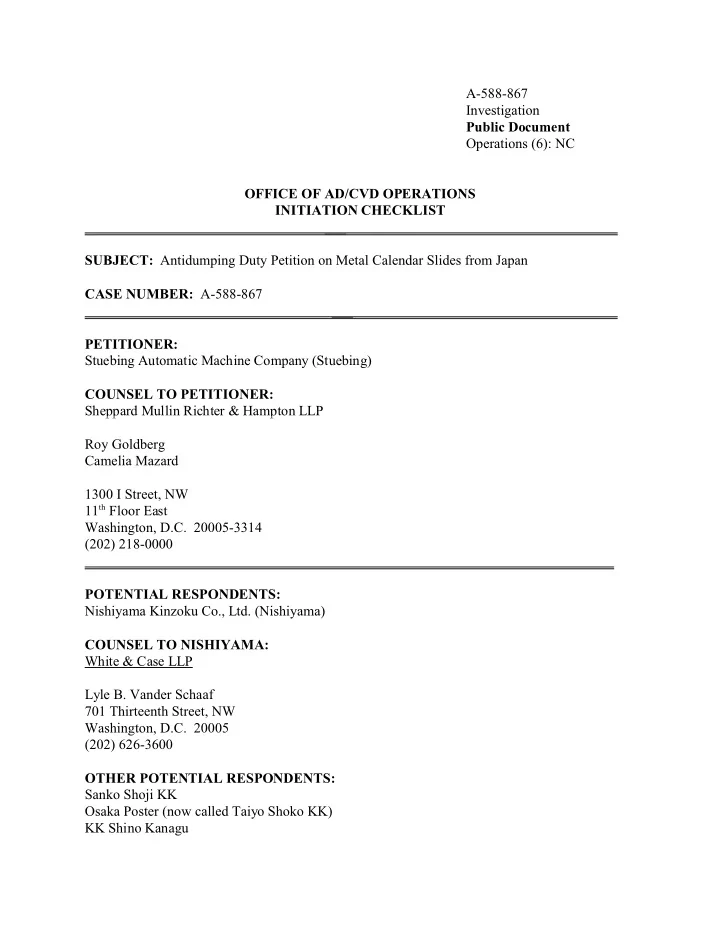
A-588-867 Investigation Public Document Operations (6): NC OFFICE OF AD/CVD OPERATIONS INITIATION CHECKLIST ___ SUBJECT: Antidumping Duty Petition on Metal Calendar Slides from Japan CASE NUMBER: A-588-867 ___ PETITIONER: Stuebing Automatic Machine Company (Stuebing) COUNSEL TO PETITIONER: Sheppard Mullin Richter & Hampton LLP Roy Goldberg Camelia Mazard 1300 I Street, NW 11th Floor East Washington, D.C. 20005-3314 (202) 218-0000 POTENTIAL RESPONDENTS: Nishiyama Kinzoku Co., Ltd. (Nishiyama) COUNSEL TO NISHIYAMA: White & Case LLP Lyle B. Vander Schaaf 701 Thirteenth Street, NW Washington, D.C. 20005 (202) 626-3600 OTHER POTENTIAL RESPONDENTS: Sanko Shoji KK Osaka Poster (now called Taiyo Shoko KK) KK Shino Kanagu
SLIDE 2
2 _ BACKGROUND: On June 29, 2005, the petitioner, Stuebing Automatic Machine Company (Stuebing), submitted its antidumping petition on metal calendar slides from Japan. See Petition for Imposition of Antidumping Duties on Metal Calendar Slides from Japan (June 29, 2005) (petition). On July 5, 2005, the U.S. Department of Commerce (the Department) issued deficiency comments requesting additional information, including information about the proposed scope. On July 6, 2005, attorneys at Sheppard Mullin Richter & Hampton, LLP., counsel for Stuebing, met with Department officials to discuss issues regarding the petition, including the proposed scope. See Memorandum from Dara Iserson through Thomas Gilgunn to the File, Antidumping Duty Investigation of Calendar Metal Slides from Japan (July 8, 2005). On July 8, 2005, the petitioner submitted additional information to the Department, in which it, among other things, clarified the proposed scope language. See Antidumping Duty Investigation of Metal Calendar Slides from Japan (July 11, 2005) (petition amendment). On July 13, 2005, the Department spoke with the vice president of the market research firm used by the petitioner, to discuss information included in the petition. See Memorandum to the File, Telephone Call to Market Research Firm Regarding the Antidumping Petition on Metal Calendar Slides from Japan (July 19, 2005) (Market Research Call). SCOPE: The scope is as follows: “V” and/or “U” shaped metal calendar slides manufactured from cold-rolled steel sheets, whether or not left in black form, tin plated or finished as tin free steel (“TFS”), typically with a thickness from 0.19 mm to 0.23 mm, typically in lengths from 152 mm to 915 mm, typically in widths from 12 mm to 29 mm when the slide is lying flat and before the angle is pressed into the slide (although they are not typically shipped in this “flat” form), that are typically either primed to protect the outside of the slide against oxidization or coated with a colored enamel or lacquer for decorative purposes, whether or not stacked, and excluding paper and plastic slides. Metal calendar slides are typically provided with either a plastic attached hanger or eyelet to hang and bind calendars, posters, maps or charts, or the hanger can be stamped from the metal body of the slide itself. These metal calendar slides are believed to be classified under Harmonized Tariff Schedule of the United States (HTSUS) subheading 7326.90.1000 (Other articles of iron and steel: Forged or stamped; but not further worked: Other: Of tinplate). This HTSUS number is provided for convenience and U.S. Customs and Border Protection purposes. The written description of the scope of this investigation is dispositive.
SLIDE 3 3
1 Source: Port Import Export Reporting Services (PIERS). (Provided in petition, at 10.) 22002 Figures based on the petitioner’s knowledge and belief that there were no imports of metal calendar
slides into the United States in 2002. (See petition, at Exh. 3A.)
3 Source: Port Import Export Reporting Services (PIERS). (Provided in petition amendment, at 11.) 4The Department confirmed that the ITC data-web does not report quantity of import data for this particular
HTSUS category.
5 The estimated value was calculated by PIERS. (See petition amendment, at 11 n. 3.)
___ IMPORT STATISTICS: QUANTITY (METRIC TONS)1 COUNTRY 20022 2003 2004 Japan 57.1 160.1 CUSTOMS VALUE (U.S.)3 COUNTRY 2002 2003 2004 Japan $0 $477,821 $1,928,600 The petitioner provided the volume and value of imports of metal calendar slides from Japan from 2002 to 2004. (See petition, 10; and petition amendment, 11.) The petitioner states that the Harmonized Tariff Schedule of the United States (HTSUS) subheading covering metal calendar slides, 7326.90.1000, is a basket category that includes non- subject merchandise. Additionally, the petitioner states that the International Trade Commission’s data-web (ITC data-web) does not report quantity of import data for this particular HTSUS category4. To separate subject merchandise from non-subject merchandise, import statistics on volume were gathered from Port Import Export Reporting Services (PIERS), a company that maintains databases of import information moving through the ports of the United
- States. The reports prepared by PIERS separated subject merchandise from non-subject
merchandise with the same HTSUS sub-heading. The reports also include imports of merchandise from Japan covered under HTSUS subheading 8308.10, as the petitioner believes that subject merchandise may have been misclassified under this subheading. (See petition, at
PIERS does not collect the actual value data on imports of subject merchandise, however an estimated value was provided.5
SLIDE 4 4 ___
APPROXIMATE CASE CALENDAR:
Event
Date of Action Antidumping Duty Investigation Petition Filed June 29, 2005 Initiation Date 20 July 19, 2005 ITC Preliminary Determination 45 August 15, 2005*** ITA Preliminary Determination 160 December 6, 2005 ITA Final Determination 235 February 20, 2006*** ITC Final Determination* 280 April 5, 2006 Publication of Order** 287 April 12, 2006 * This will take place only in the event of a final affirmative determination from the Department. ** This will take place only in the event of a final affirmative determination from the Department and the ITC. ***Adjusted to account for weekends and holidays. Note: The ITC’s final determination will take place 45 days after a final affirmative ITA determination. Note: Publication of the order will take place 7 days after an affirmative determination by the ITC.
___ INDUSTRY SUPPORT: Does the petitioner account for more than 50% of production of the domestic like product?
- Yes (See petition, at 1-4)
No If No, do those expressing support account for the majority of those expressing an opinion and at least 25% of domestic production? Yes No - do not initiate
Describe how industry support was established - specifically, describe the nature of any polling
- r other step undertaken to determine the level of domestic industry support.
The petitioner claims, to the best of their knowledge, that Stuebing is the only domestic producer
- f metal calendar slides and, therefore, comprises the whole U.S. metal calendar slide industry.
(See petition, at 1-4; petition amendment, at 2; see also, Att. I below.)
SLIDE 5 5 Was there opposition to the petition? Yes
Are any of the parties who have expressed opposition to the petition either importers or domestic producers affiliated with foreign producers? Yes No
___ INJURY ALLEGATION: We received a copy of the action notice from the Director of the Office of Investigations, International Trade Commission (ITC). (See, Att. II below.) It indicates that the ITC has instituted an investigation to determine whether there is a reasonable indication that the metal calendar slides industry in the United States is materially injured or threatened with material injury. Does the petition contain evidence of causation? Specifically, does the petition contain information relative to:
- volume and value of imports. (See petition, at 10-11; petition amendment, at 11.)
- U.S. market share (i.e., the ratio of imports to consumption). (See petition, at 26
and Exh. 2 and 3A; see also, Att. II below.)
- actual pricing (i.e., evidence of decreased pricing). (See petition, at 24-28 and
- Exh. 13A and 17.)
- relative pricing (i.e., evidence of imports under-selling U.S. products). (See
petition, at Exh. 17.) ___ PETITION REQUIREMENTS: Does the petition contain the following?:
- the name and address of the petitioner. (See petition, at 2.)
- the names and addresses of all domestic producers of the domestic like product
known to the petitioning company. (See petition, at 2.)
SLIDE 6 6
- the volume and value of the domestic like product produced by the petitioner and
each domestic producer identified for the most recently completed 12 month period for which data is available. (See petition, at Exh. 1.) Was the entire domestic industry identified in the petition?
No
- a clear and detailed description of the merchandise to be investigated, including
the appropriate HTSUS. (See petition amendment, at 3-4.)
- the name of each country in which the merchandise originates or from which the
merchandise is exported. (See petition, at 7-8.)
- the identity of each known exporter, foreign producer, and importer of the
- merchandise. (See petition, at 8-9.)
- a statement indicating that the petition was filed simultaneously with the
Department of Commerce and the International Trade Commission. (See petition at cover letter.)
- an adequate summary of the proprietary data.
- a statement regarding release under administrative protective order. (See petition
at cover letter.)
- a certification of the facts contained in the petition by an official of the petitioning
firm and its legal representative (if applicable). (See petition at cover letter.)
- import volume and value information for the most recent two-year period. (See
petition, at 10; petition amendment, at 11.) ____ PERIOD OF INVESTIGATION: The proposed period of investigation (POI) is April 1, 2004, through March 31, 2005.
SLIDE 7 7 LESS THAN FAIR VALUE ALLEGATION: The petitioner provided U.S. price information showing actual prices for which Japanese metal calendar slides were being offered for sale in the United States. Home market prices were based upon a written offer for sale by Nishiyama, obtained through market research. The petitioner explains that the home market prices are for metal calendar slides measured in millimeters, while the U.S. prices are for metal slides measured in inches. This difference between the two markets in the units of measurement resulted in a comparison of metal calendar slides with slightly different dimensions. Therefore, the petitioner compared the product sold by Nishiyama in the United States that is nearest in size to the product sold in Japan. Based on this criterion, the petitioner stated that the most conservative comparison for doing these calculations is to compare the 380 mm X 23 mm (approximately 15" X 9/10") slide sold in Japan to the 17" X 7/8" slide sold in the United States. The petitioner believes this comparison is conservative as the product sold in the United States contains more metal than the Japanese counterpart. (See petition amendment, at 15-18.)
Export Price
U.S. Value Source Petition U.S. Sale Price Exhibit 13A Shipping Costs Petition [ ] Exhibit 13A Shipping Costs Freight Costs and Packing Cost Calculations (Corrected) [ ] Attachment IV The U.S. sales price for the 17" X 7/8" slides was [ ] per thousand slides. (See petition, at
- Exh. 13.) The petitioner made adjustments for freight costs in two different ways. The first was
based on information told to petitioner, during a meeting with Norwood ([ ]), in which Norwood officials stated the “shipping costs [ ] of the Japanese products.” (See petition, at Exh. 13.) After deducting freight, petitioner presented a U.S. price of [ ] per thousand slides. The second freight adjustment, as an alternative, is based on a shipping quote from Osaka to Minnesota of [ ] per thousand slides. (See petition amendment, at Exh. C). The Department, however, corrected a conversion error from metric tons to pounds which revised this amount to equal [ ] per thousand slides. Therefore, pursuant to this methodology, the Department revised the second U.S. price to equal [ ] per thousand slides. (See Att. IV). Additionally, the petitioner explained that it provided a conservative estimate, by not deducting
SLIDE 8 8
1 For example, we contacted Japan’s International Directory Assistance and noted no
discrepancies with the contact information contained in the offer. customs documentation and customs clearance fees, and other likely costs to U.S. importers. The petitioner also did not make adjustments for possible expenses for foreign inland freight.
Normal Value
Home-Market Value Source Petition Selling Price Exhibit 8B Quantity/Volume Discount Market Research Report ([ ] Discount) Exhibit 7A The Normal Value (NV) is based on a written offer for sale, in yen, by Nishiyama, obtained in the course of market research. (See petition, at Exh. 8B). To corroborate this information, we spoke directly with the market research firm. (See Market Research Call). In addition, using all publicly available sources, we found nothing to contradict the information contained in the price
The petitioner calculated an average exchange rate for the anticipated POI. (See petition, at Exh. 10.) A quantity/volume discount adjustment was applied based on Nishiyama’s practice of discounting [ ] for sales of more than 10 million slides. (See petition, at Exh. 7A.) The petitioner made this adjustment because they believed it conservative and it was based on Norwood’s 2004 request for proposal which states Norwood purchased approximately [ ]. (See petition, at Exh. 9.) The Department adjusted the calculation of NV to apply exchange rates consistent with our normal practice. Therefore, the revised NV is [ ] per thousand slides. (See Att. IV.) Did the petition contain the following?:
- support documentation for the alleged prices or costs and claimed adjustments.
(See petition, at 11-15 and Exh. 12 and 13; petition amendment, at 13-18 and Exh. E and C.)
- any market research reports including an affidavit referring to sources and how
information was obtained. (See petition, at Exh. 7A and 7B.)
- current price data (no more than one year old). (See petition, at Exh. 8B.)
- price and cost data from contemporaneous time periods. (See petition, at Exh. 16
and 17; petition amendment at Exh. D and G.)
SLIDE 9 9
- correct currency rates used for all conversions to U.S. dollars. (See petition, at
- Exh. 10.)
- conversion factors for comparisons of differing units of measure. (See petition
amendment, at 15-18 and Exh. C.) Estimated Dumping Margins Based on a comparison of a export price to normal value calculated in accordance with Section 773(a) of the Act, the Department recalculated the estimated dumping margins ranging from 22.09 percent to 48.24 percent for metal calendar slides from Japan. Therefore, there is reason to believe that imports of metal calendar slides are being, or are likely to be, sold in the United States at less than fair value. (See Att. IV.) ___ CRITICAL CIRCUMSTANCES The petitioner claims, based on trade statistics since 2002 and the seasonal nature of the industry, that there is a reasonable basis to believe or suspect that critical circumstances will exist with regard to imports of metal calendar slides from Japan. See petition, at 10 and 39. Section 733(e)(1) of the Act states that if a petitioner alleges critical circumstances, the Department will find that such circumstances exist, at any time after the date of initiation, when there is a reasonable basis to believe or suspect that under subparagraph (A)(i) there is a history
- f dumping and there is material injury by reason of dumped imports in the United States or
elsewhere of the subject merchandise, or (ii) the person by whom, or for whose account, the merchandise was imported knew or should have known that the exporter was selling the subject merchandise at less than its fair value and that there was likely to be material injury by reason of such sales, and (B) there have been massive imports of the subject merchandise over a relatively short period. Section 351.206(h) of the Department's regulations defines “massive imports” as imports that have increased by at least 15 percent over the imports during an immediately preceding period of comparable duration. Section 351.206(i) of the regulations states that a relatively short period will normally be defined as the period beginning on the date the proceeding begins and ending at least three months later. The petitioner alleges that importers knew, or should have known, that metal calendar slides were being sold at less than fair value. Specifically, the petitioner’s recalculated margins are as high as 48.24 percent, a level high enough to impute importer knowledge that merchandise was being sold at less than its fair value. See e.g., Final Determination of Sales at Less Than Fair Value and Negative Final Determination of Critical Circumstances: Prestressed Concrete Steel Wire Strand from Thailand, 68 FR 68348 (Dec. 8, 2003) (citing Preliminary Determination of Sales at Less Than Fair Value: Certain Cut-to-Length Carbon Steel Plate From the People's Republic of China, 62 FR 31972, 31978 (June 11, 1997)). [
SLIDE 10 10 ]. See petition, at 37-38, and Exh. 3A and 13B. The petitioner requests that the Department immediately begin reviewing import data of the subject merchandise and that the Department request U.S. Customs & Border Protection (CBP) to compile information on an expedited basis regarding entries of subject merchandise. See petition, at 35-40. Section 732(e) of the Act states that when there is a reasonable basis to believe or suspect (1) there is a history of dumping in the United States or elsewhere of the subject merchandise, or (2) the person by whom, or for whose account, the merchandise was imported knew, or should have known, that the exporter was selling the subject merchandise at less than its fair value, the Department may request the CBP to compile information on an expedited basis regarding entries of the subject merchandise. Taking into consideration the foregoing, we will analyze this matter further. We will monitor imports of metal calendar slides from Japan and we will request that CBP compile information
- n an expedited basis regarding entries of subject merchandise. See Section 732(2) of the Act.
If, at any time, the criteria for a finding of critical circumstances are established, we will issue a critical circumstances finding at the earliest possible date. See Policy Bulletin 98/4, 63 FR 55364 (Oct. 15, 1998). ___ Should the need arise to use any of this information as facts available under section 776 of the Act in our preliminary or final determinations, we may re-examine the information and revise the margin calculations, if appropriate. ___ RECOMMENDATION: We have examined the accuracy and adequacy of the evidence provided in this petition as discussed in this checklist and attachments, and recommend determining that the evidence is sufficient to justify the initiation of an antidumping investigation with regard to metal calendar slides from Japan. We also recommend determining that this petition has been filed on behalf of the domestic industry. (See Att. 1) _____ ATTACHMENTS: I. Industry Support II. Analysis of Allegations and Evidence of Material Injury and Causation III. Action Letter from the ITC IV. Freight Cost and Margin Calculations
SLIDE 11 ATTACHMENT I ANALYSIS OF INDUSTRY SUPPORT Background Section 732(c)(4)(A) of the Act, states that the administering authority shall determine that a petition has been filed by or on behalf of the industry if the domestic producers or workers who support the petition account for: (1) at least 25 percent of the total production of the domestic like product; and (2) more than 50 percent of the production of the domestic like product produced by that portion of the industry expressing support for, or opposition to, the petition. The above-referenced petition claims that both ratios are met because the petitioner, Stuebing, claims that it represents 100 percent of the total production of the domestic like product. Analysis In determining whether the domestic producers who support the petition have standing, we considered the industry support data contained in the petition filed on June 29, 2005, and petition amendment filed on July 8, 2005, with reference to the domestic like product as defined above in the Scope of Investigation section. To establish industry support, the petitioner stated that it was filing on behalf of the U.S. industry, and that to the best of its knowledge Stuebing currently accounted for all domestic production of metal calendar slides. (See petition, at 2-4 and Exh.1- 3A; petition amendment, at 2.) Therefore, because Stuebing was the sole commercial producer
- f metal calendar slides in the United States during calendar year 2004, the petition is supported
by 100 percent of the domestic industry. As Stuebing claims it is the only producer of metal calendar slides in the United States, it did not provide any production data for any other domestic producers of the subject merchandise. The petitioner estimated its production volumes based on production data provided by its company
- fficials. (See petition, at 2-4 and Exh. 1-3A.) The Department also conducted a search of the
information reasonably available on the internet, and could find no information that contradicted petitioner’s assertion that it is the sole U.S. producer of metal calendar slides. Challenge to Industry Support There has been no challenge to this petition by any U.S. or foreign producer or organization of metal calendar slides producers. Findings Based on information provided by the petitioner and research conducted by the Department, as described above, we find that domestic producers or workers who support the petition account for at least 25 percent of the total production of the domestic like product. We further find that domestic producers or workers who support the petition account for more than 50 percent of the production of the domestic like products produced by that portion of the industry expressing support for, or opposition to, the petition. Therefore, we find that the petitioner has met the requirements of section 732(c)(4)(A) of the Act.
SLIDE 12 Attachment II Analysis of Allegations and Evidence of Material Injury and Causation Introduction When making a determination regarding the initiation of an antidumping investigation, the Department examines whether the petition alleges the elements necessary for the imposition of antidumping duties and contains the information reasonably available to the petitioner which supports the allegations. (See section 732(c)(1)(A)(I) of the Act.) This attachment analyzes the sufficiency of the allegations and supporting evidence regarding material injury and causation. Definition of Domestic Industry The domestic industry is described with reference to the domestic like product, as provided for in section 771(4)(A) of the Act. The petition describes the domestic industry as consisting of one company, Stuebing, that produces metal calendar slides. (See petition, at 2-4 and 16-17 and Exh. 3-A.) Evidence of Injury and Threat of Injury Section 771(7)(C)(iii) of the Act states that: In examining the impact {of imports on domestic producers}, the ITC shall evaluate all relevant economic factors which have a bearing on the state of the industry in the United States, including, but not limited to– (I) actual and potential decline in output, sales, market share, profits, productivity, return on investments, and utilization of capacity, (II) factors affecting domestic prices, (III) actual and potential negative effects on cash flow, inventories, employment, wages, growth, ability to raise capital, and investment, (IV) actual and potential negative effects on the existing development and production efforts of the domestic industry..., and (V) in {an antidumping proceeding}, the magnitude of the margin of dumping. The petition alleges that the domestic industry has experienced the following types of injury:
- Reduced market share (See petition, at 26 and Exh. 2 and 3-A);
- Lost sales (See petition, at 26-28 and Exh. 18, 13-A and 3-A; petition amendment, at 20-
21 and Exh. F);
- Production decline and reduced capacity (See petition, at 31 and Exh. 1 and 3-A);
- Decreased U.S. shipments (See petition, at 25-26 and 31 and Exh. 2 and 13-A);
- Decline in prices (See petition, at 24 -28 and Exh. 17 and 13-A);
- Lost revenue (See petition, at 26-28 and Exh. 18, 13-A, and 3-A; petition amendment, at
20-21 and Exh. F);
- Price suppression (See petition, at 28 and 34; petition amendment, at Exh. F);
- Decline in income (See petition, at 30 and Exh. 15);
- Reduced profit (See petition, at 30 and Exh. 15);
SLIDE 13 Attachment II - Page 2
- Reduced employment (See petition, at 32 and Exh. 3-A and 13-A);
- Imminent increases in production capacity in Japan (See petition, at 33-34 and Exh. 7-A);
- Negative effect on capital investment and investment in research and development (See
petition, at 22-23, 32 and 35 and Exh. 3-A); The information from the petition provides the Department with a sufficient basis to believe that the domestic industry is materially injured or threatened with material injury as a result of imports of subject merchandise. We find that the evidence of material injury presented in the petition is adequate for purposes of initiation. Negligibility Section 771(24)(A)(i) of the Act states that "imports from a country of merchandise corresponding to a domestic like product identified by the Commission are 'negligible' if such imports account for less than 3 percent of the volume of all such merchandise imported into the United States in the most recent 12-month period for which the data are available..." The petitioner asserts that "{i}t is beyond question that imports of metal calendar slides from Japan exceed 3 percent of the volume of all such merchandise imported into the United States in the most recent 12-month period. Rather, the figure is either 100 percent or very nearly 100 percent." (See petition, at 3 of Exh. 3-A.) Causation of Material Injury or Threat of Material Injury The petition alleges that the material injury, and the threat of material injury, to the domestic industry has been caused by the individual and cumulated impact of the allegedly dumped imports of metal calendar slides from Japan. In support of their arguments, the petitioner provides information on the evolution of the volume and prices of the allegedly dumped imports
- ver the period beginning with 2002 and ending in April 2005. In this petition, the petitioner
demonstrates the effect of these import volumes and their respective prices on domestic prices, production, market share, and shipments and the consequent impact on the domestic industry. This evidence shows the retardation of the U.S. industry's profitability and market share resulting from increasing imports of the subject metal calendar slides at prices substantially lower than price offers from U.S. producers, thereby resulting in lost sales and revenue. (See petition, at 25- 33.) In making a determination regarding causation, the ITC is directed to evaluate the volume of dumped imports (section 771(7)(B)(i)(I) of the Act) and the effect of those imports on the prices
- f domestically-produced products (section 771(7)(B)(i)(II) of the Act) and their impact on the
domestic operations of U.S. producers (section 771(7)(B)(i)(III) of the Act). The petitioner bases the allegations of causation of current injury upon trends of increasing import volumes, falling prices, decreased industry profitability, and significant price underselling of the subject imports. The allegations of causation of material injury and the threat of injury are based upon the factors indicating current injury, as noted above, as well as increases in production capacity in the respective subject country. (See petition, at 33-35.) The factors related to causation presented in
SLIDE 14
Attachment II - Page 3 the injury section of the petition are the types of factors that the ITC is directed to consider for the purpose of evaluating causation under sections 771(7)(C) and 771(7)(F) of the Act. Conclusion In order to assess the accuracy and adequacy of the evidence relating to the allegations regarding material injury and causation, the information presented in the petition was examined and compared with information that was reasonably available (e.g., PIERS). This comparison of information provided in the petition with other public data did not reveal any indication that the evidence presented in the petition is inaccurate or inadequate. Therefore, the Department concludes that the petitioner's allegations and supporting evidence regarding material injury, causation, and threat of material injury, are sufficient for purposes of this initiation.
SLIDE 15
ATTACHMENT III (Action Letter from the ITC)
SLIDE 16
ATTACHMENT IV (Freight Cost and Packing Cost Calculations)