SLIDE 1
9 October 2013 Summary Talk to cover three themes: 1. How - - PowerPoint PPT Presentation
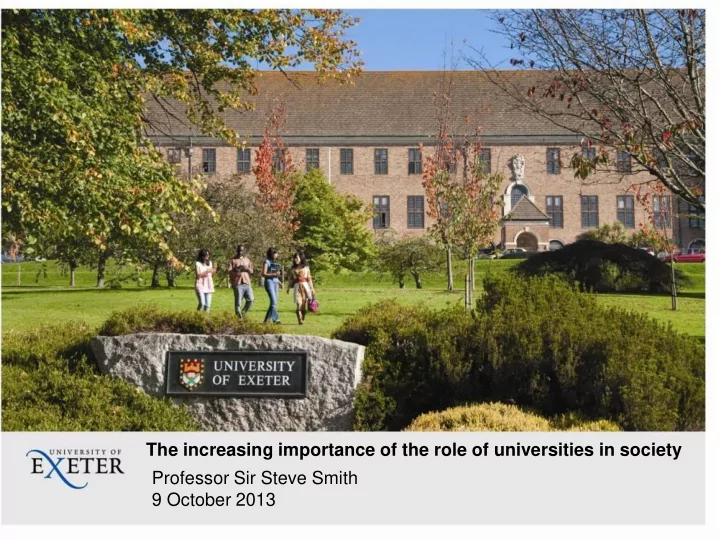
The increasing importance of the role of universities in society Professor Sir Steve Smith 9 October 2013 Summary Talk to cover three themes: 1. How universities contribute to economic prosperity 2. Government investment in HE and the impact
SLIDE 2
SLIDE 3
Universities as contributors to national prosperity
- Winning the global race for jobs and wealth – the role of
universities
- By 2020, 82% of new jobs in the UK will require a degree
- Top 10 ‘in demand’ jobs in 2010 were in industries that did
not exist in 2004
- Two thirds of growth between 2000 and 2007 came from
knowledge intensive sectors of the economy (and 2% of job losses)
- Universities are a crucial partner in economic growth
SLIDE 4
Universities as contributors to national prosperity
- The UK has a leading HE system – 7th largest export industry
worth £10.2bn per year
- UK universities on track to generate £17bn annual export
earnings by 2025
- Lord Sainsbury’s Review, The Race to the Top (2007) is the best
available analysis of how science and research policy relate to economic growth
SLIDE 5
Universities as contributors to national prosperity
- Logic of Sainsbury’s argument is to fund research selectively
- In the UK, out of 110 universities:
- c.80% research funding focussed on 25 institutions
- concentration of PhD training in Doctoral Training Centres
- Debate about the ‘right’ distribution of research resources
- Leading universities must compete in a global market
SLIDE 6
Global Investment in Higher Education
- Economic recovery has begun, but it will take time
- Massive growth in Indian and Chinese economies
- Total investment in higher education as proportion of GDP:
- UK (1.4%)
- US (2.8%)
- Japan (1.5%)
- OECD average(1.6%)
- UK public investment in HE is only 0.7% of GDP
SLIDE 7
Research and demonstrating impact
- Research Excellence Framework and the impact agenda
- Impact worth 1/5 of grading in new research assessment rules
- New knowledge and innovation has generated at least two-thirds
- f productivity growth in the UK over the past 10 years
- Public engagement agent
- Exeter Catalyst Project
SLIDE 8
Global research performance
- Universitas 21 rankings: UK is 24th on resource inputs and 2nd on
- utputs
- Japan is 25th on inputs and 14th on outputs
- Japan – fourth most successful education superpower (Learning
Curve)
- Research concentration
SLIDE 9
Global research concentration
- Concentration is a global trend:
- Japan: ‘Leading PhD Initiative’
- US: doctoral degrees offered by only 614 (out of 7018) universities
- China: pursuing world-class status for a maximum of 39 and a
minimum of 9 universities (C9) out of 2300 institutions (Project 985)
- Germany: £2bn to create 37 clusters of research excellence and
9 world-class universities
- France: 33 (out of c.160) universities, got 2/3 of the resource in
2010
- South Korea: Brain 21 Programme
SLIDE 10
International Research Collaboration
- ‘The Fourth Age of Research’ (Jonathan Adams, Nature)
- Most highly cited work is international (50% increase with papers
with authors in more than one country)
- In 2011: 48% of UK papers had no overseas author (down from
85% in the 1980s)
- US: 67% of research is still domestic (1981: 94%)
- China: 75% of research is produced in-country
- Growing divide between international and domestic focussed
institutions
SLIDE 11
International Research Collaboration
- UK & US: international collaboration = adds 20% to average citations
- UK: 2001 publications: 1.21 world average levels of citation
2011 publications: 1.47 world average levels of citation
- Papers with at least one international co-author: rose from 1.48 to
1.72 world average citations (2001-2011)
- 65 UK HEIs with 40% international co-authored papers: 1.1
world average citations; 10% of research funding; 5% research grants; 1% of research council studentships
SLIDE 12
Concluding Remarks
- How do we win the global race?
- 1. Need public investment in higher education
- 2. Concentration of research funding
- 3. Promote international collaboration
- 4. Invest sufficiently in R&D
- 5. Embrace the marketisation and internationalisation of HE
SLIDE 13
Thank you for listening Questions and Answers
Contact us: Dr Victoria Alcock Executive Officer to the Vice-Chancellor, v.j.alcock@exeter.ac.uk