8/16/2013 Why Conduct Background Checks? To determine whether the - - PDF document

8 16 2013
SMART_READER_LITE
LIVE PREVIEW

8/16/2013 Why Conduct Background Checks? To determine whether the - - PDF document

8/16/2013 Why Conduct Background Checks? To determine whether the candidate can perform the job: Back It Up! Risks, Rewards (and A persons criminal record can indicate whether the individual NEW Regulations) Regarding should be allowed


slide-1
SLIDE 1

8/16/2013 1

1

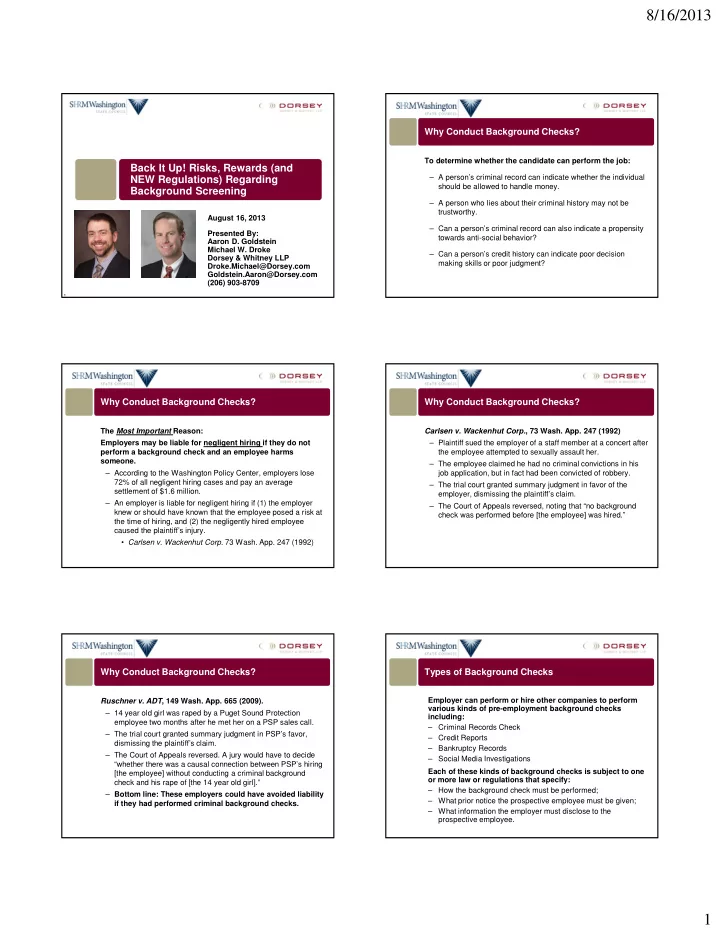
Back It Up! Risks, Rewards (and NEW Regulations) Regarding Background Screening

August 16, 2013 Presented By: Aaron D. Goldstein Michael W. Droke Dorsey & Whitney LLP Droke.Michael@Dorsey.com Goldstein.Aaron@Dorsey.com (206) 903-8709

Why Conduct Background Checks?

To determine whether the candidate can perform the job: – A person’s criminal record can indicate whether the individual should be allowed to handle money. – A person who lies about their criminal history may not be trustworthy. – Can a person’s criminal record can also indicate a propensity towards anti-social behavior? – Can a person’s credit history can indicate poor decision making skills or poor judgment?

Why Conduct Background Checks?

The Most Important Reason: Employers may be liable for negligent hiring if they do not perform a background check and an employee harms someone. – According to the Washington Policy Center, employers lose 72% of all negligent hiring cases and pay an average settlement of $1.6 million. – An employer is liable for negligent hiring if (1) the employer knew or should have known that the employee posed a risk at the time of hiring, and (2) the negligently hired employee caused the plaintiff’s injury.

  • Carlsen v. Wackenhut Corp. 73 Wash. App. 247 (1992)

Why Conduct Background Checks?

Carlsen v. Wackenhut Corp., 73 Wash. App. 247 (1992) – Plaintiff sued the employer of a staff member at a concert after the employee attempted to sexually assault her. – The employee claimed he had no criminal convictions in his job application, but in fact had been convicted of robbery. – The trial court granted summary judgment in favor of the employer, dismissing the plaintiff’s claim. – The Court of Appeals reversed, noting that “no background check was performed before [the employee] was hired.”

Why Conduct Background Checks?

Ruschner v. ADT, 149 Wash. App. 665 (2009). – 14 year old girl was raped by a Puget Sound Protection employee two months after he met her on a PSP sales call. – The trial court granted summary judgment in PSP’s favor, dismissing the plaintiff’s claim. – The Court of Appeals reversed. A jury would have to decide “whether there was a causal connection between PSP’s hiring [the employee] without conducting a criminal background check and his rape of [the 14 year old girl].” – Bottom line: These employers could have avoided liability if they had performed criminal background checks.

Types of Background Checks

Employer can perform or hire other companies to perform various kinds of pre-employment background checks including: – Criminal Records Check – Credit Reports – Bankruptcy Records – Social Media Investigations Each of these kinds of background checks is subject to one

  • r more law or regulations that specify:

– How the background check must be performed; – What prior notice the prospective employee must be given; – What information the employer must disclose to the prospective employee.

slide-2
SLIDE 2

8/16/2013 2

The Scope of the Fair Credit Reporting Act

The Fair Credit Reporting Act or FCRA covers practically any investigation that a third-party performs for an employer. – The FCRA applies to both so called “consumer reports” and “investigative reports.

  • Consumer reports include reports that relate to an

applicant’s or employee’s: – credit worthiness, credit standing, or credit capacity; – character, general reputation, personal characteristics,

  • r mode of living,

– when such information is used, or expected to be used, or collected in whole or in part for “employment purposes.”

The Scope of the Fair Credit Reporting Act

– The FCRA applies to both so called “consumer reports” and “investigative reports.

  • Investigative reports include reports that relate to an

employee or prospective employee’s – Investigative consumer reports are a subset of consumer reports. – An investigative report includes information about an applicant or employee’s character, general reputation, personal characteristics, or mode of living . . . » . . . that is obtained through personal interviews with the applicant or employee’s friends, neighbors, or business associates.

FCRA in Four Steps: Step One: Disclosure and Written Consent

Step One: – Before requesting a consumer or investigative consumer report, an employer must: » Separately disclose that you may request a report: » Provide the applicant or employee with a clear and conspicuous disclosure that the employer may request a report on the applicant or employee. » This disclosure must be in its own “separate document” that does not refer to other subjects. » Obtain the applicant’s written consent to the employer

  • btaining the report.

Step One: Disclosure and Written Consent

Further Disclosure Concerning Investigative Consumer Reports If Requested: – Within 3 days of requesting an investigative consumer report, an employer must: » Inform the person that a request for information regarding the person’s character, general reputation, personal characteristics and mode of living may be made; » Inform the person of his or her right to request additional disclosures regarding the nature and scope of the investigation; » Provide a copy of “A Summary of Your Rights Under the Fair Credit Reporting Act.”

Step One: Additional Requirement for Current Employees Under Washington Law

Washington law includes additional disclosure requirements: – For current employees, the disclosure must notify the employee that the consumer report may be used for employment purposes. » A statement to this effect in an employee manual will satisfy this requirement. – This requirement does not apply to a consumer report when the employer reasonably believes that the employee engaged in illegal conduct. RCW 19.182.020(2)(b)

Step One: Disclosure and Written Consent

– Many consumer reporting agencies will provide agreements and forms to employers that misinterpret the FCRA and its amendments—particularly employer

  • bligations.

– We recommend that you or your counsel carefully review such materials to ensure that they comply with FCRA and

  • ther applicable regulations.
slide-3
SLIDE 3

8/16/2013 3

Step One: Disclosure and Written Consent

Follow up disclosures upon request: – If the person being investigated for an “investigative consumer report” makes a written request for additional disclosures, the employer must provide “a complete and accurate” disclosure of the nature and scope of the investigation. » This disclosure must be in writing and delivered no later than 5 days after the employer receives the request for additional disclosures or 5 days after the employer

  • riginally requested the report, whichever is later.

» The additional disclosure must include the types of questions asked, the number and types of persons interviewed, and the name and address of the investigating agency.

Step Two: Certification to the Reporting Agency

Step Two: – Before obtaining a consumer report, the employer must provide certification to the consumer reporting agency retained to produce the report. – Most, if not all, consumer reporting agencies will request that the employer sign their certification agreement. – Employers should carefully review these agreements to ensure minimum compliance with applicable law and that no undesirable, additional requirements are incorporated.

Step Two: Certification to the Reporting Agency

The employer must certify: – Disclosures and Consent Have Been Made and Obtained: » The disclosures required for consumer reports have been made to, and written consent has been obtained from, the applicant or employee who is the subject of the requested report; – Pre-Adverse Action Disclosures Will Be Made If Required: » The additional procedures required by the FCRA in the event of a potential adverse action (described below in Step Three) will be followed before any adverse action is taken;

Step Two: Certification to the Reporting Agency

The employer must certify: – No State Or Federal EEO Laws Or Regulations Will Be Violated: » The information from the consumer report will not be used in violation of any applicable federal or state equal employment opportunity law or regulation; – Additional Investigative Consumer Report Disclosures Made If Applicable: » The additional disclosures required for investigative consumer reports have been made as required by the Act. (The agency must receive this certification before it can prepare or furnish the investigative report);

Step Two: Certification to the Reporting Agency

Common Questions Concerning Certification: – Who prepares the required certification? » The consumer reporting agency is required to prepare this form and ensure that it is completed by the employer before providing a report to an employer for employment purposes.

Step Two: Certification to the Reporting Agency

Common Questions Concerning Certification: – May the employer request an investigative consumer report before certifying that the applicable disclosure has been made? » Yes, because the required disclosure to the applicant or employee may be made as late as three days following the request. » The consumer reporting agency, however, cannot prepare the report or provide the report to the employer until the certification has been made.

slide-4
SLIDE 4

8/16/2013 4

Step Three: Providing Documents Before Taking “Adverse Actions”

If any employer decides not to hire an individual or decides to take a negative employment action based upon a consumer report, the employer must provide the individual with: – A copy of the consumer report that influenced the employer’s decision (even if the influence was slight); – A “Summary of Rights” in the form required by the Federal Trade Commission.

Step Three: Providing Documents Before Taking “Adverse Actions”

Common Questions Concerning Adverse Actions – How long does an employer have to wait before taking adverse action based upon a consumer report? » The FCRA and cases interpreting it are silent on this issue. » But FTC staff opinion letters have stated that employees should wait five days after receiving the report before taking any adverse action.

Step Three: Providing Documents Before Taking “Adverse Actions”

Common Questions Concerning Adverse Actions: – What if the report contains negative information, but the employer would have taken the adverse action even without the negative information? » Technically, an employer would not have to provide the applicant or employee with a copy of the report. » However, proving that the negative information did not influence the employer is very difficult and the employer may still be held liable. » The best practice is to disclose the report if it contains negative information and the employer is taking any negative employment action.

Step Four: Providing Notice After an Adverse Action

After an employer has taken an adverse action based upon information in a consumer report, the employer must provide the individual with an “adverse action notice.” – The adverse action notice must contain: » The consumer reporting agency’s contact information, including name, address, and telephone number (toll-free if available); » A statement that the consumer reporting agency was not the decision-maker and cannot tell the individual why the employer took the adverse action;

Step Four: Providing Notice After an Adverse Action

– The adverse action notice must contain: » A statement that the applicant or employee has the right to

  • btain a free copy of the consumer report by requesting it

within sixty days of receiving the adverse action notice. » A statement that the consumer has the right to dispute the accuracy or completeness of any information in the report with the consumer reporting agency.

Step Four: Providing Notice After an Adverse Action

Common Question Concerning Notices After an Adverse Action: – Does the employer have to explain what part of the consumer report contributed to the employer’s adverse action? » No. The employer is not required to disclose this information and should not share it with the consumer reporting agency. – What happens if the employer does not provide the applicant or employee with the notices and disclosures required by FCRA? » FCRA allows the employee or applicant to sue in federal or state court for either the employee’s actual damages or fixed penalties of up to $1,000 per violation.

slide-5
SLIDE 5

8/16/2013 5

Qualified Privilege for Employer References

Employers who give references have a limited protection against civil and criminal liability if the information disclosed relates to: – The employee’s ability to perform his or her job; – The diligence, skill, or reliability with which the employee carried out the duties of his or her job; or – Any illegal or wrongful act committed by the employee when related to the duties of his or her job. RCW 4.24.730(1)

Qualified Privilege for Employer References

– Employers must keep records of the identity of any person

  • r entity to which the employer discloses such

information. » The employee or former employee has a right to inspect such written records upon request. » These written records must be kept as part of the employee’s personnel file. – This privilege is “limited” because an employer can still be sued if the employer made statements that are “knowingly false, deliberately misleading, or made with reckless disregard for the truth.” RCW 4.24.730(2)-(3)

Criminal Background Checks and Discrimination

Courts and the Equal Employment Opportunity Commission (EEOC) have held that criminal background checks can discriminate against minorities because of the disproportionate number of minorities in the criminal justice system. – April 25, 2012 EEOC Guidance: » “With respect to criminal records, there is Title VII disparate impact liability where the evidence shows that a covered employer’s criminal record screening policy or practice disproportionately screens out a Title VII – protected group and the employer does not demonstrate that the policy or practice is job related for the positions in question and consistent with business necessity.”

Criminal Background Checks and Discrimination

Job Related and Consistent with Business Necessity: – The EEOC’s guidance echo’s the U.S. Supreme Court’s ruling in Griggs v. Duke Power Co., 401 U.S. 424 (1971), that any criminal background screening policy that has a disparate impact upon a protected group must be job related and consistent with business necessity.

Criminal Background Checks and Discrimination

Green v. Mo. Pac. R.R., 524 F.2d 1290 (8th Cir. 1975): – The employer in Green had a policy of excluding all applicants with any criminal records other than minor traffic offenses. – The employer refused to hire the plaintiff who had been convicted for refusing the military draft. » “We cannot conceive of any business necessity that would automatically place every individual convicted of any

  • ffense, except a minor traffic offense, in the permanent

ranks of the unemployed. This is particularly true for blacks who have suffered and still suffer from the burdens of discrimination in our society. To deny job opportunities to these individuals because of some conduct which may be remote in time or does not significantly bear upon the particular job requirements is an unnecessarily harsh and unjust burden.”

Criminal Background Checks and Discrimination

The court in Green identified three factors to assess an employer’s refusal to hire an employee with a criminal record: – The nature and gravity of the offense or conduct; – The time that has passed since the offense or conduct/or completion of the sentence; and – The nature of the job held or sought.

slide-6
SLIDE 6

8/16/2013 6

Criminal Background Checks and Discrimination

EEOC Guidance Regarding Convictions: – Develop a targeted screening procedure that considers at the very least: » The nature of the crime; » The time elapsed since the crime; » The nature of the job; » Notice to the applicant that he/she has been screened out because of a conviction; » An opportunity for the applicant to argue that he or she should not be screened out because of his or her particular circumstances; » The employer must consider the applicant’s argument and consider making an exception.

Criminal Background Checks and Discrimination

Washington regulations also govern when an employer may refuse to hire because of an applicant’s prior conviction. – “Statistical studies on convictions and imprisonment have shown a disparate impact on some racial and ethnic minority groups.” – “Inquiries concerning convictions (or imprisonment) will be considered to be justified by business necessity if the crimes inquired about relate reasonably to the job duties, and if such convictions (or release from prison) occurred within the last ten years.” – “Inquiries … which either do not relate reasonably to job duties

  • r did not occur within the last ten years will not be considered

justified by business necessity.” WAC 162-12-140(3)(d)

Criminal Background Checks and Discrimination

Arrests: – EEOC Guidance: » “The fact of an arrest does not establish that criminal conduct has occurred.” » “An arrest, however, may in some circumstances trigger an inquiry into whether the conduct underlying the arrest justifies an adverse employment action. Title VII calls for a fact-based analysis to determine if an exclusionary policy or practice is job related and consistent with business necessity.” » “Therefore, an exclusion based on an arrest, in itself, is not job related and consistent with business necessity.”

Criminal Background Checks and Discrimination

– Washington Regulations Regarding Arrests » “Because statistical studies regarding arrests have shown a disparate impact on some racial and ethnic minorities, and an arrest by itself is not a reliable indication of criminal behavior, inquiries concerning arrests must include whether charges are still pending, have been dismissed, or led to conviction of a crime involving behavior that would adversely affect job performance, and the arrest occurred within the last ten years.” WAC 162-12-140(3)(b)

Criminal Background Checks and Discrimination

Proposed New City of Seattle Ordinance: – Employers cannot investigate an applicant’s criminal record until after the employer completes an “initial screening” to eliminate unqualified applicants. – Employers cannot reject an applicant or take action against an employee based upon an arrest record alone. – Employers cannot take action against an applicant or current based upon pending criminal charges, a conviction record, or conduct related to an arrest, unless the employer has a “legitimate business reason,” including several factors including consideration of the specific criminal conviction and the job in question.

Criminal Background Checks and Discrimination

Proposed New City of Seattle Ordinance: – A “legitimate business reason” is a good faith belief that the conviction or pending charge may have a negative impact on the person ability to do the job sought, or that the individual may harm or cause injury to people, property, or business assets. – Before taking any adverse action based solely on an applicant’s

  • r employee’s criminal conduct or pending charge, an employer

must inform the applicant of the reason and give the applicant

  • r current employee a chance to explain or correct the
  • information. When hiring for an open position, the employer

must also hold the position open for two days to give the applicant or current employee the opportunity to respond. TAKE AWAY: Check application forms to delete references to criminal background for Seattle-based positions.

slide-7
SLIDE 7

8/16/2013 7

Criminal Background Checks and Discrimination

EEOC Best Practices for Criminal Background Checks: – Eliminate policies or practices that exclude people from employment based on any criminal record. – Train managers, hiring officials, and decision-makers about Title VII and its prohibition on employment discrimination. – Develop a narrowly tailored written policy and procedure for screening applicants and employees for criminal conduct. » Identify essential job requirements and the actual circumstances under which the jobs are performed. » Determine the specific offenses that may demonstrate unfitness for performing such jobs. » Identify the criminal offenses based on all available evidence.

Criminal Background Checks and Discrimination

EEOC Best Practices for Criminal Background Checks: » Determine the duration of exclusions for criminal conduct based on all available evidence. » Include an individualized assessment. » Record the justification for the policy and procedures. » Note and keep a record of consultations and research considered in crafting the policy and procedures. – Train managers, hiring officials, and decision-makers on how to implement the policy and procedures consistent with Title VII. – When asking questions about criminal records, limit inquiries to records for which exclusion would be job related for the position in question and consistent with business necessity. – Keep applicant/employee criminal records confidential.

Other Types of Background Checks

Credit Checks: – The EEOC’s Position: » “Inquiry into an applicant's . . . credit rating, including bankruptcy . . . generally should be avoided because they tend to impact more adversely on minorities and females. Exceptions exist if the employer can show that such information is essential to the particular job in question.” – Fun Fact: » In a case the EEOC brought against an employer for using credit checks, the employer discovered that “According to the EEOC’s Personnel Suitability and Security Program Handbook, credit checks are required for 84 of the 97 positions at the EEOC.”

Other Types of Background Checks

Credit Reports: – The Washington Fair Credit Reporting Act states: » “a person may not procure a consumer report for employment purposes where any information contained in the report bears on the consumer's creditworthiness, credit standing, or credit capacity, unless the information is either: » Substantially job related and the employer’s reasons for the use of such information are disclosed to the consumer in writing; or » Required by law.” RCW 19.182.020(2)(c)

Other Types of Background Checks

Bankruptcy Records: 11 USC § 525(b) – “No private employer may terminate the employment of, or discriminate with respect to employment against, an individual who is or has been a debtor under this title, a debtor or bankrupt under the Bankruptcy Act . . . solely because such debtor or bankrupt— » is or has been a debtor under this title or a debtor or bankrupt under the Bankruptcy Act; » has been insolvent before the commencement of a case under this title or during the case but before the grant or denial of a discharge; or » has not paid a debt that is dischargeable in a case under this title or that was discharged under the Bankruptcy Act.”

Other Types of Background Checks

BUT… – The Third and Eleventh Circuit Courts of Appeal have held that Section 525(b) does prohibit a private employer from refusing to hire an applicant who has filed for bankruptcy. » Rea v. Federated Investors, 627 F.3d 937 (3d Cir. 2010) » Myers v. Toojay’s, 640 F.3d 1278 (11th Cir. 2011) – Public employers may not refuse to hire an applicant based upon a bankruptcy filing. 11 USC § 525(a).

slide-8
SLIDE 8

8/16/2013 8

Other Types of Background Checks

Social Media Investigations – Social media data that is compiled and provided to employers for screening purposes constitutes a “credit report” subject to all

  • f the attendant FCRA requirements.

» In 2012, Spokeo, Inc. paid $800,000 to settle a suit by the FTC charging that Spokeo marked applicant profiles to human resource departments but failed to follow FCRA requirements. – The latest trend among lawmakers is to prohibit employers from requiring applicants or employees to provide employers with social media passwords. » Who actually does this?

Other Types of Background Checks

Social Media Investigations – The latest trend among lawmakers is to prohibit employers from requiring applicants or employees to provide employers with social media passwords. – Washington S.B. 5211 » Prohibits employers from demanding social media passwords from applicants or current employees. » Employers may still look at publically available pages.

45

Thank you!

Presented By: Aaron D. Goldstein Michael W. Droke Dorsey & Whitney LLP Droke.Michael@Dorsey.com Goldstein.Aaron@Dorsey.com (206) 903-8709

HRCI Credit

Program ID: ORG-PROGRAM- 151963 Title: Back It Up! Risks, Rewards (and NEW Regulations) Regarding Background Screening Start Date: 8/16/2013 End Date: 8/16/2013 Recertification Credit Hours Awarded: 1.00 Specified Credit Hours:General

This program,ORG-PROGRAM-151963, has been approved for 1.00 (General ) recertification credit hours toward PHR, SPHR and GPHR recertification through the HR Certification

  • Institute. Please be sure to note the program ID

number on your recertification application form. For more information about certification or recertification, please visit the HR Certification Institute website at www.hrci.org

Training Within The Industry

Presented by:

Michael Redmond President of Ops Savvy

September 13, 2013 10:00-11:00am

This activity has been approved for HRCI credit (1 General).

Register at: www.TerraStaffingGroup.com/HRHotspot