7/16/2013 Scenarios from practice Judicial Decisions NYSBA Ethical - - PowerPoint PPT Presentation

7 16 2013
SMART_READER_LITE
LIVE PREVIEW

7/16/2013 Scenarios from practice Judicial Decisions NYSBA Ethical - - PowerPoint PPT Presentation

7/16/2013 Scenarios from practice Judicial Decisions NYSBA Ethical Decisions Judiciary Discipline 1 2 Issues that come up in hearings, trials We will use Including the ethical issues around dealing with Scenarios


slide-1
SLIDE 1

7/16/2013 1

1

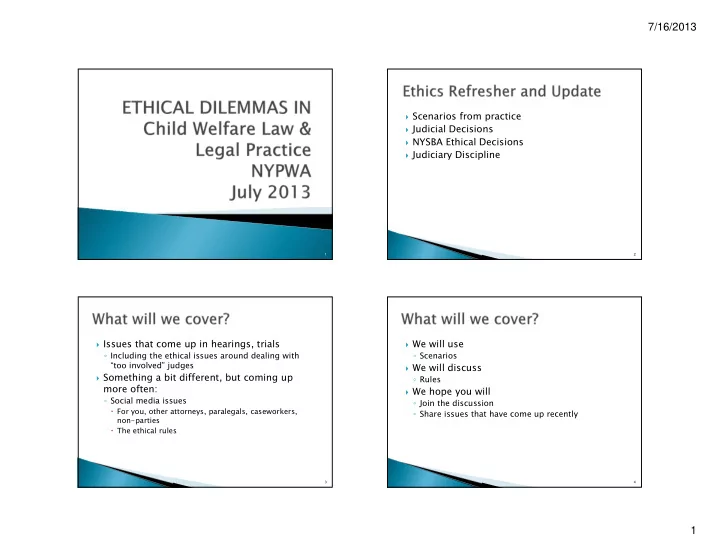
 Scenarios from practice  Judicial Decisions  NYSBA Ethical Decisions  Judiciary Discipline

2

 Issues that come up in hearings, trials

  • Including the ethical issues around dealing with

“too involved” judges

 Something a bit different, but coming up

more often:

  • Social media issues

 For you, other attorneys, paralegals, caseworkers, non-parties  The ethical rules

3

 We will use

  • Scenarios

 We will discuss

  • Rules

 We hope you will

  • Join the discussion
  • Share issues that have come up recently

4

slide-2
SLIDE 2

7/16/2013 2

 Here is where it all begins

  • How do the rules control our professional conduct?
  • Different standards as government attorneys?
  • Different pitfalls?

5

At a 1027 on a newly filed neglect petition you request the child be removed. The court is upset that DSS has not sought court intervention until today given the allegations in the petition. The Judge asks why didn’t we file sooner or do an emergency removal?

6

Should you disclose that the CPS supervisor never came to us to ask for a removal or anything earlier? If you do disclose that the supervisor did come to us a few days ago…..

 Can the Judge direct you to reveal what the

CPS told us?

 Can the Judge ask you what you advised the

supervisor?

7

“Con “Confi fide dentia ntial i l information” c formation” consists of ists of informatio formation ga n gained du during or ring or relating to lating to th the e repre presen entati tation

  • n o
  • f a client,

nt, what atev ever er i its source source, that is that is (a) prot (a) protecte ted by d by the the attorne attorney- client pr nt privil ivilege, (b) l e, (b) likely to y to be be emba embarr rrassing sing

  • r
  • r detrime

detrimental to l to the clie the client if nt if disclos disclosed, d, or

  • r (c)

(c) informatio formation th n that th the e client nt has r s reque queste ted be d be kept kept confi confidenti tial. . Rule Rule 1.6( 1.6(a)

8

slide-3
SLIDE 3

7/16/2013 3

(a) 1

  • 1. Conf

nfident idential al c communi unicat cation

  • n privileged.
  • ivileged. Unless t

less the e clien client waives the pr waives the privi ivilege, , an an atto attorney or his or

  • r his or he

her r employe ployee, o , or any y perso rson wh who o

  • obtains withou

tains without th t the e knowl

  • wledg

dge of

  • f the clien

the client evide evidence of

  • f a

a confi confiden enti tial al comm commun unic ication m made de be betwee tween th the attorn e attorney or ey or h his or s or her r employe ployee an and th d the e client client in in th the co e cour urse se o

  • f pr

profes

  • fessiona

sional employment, ployment, s shall n all not d t disclose, o lose, or be allowed lowed to to disclose lose such ch communi unica cation, n

  • n, nor s

shall t all the e client b nt be compelled t elled to disclose s lose such c ch communi unica cation,

  • n, in any

y action,

  • n, d

disciplinary t linary trial l or hear aring ing, o

  • r administr

nistrati tive ve acti action, , pro proceeding or he

  • r hearing con

conducted by or on by or on beh behalf

  • f an
  • f any stat

state, e, mu municipal or loc

  • r local

l gov governmental agen agency or

  • r

by by th the e le legislat gislatur ure o e or an any co y comm mmitt ittee or bo body dy th ther ereo eof. f. Evidence idence of a any s y such ch communication o unication obtained b ined by any y such p ch person,

  • n, and e

d evidence r ence resul sulting ing therefr erefrom, m, s shal all l not not be disc be disclosed by an by any stat y state, e, mu municipal or loc

  • r local

l gov government ntal agenc agency or by

  • r by the legi

the legislature ure or

  • r any

any comm commit ittee o ee or bo body th dy there ereof.

9

You are preparing a law enforcement witness for fact-finding. During your conversation, the detective says that recently the eyewitness to the abuse came to the station to tell the police that he lied about what he

  • saw. This conversation is not yet in any of

the police department’s records that have already been obtained through discovery.

10

Do you have to report this new information? Does it matter if it is exculpatory in nature? What if it was a child’s recantation instead, and the detective states that he thinks the abuse happened and the child is now covering it up?

11

A A lawye wyer sh shall n ll not: t:

(a)(1) su )(1) suppress a ppress any ev y evidence th ence that th the e lawyer er

  • r the

the clie client has has a a le lega gal o

  • blig

ligation to to re reveal

  • r
  • r pr

produce

  • duce;

(a (a)(3) c )(3) conceal or l or kn knowingly fa

  • wingly fail to

to di disclose sclose that that whic which the the lawye lawyer is re is requ quired by by law law to to re reveal;

12

slide-4
SLIDE 4

7/16/2013 4

Unde Under Brad r Brady, y, a a prose prosecuto utor must disclos must disclose exculpatory atory e eviden ence t ce to a defendan ant. Exculp Exculpato atory Evide y Evidence ce, or

  • r Brad

Brady Mate y Materia rial, is is evid vidence in in the the go gove vernme ment’s po posse ssess ssion that that is favo is favorable to to the acc the accused ed and and that that is is materia material to to eithe either guilt guilt o

  • r pun

punishme ment, incl including e g evid vidence that that may may impac impact the the credibility of edibility of a wi witn tness.

  • s. Co

Codifie dified in in Rule Rule 3.8( 3.8(b)

13

Are DSS attorney’s required to disclose exculpatory information? What is best practice in this area? If we put the detective on the stand, do we have an obligation to elicit this new fact?

14

A CPS worker that you have worked with in the past approaches you in court and tells you that she recognizes the respondent’s witness

  • n your case. She states that a few years ago

she was at a party and observed the witness smoking pot. Can you use the information for cross examination?

15

A lawyer wyer shal shall not…in l not…in a appearing ppearing before a fore a tribu tribunal al on beh

  • n behalf

lf of a

  • f a clie

client:

(d)( (d)(1) stat state or

  • r allud

allude to any to any mat matter that r that the the lawyer wyer does not es not rea reasonab ably b ly believe i lieve is relev relevant or

  • r that

that will not will not be supp be support

  • rted by

by ad admissible evid evidence;

(d)( (d)(4) 4) ask ask any any que question tion that the law that the lawyer has has no r no reas asonable ba basis to to bel believe is is relev relevant to the case to the case and and that that is inte is intend nded to to degr degrade ade a wit a witness or othe

  • r other

r pers person;

16

slide-5
SLIDE 5

7/16/2013 5

You file for a 1034 (2) access order. Your CPS worker’s affidavit states that CPS advised the parent of their intent to seek the order as is

  • required. The court grants the order. After

leaving the courtroom the CPS worker is re- reading the court order and says that she actually forgot to advise the parent that she was going to go to court. Do you have to do anything?

17

(a) (3) (a) (3) A lawye A lawyer shall shall not not know knowing ingly: y: off

  • ffer

r

  • r
  • r use evidence

use evidence that that the lawye the lawyer knows to knows to be fa fals

  • lse. If
  • e. If a lawyer,

wyer, the l the lawyer’s wyer’s cl client, or ient, or a witne witness calle called by the by the lawy lawyer has has offer

  • ffered

d mat materia rial evide evidence and and the lawyer the lawyer come comes to s to know of i know of its s fa fals lsity, ity, the l the lawyer shal wyer shall l ta take ke rea reason

  • nab

able le reme remedia dial measure measures, inclu , including, if if nece necess ssar ary, disc disclos losure re to to the tribuna the tribunal. l.

18

(d) (d) In In an an ex ex part parte pr e procee

  • ceeding, a

ding, a lawye wyer sh shall all inform the tribunal of inform the tribunal of all all mater material facts facts kno known to to the the lawye lawyer tha that will e will enable the the tribuna tribunal to l to make an informe make an informed decision, decision, wheth whether or

  • r not

not the the facts facts are are adve adverse.

19

 Issues  Rules  Discussion

20

slide-6
SLIDE 6

7/16/2013 6

You receive an e-mail from respondent’s

  • counsel. It is addressed to “Ms. Smith” (the

respondent). The e-mail chain contains e- mails back and forth between the respondent and her attorney. It is clear that the e-mail was sent to you in error.

21

Once you realize the error, should you continue to read the entire e-mail? If you do read the e-mail, can you use any of the information you learn during the course

  • f the litigation?

22

A A lawye lawyer who rece who receives s a docume a document rel relating to to th the e repre presentat tation of

  • n of th

the l e lawye wyer’s cl ’s client an nt and d kn knows or

  • ws or reaso

asonably sh ably should kn

  • uld know th
  • w that

at th the e docume document was inad was inadve vertently tly sent shall sent shall promptly notify the promptly notify the sende sender.

23

Does this mean I could continue to read on? Has opposing counsel now waived the client- attorney privilege?

24

slide-7
SLIDE 7

7/16/2013 7

A foster care worker says that the respondent mother has advised her that she is pregnant. She does not want the respondent father to know and has asked the case worker to “help her” get an abortion without the father

  • knowing. The caseworker tells you that she

went to her supervisor who told her that this is “not our business” and that it is a “conflict” for her to help the mother deceive the father. The caseworker is upset and wants you to advise her.

25

For social work purposes, are both parents the “client”? Can you withhold information from

  • ne of them? Does it matter if the

withholding would not be a conflict? Is there an ethical prohibition barring the case worker from sharing this kind of information?

26

A 14 year old girl in foster care has approached her caseworker and stated that she is

  • pregnant. She wants assistance in obtaining

an abortion but doesn’t want to disclose the pregnancy to her parents or to the foster family – both, she is convinced will try to talk her out of it. What is the caseworker’s obligation to the youth? To the parents? To the foster parents? How do you advise within the ethical rules?

27

 Issues  Rules  Discussion

28

slide-8
SLIDE 8

7/16/2013 8

An unrepresented non-respondent parent says she has some papers that might help with the

  • case. She said she left them for you at your
  • ffice. “Some papers” turns out to be three

letters written by the respondent to his brother containing admissions to the abuse allegations.

29

Can you read the letters? Do you have to notify anyone that you received them? If you suspect they were obtained illegally, can you still use them in the course of your litigation?

30

In In rep repres esenting a a clie client, a a lawy lawyer shal shall not not … … use meth e methods of

  • ds of obtaining ev
  • btaining evidence

ce th that at violate violate the legal rights the legal rights of

  • f su

such a per ch a person.

  • n.

31

Non-represented foster parents, and potential adoptive parents, want to talk to you during the TPR proceedings. It is likely your interests are aligned, but you do not know exactly what they want to talk about.

32

slide-9
SLIDE 9

7/16/2013 9

Do they think you are their lawyer too?

 Eth

Ethical r cal respo sponsibilitie sibilities

  • Upj

Upjohn or “c

  • r “cor
  • rporate M

Mira randa”

 Upjoh Upjohn Co. v.

  • Co. v. United State

United States, 449 U.S. 449 U.S. 383, 383, 101 S.Ct. 101 S.Ct. 677 (198 677 (1981)  Lets the Lets the part party know that know that yo you d u do no not r t represent their esent their interest (and interest (and who whose yo e you d u do r represent) esent)  Pro Problem wo lem would b uld be false sense o false sense of privilege attach ivilege attachin ing g – party might think it’s rty might think it’s there and there and it it is is no not

33

An aggressive defense attorney is trying to talk to the foster parents about visitation issues.

 Can you tell the attorney that he is not

permitted to talk to the foster parents?

  • Remind him of Rule 4.3?

 Can you tell the foster parents they are not

permitted to talk to the defense attorney?

 What about AFCs? Can you have a policy that

foster parents are not permitted to talk to

  • ther attorneys?

34

You have decided that you need to call the 15 year old victim to testify in an abuse case. Of course the caseworker has talked to the child several times but you feel you need to as well to properly prep the child. Do you have to ask the AFC’s permission? Can the AFC refuse to let you speak to the child?

 Note – there are several cases on this one.

One from Suffolk and 2nd Dept., one from Westchester and one from Erie- MAB will try to find

35

 In

In re Marvi Marvin Q, Q, 45 45 A.D.3 D.3d 852 ( 852 (2d De d Dep’t p’t 2007 2007) ( (Nass assau u Cou County Cas Case)

  • Child a

ild abuse/neglect, u use/neglect, uncle cle hired red priv ivate a ate attorney/ torney/firm w irm which w h was s DQ’d ’d for t talkin ing t g to child w ild withou thout A t ATC

 “appo ppointmen intment … t … crea eates tes at attorney-c ey-clie lient nt r relationship lationship, a , and the a absence nce of the e [ATC] at TC] at the s e subject i bject intervie iew w constitu tituted a ted a de denial o

  • f the c

e child’s ’s du due pr process ess r righ ghts” ts” citing ng C Campolongo

  • longo v. C

Campolongo,

  • ngo, 2 A.D.3d

3d 4 476)  In the Matt

In the Matter er of

  • f Tiaji

Tiajiann nna M., ., 55 A 55 A.D.3 D.3d 1321 1321 ( (4th De Dep’ p’t 2008 2008) ( (Erie e Count County) y)

  • Neglect

ect proceeding, ding, m mother g ther granted 1 anted 1-year year ACD, A D, AFC m moved d to preclud eclude DSS c caseworker f seworker from inter terviewin iewing child, c ild, court s urt said id no, , child c ild can n be inte terviewed d rviewed due t e to ACD. D.

36

slide-10
SLIDE 10

7/16/2013 10

 Issues  Ethical Decisions  Discussion

37

 Judge takes foster child to a park to talk  Judge visits foster child at a hospital  Judge seems to take a very personal interest

in a client in drug court asking questions about housing and her romantic life which are really not issues in the case

 Judge has, for years, called caseworkers on

the phone to ask about the status of cases

 Referee in perm hearings asks questions of

youth concerning birth control

38

 ..only we could just “talk to the Judge” - Can

judges participate regularly in meetings with County DSS child welfare?

 ..only commissioner could just “explain”

about an agency policy to the Judge, then he/she would understand – Can the Judge speak to just the Commissioner if it is not about a specific case?

39 40

So, can you invite a judge to participate in regular meetings where active child protective cases are being discusses?

 Joi

Joint Opi t Opinion ion 06-154 a 154 and 0 d 06-16 167 -a 7 -answer nswer is: : Judge Judge can can’t go.

  • go. Viol

Violates 22NYCR 22NYCRR 100. 100.4(A)(1)

  • “A

“A pivota pivotal issue in issue in all all such matte such matters is is wheth whether a a jud judge’s p s partic icipation w ipation would c uld cast doubt o ubt on the jud judge’s i s impartiality.” rtiality.”

slide-11
SLIDE 11

7/16/2013 11

 Issues  Ethics  Discussion

41

Parents in TPR have a public Facebook page – no privacy settings, anyone can go on and see the page. There is all kind of stuff on there that more than implies illegal drug use. Can you bring this into a hearing?

42

 Rule

Rules 4.1, 4.2, 4.1, 4.2, 4.3, 4.3, 5.3 (b)( 5.3 (b)(1), 8.4 (c) 8.4 (c)

 This

This was co was cove vered in in NYSBA NYSBA Co Committe mmittee o

  • n

Pr Profe

  • fessiona

ssional Eth Ethics Opi cs Opinion 843 ion 843

 “A

“A lawy lawyer who who re represents a clie a client in a in a pend pending litig g litigation, and and has has acce access to to the the Face Facebook or book or MySpace MySpace n netwo twork u k used by ed by ano another par party in litig in litigation, may may acc access and and revi view th the pu e public soc blic social al netwo network page k pages s of

  • f that

that party party to to search search for potentia for potential impe l impeachme achment materia materials.” s.”

43

Parents in child welfare proceeding are on Facebook – and I mean ON Facebook, posting

  • penly and often.

Can a caseworker/paralegal/attorney create a fake Facebook profile to “friend” parents and get information? If they do, can they use it in litigation? Should there be a policy about this at your agency?

44

slide-12
SLIDE 12

7/16/2013 12

Opin Opinion 843 conti 843 continues-

 “As l

“As long as th as the e lawye wyer does n does not “fr t “friend” d” th the e

  • ther
  • ther par

party OR OR DIRE DIRECT CT A A THIR THIRD PER D PERSON ON TO TO DO SO” DO SO”

45

 NYSBA opi

NYSBA opinio ion does n does not t addre address wi ss witn tnesse ses

 NY

NY City City Bar Bar Form Formal Opin Opinion 2010- 2010-2 does does

  • City

City Bar r is clear. is clear. Public Public is OK – is OK – but no ut no deceptio deception. n.

  • “A lawyer

“A lawyer may no may not t use decepti use deception to to access access inform informati ation fro from a a so soci cial al networki networking page. Rather,

  • page. Rather,

a a lawy lawyer er shou should rely on rely on the infor the informal al and for and formal al discovery p

  • very procedures s

edures sanct nctioned

  • ned b

by t the ethi hical cal rules rules and and case case law law to obta to obtain relev relevant eviden nt evidence ce.”

46

 As City Bar

As City Bar state states:

  • “[I]t does not matte

“[I]t does not matter wheth whether the the lawy lawyer er empl employ

  • ys an

an agent such as agent such as an an invest investiga igator [casewor

  • r [caseworker?]

ker?] t to engage engage in the ruse. in the ruse. As prov As provided by 8.4(a) by 8.4(a), ‘[a] ‘[a] lawye lawyer or law

  • r law firm shall

firm shall not viol not violate or attemp e or attempt the the Ru Rules les of

  • f Prof
  • fes

essional Con Conduct, kn know

  • wingly a

assis ssist or

  • r

induc induce anot anothe her to to do so do so or

  • r do so

do so thro through the the acts acts

  • f a
  • f anot
  • ther.”

 Make sure caseworkers know this

47

What if you have judge “friends”?

 Opin

Opinion 08-1 08-176 of

  • f the

the Rule Rules s Gove Governing Judic Judicial Condu Conduct

  • “provi

rovided t ded the e judge o dge otherwis rwise c e compli mplies es with the R e Rules s Gove Governing Jud Judicial Con Conduct, he/s he/she may may jo join in an and make make sure sure

  • f a

an i intern rnet et-bas

  • based

ed social n al networ

  • rk.
  • k. A judge

dge choosi

  • osing t

ng to do do so so shou should exer ld exerci cise se an ap an appropri propriat ate d e degree ee of d disc scretion

  • n

in in ho how he he/she use uses the the soc social ne network an and sho should sta stay abreast ast o

  • f the f

e feat atur ures o es of any y such service h e he/sh /she u uses as new d w developm pmen ents m may i impac pact his/her her d duties es u under er the e Rules Rules.”

 Be

Be car

  • careful. I

In NY s NY social medi dia co connections wit with jud judge co could gi give ve ri rise t se to “ “clo lose se so socia cial relati l relation

  • nship” a

” and d judge dge ma may y have ve duty t ty to disc sclose lose to o

  • pposi

posing c ng counsel unsel

 And

d if s/h s/he doesn’t … n’t … the et ethi hics ru rules sa les say, y you ma u may y have ve t to

48

slide-13
SLIDE 13

7/16/2013 13

This is a North Carolina child custody case, but it could happen anywhere (In re Public Reprimand of Terry, Inquiry

  • No. 09-234 (April 1, 2009))

 Judge friends defense counsel and sees information

posted about case

  • A problem itself!!

 Lawyer was asking how could he prove a negative (that

his client did not not have an affair)

 Notes that he has a wise judge (kiss some judicial butt)  Judge RESPONDS that there are two good parents in the

case/conversation about length of trial

 Judge receives public reprimand

49

 There are issues with whom an attorney can

have a “friend” relationship on social media

  • Opposing counsel?
  • Parties? (where any of co-workers are counsel)
  • Witnesses

 Bottom line: don’t discuss cases. EVER.

EVER. Facebook and “friends” are no exception- should this also be required policy for caseworkers and foster parents?

 Don’t “friend” for information. No fake

profiles.

50

 Inside many lawyers is a writer screaming to

be heard

  • blogs, comments on news sites

 BE CAREFUL  Florida Attorney posted comments on local

blog (not his own)

  • Called judge “evil unfair witch” “seemingly mentally ill”
  • Florida bar told him? Violated FIVE ethics rules (included

“false” statements re: judge and conduct prejudicial to administration of justice)

  • Rejected 1st Amendment claim
  • Reprimand and fine

51

 More issues you may encounter  Or likely have already encountered

52

slide-14
SLIDE 14

7/16/2013 14

You are about to resolve the Jones matter, the caseworker thinks it is time to send the child back to the mother and the mother’s new boyfriend who the caseworker says is “just great” with the child. They show up at court and you realize you know the boyfriend –he was a criminal client of yours when you were in private practice. He had a statutory rape charge that you got dismissed when his young alleged victim would not testify. You think he recognizes you but he says nothing.

53

 Take him aside and tell him that he better

either disappear or admit his past

 Tell the court you have a conflict and cannot

disclose what it is and that another attorney will have to represent DSS’ interests

 Grab the caseworker and ask her if she ever

looked up the boyfriend’s arrest records

 It is not a problem as he was never convicted

and, therefore, nothing happened that would affect the current proceedings

54

You are trying a complicated mental illness TPR, it is

  • bvious that the young attorney representing the

mother has no idea what he is doing, doesn’t seem to even know what the basic cause of action is or have a basic understanding of rules of evidence. The Judge is annoyed but pretty much ignoring it and pushing on. Can you/Should you do anything? What if the mother’s relative comes up to you and says “Does this attorney know what he is doing – should we get a new attorney?”

55

 Can you have a romantic relationship with

…a caseworker? …the commissioner? …a Judge you sometimes appear in front of? …another attorney who sometimes is on another side?

 If you had a relationship in the past, must you

disclose it?

 Does it matter how “far” you/he/she/they

went?

56

slide-15
SLIDE 15

7/16/2013 15

 What’s on your mind?

57