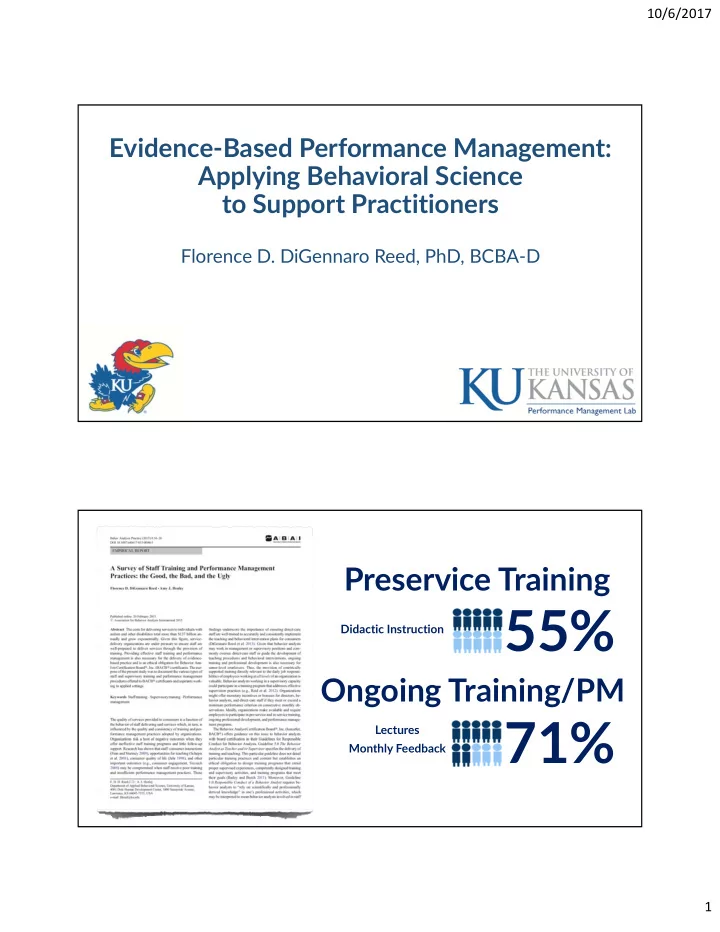
55% Didactic Instruction Ongoing Training/PM 71% Lectures Monthly - - PDF document

55
SMART_READER_LITE
LIVE PREVIEW

55% Didactic Instruction Ongoing Training/PM 71% Lectures Monthly - - PDF document

10/6/2017 Evidence Based Performance Management: Applying Behavioral Science to Support Practitioners Florence D. DiGennaro Reed, PhD, BCBA D Preservice Training 55% Didactic Instruction Ongoing Training/PM 71% Lectures Monthly Feedback


slide-1
SLIDE 1

10/6/2017 1

Evidence‐Based Performance Management: Applying Behavioral Science to Support Practitioners

Florence D. DiGennaro Reed, PhD, BCBA‐D

Didactic Instruction

55%

Preservice Training Ongoing Training/PM

71%

Lectures Monthly Feedback

slide-2
SLIDE 2

10/6/2017 2

Supervisory Training

33%

Who cares?!? Who cares?!?

slide-3
SLIDE 3

10/6/2017 3

Sundberg (2016)

slide-4
SLIDE 4

10/6/2017 4

Treatment integrity impacts client outcomes. Staff training impacts treatment integrity.

Session

10 20 30 40 50 20 40 60 80 100 20 40 60 80 100

Student Percent Accuracy on Receptive Identification Task

20 40 60 80 100

Baseline Consequence Manipulation

0% Errors of Commission 50% Errors of Commission 100% Errors of Commission

Alek Justin Salvatore

DiGennaro Reed et al. (2011) Hirst & DiGennaro Reed (2015)

slide-5
SLIDE 5

10/6/2017 5

If the supervisee does not have the skills necessary to perform competently, ethically, and safely, behavior analysts provide conditions for the acquisition of those skills. Behavior analysts design feedback and reinforcement systems in a way that improves supervisee performance. Behavior analysts provide documented, timely feedback regarding the performance of a supervisee on an ongoing basis.

slide-6
SLIDE 6

10/6/2017 6

Performance Management OBM Applied Behavior Analysis

Presence of relevant antecedents and consequences to ensure staff correctly implement assessment and treatment protocols, and perform other job responsibilities as prescribed.

slide-7
SLIDE 7

10/6/2017 7

Instruction Instruction Modeling Modeling Rehearsal Rehearsal Feedback Feedback

Behavioral Skills Training Instruction involves describing a target skill.

slide-8
SLIDE 8

10/6/2017 8

Instruction is insufficient. Training begins with instruction. Lecture is insufficient.

slide-9
SLIDE 9

10/6/2017 9

You must The way Might consider None

slide-10
SLIDE 10

10/6/2017 10

Practice Guidelines

  • Be clear and succinct about procedures.
  • Provide jargon‐free, written protocols.
  • Describe a rationale.
  • Use diagrams, if appropriate.
  • Be transparent about specific staff behaviors you

will observe and measure.

Models demonstrate perfect performance of a skill.

slide-11
SLIDE 11

10/6/2017 11

10 20 30 40 50 60 70 80 90 100 1 2 3 4 5 6 7 8 9 10 11 12 13 14 15 16 Sessions 10 20 30 40 50 60 70 80 90 100 1 2 3 4 5 6 7 8 9 10 11 12 13 14 15 16 Sessions 10 20 30 40 50 60 70 80 90 100 1 2 3 4 5 6 7 8 9 10 11 12 13 14 15 16 Sessions BL Video Model Rec Exp 1-week Percent Accuracy Kara Rob Joanne Adult Student probe Performance Feedback 10 20 30 40 50 60 70 80 90 100 1 2 3 4 5 6 7 8 9 10 11 12 13 14 15 16 Sessions 10 20 30 40 50 60 70 80 90 100 1 2 3 4 5 6 7 8 9 10 11 12 13 14 15 16 Sessions 10 20 30 40 50 60 70 80 90 100 1 2 3 4 5 6 7 8 9 10 11 12 13 14 15 16 Sessions BL Video Model Rec Exp 1-week Percent Accuracy Kara Rob Joanne 10 20 30 40 50 60 70 80 90 100 1 2 3 4 5 6 7 8 9 10 11 12 13 14 15 16 Sessions 10 20 30 40 50 60 70 80 90 100 1 2 3 4 5 6 7 8 9 10 11 12 13 14 15 16 Sessions 10 20 30 40 50 60 70 80 90 100 1 2 3 4 5 6 7 8 9 10 11 12 13 14 15 16 Sessions BL Video Model Rec Exp 1-week Percent Accuracy Kara Rob Joanne Adult Student probe Performance Feedback
slide-12
SLIDE 12

10/6/2017 12

10 20 30 40 50 60 70 80 90 100

Percentage of Steps Implemented Correctly

10 20 30 40 50 60 70 80 90 100

Sessions

1 2 3 4 5 6 7 8 9 10 11 12 13 14 15 16 17 10 20 30 40 50 60 70 80 90 100 Kelly Baseline IVM IVM+PF Follow-up Lauren Shannon 10 20 30 40 50 60 70 80 90 100

Percentage of Steps Implemented Correctly

10 20 30 40 50 60 70 80 90 100

Sessions

1 2 3 4 5 6 7 8 9 10 11 12 13 14 15 16 17 10 20 30 40 50 60 70 80 90 100 Kelly Baseline IVM IVM+PF Follow-up Lauren Shannon
slide-13
SLIDE 13

10/6/2017 13

Practice Guidelines

  • Model entire procedure.
  • Standardize models across training episodes.
  • Provide multiple exemplars.
  • Supplement with other training procedures.
slide-14
SLIDE 14

10/6/2017 14

Rehearsal entails practicing a target skill. Rehearsal without feedback is not effective.

slide-15
SLIDE 15

10/6/2017 15

Many Variations

  • Trainer vs. trainee vs. client
  • Scripts to guide “client” responding
  • Analog vs. in vivo
  • Directed rehearsal
  • Arbitrary number vs. mastery criterion
slide-16
SLIDE 16

10/6/2017 16

slide-17
SLIDE 17

10/6/2017 17

Practice Guidelines

  • Practice does not make perfect.
  • Practice with feedback makes perfect.
  • Engineer opportunities to practice the entire

procedure and respond to a range of client responses.

  • Establish a mastery criterion.

Feedback contains information regarding past performance that specifies how performance can be improved in the future.

slide-18
SLIDE 18

10/6/2017 18

Behavioral Function

Excellent teaching! I especially liked how you effectively faded your prompts within session. Just remember to deliver the reinforcer more quickly next time.

Behavioral Function

SR+ SR‐ SD EO CSS

slide-19
SLIDE 19

10/6/2017 19

Many Variations

  • Source
  • Medium (or mechanism)
  • Frequency
  • Recipients
  • Privacy
  • Content
  • Sequence
slide-20
SLIDE 20

10/6/2017 20

Good job! Bad job! Good job! Huh!?!

slide-21
SLIDE 21

10/6/2017 21

slide-22
SLIDE 22

10/6/2017 22

Practice Guidelines

  • Base feedback on observations.
  • Provide feedback about areas requiring

improvement and tasks performed well.

  • Deliver feedback respectfully.
  • Immediate feedback preferred by staff.
  • Incorporate other training procedures, as needed.

Recruitment and Hiring Pre‐Service Training (BST) Performance Management

Staff Support

Green light

slide-23
SLIDE 23

10/6/2017 23

“Do good, take data.”

(Risley, 2001, p. 267)

Ricciardi (2005)

slide-24
SLIDE 24

10/6/2017 24

slide-25
SLIDE 25

10/6/2017 25

Preference Assessments

  • Manager selection
  • Survey methods effective
  • Preferences change; assess often
  • Varied delivery of stimuli may improve

performance

  • Effort not carefully examined
slide-26
SLIDE 26

10/6/2017 26

slide-27
SLIDE 27

10/6/2017 27

slide-28
SLIDE 28

10/6/2017 28

slide-29
SLIDE 29

10/6/2017 29

fdreed@ku.edu

Evidence‐Based Performance Management: Applying Behavioral Science to Support Practitioners