5-6 Homework Assignments Attend class. Written, problem set, and - - PDF document

5 6 homework assignments
SMART_READER_LITE
LIVE PREVIEW

5-6 Homework Assignments Attend class. Written, problem set, and - - PDF document

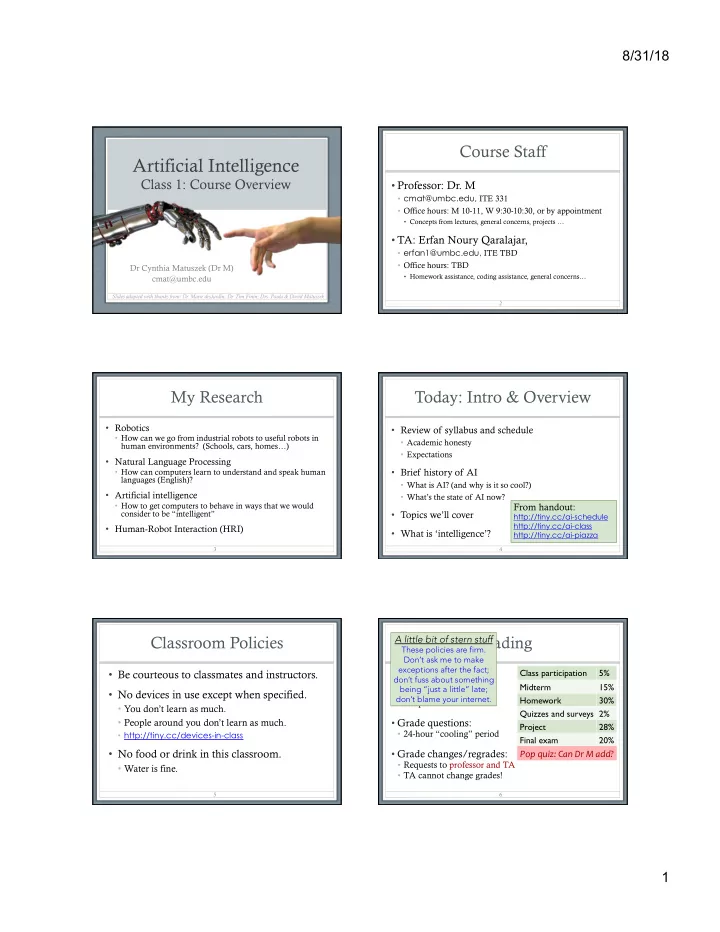
8/31/18 Course Staff Artificial Intelligence Class 1: Course Overview Professor: Dr. M cmat@umbc.edu, ITE 331 Office hours: M 10-11, W 9:30-10:30, or by appointment Concepts from lectures, general concerns, projects TA:


slide-1
SLIDE 1

8/31/18 1

Artificial Intelligence

Class 1: Course Overview

Dr Cynthia Matuszek (Dr M) cmat@umbc.edu

Slides adapted with thanks from: Dr. Marie desJardin; Dr. Tim Finin; Drs. Paula & David Matuszek

Course Staff

  • Professor: Dr. M
  • cmat@umbc.edu, ITE 331
  • Office hours: M 10-11, W 9:30-10:30, or by appointment
  • Concepts from lectures, general concerns, projects …
  • TA: Erfan Noury Qaralajar,
  • erfan1@umbc.edu, ITE TBD
  • Office hours: TBD
  • Homework assistance, coding assistance, general concerns…

2

My Research

  • Robotics
  • How can we go from industrial robots to useful robots in

human environments? (Schools, cars, homes…)

  • Natural Language Processing
  • How can computers learn to understand and speak human

languages (English)?

  • Artificial intelligence
  • How to get computers to behave in ways that we would

consider to be “intelligent”

  • Human-Robot Interaction (HRI)

3

Today: Intro & Overview

  • Review of syllabus and schedule
  • Academic honesty
  • Expectations
  • Brief history of AI
  • What is AI? (and why is it so cool?)
  • What’s the state of AI now?
  • Topics we’ll cover
  • What is ‘intelligence’?

4

From handout:

http://tiny.cc/ai-schedule http://tiny.cc/ai-class http://tiny.cc/ai-piazza

Classroom Policies

  • Be courteous to classmates and instructors.
  • No devices in use except when specified.
  • You don’t learn as much.
  • People around you don’t learn as much.
  • http://tiny.cc/devices-in-class
  • No food or drink in this classroom.
  • Water is fine.

5

Grading

Class participation 5% Midterm 15% Homework 30% Quizzes and surveys 2% Project 28% Final exam 20%

6

Pop quiz: Can Dr M add?

  • Grades in Blackboard
  • Know your grades

but also

  • Keep track of what’s left
  • Grade questions:
  • 24-hour “cooling” period
  • Grade changes/regrades:
  • Requests to professor and TA
  • TA cannot change grades!

A little bit of stern stuff

These policies are firm. Don’t ask me to make exceptions after the fact; don’t fuss about something being “just a little” late; don’t blame your internet.

slide-2
SLIDE 2

8/31/18 2

Participation

  • Attend class.
  • The program (and I) expect you

to be here for the whole semester.

  • Speak up.
  • Answer questions
  • Ask questions
  • Tell us your thoughts
  • There are lots of opportunities to talk here!
  • Be active on Piazza.
  • Ask and answer questions.
  • Post links to interesting material.

7

5-6 Homework Assignments

  • Written, problem set, and programming
  • Due at 11:59pm the day before class
  • Late: 25% off /day
  • Assignments will be turned in electronically
  • Blackboard / online forms / email
  • Assignment will specify
  • 10% penalty for not following turn-in instructions
  • Example: Wrong file type
  • Questions? Piazza, then TA

8

Time Management

  • Some things can be rescheduled
  • E.g., overlapping exams
  • If enough people have them
  • Individual extensions may be given:
  • 1. With reasonable cause
  • 2. When made in advance
  • Please talk to me!

9

Some Advice

  • Grad School is a hard transition
  • Everyone is smart now!
  • New expectations about writing, time

management, and behavior

  • I know you don’t believe me right now; that’s cool
  • Moving to a new place/field is hard
  • There’s a lot we can do to help – if we know.

10

Reading

  • Pre-readings: Do these before that class
  • First ~10 minutes will be Q&A about them
  • Readings: Do these after class
  • More detail on concepts

11

Academic Integrity

  • Instructor’s responsibilities:
  • Be respectful
  • Be fair
  • Be available
  • Tell the students what they need to know and how they

will be graded

  • Students’ responsibilities:
  • Be respectful
  • Do not cheat, plagiarize, or lie, or help anyone else do so
  • Do not interfere with other students’ academic activities

12

slide-3
SLIDE 3

8/31/18 3

Academic Integrity Policy

  • “By enrolling in this course, each student assumes the

responsibilities of an active participant in UMBC’s scholarly community, in which everyone’s academic work and behavior are held to the highest standards

  • f honesty. Cheating, fabrication, plagiarism, and

helping others to commit these acts are all forms

  • f academic dishonesty, and they are wrong.

Academic misconduct could result in disciplinary action that may include, but is not limited to, suspension or dismissal.”

[Statement adopted by UMBC’s Undergraduate Council and Provost’s OfFice]

13

Integrity: Plagiarism

  • Representing someone else’s work as

your own is plagiarism.

  • What if the reference is in the bibliography?
  • If you didn’t explicitly quote the text you used and

cite the source where you used the text, it is plagiarism.

  • What if I only use some of the words?
  • Scattering some of your own words and rephrasing

isn’t enough. If the ideas are not restated entirely in your own words, it is plagiarism.

14

Integrity: Plagiarism

  • More Examples
  • The introduction and background material are

borrowed; all of the research is original.

  • If somebody else’s words appear in any document that

you claim is written by you, it is plagiarism.

  • It was a draft or not an official assignment
  • If you represented somebody else’s words as your own,

even in an informal context, it is plagiarism.

  • “But the professor told me to use that source!”
  • Unless you are explicitly told to copy a quote from a

source, you must write your answers in your own words.

15

Integrity: Abetting

  • This includes putting someone’s name on

something when they didn’t work on it.

  • “This is just everyone on our team” is wrong.
  • Know what your project partners are doing.
  • Their cheating can hurt you.
  • Helping another student to cheat, falsify, or

plagiarize will result in you receiving the same penalty.

16

Integrity: What To Do

  • You can always bring it to me.
  • Cheating from you / in your group / etc.:
  • You may talk to them about it first
  • Unless it’s too late (it’s been turned in, the test is over)
  • Then you are abetting unless you report
  • Some people may get sneakier instead of improving
  • You do not have to talk to anyone but me.

17

Integrity: Penalties

  • Penalties depend on the offense and whether it recurs
  • The minimum penalties are:
  • Receiving a zero on an assignment
  • Being required to redo the assignment, without credit, in
  • rder to pass the class
  • Additional penalties may include:
  • Receiving a full grade reduction in the class
  • Failing the class without possibility of dropping it
  • Suspension or expulsion from the university

18

slide-4
SLIDE 4

8/31/18 4

About Groupwork

19

  • Study groups are encouraged!
  • Talking about the homework is completely acceptable
  • Just don’t share code
  • Programming must be done individually
  • Programs must be written entirely by you
  • Copying another person’s code is never acceptable
  • You can help debug
  • Some homework is for 2-3 students working together
  • The assignment will say so; otherwise, it’s individual.

Availability & Communication

  • Post all questions to Piazza (unless it violates integrity)
  • We will try to respond to Piazza posts immediately
  • Email takes 24-48 hours
  • Always send email to professor and TA
  • Piazza, then TA, then prof+TA
  • Office hours
  • Drop by when my door is open
  • If I’m busy (often), we’ll make an appointment
  • I will remain after class when I can

20

Schedule

21

  • You will check this pretty much every class

What is AI?

22

  • Key types
  • Strong AI: mental/thought capabilities equal to

(or better than) human

  • Weak (bounded) AI: intelligent actions or

reasoning in some limited situations

  • “Human-level” intelligence
  • In what situation?
  • Internally?
  • Self-awareness / Consciousness

Artificial Intelligence

23

  • These are problematic.
  • How do we measure it?
  • What’s an ‘intelligent action’?
  • In practice, ‘previously human only’
  • Is there something ineffable missing?
  • What?
  • How do we test?

“Intelligence” is Problematic

24

slide-5
SLIDE 5

8/31/18 5

AI: A Vision

  • Could an intelligent agent living on your

home computer…

  • Manage your email
  • Coordinate your work and social activities
  • Help plan your vacations
  • Watch your house while you take those vacations?

25

Main Goals of AI

  • Represent and store knowledge
  • Retrieve and reason about knowledge
  • Behave intelligently in complex environments
  • Learn from environment and interactions
  • Develop interesting and useful applications
  • Interact with people, agents, and environment

26

  • Engineering
  • To get machines to do a wider variety of useful things
  • Understand spoken natural language
  • Recognize individual people in visual scenes
  • Find the best travel plan for your vacation
  • Cognitive Science
  • Help understand how natural minds work
  • Visual perception, memory, learning, language, etc.
  • Philosophy
  • As a way to explore interesting (and important)

philosophical questions

27

Why AI?

Foundations of AI

Computer Computer Science & Science & Engineering Engineering

AI AI

Mat Mathemat hematics ics Cognit Cognitive ive Science Science Philosophy Philosophy Psychology Psychology Linguist Linguistics ics

Biology Biology

Economics Economics

Big Questions

  • Can machines think?
  • If so, how?
  • If not, why not?
  • What does this say about human beings?
  • What does this say about the mind?

36

What’s Easy and What’s Hard?

  • It’s easi(er) to mechanize high-level tasks
  • Symbolic integration
  • Proving theorems
  • Playing chess
  • Medical diagnosis
  • It’s hard to mechanize tasks that lots of animals can do
  • Walking around without running into things
  • Catching prey and avoiding predators
  • Interpreting complex sensory information (e.g., visual, aural, …)
  • Modeling the internal states of other animals from their behavior
  • Working as a team (e.g., with pack animals)
  • Is there a fundamental difference?

37

slide-6
SLIDE 6

8/31/18 6

Turing Test

  • Three rooms:
  • 1 person, 1 computer, and 1 interrogator
  • The interrogator can communicate with the other two
  • The interrogator tries to decide which is the person
  • Both try to convince the interrogator they are the person
  • If the machine succeeds, the machine can think

…Right? (no)

Image: Filipinofreethinkers.org/2012/06/23/turings-tremendous-talent-and-trenchant-test/turing-test

The Loebner Contest

  • A modern version of the Turing Test, held annually
  • $100,000 cash prize.
  • Hugh Loebner was once director of UMBC’s Academic Computing

Services (née UCS)

  • Restricted topic (removed in 1995) and limited time.
  • Participants: set of humans, set of computers, set of judges.
  • Scoring
  • Rank from least human to most human.
  • Highest median rank wins $2000

39

What Can AI Systems Do Now?

  • Computer vision: face

recognition from a large set

  • Natural language processing:

machine translation

  • Expert systems: medical

diagnosis in a narrow domain

  • Spoken language systems:

~1000 word continuous speech

  • Planning and scheduling:

Hubble Telescope experiments

  • Robotics: autonomous (mostly)

automobile

  • User modeling: Bayesian reasoning

in Windows help (the infamous paper clip…)

  • Games: Grand Master level in chess

(world champion), perfect play in checkers, Go

  • Search: You’ve used Google.
  • Learning: So much learning.

What Can’t AI Systems Do Yet?

  • Understand natural language robustly
  • Learn a natural language
  • Surf the web
  • Interpret an arbitrary visual scene
  • Play Go as well as the best human players
  • Construct plans in dynamic real-time domains
  • Refocus attention in complex environments
  • Perform life-long learning

41

Who Does AI?

  • Academic researchers (perhaps the most Ph.D.-generating area of

computer science in recent years)

  • Some top schools: CMU, Stanford, Berkeley, MIT, UW

, UMd, U Alberta, UT Austin, ... (and, actually, UMBC!)

  • Government and private research labs
  • NASA, NRL, NIST, IBM, AT&T, SRI, ISI, MERL, ...
  • Lots of companies!
  • Google/Alphabet, Microsoft, Amazon, Honeywell, Teknowledge, SAIC,

MITRE, Fujitsu, Global InfoTek, BodyMedia, ...

42

Applications

43

slide-7
SLIDE 7

8/31/18 7

Game Playing

44

Text/Sketch Recognition

45

User Modeling & NLP

46

Robotics

47

Knowledge Representation

Watson

48 48

Evolutionary Art

49

slide-8
SLIDE 8

8/31/18 8

Computer Vision

50

Possible Approaches

Think Act

Like humans Well

GPS Eliza Rational agents Heuristic systems AI tends to work mostly in this area

51

Thinking Well

  • Develop formal models of

knowledge representation, reasoning, learning, memory, and problem solving, that can be rendered in algorithms.

  • There is often an emphasis on systems that are

provably correct, and guarantee finding an

  • ptimal solution.

Think Act

Like humans Well

GPS Eliza Rational agents Heuristic systems

52

  • For a set of inputs, generate an appropriate
  • utput that is not necessarily correct but

gets the job done.

  • A heuristic (heuristic rule, heuristic method) is a rule of

thumb, strategy, trick, or any other kind of device which drastically limits search for solutions in large problem spaces.

  • Heuristics do not guarantee optimal solutions; in fact, they do

not guarantee any solution at all: all that can be said for a useful heuristic is that it offers solutions which are good enough most of the time. – Feigenbaum and Feldman, 1963, p. 6

53

Acting Well

Think Act

Like humans Well

GPS Eliza Rational agents Heuristic systems

Think Act

Like humans Well

GPS Eliza Rational agents Heuristic systems

  • Cognitive science approach
  • Focus not just on behavior and I/O
  • Also look at reasoning process.
  • Computational model reflects “how” results were obtained
  • Providea a new language for expressing cognitive theories and

new mechanisms for evaluating them

  • GPS (General Problem Solver):
  • Not just to produce humanlike behavior, but to produce a sequence of

steps of the reasoning process similar to the steps followed by a person

54

Thinking Like Humans

  • Behaviorist approach.
  • Not about how you get results,

just the similarity to what human results are.

  • Exemplified by the Turing Test

Think Act

Like humans Well

GPS Eliza Rational agents Heuristic systems

55

Acting Like Humans

slide-9
SLIDE 9

8/31/18 9

Think Act

Like humans Well

GPS Eliza Rational agents Heuristic systems

56

What about Statistical Methods?

For Next Time

  • Due at 11:59pm before next class:
  • Fill out the survey
  • Posted before weekend
  • Where? J
  • Read academic integrity statement
  • Read syllabus
  • Sign up for Piazza and join this class
  • Look at the reading lists
  • Do pre-reading for next time!

57