
SLIDE 1
5/18/2010 1
Rui Wang, XiaoFeng Wang and Kehuan Zhang Shuo Chen IEEE Symposium on Security and Privacy Oakland, California May 17th, 2010
(1) split between client and server
Traditional PC application Web application (1) split between client and server
(2) state transitions driven by network traffic
Web application
Worry about privacy? Let’s do encryption.
- The eavesdropper cannot see the contents, but can
- bserve :
- number of packets, timing/size of each packet
- Previous research showed privacy issues in various
domains: domains:
- SSH, voice-over-IP, video-streaming, anonymity channels (e.g.,
Tor)
- Our motivation and target domain:
- target: today’s web applications
- motivation: Software-as-a-Service (SaaS) becomes mainstream,
and the web is the platform to deliver SaaS apps.
- Surprisingly detailed user information is being leaked
- ut from several high-profile web applications
- personal health data, family income, investment details,
search queries
- (Anonymized app names per requests from related
companies) p )
- The root causes are some fundamental characteristics
in today’s web apps
- stateful communication, low entropy input and significant
traffic distinctions.
- Defense is non-trivial
- effective defense needs to be application specific.
- calls for a disciplined web programming methodology.
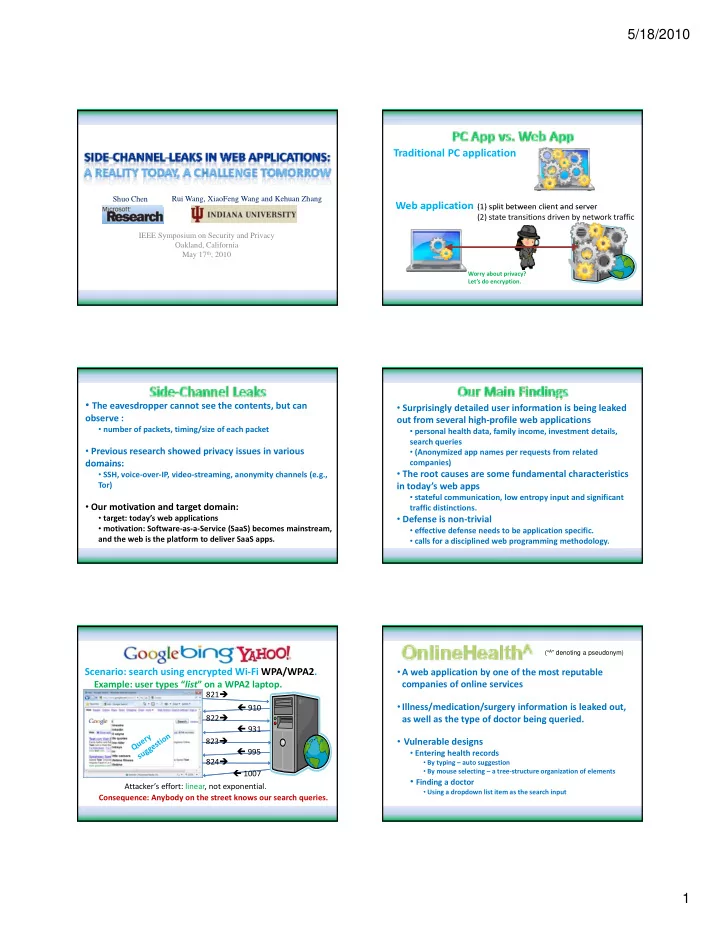
Scenario: search using encrypted Wi-Fi WPA/WPA2.
Example: user types “list” on a WPA2 laptop.
821 910 822 Consequence: Anybody on the street knows our search queries. Attacker’s effort: linear, not exponential. 931 823 995 824 1007
(“A” denoting a pseudonym)
- A web application by one of the most reputable
companies of online services
- Illness/medication/surgery information is leaked out,
as well as the type of doctor being queried. yp g q
- Vulnerable designs
- Entering health records
- By typing – auto suggestion
- By mouse selecting – a tree-structure organization of elements
- Finding a doctor
- Using a dropdown list item as the search input