5/10/2012 Presentation Overview Permitting the Obvious? Project - - PDF document

5 10 2012
SMART_READER_LITE
LIVE PREVIEW

5/10/2012 Presentation Overview Permitting the Obvious? Project - - PDF document

5/10/2012 Presentation Overview Permitting the Obvious? Project History A Recycled Water Regulatory Drivers Success Story in Getting to a Solution Hermiston, Oregon Solution Mark Cullington Screeching Halt Idaho Water


slide-1
SLIDE 1

5/10/2012 1

Permitting the Obvious? A Recycled Water Success Story in Hermiston, Oregon

Mark Cullington Idaho Water Reuse Conference April 17-18, 2012

Presentation Overview

 Project History  Regulatory Drivers  Getting to a Solution  Solution  Screeching Halt  Solution  Questions

Acknowledgements

 Ed Brookshier, City of Hermiston  Al Shewey, Kennedy/Jenks  Brad Bogus, Tetra Tech

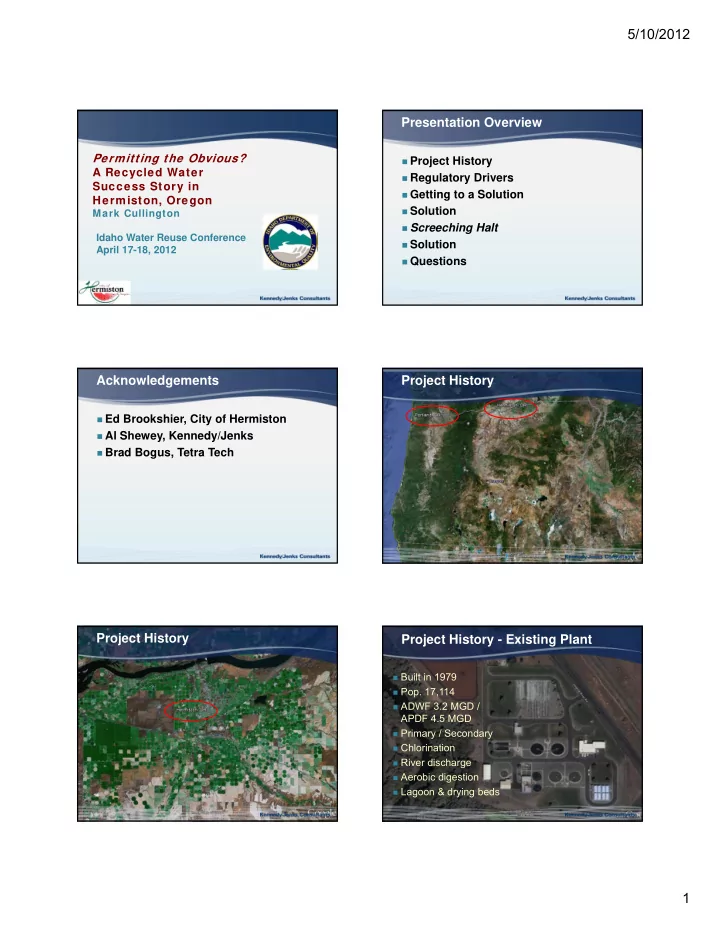
Project History Project History Project History - Existing Plant

 Built in 1979  Pop. 17,114  ADWF 3.2 MGD /

APDF 4.5 MGD

 Primary / Secondary  Chlorination  River discharge  Aerobic digestion  Lagoon & drying beds

slide-2
SLIDE 2

5/10/2012 2

Project History - Existing Discharge

Summer

 Class C Recycled

Water

 LGW Ranch

Winter

 Umatilla River

LGW Ranch 570 acres River Discharge

Regulatory - TMDL

Umatilla River TMDL

  • Established in 2001
  • Temperature, sediment, aquatic weeds, algae,

pH, ammonia, bacteria

Meet all permit conditions except:

  • Ammonia
  • Temperature (TMDL & WQ Standard)

Regulatory - Ammonia

 Current outfall location does not provide

enough flow or dilution to meet new stringent permit limits

 Ammonia standard for Umatilla River is

the lowest in the State of Oregon

 Fish Use drives compliance in the

Umatilla River

Regulatory - Temperature

Temperature Non-Compliance River Temperature Temperature Standard

Regulatory - Future Regulations

The City is planning ahead in anticipation of future water quality regulations to protect salmon fisheries

  • Fish consumption rate increase
  • Senate Bill 737
  • Turbidity
  • Nutrient standards
  • Mixing zone challenges

Getting to a Solution

Challenges

 TMDL  Ammonia  Temperature  Future Regulations  ‘Hot bed’ of tribal,

regulatory, political influences

 Costs

Potential Solutions

 Facility upgrades  MBR technology  Minimize discharge  Class A Recycled

Water

 Forge new

partnerships

slide-3
SLIDE 3

5/10/2012 3

Getting to a Solution – NPDES Permitting

2006 – Proposed LGW Ranch and Hyporheic Discharge 2007 – Revisions to Recycled Water Regulations 2007 – Discussions with DEQ on Recycled Water 2007 – Discussions with WEID, USBR and other stakeholders 2008 – Proposed WEID Discharge to Oregon DEQ 2008 – Title XVI Recycled Water Grant 2009 – Established NPDES Approach 2011 – Additional NPDES requirements

Getting to a Solution - Stakeholders

▼ West Extension Irrigation District ▼ CTUIR (tribes) ▼ Hermiston ▼ Umatilla County ▼ Oregon Farm Bureau ▼ Oregon Tilth ▼ Oregon DEQ ▼ Oregon DOJ ▼ Oregon DF&W ▼ Oregon DSL ▼ Oregon SHPO ▼ U.S. NOAA ▼ U.S. EPA ▼ U.S. Corps of Engineers ▼ U.S. Bureau of Reclamation ▼ Congressman Walden ▼ Senator Wyden

* Heavily involved partners

Solution - West Extension Irrigation District

10,000 acres

Solution - New Umatilla River Discharge

10,000 acres

Solution - New Umatilla River Discharge

Old Outfall New Outfall

Solution – Some Details

slide-4
SLIDE 4

5/10/2012 4

Solution – Screeching Halt Solution – Screeching Halt Solution – Screeching Halt

Use Attainability Analysis

  • Regulatory process that authorizes changing

designated uses that in State water quality standards

  • ~200 since the CWA was promulgated
  • 10 related to temperature
  • None in the Pacific Northwest
  • Can take 2-4 years to complete!

Solution – UAA Solution – UAA Solution – Help Make UAA Successful

Successful UAA Process Legal and Regulatory Understanding Scientific Understanding Regulatory Agency Preparedness Public Awareness Financial Needs and Impacts

Adapted from WERF, 2007

slide-5
SLIDE 5

5/10/2012 5

Solution – Help Make UAA Successful

Fish

  • Fish Screens of intake and Pump Stations
  • Fish Passage Barrier at outlet to Columbia River
  • No Fish Present in Canal

Drinking Water

  • Prohibited By Law

Contact Recreation

  • Prohibited

Existing NPDES

  • Herbicide applications – Acrolein

Solution – Help Make UAA Successful

NPDES Approach based on Irrigation Beneficial Use

 Establish Beneficial Use in the Evaluation Report  Document Oregon DFW support for no fish  Establish WEID/USBR policies on water use

Establish Mixing Zone in the Canal

 Over 2 Miles to First Withdrawal Point Fish

Solution – Success…Almost There

 One additional & existing stakeholder  Recycled Water in Summer  Drought proof supplemental supply for WEID  Approximately 600 acres (1,800 Acre-Feet)  Reduced pumping costs & energy savings  Establishes Precedent with USBR, EPA, DEQ  High Quality Winter Discharge  Protects cold water habitat  Highest quality recycled water  Proactive – Anticipates futures toxics reduction regulations

Questions?

Mark Cullington markcullington@kennedyjenks.com (503) 423-4043