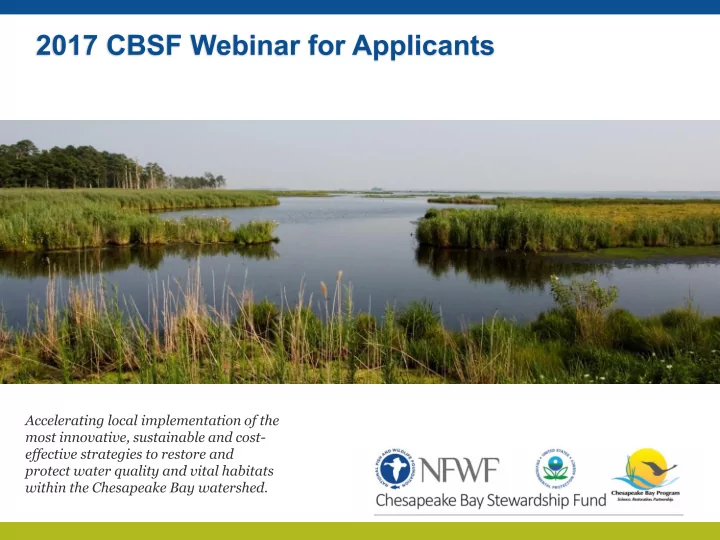
SLIDE 1
SLIDE 2
1. Webinar Instructions 2. Overview of Chesapeake Bay Stewardship Fund 3. Review of 2017 Chesapeake Bay Stewardship Fund RFP 4. How to Submit a Proposal Using EasyGrants
SLIDE 3
- To improve sound quality, all participants will be
muted for the duration of the webinar. If you want to ask a question you have two options: 1. Enter your query where it says “Enter a question for staff” and click send. Elizabeth will type a response or read your question aloud when we pause for Q&A. 2. Write it down and contact us after the
- webinar. We have a lot of material to cover,
so you may prefer to have a more in-depth discussion later.
- We may ask you to raise your “hand” in the
webinar dialogue box to confirm participants can hear us.
- If you experience a technical glitch, please type it
into the question box, since we can’t hear you. (We may not know about the glitch unless you say something!)
SLIDE 4 NFWF Chesapeake Bay Business Plan Strategies
- 1. Focus on High Priority Targeted Watersheds
- 2. Support Innovation on Cross Cutting Issues
- 3. Advance Local Government Green Infrastructure Solutions
Chesapeake Bay Stewardship Fund (CBSF)
CBSF Implementation Grant Programs Technical Assistance Programs Networking and Information Sharing
Private Sources Federal Agencies Settlement and Mitigation
Chesapeake Bay Program Partnership
Funding Sources
Strategic Direction and Program Delivery
SLIDE 5 Investments 1999-2016
- Approximately 950 grants totaling
roughly $126M
- $233M in matching funds
- Funded c. 30% of requests
- Awarded $6M - $12M per year
Outcomes 1999-2016
- Restored 1,075,715 acres of habitat
including:
- 6,600 acres of wetlands
- 279 acres of oyster reefs
- 1,670 miles of riparian buffer
- Preserved 520,000 acres
- Engaged over 1.9 million
homeowners, farmers and children in conservation
- Reduced 18M lbs of nitrogen and
4.3M lbs of phosphorous, 776M lbs of sediment
SLIDE 6
- 1. Focus on High Priority Targeted Watersheds
Using a science-based approach, NFWF has identified 17 watersheds where investments will result in measurable increases in species populations, improvements in local stream health, and reductions in nutrient and sediment loading to Chesapeake Bay.
- 2. Support Innovation on Cross Cutting Issues
Invest in innovative methods and new techologies that hold the promise to drive down costs, expand the effectiveness of restoration practices and accelerate the pace of recovery.
- 3. Advance Local Government Green Infrastructure
Solutions
Over 1800 units of local government have authority over decisions that will determine the future of the Chesapeake
- Bay. NFWF helps local governments restore their rivers and
streams while meeting the challenges posed by Chesapeake restoration.
6
SLIDE 7 Eastern Brook Trout Population Status Source: Eastern Brook Trout Joint Venture Priority Watersheds for River Herring Conservation
Source: USDA-NRCS
Priority Investment Areas for Oyster Reef Restoration
Source: MD DNR
SLIDE 8
2
SLIDE 9
1. Webinar Instructions 2. Overview of Chesapeake Bay Stewardship Fund 3. Review of 2017 Chesapeake Bay Stewardship Fund RFP 4. How to Submit a Proposal Using EasyGrants
SLIDE 10
Small Watershed Grants
Grant size: Between $20,000 to and $200,000 Matching Funds: Non-federal matching contribution equal to one-third of the grant request required Eligibility: Non-profits, local governments, municipal governments, Indian tribes, and K-12 educational institutions. Duration: 2 years Outcome: CBSF conservation objectives tied to 2014 Chesapeake Bay Watershed Agreement
Innovation Nutrient and Sediment Reduction Grants
Grant size: Between $200,000 and $500,000; up to $1M for regional proposals. Matching Funds: 1:1 non-federal match encouraged Eligibility: Nonprofits, state government agencies, local governments, municipal governments, Indian tribes, and educational institutions. Duration: 3 years Outcome: N/P/S reductions to the BAY Meets “innovation” bar
SLIDE 11 STEWARDSHIP FUND CONSERVATION OBJECTIVES Restore and protect vital habitats Restore riparian areas (incl. buffers) to improve water quality and wildlife habitat. Restore eroding streambanks to reduce sediment pollution and improve in-stream fish habitat. Restore and enhance wetlands for water quality and habitat. Preserve forests, riparian corridors, wetlands and farmland vital for protecting water quality and wildlife habitat. Improve fish passage to provide access to up-stream habitat for fish target species (esp., Eastern brook trout, river herring, American shad, and American eel). Restore sustainable populations of native oysters. Improve conservation on private lands Reduce nutrient and sediment runoff and restore wetlands, streams, and riparian forested buffers on working forests and farms. Reduce nutrient and sediment pollution and stormwater runoff from residential and commercial properties. Improve urban stormwater management Store, treat and infiltrate stormwater runoff through management practices such as bio-retention and rain gardens, etc.
SLIDE 12
SLIDE 13
PRIORITY FUNDING STRATEGY #1: Targeted River and Watershed Restoration
Increasing Conservation on Working Lands Implementing Priority Agricultural Practices in Pennsylvania Restoring Streams, Floodplains, and Wetlands Restoring Native Oyster Reefs Improving Fish Passage
NFWF will invest in projects capable of achieving measurable water quality improvements consistent with state WIPs, as well as habitat restoration and species recovery goals for targeted species identified by NFWF and the Chesapeake Bay Program.
SLIDE 14
PRIORITY FUNDING STRATEGY #2: Green Infrastructure in Developed Landscapes
NFWF will invest in projects that build the capacity of local governments and watershed partners to advance green infrastructure (GI) strategies, integrate green infrastructure into existing local government and watershed partner programming, and/or accelerate adoption of green infrastructure practices on public and private lands.
Integrating GI into Capital
Improvement Programs
Implementing GI in Small, High-
Growth, and Unregulated Communities
Behavior Change for GI
Adoption
SLIDE 15
PRIORITY FUNDING STRATEGY #3: Innovation on Crosscutting Issues
NFWF will invest in innovative approaches that hold the promise to drive down costs, expand the effectiveness of restoration practices, and accelerate the pace of recovery.
Industry-Led Partnerships and Market-Based Approaches for Pennsylvania Agriculture Regional-Scale Restoration Program Delivery New technologies or techniques for reducing nonpoint nutrient/sediment loads to the Bay Sustainable improvements in removal efficiencies and/or cost-effectiveness of current practices and approaches.
SLIDE 16
SLIDE 17
To assist applicants in generating credible nutrient and sediment load reduction estimates, NFWF has partnered with the Chesapeake Commons and Maryland Department of Natural Resource to develop FieldDoc, a user-friendly tool that allows consistent planning, tracking, and reporting of selected water quality improvement activities and associated nutrient and sediment load reductions from proposed grant projects. NFWF will be hosting a demonstration webinar with Chesapeake Commons on March 23rd at 10 a.m. EST Registration for the webinar can be found on NFWF’s RFP page at: nfwf.org/chesapeake
SLIDE 18 You will want to review the entire section, but here are some highlights / changes from last year:
- All applicants with active grants from NFWF must be in good standing in
terms of reporting requirements, expenditure of funds, and QAPPs (if required).
- Applicants will be required to indicate the status of all permits required to comply
with federal, state or local requirements.
- If projects involve significant environmental monitoring or data
collection/generation, applicants will be asked to develop Quality Assurance Project Plans (QAPPs) as part of their grant. Applicants should budget time and resources to complete this task if appropriate. So budget for it!
- When procuring goods and services, NFWF recipients must follow documented
procurement procedures which reflect applicable laws and regulations.
SLIDE 19
Small Watershed Grants Eligible applicants include non-profit 501(c) organizations, local governments, municipal governments, Indian tribes, and K-12 educational institutions. x Ineligible applicants include U.S. federal government agencies, state government agencies, businesses, unincorporated individuals, and international organizations. Innovative Nutrient and Sediment Reduction Grants Eligible applicants include non-profit 501(c) organizations, state government agencies, local governments, municipal governments, Indian tribes, and educational institutions. x Ineligible applicants include U.S. federal government agencies, businesses, unincorporated individuals, and international organizations.
SLIDE 20
x Projects that seek funding for land or easement acquisition, political advocacy, lobbying or litigation are eligible. x Ongoing efforts to comply with legal requirements (except to improve on baseline compliance, or develop cost-effective programs to implement MS4 permit requirements). Note regarding policy on indirect: Grantees may only use grant funds for indirect costs if: 1.) the grantee organization has a federally-approved indirect rate; OR 2.) They can take the de minimus 10% indirect cost rate without an approved NICRA Direct administrative expenses are allowed
SLIDE 21 Proposals will be reviewed, evaluated, and scored based on the extent to which they meet the following criteria:
- Environmental Results
- Priority Strategies and Goals
- Partnership and Community Engagement
- Transferability and Dissemination Plans
- Technical Merit, Work Plan, and Budget
SLIDE 22
- Proposals Due ……………………….Midnight, May 9th, 2017
(Committee Reviews, Congressional/Board Notification through August)
…………………..August
…………..Likely starting in October
SLIDE 23
SLIDE 24
Jake.Reilly@nfwf.org Elizabeth.Nellums@nfwf.org Alyssa.Hildt@nfwf.org Easygrants@nfwf.org
SLIDE 25
SLIDE 26
SLIDE 27
Kristen@headwaters-llc.org
Questions?
Jake.Reilly@nfwf.org Elizabeth.Nellums@nfwf.org Alyssa.Hildt@nfwf.org