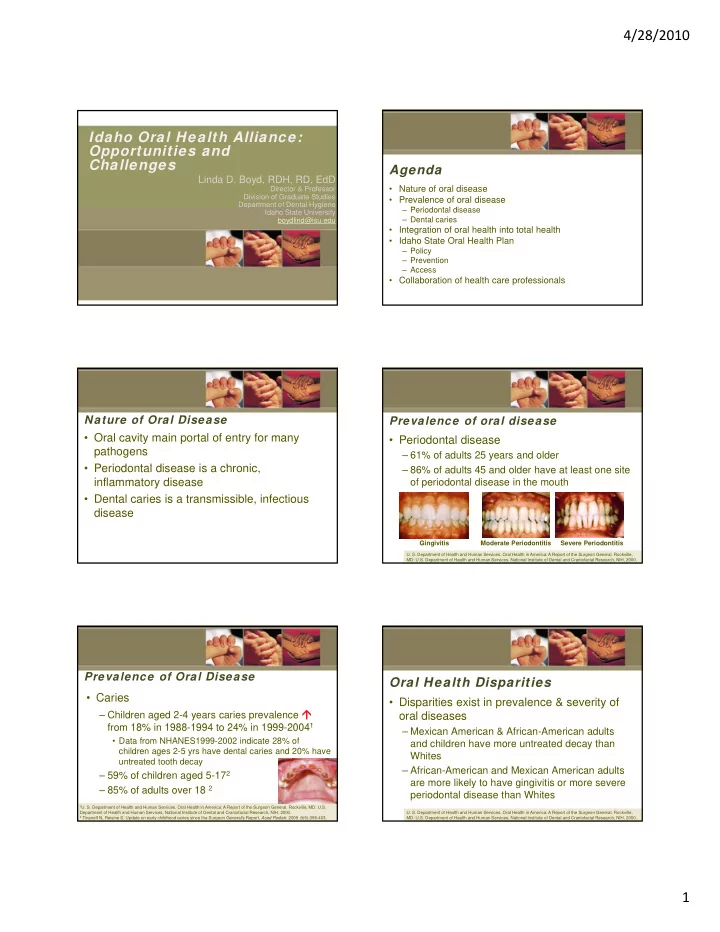
4/28/2010 Idaho Oral Health Alliance: Opportunities and Challenges - - PDF document

4 28 2010
SMART_READER_LITE
LIVE PREVIEW

4/28/2010 Idaho Oral Health Alliance: Opportunities and Challenges - - PDF document

4/28/2010 Idaho Oral Health Alliance: Opportunities and Challenges Agenda Linda D. Boyd, RDH, RD, EdD Director & Professor Nature of oral disease Division of Graduate Studies Prevalence of oral disease Department of Dental


slide-1
SLIDE 1

4/28/2010 1

Idaho Oral Health Alliance: Opportunities and Challenges

Linda D. Boyd, RDH, RD, EdD

Director & Professor Division of Graduate Studies Department of Dental Hygiene p yg Idaho State University boydlind@isu.edu

Agenda

  • Nature of oral disease
  • Prevalence of oral disease

P i d t l di – Periodontal disease – Dental caries

  • Integration of oral health into total health
  • Idaho State Oral Health Plan

– Policy – Prevention – Access

  • Collaboration of health care professionals

Nature of Oral Disease

  • Oral cavity main portal of entry for many

pathogens P i d t l di i h i

  • Periodontal disease is a chronic,

inflammatory disease

  • Dental caries is a transmissible, infectious

disease Prevalence of oral disease

  • Periodontal disease

– 61% of adults 25 years and older – 86% of adults 45 and older have at least one site

  • f periodontal disease in the mouth
  • U. S. Department of Health and Human Services. Oral Health in America: A Report of the Surgeon General. Rockville,

MD: U.S. Department of Health and Human Services, National Institute of Dental and Craniofacial Research, NIH, 2000.

Gingivitis Moderate Periodontitis Severe Periodontitis

Prevalence of Oral Disease

  • Caries

– Children aged 2-4 years caries prevalence  f 18% i 1988 1994 t 24% i 1999 20041 from 18% in 1988-1994 to 24% in 1999-20041

  • Data from NHANES1999-2002 indicate 28% of

children ages 2-5 yrs have dental caries and 20% have untreated tooth decay

– 59% of children aged 5-172 – 85% of adults over 18 2

  • 1U. S. Department of Health and Human Services. Oral Health in America: A Report of the Surgeon General. Rockville, MD: U.S.

Department of Health and Human Services, National Institute of Dental and Craniofacial Research, NIH, 2000.

2 Tinanoff N, Reisine S. Update on early childhood caries since the Surgeon General's Report. Acad Pediatr. 2009 ;9(6):396-403.

Oral Health Disparities

  • Disparities exist in prevalence & severity of
  • ral diseases

– Mexican American & African-American adults and children have more untreated decay than Whites – African-American and Mexican American adults are more likely to have gingivitis or more severe periodontal disease than Whites

  • U. S. Department of Health and Human Services. Oral Health in America: A Report of the Surgeon General. Rockville,

MD: U.S. Department of Health and Human Services, National Institute of Dental and Craniofacial Research, NIH, 2000.

slide-2
SLIDE 2

4/28/2010 2

Prevalence of Oral Disease in Idaho

  • Idaho Smile Survey, 2009

– 67.1 of 3rd graders had caries experience 1 in 5 had untreated tooth decay – 1 in 5 had untreated tooth decay

  • Rate of third-grade students needing urgent restorative

dental services due to pain, infection, inflammation or bleeding declined from 5.4% (2001) to 2.8%

  • Lower incomes associated w/higher rates of active

tooth decay, caries experience and urgent care needs

– Hispanic students had higher rates of active tooth decay, caries experience & urgent needs compared to non-Hispanic Whites

Idaho Dept of Health & Welfare. Idaho Smile Survey,, 2009,

Integration of Oral Health into Total Health

  • The mouth and oral cavity are an integral and

interrelated part of the human body interrelated part of the human body

– Research has shown associations between chronic periodontal disease and several systemic conditions including, but not limited to:

  • Diabetes
  • Low birth weight outcomes
  • Cardiovascular disease

Seymour GJ, Ford PJ, Cullinan MP, Leishman S, Yamazaki K. Relationship between periodontal infections and systemic disease. Clin Microbiol Infect. 2007 Oct;13 Suppl 4:3-10.

For Want For Want of

  • f a

a Dentist… Dentist…

  • In February 2007, 12 yr old Deamonte Driver

died of a toothache in Prince George’s County, Maryland

– A routine $80 tooth extraction might have saved him – If his mother had been insured – If his family had not lost its Medicaid – If Medicaid dentists weren't so hard to find

http://www.washingtonpost.com/wp-dyn/content/article/2007/02/27/AR2007022702116.html

Integration of Oral Health into Total Health

  • Impact of dental caries

– Estimated 51 million school hrs/year lost because of Estimated 51 million school hrs/year lost because of dental-related illness – Early tooth loss caused by dental decay results in failure to thrive, impaired speech development, absence from and inability to concentrate in school &  self-esteem – Poor oral health related to decreased school performance, poor social relationships & less success later in life

Oral Health and Learning: When Children's Health Suffers, So Does Their Ability to Learn (2nd ed.) 2003 by National Maternal and Child Oral Health Resource Center, Georgetown University. http://www.mchoralhealth.org/pdfs/learningfactsheet.pdf

Idaho State Oral Health Plan 2010-2015

  • Plan consists of three interconnected goals-

Prevention, Access to Care, and Policy

GOAL 1 PREVENTION E h i – GOAL 1. PREVENTION: Emphasizes strategies to provide oral health education messages, preventive care provided by oral health professionals, and community public health programs such as community water fluoridation and school-based fluoride and sealant programs.

Idaho State Oral Health Plan 2010-2015

  • GOAL 1. PREVENTION

–Priority 1. Populations-Based Preventive Measures Measures –Priority 2. Oral Health Education of the Public –Priority 3. Prevention of Periodontal Diseases –Priority 4. Chronic Disease and Risk Behavior –Priority 5. Training, Collaboration and Education

  • f non-Dental Health Professionals
slide-3
SLIDE 3

4/28/2010 3

Idaho State Oral Health Plan 2010-2015

– GOAL 2. ACCESS TO CARE: Identifies the most common barriers to oral health care in Idaho and recommends solutions that will help to Idaho and recommends solutions that will help to ensure effective care for pregnant women, children, adults, and seniors, as well as people who are at high risk for poor oral health.

Idaho State Oral Health Plan 2010-2015

  • GOAL 2. ACCESS TO CARE

–Priority 1. Pregnant Women Priority 2 Children and Adolescents –Priority 2. Children and Adolescents –Priority 3. Adults & Older Adults –Priority 4. Medicaid

Idaho State Oral Health Plan 2010-2015

  • GOAL 2. ACCESS TO CARE

–Priority 5. Headstart Priority 6 Oral Health Workforce –Priority 6. Oral Health Workforce –Priority 7. Federally Qualified Health Clinics –Priority 8. Hospital Emergency Medical Care

Idaho State Oral Health Plan 2010-2015

– GOAL 3. POLICY: Recognizes the importance

  • f creating policies to ensure access to care and

prevention, seeking funding and supporting oral prevention, seeking funding and supporting oral health programs.

Idaho State Oral Health Plan 2010-2015

  • GOAL 3. POLICY

– Priority 1. Public Health Leadership – Priority 2. Data & Surveillance – Priority 3. The Idaho Oral Health Plan 2010-2015 – Priority 4. Public-Private Partnerships – Priority 5. Funding Idaho Oral Health Programs

Idaho State Oral Health Plan 2010-2015

  • GOAL 3. POLICY (CONT)

– Priority 6. Oral Health Workforce – Priority 7. Evidence-Based Approaches to Care – Priority 8. Health Information Technology (HIT) – Priority 9. Publicly Funded Dental Insurance

slide-4
SLIDE 4

4/28/2010 4

Collaboration of Health Care Professionals

  • FQHCs serve patients with highest levels of
  • ral disease & least able to access care
  • ral disease & least able to access care.

– HRSA data show FQHCs treat 14 mil medical users & capacity for only 2.1 mil dental users – Unmet need combined with chronic nature of oral disease and desired focus on prevention and control of risk factors makes oral health an area for developing collaborative interventions

Collaboration of Health Care Professionals

  • Idaho Oral Health Alliance (IOHA)

– Non-profit organization of dental professionals – Non-profit organization of dental professionals, public health agencies, businesses, community health providers and individuals, dedicated to better oral and overall health for all Idahoans

  • http://www.idahooralhealth.org/
  • Covering Idaho Kids http://idahokidscount.org/index.php
  • Diabetes Alliance of Idaho

Conclusion

  • Next Steps—

Strategies for Encouraging Collaboration – Strategies for Encouraging Collaboration – Strategies for Addressing Oral Health Issues