4/18/19 Thomas and Cherney (2018) Diabetologia DOI - - PDF document

4 18 19
SMART_READER_LITE
LIVE PREVIEW

4/18/19 Thomas and Cherney (2018) Diabetologia DOI - - PDF document

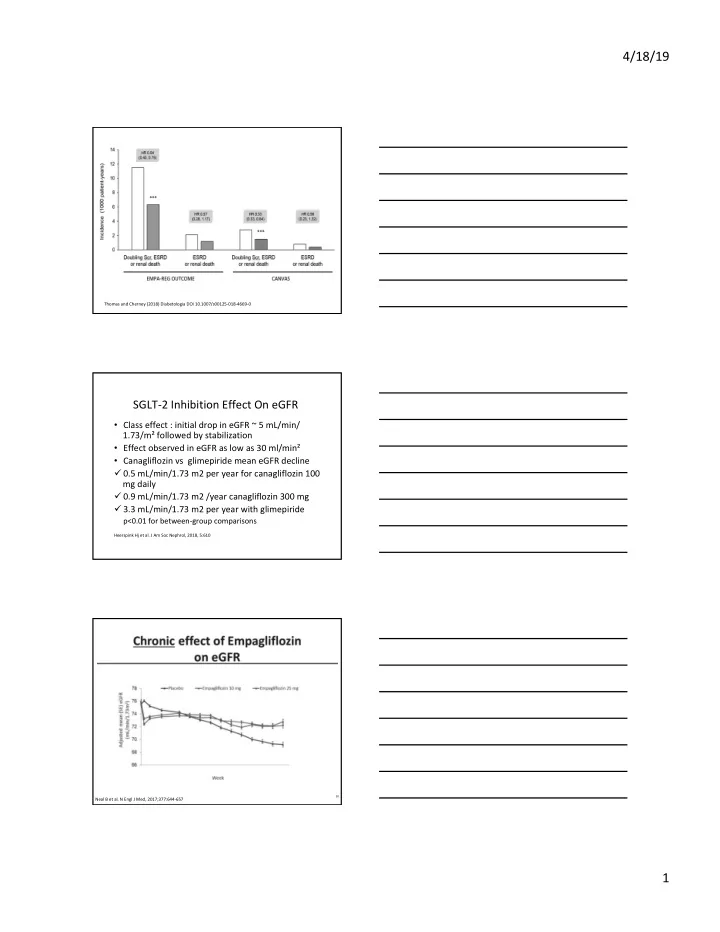
4/18/19 Thomas and Cherney (2018) Diabetologia DOI 10.1007/s00125-018-4669-0 SGLT-2 Inhibition Effect On eGFR Class effect : initial drop in eGFR ~ 5 mL/min/ 1.73/m followed by stabilization Effect observed in eGFR as low as 30 ml/min


slide-1
SLIDE 1

4/18/19 1

Thomas and Cherney (2018) Diabetologia DOI 10.1007/s00125-018-4669-0

SGLT-2 Inhibition Effect On eGFR

  • Class effect : initial drop in eGFR ~ 5 mL/min/

1.73/m² followed by stabilization

  • Effect observed in eGFR as low as 30 ml/min²
  • Canagliflozin vs glimepiride mean eGFR decline

ü 0.5 mL/min/1.73 m2 per year for canagliflozin 100 mg daily ü 0.9 mL/min/1.73 m2 /year canagliflozin 300 mg ü 3.3 mL/min/1.73 m2 per year with glimepiride

p<0.01 for between-group comparisons

Heerspink Hj et al. J Am Soc Nephrol, 2018, 5:610

30

Neal B et al. N Engl J Med, 2017;377:644-657

slide-2
SLIDE 2

4/18/19 2

Effects of Canagliflozin on eGFR in DM 2 and DKD stage 3 ( mean eGFR 40 ml/min; UACR > 30 mg/g)

Concurrent decrease in body weight (~ 1 kg) and systolic blood pressure (~ 6 mm Hg) at 100 and 300 mg dose

Yale JF et al. Diabetes and Metabolism 2013; 15: 463-473463

SGLT-2 Inhibition Effect on Albuminuria

  • 38% reduction in EMPA-REG
  • CANVAS showed 27% reduction in

progression to severe albuminuria and 1.7- fold higher regression

  • 36% dapa decreased 24-hour urine

secretion

  • Effect preserved in eGFR ≥30 to <50 ml/

min/1.732 ( cana vs. glimepiride)

Heerspink HJ et al. J Am Soc Nehprol 2017; 28:368 Neal B et al. N Engl J Med 2017;377:644-657 Wanner C et al. N Engl J Med. 2016;375:323

Putative mechanism (Indirect Mechanism)

  • 1. Blood glucose-lowering effect
  • 2. Blood pressure reduction is class effect ,

decrease in systolic and diastolic blood pressure by ~2 and ~ 5 mmHg amplified in CKD patients :

  • 3.2 mmHg in eGFR > 90; -4 mmHg in 60-89; -6.6

mmHg in eGFR < 30 ml/min/1.73m²

  • 2-3 kg weight loss within 6 months of initiation
  • f treatment, preserved after 2 years of

treatment with dapagliflozin, preserved in eGFR as low as 30 ml/min/1.73m²

33

Cherney DZ et al. Kidney Int 2018; 93:231 Thomas MC et al. Diabetologia 2018; 61:2098-2107

slide-3
SLIDE 3

4/18/19 3

Neal B et al. N Engl J Med 2017;377:644-657 l B et al. N Engl J Med 2017;377:644-657.

Effects of Canagliflozin on Glycated Hemoglobin Level, Body Weight, and Systolic and Diastolic Blood Pressure in the Integrated CANVAS Program.

  • A. Diabetic nephron

high PGC afferent vasodilation reduced feedback from macula densa increased NaCl and glucose reabsorption via SGLT-2 decreased distal delivery

  • f NaCl

increased NaCl and glucose filtration

  • B. Diabetic nephron with SGLT inhibition

Sodium-glucose co-transporter-2 (SG LT-2) Sodium-glucose co-transporter-1 (SG LT-1) Sodium (Na) Chloride (Cl) Glucose PGC = pressure in glomerular capillary normalized distal delivery

  • f NaCl

decreased NaCl and glucose reabsorption via SGLT-2 inhibition increased feedback from macula densa Tubular lumen Tubular epithelial cell Afferent arteriole [Na+] [K+] [Cl-] Na+/K+- ATPase 3 Na+ ATP ADP + Pi 2 K+ H2O Basolateral ATP release [Ca2+] Vaso- constriction ATP cleavage to adenosine Tubular lumen Tubular epithelial cell Afferent arteriole [Na+] [K+] [Cl-] Na+/K+- ATPase 3 Na+ ATP ADP + Pi 2 K+ H2O Basolateral ATP release Adenosine activation

  • f (A1) receptor

[Ca2+] Vaso- dilation ATP cleavage to adenosine normalized PGC reversed afferent vasodilation Adenosine activation

  • f (A1) receptor

Adapted from Alicic et al., Diabetes 2019; 68: 248-257

Putative mechanisms (Direct effects)

  • Hemodynamic effect– normalization of

hyperperfusion , hyperfiltration and glomerular hypertension

  • Metabolic effect:
  • anti-inflammatory
  • antifibrotic effect
  • effect on tubular hypoxia

Thomas MC et al. Diabetologia 2018; 61:2098-2107 Alicic RZ et al. Diabetes 2019;68:248–257 |

slide-4
SLIDE 4

4/18/19 4

Scheen AJ. Circ Res 2018; 122:1439

SGLT-2 and NHE3 crosstalk and effects of SGLT2 inhibition

  • Decreased

inflammation and oxidative stress

  • Reduction of

necrosis and fibrosis

  • Improved

endothelial function and vascular compliance

Verma S. et al. Diabetologia, 2018; 61:2108-2125

Role and regulation of intestinal SGLT1 for glucose uptake and potential therapeutic applications of SGLT1 inhibitors ( Gut)

39

Rieg and Vallon (2018) Diabetologia DOI 10.1007/s00125-018-4654-7

slide-5
SLIDE 5

4/18/19 5 SGLT1 inhibition

  • Predominantly reduces glucose absorption in the

proximal intestine, which significantly blunts and delays postprandial hyperglycemia

  • Small effect of glucose reabsorption in the kidney
  • SGLT1 role in etiology of cardiomyopathy unclear

40

Powell DR, et al. Am J Physiol Endocrinol Metab 2013; 304:E117–E130 Song P et al. Expert Opin Ther Targets 2016; 20:1109-1125

SGLT inhibitors adjunct therapy in DM 1

  • Placebo-controlled phase II trials with empagliflozin

(EASE-1), canagliflozin, dapagliflozin and sotagliflozin conducted in 2014 and 2015

  • Phase III trials ( DEPICT-1 and 2, TANDEM1,2,3, EASE-2)
  • Demonstrated average effect :

ü 0.4-0.5 % reduction in HbA1c ( 5-6 mmol/mol) ü 10-15% Reduction in daily insulin dose; reduction in glucose excursions ü 3-4 kg weight loss ü No increase in rates of hypoglycemia

41

McCrimmon RJ et al. Diabetologia,2018;61:2126-2133

Effects of Sotagliflozin Added to Insulin in Patients with Type 1 Diabetes (TANDEM3)

42

Garg SK et al. N Engl J med 2017;377:2337-2348

  • The reduction in body weight greater

in the sotagliflozin group than in the placebo group (difference, −2.98 kg; P<0.001)

  • Reductions from baseline in the

mean daily total, bolus, and basal doses of insulin were −5.3 units per day (−9.7%), −2.8 units per day (−12.3%), and −2.6 units per day (−9.9%) ( P <0.001 )

  • The reduction in systolic blood

pressure was significantly greater in the sotagliflozin group than in the placebo group (difference, −3.5 mm Hg; P=0.002)

slide-6
SLIDE 6

4/18/19 6 Side Effects of SGLT2 inhibitors

  • Genital mycotic infections
  • FDA warning: DKA ( in DM1 and DM2 patinets)
  • 2013 – 2015 reported 73 cases
  • FDA warning: Fournier’s gangrene
  • 2013 – 2018 reported 12 cases
  • Initial concern for AKI and hyperkalemia not
  • bserved in large trials
  • Low risk of hypoglycemia
  • Lower extremity amputations (cana)

Garg S and Strumph P. N Engl J Med 2018;378:966-968.

Comparison of Rates of Diabetic Ketoacidosis in DEPICT-1 and in Tandem3 Trials after Standardization of the Criteria Used

Fralick M et al. N Engl J Med 2017;376:2300-2302.

Risk of Diabetic Ketoacidosis after Initiation of an SGLT2 Inhibitor

slide-7
SLIDE 7

4/18/19 7

TANDEM3 trial

  • The number need to treat to show benefit is 7
  • The numbers of patients who would need to be

treated with sotagliflozin to show harm from at least: ü one episode of severe hypoglycemia 167 ü diabetic ketoacidosis 40 ü volume depletion 64 ü genital mycotic infection 23

Gogtay NT et al. N Eng J Med 2018;378:966 McCrimmon RJ et al. Diabetologia,2018;61:2126-2133

Lower extremities amputations

  • Observed in the CANVAS program (6 vs

3 participants per 1,000 years ; HR 1.97)

  • The highest risk among patients with

PVD and h/o amputations majority at the toe/metatarsal level

  • Canagliflozin labeling changed in 2017
  • Not reported with empa-or dapagliflozin
slide-8
SLIDE 8

4/18/19 8

SGLT2 inhibition effect on HbA1C and fasting glucose is blunted in DKD

  • In diabetic patients with preserved kidney

function, SGLT2 inhibition reduces hemoglobin A1c by approximately 1%

  • If eGFR 60-90 ml/min/1.73m² HbA1C reduced
  • 0.7% and -0.4% in eGFR 30-60 ml/min/1.73m²

with empagliflozin

  • If eGFR 45-60 ml/min/1.73m² HbA1C reduced by

0.3-0.4% with dapagliflozin

49

Barnett, A.H., et al.The Lancet Diabetes & Endocrinology, 2014; 2:369-384. Kohan DE et al. Kidney int,2014;2:962-971

  • Agent

Recommendations Renal Dosing Recommendations Canagliflozin

  • The recommended starting

dose is 100 mg once daily, taken before the first meal of the day

  • The dose can be increased

to 300 mg once daily in those who require additional glycemic control

  • Assess

kidney function before initiating and periodically thereafter

  • Limit the dose to 100 mg once daily in

patients who have an eGFR of 45 to less than 60 mL/min/1.73 m

2

  • Initiation is not recommended in

patients with an eGFR less than 45 mL/min/1.73 m 2

  • Use is not recommended when eGFR

is persistently less than 45 mL/min/1.73 m 2

  • Use is contraindicated in patients with

an eGFR less than 30 mL/min/1.73 m

2

Dapagliflozin

  • The recommended starting

dose is 5 mg once daily, taken in the morning, with or without food

  • The dose can be increased

to 10 mg once daily in those tolerating the medication who require additional glycemic control

  • Assess

kidney function before initiating and periodically thereafter

  • Initiation is not recommended in

patients with an eGFR less than 60 mL/min/1.73 m 2

  • Use is not recommended in patients

with an eGFR persistently between 30 and less than 60 mL/min/1.73 m

2

  • Use is contraindicated with an eGFR

less than 30 mL/min/1.73 m

2

Empagliflozin

  • The recommended starting

dose is 10 mg once daily, taken in the morning, with or without food.

  • The dose can be increased

to 25 mg once daily.

  • Initiation

is not recommended if eGFR is below 45 mL/min/1.73 m

2

  • Discontinue if eGFR is persistently

below 45 mL/min/1.73 m

2

Ertugliflozin

  • The recommended starting

dose is 5 mg once daily, taken in the morning, with or without food

  • The dose can be increased

to 15 mg once daily in those tolerating the medication who need additional glycemic control

  • Assess

kidney function before initiating and periodically thereafter

  • Initiation is not recommended in

patients with an eGFR of 30 to less than 60 mL/minute/1.73 m

2

  • Continued use is not recommended in

patients with an eGFR persistently between 30 and less than 60 mL/min/1.73 m 2

  • Use is contraindicated with eGFR less

than 30 mL/minute/1.73 m

2

Abbreviations: eGFR: estimated glomerular filtration rate. 51
slide-9
SLIDE 9

4/18/19 9

Dapa-CKD

  • Type 2 diabetes, eGFR ≥25 and ≤75 mL/min/

1.73m2, 200 ≥UACR ≤5000 mg/g

  • Primary outcome: Time to the first occurrence of

any of the components of the primary composite endpoint (ESKD, ≥50% sustained decline in eGFR, kidney or CV death)

  • Trial in progress; estimated completion in

November of 2020

“ Few can forsee whither their road will lead them, till they come to its end”

J.R.R. Tolkien