28. Parallel Programming II 28.1 Shared Memory, Concurrency Shared - - PowerPoint PPT Presentation

28 parallel programming ii
SMART_READER_LITE
LIVE PREVIEW

28. Parallel Programming II 28.1 Shared Memory, Concurrency Shared - - PowerPoint PPT Presentation

28. Parallel Programming II 28.1 Shared Memory, Concurrency Shared Memory, Concurrency, Excursion: lock algorithm (Peterson), Mutual Exclusion Race Conditions [C++ Threads: Williams, Kap. 2.1-2.2], [C++ Race Conditions: Williams, Kap. 3.1] [C++


slide-1
SLIDE 1
  • 28. Parallel Programming II

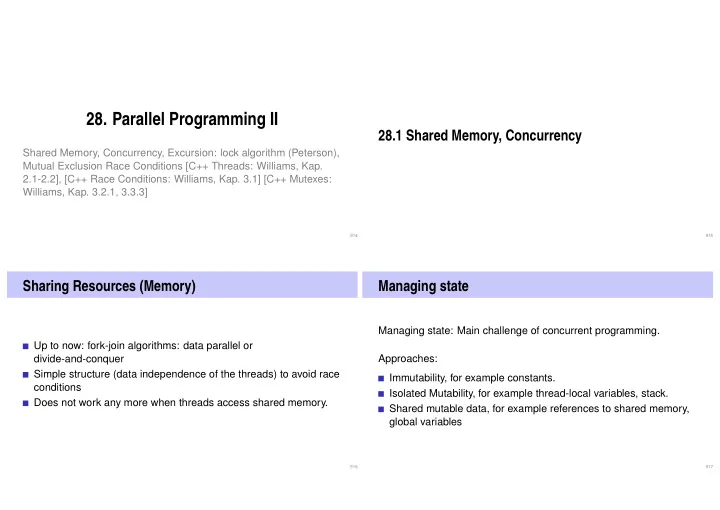
Shared Memory, Concurrency, Excursion: lock algorithm (Peterson), Mutual Exclusion Race Conditions [C++ Threads: Williams, Kap. 2.1-2.2], [C++ Race Conditions: Williams, Kap. 3.1] [C++ Mutexes: Williams, Kap. 3.2.1, 3.3.3]

914

28.1 Shared Memory, Concurrency

915

Sharing Resources (Memory)

Up to now: fork-join algorithms: data parallel or divide-and-conquer Simple structure (data independence of the threads) to avoid race conditions Does not work any more when threads access shared memory.

916

Managing state

Managing state: Main challenge of concurrent programming. Approaches: Immutability, for example constants. Isolated Mutability, for example thread-local variables, stack. Shared mutable data, for example references to shared memory, global variables

917

slide-2
SLIDE 2

Protect the shared state

Method 1: locks, guarantee exclusive access to shared data. Method 2: lock-free data structures, exclusive access with a much finer granularity. Method 3: transactional memory (not treated in class)

918

Canonical Example

class BankAccount { int balance = 0; public: int getBalance(){ return balance; } void setBalance(int x) { balance = x; } void withdraw(int amount) { int b = getBalance(); setBalance(b − amount); } // deposit etc. };

(correct in a single-threaded world)

919

Bad Interleaving

Parallel call to widthdraw(100) on the same account Thread 1

int b = getBalance(); setBalance(b−amount);

Thread 2

int b = getBalance(); setBalance(b−amount);

t

920

Tempting Traps

WRONG:

void withdraw(int amount) { int b = getBalance(); if (b==getBalance()) setBalance(b − amount); }

Bad interleavings cannot be solved with a repeated reading

921

slide-3
SLIDE 3

Tempting Traps

also WRONG:

void withdraw(int amount) { setBalance(getBalance() − amount); }

Assumptions about atomicity of operations are almost always wrong

922

Mutual Exclusion

We need a concept for mutual exclusion Only one thread may execute the operation withdraw on the same account at a time. The programmer has to make sure that mutual exclusion is used.

923

More Tempting Traps

class BankAccount { int balance = 0; bool busy = false; public: void withdraw(int amount) { while (busy); // spin wait busy = true; int b = getBalance(); setBalance(b − amount); busy = false; } // deposit would spin on the same boolean };

d

  • e

s n

  • t

w

  • r

k !

924

Just moved the problem!

Thread 1

while (busy); //spin busy = true; int b = getBalance(); setBalance(b − amount);

Thread 2

while (busy); //spin busy = true; int b = getBalance(); setBalance(b − amount);

t

925

slide-4
SLIDE 4

How ist this correctly implemented?

We use locks (mutexes) from libraries They use hardware primitives, Read-Modify-Write (RMW)

  • perations that can, in an atomic way, read and write depending
  • n the read result.

Without RMW Operations the algorithm is non-trivial and requires at least atomic access to variable of primitive type.

926

28.2 Excursion: lock algorithm

927

Alice’s Cat vs. Bob’s Dog

928

Required: Mutual Exclusion

929

slide-5
SLIDE 5

Required: No Lockout When Free

930

Communication Types

Transient: Parties participate at the same time Persistent: Parties participate at different times Mutual exclusion: persistent communication

931

Communication Idea 1

932

Access Protocol

933

slide-6
SLIDE 6

Problem!

934

Communication Idea 2

935

Access Protocol 2.1

936

Different Scenario

937

slide-7
SLIDE 7

Problem: No Mutual Exclusion

938

Checking Flags Twice: Deadlock

939

Access Protocol 2.2

940

Access Protocol 2.2:provably correct

941

slide-8
SLIDE 8

Weniger schwerwiegend: Starvation

942

Final Solution

943

General Problem of Locking remains

944

Peterson’s Algorithm54

for two processes is provable correct and free from starvation

non−critical section flag[me] = true // I am interested victim = me // but you go first // spin while we are both interested and you go first: while (flag[you] && victim == me) {}; critical section flag[me] = false

The code assumes that the access to flag / victim is atomic and particularly lineariz- able or sequential consistent. An assump- tion that – as we will see below – is not nec- essarily given for normal variables. The Peterson-lock is not used on modern hard- ware.

54not relevant for the exam 945

slide-9
SLIDE 9

28.3 Mutual Exclusion

946

Critical Sections and Mutual Exclusion

Critical Section Piece of code that may be executed by at most one process (thread) at a time. Mutual Exclusion Algorithm to implement a critical section

acquire_mutex(); // entry algorithm\\ ... // critical section release_mutex(); // exit algorithm

947

Required Properties of Mutual Exclusion

Correctness (Safety) At most one process executes the critical section code Liveness Acquiring the mutex must terminate in finite time when no process executes in the critical section

948

Almost Correct

class BankAccount { int balance = 0; std::mutex m; // requires #include <mutex> public: ... void withdraw(int amount) { m.lock(); int b = getBalance(); setBalance(b − amount); m.unlock(); } };

What if an exception occurs?

949

slide-10
SLIDE 10

RAII Approach

class BankAccount { int balance = 0; std::mutex m; public: ... void withdraw(int amount) { std::lock_guard<std::mutex> guard(m); int b = getBalance(); setBalance(b − amount); } // Destruction of guard leads to unlocking m };

What about getBalance / setBalance?

950

Reentrant Locks

Reentrant Lock (recursive lock) remembers the currently affected thread; provides a counter

Call of lock: counter incremented Call of unlock: counter is decremented. If counter = 0 the lock is released.

951

Account with reentrant lock

class BankAccount { int balance = 0; std::recursive_mutex m; using guard = std::lock_guard<std::recursive_mutex>; public: int getBalance(){ guard g(m); return balance; } void setBalance(int x) { guard g(m); balance = x; } void withdraw(int amount) { guard g(m); int b = getBalance(); setBalance(b − amount); } };

952

28.4 Race Conditions

953

slide-11
SLIDE 11

Race Condition

A race condition occurs when the result of a computation depends

  • n scheduling.

We make a distinction between bad interleavings and data races Bad interleavings can occur even when a mutex is used.

954

Example: Stack

Stack with correctly synchronized access:

template <typename T> class stack{ ... std::recursive_mutex m; using guard = std::lock_guard<std::recursive_mutex>; public: bool isEmpty(){ guard g(m); ... } void push(T value){ guard g(m); ... } T pop(){ guard g(m); ...} };

955

Peek

Forgot to implement peek. Like this?

template <typename T> T peek (stack<T> &s){ T value = s.pop(); s.push(value); return value; }

n

  • t

t h r e a d

  • s

a f e !

Despite its questionable style the code is correct in a sequential

  • world. Not so in concurrent programming.

956

Bad Interleaving!

Initially empty stack s, only shared between threads 1 and 2. Thread 1 pushes a value and checks that the stack is then non-empty. Thread 2 reads the topmost value using peek(). Thread 1

s.push(5); assert(!s.isEmpty());

Thread 2

int value = s.pop(); s.push(value); return value;

t

957

slide-12
SLIDE 12

The fix

Peek must be protected with the same lock as the other access methods

958

Bad Interleavings

Race conditions as bad interleavings can happen on a high level of abstraction In the following we consider a different form of race condition: data race.

959

How about this?

class counter{ int count = 0; std::recursive_mutex m; using guard = std::lock_guard<std::recursive_mutex>; public: int increase(){ guard g(m); return ++count; } int get(){ return count; } }

not thread-safe!

960

Why wrong?

It looks like nothing can go wrong because the update of count happens in a “tiny step”. But this code is still wrong and depends on language-implementation details you cannot assume. This problem is called Data-Race Moral: Do not introduce a data race, even if every interleaving you can think of is correct. Don’t make assumptions on the memory

  • rder.

961

slide-13
SLIDE 13

A bit more formal

Data Race (low-level Race-Conditions) Erroneous program behavior caused by insufficiently synchronized accesses of a shared resource by multiple threads, e.g. Simultaneous read/write or write/write of the same memory location Bad Interleaving (High Level Race Condition) Erroneous program behavior caused by an unfavorable execution order of a multithreaded algorithm, even if that makes use of otherwise well synchronized resources.

962

We look deeper

class C { int x = 0; int y = 0; public: void f() { x = 1; y = 1; } void g() { int a = y; int b = x; assert(b >= a); } }

A B C D Can this fail? There is no interleaving of f and g that would cause the assertion to fail: A B C D A C B D A C D B C A B D C C D B C D A B It can nevertheless fail!

963

One Resason: Memory Reordering

Rule of thumb: Compiler and hardware allowed to make changes that do not affect the semantics of a sequentially executed program

void f() { x = 1; y = x+1; z = x+1; }

⇐ ⇒

sequentially equivalent

void f() { x = 1; z = x+1; y = x+1; }

964

From a Software-Perspective

Modern compilers do not give guarantees that a global ordering of memory accesses is provided as in the sourcecode: Some memory accesses may be even optimized away completely! Huge potential for optimizations – and for errors, when you make the wrong assumptions

965

slide-14
SLIDE 14

Example: Self-made Rendevouz

int x; // shared void wait(){ x = 1; while(x == 1); } void arrive(){ x = 2; }

Assume thread 1 calls wait, later thread 2 calls arrive. What happens? thread 1 thread 2 wait arrive

966

Compilation

Source

int x; // shared void wait(){ x = 1; while(x == 1); } void arrive(){ x = 2; }

Without optimisation

wait: movl $0x1, x test: mov x, %eax cmp $0x1, %eax je test arrive: movl $0x2, x

With optimisation

wait: movl $0x1, x test: jmp test arrive movl $0x2, x

if equal always

967

Hardware Perspective

Modern multiprocessors do not enforce global ordering of all instructions for performance reasons: Most processors have a pipelined architecture and can execute (parts of) multiple instructions simultaneously. They can even reorder instructions internally. Each processor has a local cache, and thus loads/stores to shared memory can become visible to other processors at different times

968

Memory Hierarchy

Registers L1 Cache L2 Cache ... System Memory

slow,high latency,low cost,high capacity fast,low latency, high cost, low capacity

969

slide-15
SLIDE 15

An Analogy

970

Schematic

971

Memory Models

When and if effects of memory operations become visible for threads, depends on hardware, runtime system and programming language. A memory model (e.g. that of C++) provides minimal guarantees for the effect of memory operations leaving open possibilities for optimisation containing guidelines for writing thread-safe programs For instance, C++ provides guarantees when synchronisation with a mutex is used.

972

Fixed

class C { int x = 0; int y = 0; std::mutex m; public: void f() { m.lock(); x = 1; m.unlock(); m.lock(); y = 1; m.unlock(); } void g() { m.lock(); int a = y; m.unlock(); m.lock(); int b = x; m.unlock(); assert(b >= a); // cannot fail } };

973

slide-16
SLIDE 16

Atomic

Here also possible:

class C { std::atomic_int x{0}; // requires #include <atomic> std::atomic_int y{0}; public: void f() { x = 1; y = 1; } void g() { int a = y; int b = x; assert(b >= a); // cannot fail } };

974