
27/2/2012 1
1
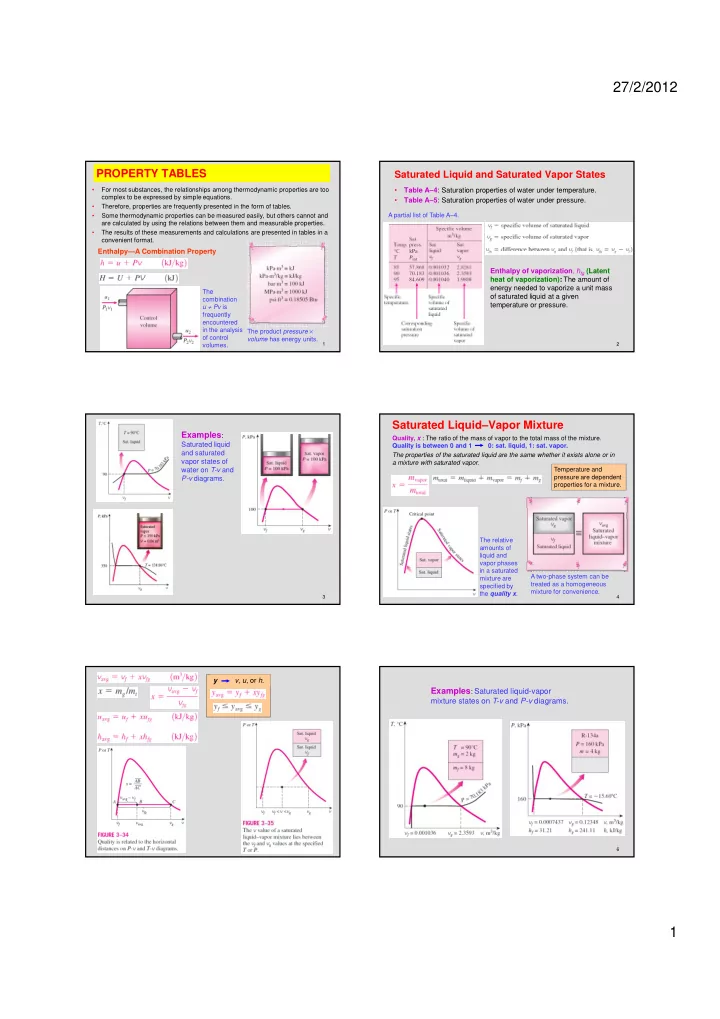
PROPERTY TABLES
- For most substances, the relationships among thermodynamic properties are too
complex to be expressed by simple equations.
- Therefore, properties are frequently presented in the form of tables.
- Some thermodynamic properties can be measured easily, but others cannot and
are calculated by using the relations between them and measurable properties.
- The results of these measurements and calculations are presented in tables in a
convenient format.
Enthalpy—A Combination Property
The combination u + Pv is frequently encountered in the analysis
- f control
volumes. The product pressure × volume has energy units.
2
Saturated Liquid and Saturated Vapor States
- Table A–4: Saturation properties of water under temperature.
- Table A–5: Saturation properties of water under pressure.
A partial list of Table A–4.
Enthalpy of vaporization, hfg (Latent heat of vaporization): The amount of energy needed to vaporize a unit mass
- f saturated liquid at a given
temperature or pressure.
3
Examples:
Saturated liquid and saturated vapor states of water on T-v and P-v diagrams.
4
Saturated Liquid–Vapor Mixture
Quality, x : The ratio of the mass of vapor to the total mass of the mixture. Quality is between 0 and 1 0: sat. liquid, 1: sat. vapor. The properties of the saturated liquid are the same whether it exists alone or in a mixture with saturated vapor. The relative amounts of liquid and vapor phases in a saturated mixture are specified by the quality x. A two-phase system can be treated as a homogeneous mixture for convenience. Temperature and pressure are dependent properties for a mixture.
5
y v, u, or h.
6