25/02/2013 OVERVIEW Increasing accessibility to evidence- - - PDF document

25 02 2013
SMART_READER_LITE
LIVE PREVIEW

25/02/2013 OVERVIEW Increasing accessibility to evidence- - - PDF document

25/02/2013 OVERVIEW Increasing accessibility to evidence- Examining the effectiveness of based parenting support Triple P Online Comparing online and workbook delivery of Triple P The role of child, parent, and family Cassandra K.


slide-1
SLIDE 1

25/02/2013 1

Name of presentation Month 2009

Examining the effectiveness of Triple P Online

Cassandra K. Dittman, Matthew R. Sanders Susan P. Farruggia, Louise J. Keown, and Melanie L. Palmer

Name of presentation Month 2009

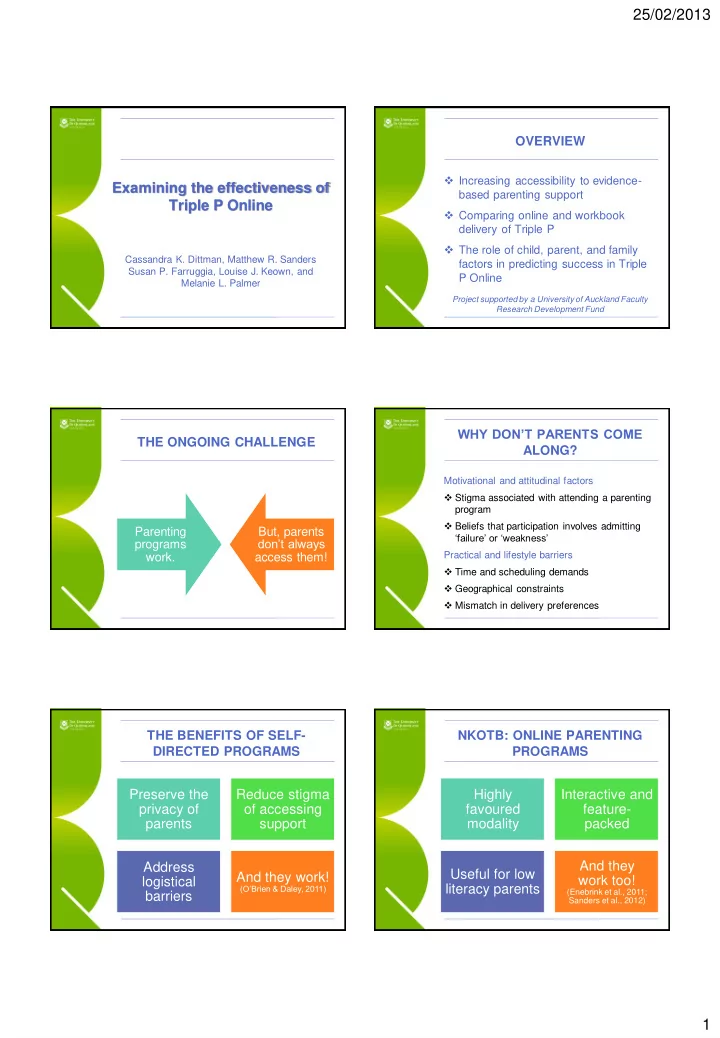
OVERVIEW

 Increasing accessibility to evidence- based parenting support  Comparing online and workbook delivery of Triple P  The role of child, parent, and family factors in predicting success in Triple P Online

Project supported by a University of Auckland Faculty Research Development Fund

Name of presentation Month 2009

THE ONGOING CHALLENGE

Parenting programs work. But, parents don’t always access them!

Name of presentation Month 2009

WHY DON’T PARENTS COME ALONG?

Motivational and attitudinal factors  Stigma associated with attending a parenting program  Beliefs that participation involves admitting ‘failure’ or ‘weakness’ Practical and lifestyle barriers  Time and scheduling demands  Geographical constraints  Mismatch in delivery preferences

Name of presentation Month 2009

THE BENEFITS OF SELF- DIRECTED PROGRAMS

Preserve the privacy of parents Reduce stigma

  • f accessing

support Address logistical barriers And they work!

(O’Brien & Daley, 2011)

Name of presentation Month 2009

NKOTB: ONLINE PARENTING PROGRAMS

Highly favoured modality Interactive and feature- packed Useful for low literacy parents And they work too!

(Enebrink et al., 2011; Sanders et al., 2012)

slide-2
SLIDE 2

25/02/2013 2

Name of presentation Month 2009

THE CURRENT PROJECT

 A head-to-head comparison of the new Triple P Online with the existing Every Parent’s Self- Help Workbook  Noninferiority RCT comparing effects on child behaviour and parenting  Also examined effects of each intervention on a number of child, parenting, and family

  • utcomes at post-intervention and 6-month

follow up

Name of presentation Month 2009

THE NONINFERIORITY RESEARCH DESIGN

 Null hypothesis = TPOL is inferior to the workbook by at least a prespecified and empirically-derived noninferiority margin  Alternative hypothesis = TPOL is inferior to the workbook by less than the noninferiority margin  Noninferiority margin

  • Derived from past RCT on the workbook
  • Cohen’s d = 0.20

Name of presentation Month 2009

PARTICIPANTS

 N = 192 (TPOL = 97, Workbook = 95)  Recruited from around New Zealand  Target child

  • 3 to 8 years (mean = 5.64 years)
  • 67% male, 33% female
  • 87% with clinical level conduct problems

 Families

  • Mothers’ mean age = 37.19 years; fathers’

mean age = 39.63 years

  • 77% two-parent biological; 14% sole-parent;

7% step-family

  • 83% completed high school, 47% university

educated

THE TRIPLE P SYSTEM OF INTERVENTION

Level 1 Level 2 Level 3 Level 4 Level 5

Intensive family intervention Broad focus parenting support Narrow focus parenting support Brief parenting advice Media & communication strategy

Breadth of reach Intensity of intervention

Name of presentation Month 2009

THE INTERVENTION CONDITIONS

 Every Parent’s Self-Directed Workbook

  • 10-module program involving readings, exercises,

and structured practice sessions

 Triple P Online

  • Designed to be highly interactive and engaging
  • User-friendly interface and navigation
  • Audiovisual presentation of information and

strategies

  • Goal-setting and exercises for checking mastery
  • Downloadable tipsheets, monitoring forms,

podcasts

  • Customisable and printable parent workbook
  • Review and reminder strategies

Name of presentation Month 2009

slide-3
SLIDE 3

25/02/2013 3

Name of presentation Month 2009

PRE-POST IMPROVEMENT: ECBI-INTENSITY

5 10 15 20 25 30 35 40 45 Mothers Fathers Workbook Triple P Online

d = -.13 d = -.14

Name of presentation Month 2009

PRE-POST IMPROVEMENT: ECBI-PROBLEM

2 4 6 8 10 12 Mothers Fathers Workbook Triple P Online

d = -.09 d = -.16

Name of presentation Month 2009

PRE-POST IMPROVEMENT: PARENTING SCALE (OVR)

0.2 0.4 0.6 0.8 1 1.2 Mothers Fathers Workbook Triple P Online

d = -.03 d = .05

TPOL: SHORT-TERM EFFECTS FOR MOTHERS I

Pre M (SD) Post M (SD) Effect size d Descriptor ECBI Intensity 155.60 (20.71) 114.17 (23.77) 1.54

Large ECBI Problem 22.40 (5.80) 10.92 (7.50) 1.44 Large Over-reactivity 3.61 (0.77) 2.57 (0.77) 1.29 Large Laxness 2.79 (0.81) 2.16 (0.80) 1.00 Large Verbosity 3.73 (0.79) 2.73 (0.91) 1.06 Large Setting Self Efficacy 79.10 (10.25) 90.46 (7.07)

  • 1.27

Large Behaviour Self Efficacy 67.75 (14.07) 86.20 (11.85)

  • 1.38

Large

TPOL: SHORT-TERM EFFECTS FOR MOTHERS II

Pre M (SD) Post M (SD) Effect size d Descriptor Parental Anger 124.10 (29.70) 111.62 (35.23) 0.46

Small Child Abuse Risk 5.13 (4.03) 3.56 (3.34) 0.49 Small Depression 5.23 (6.03) 3.52 (5.36) 0.27 Small Anxiety 2.86 (4.23) 1.65 (2.78) 0.38 Small Stress 11.91 (6.87) 6.90 (5.67) 0.66 Medium Interparental Conflict 5.24 (3.54) 3.34 (2.50) 0.66 Medium Parent Child Relationship 41.08 (7.00) 52.51 (6.44)

  • 1.49

Large

Name of presentation Month 2009

PRELIMINARY CONCLUSIONS

  • 1. Triple P Online is effective when compared

to a waitlist control (Sanders et al., 2012)

  • 2. Triple P Online is not inferior (equivalent) in

its effectiveness to the Every Family workbook

  • Comparable effectiveness of both

programs = choice for parents and services

  • Highlights the value of the noninferiority

approach

slide-4
SLIDE 4

25/02/2013 4

Name of presentation Month 2009

PRELIMINARY CONCLUSIONS

BUT… Is Triple P Online effective for families:

  • from diverse SES backgrounds?
  • with high levels of child behaviour

problems?

Name of presentation Month 2009

WHAT PREDICTS TPOL CHILD BEHAVIOUR OUTCOMES?

Significant predictors

  • Session

completion (β = - .33)

  • T1 parent-child

relationship quality (β = -.24) No predictive association

  • Family SES

factors

  • Child factors
  • T1 child behaviour

severity

  • T1 level of

parenting difficulty

  • Father

involvement

Name of presentation Month 2009

WHAT PREDICTS TPOL PARENTING OUTCOMES?

Significant predictors

  • Session

completion (β =

  • .41)
  • T1 ineffective

parenting (β = .47) No predictive association

  • Family SES

factors

  • Child factors
  • T1 child

behaviour severity

  • Father

involvement

Name of presentation Month 2009

IMPLICATIONS & CONSIDERATIONS

 Well-established family and child risk factors may not have a large influence on success in

  • nline parenting programs

 Points to the importance of identifying and testing strategies to maximise retention  Possible strategies:

  • Adjunctive professional support (e.g., by

telephone, Skype, or online messaging),

  • Peer support via social networking
  • Moving beyond ‘grandfather machines’