2019 Stewardship Forester & Tree Farm Inspector Training and - - PowerPoint PPT Presentation

2019 stewardship forester amp tree farm inspector
SMART_READER_LITE
LIVE PREVIEW

2019 Stewardship Forester & Tree Farm Inspector Training and - - PowerPoint PPT Presentation

2019 Stewardship Forester & Tree Farm Inspector Training and Information Meeting-- AGENDA 8:00: Coffee and registration 8:15-8:30: Welcome & Introductions 8:30-8:45: WoodsWISE Program Status Update- Andy Shultz, MFS


slide-1
SLIDE 1

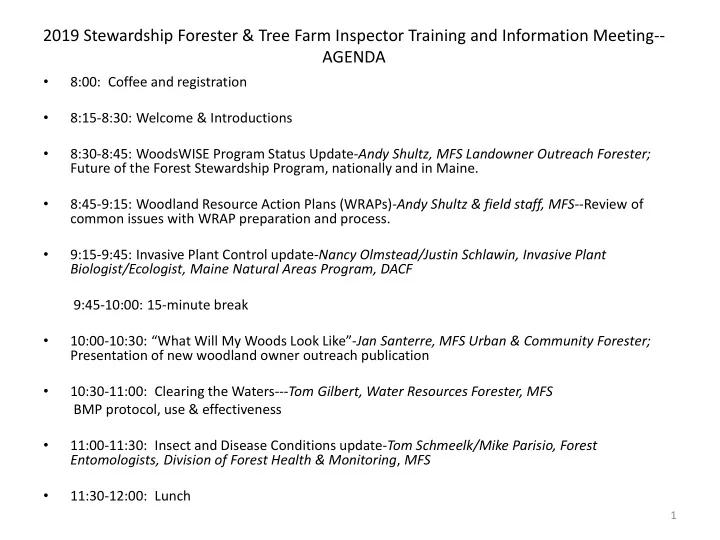
2019 Stewardship Forester & Tree Farm Inspector Training and Information Meeting-- AGENDA

  • 8:00: Coffee and registration
  • 8:15-8:30: Welcome & Introductions
  • 8:30-8:45: WoodsWISE Program Status Update-Andy Shultz, MFS Landowner Outreach Forester;

Future of the Forest Stewardship Program, nationally and in Maine.

  • 8:45-9:15: Woodland Resource Action Plans (WRAPs)-Andy Shultz & field staff, MFS--Review of

common issues with WRAP preparation and process.

  • 9:15-9:45: Invasive Plant Control update-Nancy Olmstead/Justin Schlawin, Invasive Plant

Biologist/Ecologist, Maine Natural Areas Program, DACF 9:45-10:00: 15-minute break

  • 10:00-10:30: “What Will My Woods Look Like”-Jan Santerre, MFS Urban & Community Forester;

Presentation of new woodland owner outreach publication

  • 10:30-11:00: Clearing the Waters---Tom Gilbert, Water Resources Forester, MFS

BMP protocol, use & effectiveness

  • 11:00-11:30: Insect and Disease Conditions update-Tom Schmeelk/Mike Parisio, Forest

Entomologists, Division of Forest Health & Monitoring, MFS

  • 11:30-12:00: Lunch

1

slide-2
SLIDE 2

2019 Stewardship Forester & Tree Farm Inspector Training and Information Meeting—AGENDA, continued

  • 12:00-3:30: Tree Farm Inspector training-Logan

Johnson, et al, Maine Tree Farm Committee

  • Introduction to the American Tree Farm System
  • 2015-20 AFF Standards of Sustainability
  • Management Plan review
  • The ATFS Inspector’s Manual
  • 004 Form & Tools, including fillable .pdf
  • Future of Maine Tree Farm program
  • Wrap-up & Questions
  • 3:30 Adjourn, and safe travels home!

2

slide-3
SLIDE 3

WoodsWISE 2018-program status

  • 2015 allocation down almost 7 %, continuing previous

years trend.(biggest drop in 2009)

  • 2016-esentially same as 2015
  • 2017-slight increase
  • 2018-19: essentially flat

No major changes for 2019—keep on keeping on, but---

FSP program 2020 prospects in jeopardy!

3

slide-4
SLIDE 4

As Always

  • Thanks to everyone who is out there helping

landowners, whether you write a lot of plans

  • r not, with or without cost-sharing.
  • only 25-30% range for landowners who

actually involve a licensed forester in implementing harvesting

  • Stewardship, a path of many steps…

4

slide-5
SLIDE 5

WOODSWISE INCENTIVES PROGRAM WEB PAGE

5

slide-6
SLIDE 6

http://www.maine.gov/dacf/mfs/policy_management/wwi.html

6

slide-7
SLIDE 7

Eligibility requirements

Type of ownership: Participating landowners must be private individuals, persons, companies, or other entities that hold title to land (and timber), including joint owners or tenants in common, groups, associations, corporations, Indian tribes or other native groups, or other private legal entities. Corporations whose stocks are publicly traded, owners principally engaged in the processing of wood products from their ownership, and properties where the ownership of the timber is different from the fee

  • wnership of the land are excluded.

Quasi-municipal entities such as water, sewer and utility districts are not eligible for WoodsWISE assistance. They are encouraged to apply for a Project Canopy Urban & Community Forestry grant. Limited Liability Corporations, 501(c) 3 corporations, family partnerships, and similar entities that otherwise meet program requirements will be considered

  • n a case-by-case basis. Such applicants may be asked to provide further

documentation supporting their application.

7

slide-8
SLIDE 8

Eligibility requirements, continued

Acreage limitations:

  • a. Applicants must own at least 10 contiguous forested acres, but

not more than 1000 forested acres statewide.

  • b. WAIVER: Applicants who own 1001 – 5000 forested acres may

submit a written proposal for cost-sharing, which may be approved at the discretion of the State Forester if there is a demonstrated public benefit to be derived from cost-sharing, and if funds are available. EFFECTIVE AUGUST 11, 2015, THIS PROVISION IS SUSPENDED, DUE TO LACK OF SUFFICENT PROGRAM FUNDING Landowner commitment: Landowners must sign pledge to maintain plans and practices for a minimum of ten years from the time of

  • establishment. Additional cost-sharing for the same plan/practice type

for the same acres will not be approved by MFS until the last year of the 10 year practice period. Landowners who fail to maintain the practice for ten years may be required to repay the Maine Forest Stewardship Program the cost-share amount received, with interest at the statutory rate.

8

slide-9
SLIDE 9

Section II-Planning menu

  • Currently only applications for Woodland

Resource Action Plans and Amendments of existing FMPs will be accepted. No other WoodsWISE forest management planning incentives are available until further notice.

  • The maximum cost-share payment to any single

landowner in a calendar year will be $2500. WoodsWISE Incentives.

  • Forest Management Planning is funded in part by

the USDA Forest Service’s Forest Stewardship Program.

9

slide-10
SLIDE 10

WoodsWISE Incentives

Summary Table of Eligible Practices

WoodsWISE Manual Section II Forest Management Planning Code Component Description Max % Not-to-exceed FMP-1a Development of a New Forest Management Plan (10- 50 wooded acres) na na FMP- 1b Development of a New Forest Management Plan (51+ wooded acres) na na FMP-2 Amendment of an existing Forest Management Plan (includes Silvicultural Operations Plans) 50 $150 FMP-3 Expansion (in area) of an existing Forest Management Plan na na FMP-4a Periodic Update of a Forest Management Plan (10-50 wooded acres) na na FMP- 4b Periodic Update of a Forest Management Plan (51+ wooded acres) na na FMP-5a Woodland Resource Action Plan (10-50 wooded acres) 50 $250 FMP- 5b Woodland Resource Action Plan (51+ wooded acres) 50 $5/wooded acre

10

slide-11
SLIDE 11

FMP-2

  • FMP-2 Amendment of an existing Forest Management Plan –includes

Forest Management Plan or Woodland Resource Action Plan, which are necessitated by a change in landowner objectives, forest conditions, identified projects, or new information during the original 10-year planning horizon of the Plan. It may include some or all portions of the woodland originally covered by the plan, and revise information or recommendations in the original plan.

  • The Amendment is not required to provide recommendations beyond

the original 10-year planning horizon. Amendments, once approved, are considered part of the original plan.

  • Only one Amendment per existing plan will be approved during a

twelve-month period. The existing plan must still be active, i.e., the planning period has not expired.

  • Amendments must meet a set of minimum specifications, such as: a

Tree Growth Tax Law management plan, a Silvicultural Operations Plan, a Tree Farm Plan, an “In Stream Large Woody Debris Addition Treatment Plan”, an EQIP Addendum to a WoodsWISE Stewardship Plan, or other specifications to be approved by Maine Forest Service.

11

slide-12
SLIDE 12

Application form—now fillable PDF

12

slide-13
SLIDE 13

Landowner instructions

13

slide-14
SLIDE 14

14

slide-15
SLIDE 15

Claim for Payment form

15

slide-16
SLIDE 16

Affidavit

16

slide-17
SLIDE 17

Stewardship Pledge

17

slide-18
SLIDE 18

Who is the Audience?

18

slide-19
SLIDE 19

Section VII: Woodland Resource Action Plan Specifications and Appendix 2016 Update

Cover page: The following information must be clearly shown on a cover page: the Landowner name, mailing address, telephone number(s), and e-mail address if available; the Plan preparer’s name, mailing address, telephone number(s), and e-mail (if available), along with the Plan preparation date, and the location of parcel ( at a minimum show the town, county, and tax map and lot #’s) The Planning period (minimum of 10 years) and the expiration/renewal date of the Plan must be stated. Total acreage of the parcel and total wooded acreage must be shown on the cover page.* The plan preparer’s signature must be included. The landowner’s signature is

  • ptional on the Plan itself, but is required on an attached Stewardship

Pledge. *The “total wooded acreage” is for Forest Stewardship Program reporting purposes, and may not be the same as the “classified forest land” acreage for Tree Growth Tax Law purposes.

19

slide-20
SLIDE 20

Section VII: Woodland Resource Action Plan Specifications and Appendix 2016 Update, continued

  • Landowner(s) management goals and objectives:

A statement of the owner’s management goals and objectives must be included in the Plan, in a stand-alone section that is easily found.

  • Stewardship Pledge The Stewardship Pledge must be signed by the

landowner and is considered a part of the Plan.

  • A Schedule of activities to be implemented during the planning period

will summarize recommended activities by parcel, stand or other geographic location, as applicable. This can be a stand-alone page, or included with other pages. It is preferable to prominently display this section near the beginning of the Plan. The column headings in the following template are required. Exact format may vary, but plan readers should be able to easily find this information.

20

slide-21
SLIDE 21

Section VII: Woodland Resource Action Plan Specifications and Appendix 2016 Update, continued

Activity name (should be same as used in Prescription section) Extent of the activity (acres, feet, miles, etc. Recommended time frame (month, year, or range as applicable) Stand Location: name or number (should be same as used in Description section and stand type map); or

  • ther location as

applicable Cost/income :: + (expected to yield income above cost)

  • - (expected to be a net expense)

= (break-even) ? ( unable to determine at this time) [At a minimum, use the symbols; may use text if preferred.] (Optional) Priority:

  • High. Medium,
  • r Low

21

Template for Schedule of Activities:

slide-22
SLIDE 22

Section VII: Woodland Resource Action Plan Specifications and Appendix 2016 Update, continued

MAPS:

At a minimum, one Forest type and stand map shall be prepared for the parcel, including the following required items:

– property boundaries, correct to best of landowner/forester knowledge – location of water bodies (incl. intermittent/ephemeral streams and stream channels that affect forestry activities) and non-forested wetlands – forest stands, typed (at a minimum) SW/MW/HW – non-forest land uses (may be broken out to internal parcel lines, ledges and barrens, building areas, gravel

  • r other mining areas, utility rights of way, roads, agriculture, and other, as applicable)
  • (NOTE: forested/wooded wetlands must typically be identified and described as forest stands, not

considered “non-forest”, even if stocking is low);

– wildlife habitat(s) (if any) designated by the DIF&W (this must correlate to the E&SWH item in the Legal Considerations section) – specific locations where any area-based rules, regulations or other legal considerations (for example, Statewide Standards or Shoreland Zoning) affect timber harvesting and/or related management activities (this must correlate to the items in the Legal Considerations section)

All maps must include:

  • north arrow
  • preparation date
  • legend
  • map preparer or source
  • map preparer’s signature (for the primary forest type/stand map)
  • scale

22

slide-23
SLIDE 23

Section VII: Woodland Resource Action Plan Specifications and Appendix 2016 Update, continued

Land use cover typing on the Map must match the Stand Descriptions and Schedule of Activities. Additional maps showing soils information, general location in the landscape, community or watershed, or proposed activity locations are optional, and recommended for parcels where the amount of information makes a single map hard to

  • read. These maps may be in electronic OR paper formats, or
  • both. Map preparers who are not licensed surveyors are

strongly advised to include a disclaimer such as “Not a legal survey” somewhere on the map.

23

slide-24
SLIDE 24

Section VII: Woodland Resource Action Plan Specifications and Appendix 2016 Update, continued

In addition, federal reporting requires that the woodlands covered by Woodland Resource Action Plans be mapped in a Geographic Information System (GIS). This information will be considered confidential, the same as any and all personally identifiable information (PII) in the WRAP. The polygons are being collected for federal reporting purposes only, and will be used in an aggregate form only. There are several options for plan writers to meet this requirement:

A list of the latitude and longitude coordinates of the corners of the woodlands covered by the WRAP.

The coordinates must be listed in a consecutive order around the perimeter of each parcel. The datum (NAD 83 or WGS 84) must be stated.

Provide a polygon shapefile of the woodlands covered by the WRAP, with the following coordinate

system: Datum NAD83, Projection UTM Zone 19N. The shapefiles must be attributed with sufficient information to uniquely identify the landowner with the woodlands in the plan.

Provide a Google Earth .kml or .kmz file of the woodlands covered by the WRAP. Make sure to use an appropriate

scale that clearly depicts the woodland on current aerial photography. Mark enough vertices in the polygon so the woodland is depicted accurately. Include sufficient information in the label so the land owner is uniquely identified with the woodland. Other methods of meeting the GIS requirement may be considered on a case by case basis. Please contact Greg Miller at (207) 287-8121, or greg.t.miller@maine.gov, with any questions regarding these requirements.

24

slide-25
SLIDE 25

Section VII: Woodland Resource Action Plan Specifications and Appendix 2016 Update, continued

General conditions of woodlot: A statement (or statements) describing the type and current condition of physical evidence for each boundary line segment is required. The statement(s) must include an indication of need to establish and/or maintain the line segment, and the recommended activities to do so within the planning period. Line segments with similar conditions and recommended activities may be combined in a single

  • statement. Recommendations for boundary line activities may

be included here or in the Description/Prescription section, and should be identified in the Schedule of Activities.

25

slide-26
SLIDE 26

Section VII: Woodland Resource Action Plan Specifications and Appendix 2016 Update, continued

  • Soils information, at a minimum must include a listing of the soils

series, and their approximate extent/locations, found on the

  • parcel. The section must include information on the overall

suitability of each soil series for growing particular tree species or species groups. A separate map may be used to show the location

  • f the soils series.
  • Operability: optimum seasons/conditions for forestry activities for

the parcel as a whole, or for areas related to recommended

  • activities. This information may be incorporated in the Soils section,
  • r described separately in another section.

26

slide-27
SLIDE 27

Section VII: Woodland Resource Action Plan Specifications and Appendix 2016 Update, continued

  • General property description and history, which must

include topography, slopes, general hydrology (including streams/stream channels correlating with map), primary past land use(s), term of ownership (at least of the current

  • wner), and recent harvests and/or natural disturbances.

Additional items such as terrain, aspect, watershed location, etc. may be added.

  • Describe access related items including: condition of

roads and trails both on the parcel and connecting to public road system; seasonal or other limitations to access; deeded or other rights of way, etc. The name of the nearest public or private all-weather road must be included.

27

slide-28
SLIDE 28

Section VII: Woodland Resource Action Plan Specifications and Appendix 2016 Update, continued

Optional— An acreage listing including total parcel, all forest (may be broken into “classified” and “non-classified” forest for Tree Growth Tax Law (TGTL) purposes), all water bodies and all other non-forest land uses (may be further broken

  • ut as other water bodies, non-forested wetlands, ledges

and barrens, building areas, gravel or other mining areas, utility right-of-ways, roads, agriculture, and other, as applicable). Figures should be calculated at least to the nearest acre, but may be shown as square footage if appropriate (roads, building areas, for example). This item will be particularly helpful for woodland owners who use the WRAP for TGTL purposes.

28

slide-29
SLIDE 29

Section VII: Woodland Resource Action Plan Specifications and Appendix 2016 Update, continued

Stand Descriptions and Prescriptions:

Include a brief statement describing actual field methods used to develop the Plan. Any terms or labels used for stand identification and/or typing nomenclature should be clearly defined either in the Plan itself or in a separate Glossary or Key. Stand descriptions must include:

– cover type (minimum of SW, MW and HW- Land use cover typing must match the Map and Schedule of Activities.) – acreage of the stand – dominant tree species and size classes – relative stocking – condition of understory/regeneration – description of stand quality, related to current and potential forest products.

An estimate of standing volume, with an indication of range of accuracy of the estimate, may be

  • included. Other stand-specific information such as age, health, growth rates and relative volume and

value of standing forest products (veneer or other saw logs, pulpwood, biomass, etc.) may also be included.

29

slide-30
SLIDE 30

Section VII: Woodland Resource Action Plan Specifications and Appendix 2016 Update, continued Silvicultural Prescription(s) for the planning period (minimum of ten years) recommended to meet landowner’s objectives, specific to each identified forest stand, including activities to regenerate, improve and harvest timber, as

  • appropriate. If no silvicultural activities are recommended for any given stand

for the planning period, the plan must explicitly state that. The prescription(s) must specifically identify the stand(s) for which it is written, matching the Map and Schedule of Activities, and be easily located by reference on the stand map. Silvicultural terms will be appropriately used and defined. Prescriptions must include:

– the type and purpose(s) of the treatment, – tree species affected/targeted – some quantitative description of treatment intensity (e.g. number/spacing of trees removed or left, stocking target, percent crown closure) to describe how stand structure will change as a result of the prescription.

Prescriptions may also include a description of outcomes, such as expected volume and/or value yields.

30

slide-31
SLIDE 31

Section VII: Woodland Resource Action Plan Specifications and Appendix 2016 Update, continued Forest Health Assessment: A stand-alone section must describe the known presence or absence and, if present or imminent, the current or potential effects of: – invasive plant & insect species; – other (native) insects and diseases; – damage from past weather events and/or equipment operation; – other forest health items affecting landowner goals and objectives. Include any recommended actions to manage, control or monitor specific threats to forest health. These items may additionally be incorporated into the stand descriptions and prescriptions, as appropriate. Suggested reference to include: For more information, contact the MFS Division

  • f Forest Health and Monitoring at (207) 287-2431 or visit

http://www.maine.gov/dacf/mfs/forest_health/index.htm ; or contact your local MFS District Forester.”

31

slide-32
SLIDE 32

Section VII: Woodland Resource Action Plan Specifications and Appendix 2016 Update, continued

Best Management Practices for protecting water quality must be described, including measures specific to the recommended activities and/or recommendations to repair pre-existing conditions. If no specific best management practices are recommended for the planning period, a statement to that effect is required. For example, if an existing road or trail condition is or may be negatively affecting water quality, describe the BMPs recommended to correct the situation. Details such as culvert sizing or exact waterbar placement are optional.

32

slide-33
SLIDE 33

Section VII: Woodland Resource Action Plan Specifications and Appendix 2016 Update, continued

Desired future conditions: A brief parcel, stand or compartment- specific statement of desired future conditions, as applicable to at least the planning period or beyond, which may include some or all of the following elements: future forest type, size class or age, structure, forest products and grades, species composition, as well as desired recreational, wildlife habitat, aesthetic or other landowner-desired

  • utcomes. This can be contrasted with the likely future condition if no

action is taken; these can be the same, if appropriate. Other recommended activities, such as wildlife habitat practices or access improvements, may also be included in the body of the plan and on the Schedule of Activities. Alternative recommendations and/or constraints to implementation may also be included.

33

slide-34
SLIDE 34

Section VII: Woodland Resource Action Plan Specifications and Appendix 2016 Update, continued

Legal considerations affecting forestry activities recommended in the Plan.

NOTE: This template for the Legal Considerations section is optional. Stewardship Foresters may cover these items in a different order or different sections of the Plan. HOWEVER, ALL THE ITEMS MUST BE ADDRESSED AS INDICATED IN THE BODY OF THE PLAN, AND PRESENTED IN A READILY ACCESSIBLE WAY.

The Plan should not include laws in their entirety, but must include or summarize the applicable parts of the laws that are pertinent to recommended forest management activities on the particular parcel. This section may reference an appendix, other documents, publications and/or web sites, but at a minimum the following items must be addressed in the body of the Plan:

34

slide-35
SLIDE 35

Section VII: Woodland Resource Action Plan Specifications and Appendix 2016 Update, continued

Deed restrictions: Deed restrictions are encumbrances on the property and/or specific uses which are recorded at the county Registry of Deeds. The property IS / IS NOT subject to deed restrictions which affect forest management activities. [If it IS, summarize the deed restrictions and their effect on forest management activities] Easements: Easements may include legally conveyed conservation/land use restrictions, utility lines, public rights of way, and the like. The property IS / IS NOT subject to easements which affect forest management activities. [If it IS, summarize the elements of the easements that affect forest management activities]

35

slide-36
SLIDE 36

Section VII: Woodland Resource Action Plan Specifications and Appendix 2016 Update, continued Tree Growth Tax Law (TGTL). TGTL is a statewide “current use” property tax program, administered by the local assessor (or Maine Revenue Service, Property Tax Division, for properties in the Unorganized Townships). Valuation of land classified as “forest” is based on its ability to grow timber instead of so-called “highest and best use.”

Indicate one of the following conditions: __ Yes, this parcel is, or is planned to be, enrolled in the TGTL. The primary landowner goal for the acres classified as forest land under this Plan is to grow trees to be harvested for commercial use. This Plan includes activities to regenerate, improve and harvest a standing crop of timber. __ No, this parcel is not enrolled in the TGTL [Note: some properties may have woodlands enrolled in the Open Space or Farmland current use programs. If so, summarize any elements of those laws that affect forest management activities.]

For more information about the TGTL, go to http://www.maine.gov/revenue/forms/property/pubs/bull19text.htm (or page in Plan appendix).

36

slide-37
SLIDE 37

Section VII: Woodland Resource Action Plan Specifications and Appendix 2016 Update, continued Forest Operations Notifications (FON) and Landowner Report: MFS Rules Chapter 26. These rules require that landowners notify the Maine Forest Service of planned timber

  • harvesting. The notification forms are available at most town offices, and there is no fee.

A FON is valid for up to 2 years, and is not a permit. Each FON has a unique six-digit number which is used to track wood transport and marketing. Indicate one of the following conditions: __ No timber harvesting where a FON or Landowner Report would be required is recommended in this Plan. __ A timber harvest is recommended; therefore a FON must be submitted to the MFS prior to starting the operation. Forms may be obtained from the MFS, or from your Stewardship Forester. A Confidential Landowner Report of harvesting activities will be required at the end of each year from landowners who have an active/open Forest Operation Notification. The complete Chapter 26 Rules may be found at http://www.maine.gov/dacf/mfs/publications/rules_and_regs/chap_26_rules.pdf (or page in Plan appendix).

37

slide-38
SLIDE 38

Section VII: Woodland Resource Action Plan Specifications and Appendix 2016 Update, continued Clearcutting: MFS Rules Chapter 20. These rules regulate the establishment, arrangement and regeneration of clearcuts. Clearcuts are harvests which leave an area 5 acres or greater with less than a minimum stocking of trees. Indicate one of the following conditions: __ This management plan does not recommend any harvest activities which would result in clearcuts under the Chapter 20 definitions. __ This management plan recommends harvest activities which would result in clearcuts under the Chapter 20 definitions. [Summarize the activities and state the actions needed to comply with Chapter 20]. The complete Chapter 20 Rule on Clearcutting may be found at http://www.maine.gov/dacf/mfs/publications/rules_and_regs/chap_20_rules _05012014.pdf (or page in Plan appendix).

38

slide-39
SLIDE 39

Section VII: Woodland Resource Action Plan Specifications and Appendix 2016 Update, continued

Water bodies and water quality. Protection of water bodies and water quality occurs through different rules which vary with location and type of activity. Waterbodies typically include saltwater, lakes, ponds, rivers, streams, and nonforested wetlands. The Erosion and Sedimentation Control Law, the Protection and Improvement of Waters Act and the Natural Resources Protection Act apply to all woodlands. BMPs should be utilized appropriately to comply with these regulations. The rules highlighted below regulate timber harvesting and related activities within/near water bodies.

39

slide-40
SLIDE 40

Section VII: Woodland Resource Action Plan Specifications and Appendix 2016 Update, continued

For this property, the applicable jurisdiction is: __ This parcel is located in a municipality that has adopted Statewide Standards (SWS) for Timber Harvesting and Related Activities in Shoreland Areas. These standards are administered by Maine Forest Service (MFS Rules Chapter 21.) [Note: in some cases (“Option II” towns) Code Enforcement Officers and MFS share enforcement responsibilities.] __ This parcel is located in a municipality that enforces its own Shoreland Zoning Ordinance (SLZ), through the municipal Code Enforcement Officer. In such towns, Natural Resource Protection Act (NRPA) standards, administered by the Department of Environmental Protection also apply. [Note: municipalities that enforce their own Shoreland Zoning Ordinance may adopt SWS at a later date. Check status when activities take place.] __ This parcel is subject to Land Use Planning Commission (LUPC) standards regarding timber harvesting in shoreland areas. The LUPC standards are administered by Maine Forest Service (MFS Rules Chapter 27). [Summarize the applicable rules that affect forest management activities. If there are no recommended activities subject to SWS, SLZ, or LUPC rules, so state.]

40

slide-41
SLIDE 41

Section VII: Woodland Resource Action Plan Specifications and Appendix 2016 Update, continued The complete MFS Chapter 21 Rules may be found at http://www.maine.gov/dacf/mfs/publications/rules_and_regs/chap_21_rules _effective_01012016.pdf (or page in Plan appendix). The complete MFS Chapter 27 Rules may be found at http://www.maine.gov/dacf/mfs/publications/rules_and_regs/chap_27_rules. pdf (or page in Plan appendix). Note: Activities involving cutting trees for reasons other than timber harvesting (e.g. clearing vegetation for development or associated with residential uses, or conversion to agriculture) are regulated by the Department of Environmental Protection and the local Code Enforcement Officer, or the LUPC.

41

slide-42
SLIDE 42

Section VII: Woodland Resource Action Plan Specifications and Appendix 2016 Update, continued

Land Use Planning Commission (LUPC) standards: MFS Rules Chapter 27. These rules regulate timber harvesting and related activities in unorganized townships and plantations, in both shoreland and other Protection Sub-districts. Indicate one of the following conditions: __ No portion of this property is subject to LUPC standards for timber harvesting and related activities. __ All or some portions of this property (shown on the map) are subject to LUPC standards for timber harvesting and related activities. These standards are administered by the Maine Forest Service. The following Protection subdistricts are found on the property: [List the sub-districts and summarize the standards that apply to this Plan.] The complete MFS Chapter 27 Rules may be found at http://www.maine.gov/dacf/mfs/publications/rules_and_regs/chap_27_rules.pdf (or page in Plan appendix). Note: Cutting trees for reasons other than timber harvesting and related activities (e.g. clearing vegetation for development) is regulated by the LUPC.

42

slide-43
SLIDE 43

Section VII: Woodland Resource Action Plan Specifications and Appendix 2016 Update, continued

Essential or Significant Wildlife Habitats (EWH, SWH) as designated by the Maine Department of Inland Fisheries and Wildlife (DIF&W). EWH or SWH may or may not have regulatory impacts on forest management activities, depending on whether they have been legislatively adopted and mapped (as for example seabird nesting island habitats). Indicate one of the following conditions: __ There are no Essential or Significant Wildlife Habitats identified by DIF&W on this

  • parcel. [Cite source of information (MNAP, Beginning with Habitat, other) regarding absence of

EWH/SWH.] __ The following Essential or Significant Wildlife Habitats identified by DIF&W occur on this parcel, but there are no limitations on the activities recommended in this Plan based on their

  • ccurrence. [Summarize the Habitats, and cite source of information (MNAP, Beginning with

Habitat, other) regarding presence of EWH/SWH.] __ The following Essential or Significant Wildlife Habitats occur on this property: [Summarize the Habitats and the rules and/or other considerations that apply. Cite source of information (MNAP, Beginning with Habitat, other) regarding presence of EWH/SWH.]

43

slide-44
SLIDE 44

Section VII: Woodland Resource Action Plan Specifications and Appendix 2016 Update, continued

Threatened or Endangered Species: Federal and/or State Endangered or Threatened Species are designated by the US Department of the Interior and/or the Maine Department of Inland Fish and Wildlife, and may have protections regarding their habitats and/or restrictions on certain activities near these habitats at certain times of the year. Indicate one of the following conditions: __ There are no Federal or State Threatened or Endangered Species known to inhabit this property. [Cite source of information (MNAP, Beginning with Habitat, other) regarding absence of T&E species.] __ There are Federal or State Threatened or Endangered Species known to inhabit this property, but there are no limitations on the activities recommended in this Plan based on the ESA. [Summarize the species known to inhabit the property and cite source of information (MNAP, Beginning with Habitat, other) regarding presence of T&E species.] __ Based on the presence of Federal and/or State Threatened or endangered Species on this property, the following limitations on the activities recommended in this Plan are in effect: [Summarize the Federal and/or State Threatened or Endangered Species known to inhabit the property and the rules and/or other considerations that apply. Cite source of information (MNAP, Beginning with Habitat, other) regarding presence of T&E species.]

44

slide-45
SLIDE 45

Section VII: Woodland Resource Action Plan Specifications and Appendix 2016 Update, continued Liquidation Harvesting (LQH): MFS Rules Chapter 23. This rule regulates timber harvesting on land sold or offered for sale within 5 years of purchase. Indicate one of the following conditions: __ No LQH is recommended in this Plan. __ A timber harvest is recommended in this Plan that may be regulated by the Chapter 23 Rules. The complete MFS Chapter 23 Rules may be found at http://www.maine.gov/dacf/mfs/publications/rules_and_regs/chap_23_rules. pdf (or page in Plan appendix)

45

slide-46
SLIDE 46

Section VII: Woodland Resource Action Plan Specifications and Appendix 2016 Update, continued Local ordinances: A number of municipalities have adopted ordinances (other than Shoreland Zoning) that affect timber harvesting. It is always a good idea to check with town officials before proceeding with timber harvesting. Indicate one of the following conditions: __ The property is subject to the following restrictions under the [ORDINANCE NAME] for [NAME OF MUNICIPALITY]. [SUMMARIZE THE RESTRICTIONS and ACTIONS NEEDED TO COMPLY] __ At this time, there are no local ordinances regulating forest management activities on the property.

46

slide-47
SLIDE 47

Section VII: Woodland Resource Action Plan Specifications and Appendix 2016 Update, continued

Regulations can change, and it is the responsibility of the woodland owner to comply with the regulations in effect at the time any forest management activities are

  • conducted. The landowner should engage a private

consulting forester to oversee the implementation of these activities as appropriate to ensure compliance. The information in this Plan does not constitute legal advice.

47

slide-48
SLIDE 48

Section VII: Woodland Resource Action Plan Specifications and Appendix 2016 Update, continued Long term resource considerations: The following items must be addressed, as required by the National Forest Stewardship Program Standards. The Standards state “the extent to which management plans address these elements will depend upon their prevalence

  • n the property and their importance with respect to the woodland owner’s
  • bjectives.” The appendix for Section VII includes a series of sample statements

which may be used to meet the minimum standards for these items of the Plan. Plan writers can add to or replace the statements with their own version, as long as all the items are addressed.

  • Wetlands
  • Woodland legacy planning information
  • Historical, cultural & archaeological sites, other special sites: This item

may be addressed by describing any locations in the woodlot with special significance to the landowner or the community, such as scenic views, special trees or stands, or cemeteries, headstones, etc.

48

slide-49
SLIDE 49

Section VII: Woodland Resource Action Plan Specifications and Appendix 2016 Update, continued Long term resource considerations:

  • Protection from fire
  • Soil & water quality protection
  • Biodiversity
  • Fish & wildlife issues: This item may be addressed by describing any

landowner-identified interests, such as deer habitat or stocking fish in ponds.

  • Monitoring
  • Recreational opportunities: This item may be addressed by describing

landowner’s stated recreational goals and/or activities, if any.

  • Aesthetic quality

49

slide-50
SLIDE 50

Section VII: Woodland Resource Action Plan Specifications and Appendix 2016 Update, continued Long term resource considerations:

  • Carbon sequestration and climate resilience
  • Forests of Recognized Importance (FORI)
  • Agroforestry. If agroforestry practices such as silvo-pasture, alley

cropping or windbreaks are relevant and important to the woodland

  • wner, they may be included either in the stand descriptions and

prescriptions, or as a separate section. For more information on agroforestry check with the National Agroforestry Center, or your local USDA Service center.

50

slide-51
SLIDE 51

Section VII: Woodland Resource Action Plan Specifications and Appendix 2016 Update, continued Long-term resource considerations, sample statements (in italics): Woodland legacy planning information: Your land is part of your legacy. Planning for the future of your woods after you are no longer involved is an important part of good stewardship. Woodland legacy planning could, in fact, be the most important step you take as a landowner—not just for your own benefit, but for the benefit of your family, your community and of course for the land

  • itself. Who will own your land and how will it be used? What will your legacy

be? For more information from the U.S. Forest Service about conservation-based legacy planning, go to www.na.fed.us/stewardship/estate/estate.sthml. You may also want to contact the Small Woodland Owners Association of Maine (SWOAM) at 207 626-0005; info@swoam.org; or visit their website at http://www.swoam.org/LandownerResources.aspx and look for the Succession Planning link.

51

slide-52
SLIDE 52

Section VII: Woodland Resource Action Plan Specifications and Appendix 2016 Update, continued Historical, cultural & archaeological sites, other special sites: This item may be addressed by describing any locations in the woodlot with special significance to the landowner or the community, such as scenic views, special trees or stands,

  • r cemeteries, headstones, etc. The following statement can be used in addition
  • r instead of the above to address this item:

Stone walls and old cellar holes or foundations are often found in woodlands, as remnants of previous settlement and agriculture. High and dry areas near water bodies may have been pre-historic or Native American dwelling sites. Most properly conducted forest management activities will not harm these resources. Construction of roads, trails or landings, however, could potentially disturb significant sites. If you are interested in finding out more about the history of your woodland, contact the Maine Historic Preservation Commission (MHPC) at (207) 287-2132 or visit www.maine.gov/mhpc. Tree Farmers are strongly suggested to contact the MHPC to meet the current Tree Farm Standards.

52

slide-53
SLIDE 53

Section VII: Woodland Resource Action Plan Specifications and Appendix 2016 Update, continued Carbon sequestration and climate change resilience: Among the many benefits provided by forests, removing carbon from the atmosphere and storing it in trees may have increasing significance in the years to come. For more information, visit www.maine.gov/doc/mfs/mfs/topics/carbon. As climate change increases the likelihood of severe weather events, the migration of both beneficial and invasive species and new risks to forest health and productivity, good woodland stewardship is the key to preparedness. For more information, check out the Climate Smart Land Network at http://climatesmartnetwork.org/

53

slide-54
SLIDE 54

Section VII: Woodland Resource Action Plan Specifications and Appendix 2016 Update, continued Forests of Recognized Importance (FORI):

FORI are globally, regionally and nationally significant large landscape areas of exceptional ecological, social, cultural or biological values. These forests are evaluated at the landscape level, rather than the stand level and are recognized for a combination of unique values, rather than a single attribute. There is no state or federal government regulation of FORI on private lands. How do you know if your woodland is a FORI? There is no central clearinghouse for information on FORI. However, in Maine the best resources are the Maine Natural Areas Program and the Maine Historic Preservation Commission. If you are interested in finding

  • ut more, you or your forester can send a location map to either of these agencies to get

information related to FORI in your area. Most FORI in the U.S. that are globally, nationally or regionally significant have already been identified and protected by state or federal government or have been put under a conservation easement by an environmental nonprofit organization. So you’re more likely to be near a FORI than to have one. Tree Farmers are strongly suggested to contact both of these agencies to meet the current Tree Farm Standards.

54

slide-55
SLIDE 55

FORI, continued

“After careful consideration and research, the Maine Tree Farm Committee has

determined that NO Forests of Recognized Importance (FORI) Currently Exist in the State of Maine.” This statement should clarify misunderstandings about FORI and remove the uncertainty surrounding the subjective nature of the term’s definition. The Committee has adopted this statement as of August 1, 2018. Things that might qualify as FORI: Yellowstone National Park, the Everglades, or the watershed that supplies drinking water for a major metropolitan area, such as New York City. Things that are not FORI (in Maine): Canada Lynx habitat, deer wintering areas, fens and bog ecosystems, the watershed that supplies drinking water for the City of Portland. The MTFC has reviewed the qualifications for FORI and potential locations in Maine, and we have determined that currently there are none here. Please be aware, this could change, as National Tree Farm Standards and definitions are updated. If you have any questions or concerns about addressing FORI, please contact the Maine Tree Farm Committee Chair at chair@mainetreefarm.org.

55

slide-56
SLIDE 56

Common issues, WRAP Prep and process

  • Make sure Application is approved before starting work.
  • use the WRAP checklist, small stuff might be left out. Most of the time not much

more than adding a sentence or two to complete.

  • desired future conditions are still hard to find, poorly explained
  • silvicultural prescriptions need all the elements – for each stand being treated –

(use the checklist) Purpose of the treatment, tree species, quantitative description

  • f treatment intensity. Could someone else take their prescription and apply it,

and come even close?

  • Plan preparer signatures, cover page and map
  • Shoreland zones, areas shown on map
  • And of course, Tree Growth Tax Law…

56

slide-57
SLIDE 57

Presentation

  • Suggestion – people don’t read large blocks of

text anymore. Use short paragraphs, many headings/subheadings, and bullet lists

  • Pictures!

57