2018: Fumigation and IR-4 Stanley Culpepper, University of Georgia - - PowerPoint PPT Presentation

2018 fumigation and ir 4
SMART_READER_LITE
LIVE PREVIEW

2018: Fumigation and IR-4 Stanley Culpepper, University of Georgia - - PowerPoint PPT Presentation

2018: Fumigation and IR-4 Stanley Culpepper, University of Georgia Tifton Campus Fumigation / Plasticulture Past Present Future Farm Gate Value of Crops on Plastic in Georgia Georgia Farm Gate Values State Wide


slide-1
SLIDE 1

2018: Fumigation and IR-4

Stanley Culpepper, University of Georgia Tifton Campus
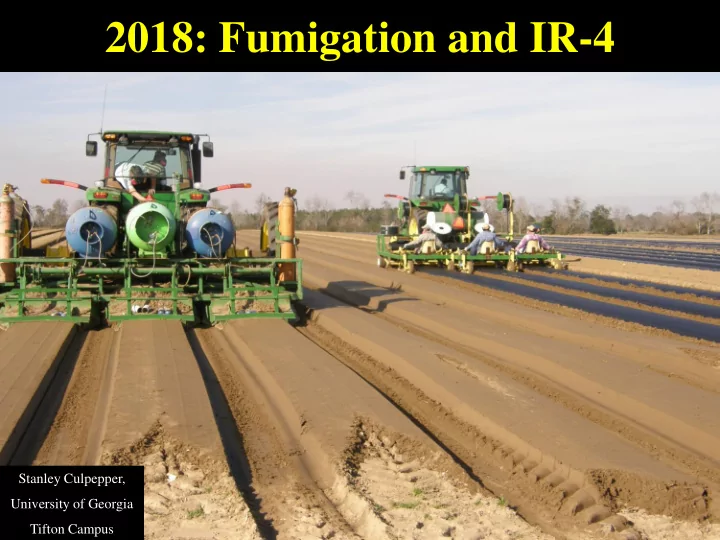
slide-2
SLIDE 2

Fumigation / Plasticulture

➢ Past

➢ Present ➢ Future

slide-3
SLIDE 3

Farm Gate Value of Crops on Plastic in Georgia

Georgia Farm Gate Values – State Wide

  • ---------------- Plasticulture ----------------

Crop Acres Farm Gate Value Banana & Hot Pepper 873 $4,321,351 Bell Pepper 5,634 $108,814,073 Cabbage 3,258 $18,391,145 Cantaloupe 3,582 $21,968,530 Cucumber 5,983 $41,202,770 Eggplant 1,454 $17,339,586 Strawberry 405 $9,871,698 Squash 2,756 $12,529,938 Tomato 2,796 $39,008,214 Watermelon 15,416 $135,619,200 Zucchini 2,335 $20,442,910 Total 44,492 $429,509,415

Source: Georgia Farm Gate Value Report, The University of Georgia, Center for Agribusiness and Economic Development

slide-4
SLIDE 4

Georgia Production on Plastic

slide-5
SLIDE 5

Methyl Bromide

➢ Over 50 years of use

slide-6
SLIDE 6

WEEDS, DISEASE, NEMATODES

slide-7
SLIDE 7

Methyl Bromide

➢ Over 50 years of use ➢ 1990 Montreal Protocol and

Clean Air Act: methyl bromide was classified as a class 1 ozone depleting substance and for its gradual removal from the market.

slide-8
SLIDE 8

1 August 2005 1 December 2005 1 November 2005 1 September 2005 1 October 2005

Ozone layer in Antarctica

http://ozonewatch.gsfc.nasa.gov/index.html

slide-9
SLIDE 9

Methyl Bromide Removal from the Market

➢ Production

1999 = 25% reduction 2001 = 25% reduction 2003 = 20% reduction 2005 = gone

(reduce methyl bromide ai over time)

slide-10
SLIDE 10

Loss of Methyl Bromide in 2005

slide-11
SLIDE 11

Methyl Bromide Uses

➢ QPS (Quarantine Pre Shipment) gas

➢Non-Soil Use (imports/exports)

  • Ex. wood

➢ Soil Use (mostly interstate movement)

  • Ex. Pine tree seedlings

➢ CUE (Critical Use Exemption) gas

➢ Preplant soil fumigant applications

slide-12
SLIDE 12

Methyl Bromide Critical Use Exemption

Pepper, Eggplant, Squash, Tomato, Melons, Cucumber

slide-13
SLIDE 13

Purple and Yellow Nutsedges: Primary Weeds in a Plasticulture System

slide-14
SLIDE 14
slide-15
SLIDE 15

Prescription Fumigation

slide-16
SLIDE 16

A Few Specialty Crop Values

(Retail Value Per Acre 2014)

  • 1. Watermelon (small bed mulch): $9000
  • 2. Watermelon (large bed mulch): $14,400
  • 3. Cantaloupe (small bed mulch): $8666
  • 4. Pepper (raised mulch): $22,400
  • 5. Tomato (raised mulch): $33,600
  • 6. Blueberry (high bush): $10,000
slide-17
SLIDE 17

Fumigant Systems For Weeds

  • 1. Paladin Pic + Vapam TIF
  • 2. UGA 3-WAY* TIF
  • 4. UGA 3-WAY LDPE
  • 5. Pic Chlor 60 TIF
  • 3. Paladin Pic TIF

All common weeds Good nutsedge, watch grass and pigweed Watch nutsedge, good grass and pigweed Watch nutsedge, grass, and pigweed… ...nematodes?? *UGA 3-WAY: system of Telone II, Pic, Metam

slide-18
SLIDE 18

Telone II Application 12 to 14 “ deep

slide-19
SLIDE 19

Chloropicrin placed 8 inches deep Pic Chlor 60 = 8-10 in. (21 G)

Low Nematode Levels

slide-20
SLIDE 20

Metam Application with blades 4” apart applying metam 4” deep – no herbicide under mulch

slide-21
SLIDE 21

Either LDPE or TIF Mulch Depending on Nutsedge Control Needed!

slide-22
SLIDE 22

Selecting the Correct Mulch Can Be Challenging

Low or High Density Polyethylene Virtually Impermeable Film Totally Impermeable Film

slide-23
SLIDE 23

Detector Tube Range 0.1 to 18 ppm

GASTEC GV100S Silicone Glue Funnel glued to mulch and then left for a set amount of time

slide-24
SLIDE 24

Nutsedge response to the 3-WAY. Tift Co., 2013.

20 40 60 80 100

Plots were 1 bed by 150 feet. Fall soil temp 84. (Veg 43-13)

LDPE TIF 89 b 99 a %

160 plant/A 494 plant/A

82,460 plant/A check

slide-25
SLIDE 25

Nutsedge response to the 3-WAY. Echols Co., 2013.

20 40 60 80 100

Plots were 1 bed by 150 feet. Spring soil temp 64. (Veg 13-13)

LDPE TIF 65 c 97 a %

290 plant/A 37,265 plant/A

319,250 plant/A check

slide-26
SLIDE 26

3-WAY; TIF Check

UGA 3-WAY. Fall 2013. Tift Co.

slide-27
SLIDE 27

Paldin Pic Systems

Light Populations: 40 GPA TIF Moderate to Severe: 50 GPA TIF

BE CAREFUL FOR ODOR MANAGEMENT MUST USE TIF MULCH

slide-28
SLIDE 28

Trifecta/Paladin Pic placed 8-10” deep

slide-29
SLIDE 29

Metam Application with blades 4” apart applying metam 4” deep

TIF MULCH ONLY

slide-30
SLIDE 30

Paladin Pic + Vapam Check

slide-31
SLIDE 31

Nutsedge response to top tier fumigant

  • systems. Tift County, 2014 - Fall.

Non-treated 129,600/A Paladin Pic + Vapam TIF UGA 3-WAY TIF

slide-32
SLIDE 32

Production Challenges - #1

COST

slide-33
SLIDE 33

Factors Influencing Rate/Control

F U M I G A N T R A T E 1.

  • 1. Higher populations of nutsedge
  • 2. Warmer soil temperatures
  • 3. Low moisture conditions (not wet either)
  • 4. Soft bed (compaction)
  • 5. Lighter texture the soil

We can influence quite quickly if willing!!!!

slide-34
SLIDE 34

Managing Nutsedge YEAR ROUND

1. Select the right fumigant system 2. Sandea in crop when feasible 3. Sandea row middles

  • 4. Spray as soon as crop done:
slide-35
SLIDE 35

Production Challenges - #2

BED FORMATION

Proper bed facilitates better fumigant, water & fertilizer movement

slide-36
SLIDE 36

Factors Influencing Rate/Control

F U M I G A N T R A T E 1.

  • 1. Higher populations of nutsedge
  • 2. Bed formation (150 lb person sink ½ inch)
  • 3. Moisture (avoid dry; avoid wet)
  • 4. Soil temperatures (cool good; hot bad)
  • 5. Soil texture (“lighter” texture less control

INFLUENCE CONCENTRATION OVER TIME

slide-37
SLIDE 37

Production Challenges - #2

BED FORMATION

Proper bed facilitates better fumigant, water & fertilizer movement

150 lb person sinks ½-1”

  • double press
  • shrink pan
slide-38
SLIDE 38

Production Challenges - #3

PLANT BACK INTERVALS P E S T C O N T R O L P L A N T B A C K concentration over time (where the pest is located)

slide-39
SLIDE 39

IR-4 Registrations Are Essential for Vegetable Producer Sustainability

Roger B. Batts Field Research Director, NCSU IR-4 Center and Interim IR-4 Southern Region Field Coordinator

GFVGA, Savannah, GA Jan 12, 2018

slide-40
SLIDE 40

IR-4 Mission

Facilitating the regulatory approval of sustainable pest management technology for specialty crops and specialty uses to promote public well-being

slide-41
SLIDE 41
slide-42
SLIDE 42

Why Is IR-4 Needed?

  • Lack of Economic Incentive for Registrants

– Development costs from ‘discovery to jug’ is estimated at $250-350M – Limited patent life – Small acreage vegetable crops = relatively small amount of product sales – “Just not worth the registration expenses and efforts”

  • Liability for Registrants

– Vegetable crops generally have higher value

  • This is not a new scenario. IR-4 was established by

USDA in 1963 because of these same factors.

slide-43
SLIDE 43

Who Benefits from IR-4

  • Growers

– Legal access to safe & effective pest management tools – Protect and sell a higher proportion of their crop

  • Food Processors & Food Retailers

– Consistent supply of materials

  • Crop Protection Industry

– Expanded registrations & potential sales – Exclusive Use of Data Extension

  • Public

– Plentiful and more economical supply of fruits & vegetables that contribute to a healthy diet.

slide-44
SLIDE 44

No Herbicide Reflex 16 oz/A

slide-45
SLIDE 45

25 50 75 100

%

8

Visual Eggplant Injury to Reflex Preplant. TyTy, GA. 2017. 26-29 DAT.

*Values followed by the same letter are not different at P = 0.05. Data combined over 2 runs.

12 16 24 32

Reflex Rate (oz/A)

0 a 0 a 1 a 4 a 10 b

slide-46
SLIDE 46

How IR-4 Helps (cont’d)

  • Crop Groups and Crop Group Expansion
  • EPA Crop Groups are based primarily on similar taxonomy and similar

growth habits. Tolerances established on a the ‘representative crop’ of a CG apply to all crops in that CG. More ‘bang for the buck’.

  • Placing ‘orphan crops’ into established EPA crop groups can automatically

get a tolerance applied to that crop. (Ex: Reflex/Eggplant)

  • Harmonization of International MRLs
  • Different tolerance levels for the same product/crop combination in

different countries can constrict trade.

  • IR-4 leading international efforts to harmonize MRLs = ‘level playing field’
slide-47
SLIDE 47

INDUSTRY

Georgia Department of Agriculture

Commissioner Gary Black

slide-48
SLIDE 48

New Vegetable Herbicide Uses - Last 10 Yr

  • 1. Chateau tomato RM
  • 2. Chateau pepper RM
  • 3. Chateau eggplant RM
  • 4. Chateau watermelon RM
  • 5. Chateau cantaloupe RM
  • 6. Chateau cucumber RM
  • 7. Chateau squash RM
  • 8. Chateau cabbage RM
  • 9. Dual Magnum pepper topical
  • 10. Dual Magnum broccoli topical
  • 11. Dual Magnum cabbage topical
  • 12. Dual Magnum collards topical
  • 13. Dual Magnum cauliflower topical
  • 14. Dual Magnum kale topical
  • 15. Dual Magnum watermelon RM
  • 16. Dual Magnum cantaloupe RM
  • 17. Dual Mag. carrot topical
  • 18. Dual Mag. sweet potato
  • 19. Dual Mag. tomato topical
  • 20. Dual Mag. snap bean topical
  • 21. Dual Mag. lima bean topical
  • 22. Dual Mag. southern pea topical
  • 23. Dual Mag. squash topical
  • 24. Caparol in Okra
  • 25. Sandea in Okra
  • 26. Reflex tomato preplant
  • 27. Reflex pepper preplant
  • 28. Reflex in Watermelon
  • 29. Reflex in Squash
  • 30. Reflex in Pumpkin
  • 31. Treflan – Intercropping
  • 32. Dual Magnum - pumpkin
slide-49
SLIDE 49

We’re from the government, we’re here to help!

Learn More About IR-4:

http://ir4.rutgers.edu/