2012-09-19 Centre for Healthcare Improvement (CHI) Chalmers and - - PDF document

2012 09 19
SMART_READER_LITE
LIVE PREVIEW

2012-09-19 Centre for Healthcare Improvement (CHI) Chalmers and - - PDF document

2012-09-19 Centre for Healthcare Improvement (CHI) Chalmers and Healthcare in Collaboration For Sustainable Healthcare CENTRE FOR Andreas Hellstrm, Assistant Professor Svante Lifvergren, M.D. Co-Director, Centre for Healthcare Improvement


slide-1
SLIDE 1

2012-09-19 1

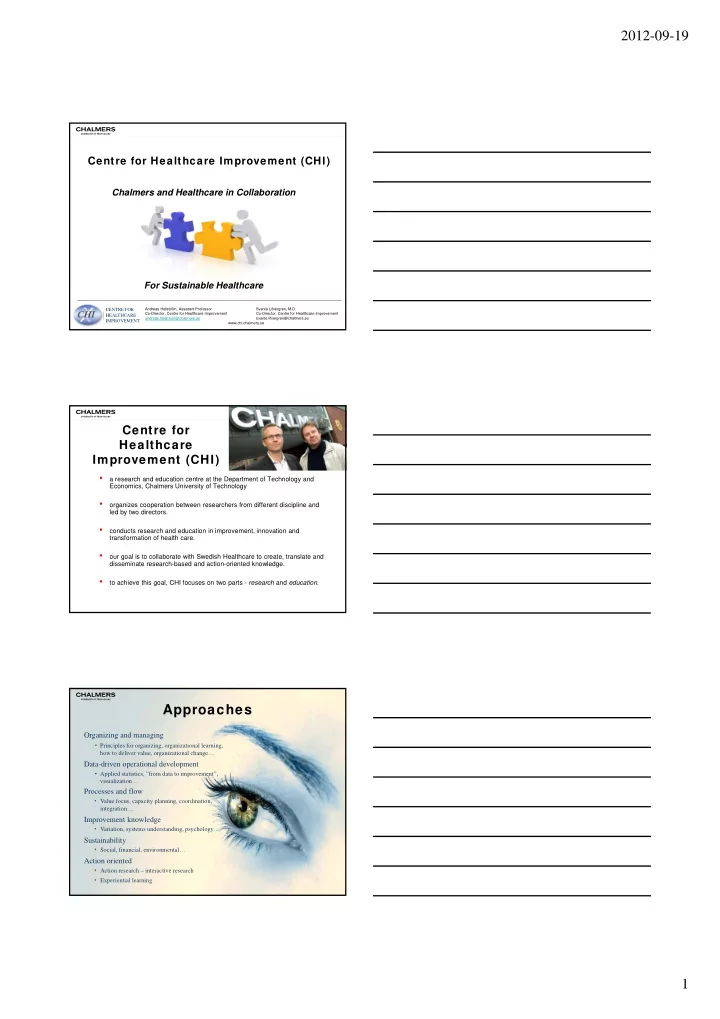
Centre for Healthcare Improvement (CHI)

Chalmers and Healthcare in Collaboration For Sustainable Healthcare

CENTRE FOR HEALTHCARE IMPROVEMENT

Andreas Hellström, Assistant Professor Svante Lifvergren, M.D. Co-Director, Centre for Healthcare Improvement Co-Director, Centre for Healthcare Improvement andreas.hellstrom@chalmers.se svante.lifvergren@chalmers.se www.chi.chalmers.se

Centre for Healthcare Improvement (CHI)

  • a research and education centre at the Department of Technology and

Economics, Chalmers University of Technology

  • rganizes cooperation between researchers from different discipline and

led by two directors.

  • conducts research and education in improvement, innovation and

transformation of health care.

  • ur goal is to collaborate with Swedish Healthcare to create, translate and

disseminate research-based and action-oriented knowledge.

  • to achieve this goal, CHI focuses on two parts - research and education.

Approaches

Organizing and managing

  • Principles for organizing, organizational learning,

how to deliver value, organizational change…

Data-driven operational development

  • Applied statistics, ”from data to improvement”,

visualization…

Processes and flow

  • Value focus, capacity planning, coordination,

integration…

Improvement knowledge

  • Variation, systems understanding, psychology…

Sustainability

  • Social, financial, environmental…

Action oriented

  • Action research – interactive research
  • Experiential learning
slide-2
SLIDE 2

2012-09-19 2

CENTRE FOR HEALTHCARE IMPROVEMENT

Management research Healthcare practice Learning about healthcare development Learning about healthcare development

Action research – w ith (not on) care practitioners

”The knowledge that is generated shall be both scientifically relevant, and relevant for

  • practitioners. You must be able to use it, and act
  • n it.”

Collaboration through research

  • Patient oriented and integrated cancer care processes
  • In Search of Sustainable High Quality Health Care
  • Decision support system for Warfarin treatment
  • Experienced Based Co-Design – to involve patients, relatives and

staff in a joint improvement work

  • Patient complaints as a basis for improvement work
  • Chest-pain – variation in quality, safety and cost
  • System dynamics at a Dermatology Department
  • Learning micro systems in healthcare processes
  • The application of Lean Six Sigma in a healthcare context
  • When process orientation meets the functional structures
  • Analyses of medication processes
  • Prognosis and and tactical planning within surgery
  • Reimbursement models and process effectiveness

Action research with interdisciplinary staffing

slide-3
SLIDE 3

2012-09-19 3

Collaboration through education

Professional education

  • Quality driven organizational development (30

credit)

  • Quality Management for senior managers (7,5

credit)

  • Advanced improvement knowledge (30 credit)
  • Lean healthcare (7,5 credit)
  • Improvement knowledge for residents (7,5 credit)

PhD education

– Reflexiv action research (7,5 credit) – Quality Management (7,5 credit) – + other courses at Technology Management

and Economics

CHI has trained more than 250 managers and improvement leaders within Region Västra Götaland Education as a catalyst for change

slide-4
SLIDE 4

2012-09-19 4

Approaches

Organizing and managing

  • Principles for organizing, organizational learning,

how to deliver value, organizational change…

Data-driven operational development

  • Applied statistics, ”from data to improvement”,

visualization…

Processes and flow

  • Value focus, capacity planning, coordination,

integration…

Improvement knowledge

  • Variation, systems understanding, psychology…

Sustainability

  • Social, financial, environmental…

Action oriented

  • Action research – interactive research
  • Experiential learning

Reduce variation in INR of patients undergoing warfarin treatment as a way to eventually decrease mortality and morbidity Warfarin treatment

  • Warfarin – an oral anticoagulant (blood thinning) treatment

effective for the prevention of thromboembolic events in various clinical contexts.

  • Serious risks related to Warfarin treatment, thus requiring great

care and caution when ordinating Warfarin pills to patients.

  • Patients undergoing Warfarin treatment are therefore monitored

regularly by blood testing.

  • International Normalized Ratio (INR) is usually used to measure

the effect of Warfarin treatment.

slide-5
SLIDE 5

2012-09-19 5

International Normalized Ratio (INR)

coagulation time of patient plasma coagulation time of normal plasma

ISI

INR       

  • The standard INR range (also called the therapeutic

range) for most clinical situations is 2.0-3.0.

Frequency 8 7 6 5 4 3 2 1 5000 4000 3000 2000 1000

Histogram over INR-values at SkaS in 2005

Probable causes of variation in INR

30% 17% 11% 11% 7% 7% 6% 4% 2% 5% At start up Drugs added/withdrawn Ordination routines Dr doesn't know of ordination Concurrent disease Information to patient Patient compliance Interruption routines Lab variation Other

slide-6
SLIDE 6

2012-09-19 6

VCHEN ( I NR: 6 0 % ) SiF ( I NR: 7 0 -7 5 % )

slide-7
SLIDE 7

2012-09-19 7

160 140 120 100 80 60 40 20 5 4 3 2 1 Time in days Y-Data

INR Tablets/day Variable

Plot of I NR and number of tablets/ day

Hem olysis Vacutainer canula

constant dimension

slide-8
SLIDE 8

2012-09-19 8

Venflon with Vacutainer adapter

Note all dimensional changes Datum Andel hemolys

2007-10-13 2007-10-07 2007-10-01 2007-09-25 2006-10-09 2006-10-03 2006-09-27 2006-06-13 2006-06-07 2006-06-01 2006-05-26 0,20 0,15 0,10 0,05 0,00 _ X=0,0317 UCL=0,0808 Före förändring Efter förändring uppföljning efter 1 år

1

Andel hemolys före och efter förändring

” The Skaraborg Hospital Group (SkaS)……..//……. Using an action research approach, this article describes the lessons that were learned from the first 22 Six Sigma projects, completed between 2006 and 2008 and having a success rate of 75%.” Net cost savings per project = 40 000 €

Lifvergren S, Gremyr I, Hellström, Chakhunashvili A, Bergman B(2010) Lessons from Sweden’s first large-scale implementation of Six Sigma in

  • healthcare. Oper Manag Res 3:117–128. DOI

10.1007/s12063-010-0038-y

slide-9
SLIDE 9

2012-09-19 9

Approaches

Organizing and managing

  • Principles for organizing, organizational learning,

how to deliver value, organizational change…

Data-driven operational development

  • Applied statistics, ”from data to improvement”,

visualization…

Processes and flow

  • Value focus, capacity planning, coordination,

integration…

Improvement knowledge

  • Variation, systems understanding, psychology…

Sustainability

  • Social, financial, environmental…

Action oriented

  • Action research – interactive research
  • Experiential learning

A physician-led, and learning driven approach to the regional developm ent of 2 3 cancer pathw ays in Sw eden

The cancer challenge

  • Every third person in Sweden at some point in their lives has experience
  • f cancer. That amounts to 50 000 patients a year = one new admission

every ten minutes.

  • Projections suggest that the number of men with cancer in 2030 will be

almost 130 % more than today - the corresponding increase for women is around 70 % .

  • Cancer care is:

– highly decentralized – involves most levels of care. – highly multi-professional activity – fragmented – long and varying delays – a general lack of patient orientation.

slide-10
SLIDE 10

2012-09-19 10

  • 4 Patient centred criterias
  • 3 Criterias regarding training, knowledge

management and research

  • 3 Criterias regarding the organizing of RCCs

National cancer strategy

Learning about healthcare development Learning about healthcare development ”The knowledge that is generated shall be both scientifically relevant, and relevant for practitioners. You must be able to use it, and act on it.” Centre for Healthcare Improvement Regional Cancer Centre West

Project Design

Agreed-upon core principles… so far

  • Patient focused
  • Physician-led
  • Learning driven
  • Systems approach
  • Positive and opportunity-driven
  • Research informed
slide-11
SLIDE 11

2012-09-19 11

Bladder cancer Brain tumor Breast cancer Cervical cancer Cervical cancer prevention Childhood cancer Colorectal cancer Colorectal cancer screening Corpus cancer Early detection Esophageal cancer Gastric cancer Head and Neck cancer Kidney cancer Leukemia Liver cancer Lung cancer Lymphoma Malignant skin tumors Ovarian cancer Mammography Myeloma Palliative care Pancreatic cancer Penile Cancer Primary tumor unknown Prostate cancer Supportive care Thyroid cancer Vulvar and vagina

A process oriented view

Patient process Care team Regional process group Regional cancer centre Community Control Cure Care Customer

4 + 1 C

Glouberman & Mintzberg 2001

slide-12
SLIDE 12

2012-09-19 12

Customer involvement

  • Experience-based codesign (patients and close relatives)
  • Patient Associations
  • Patient diaries
  • Young Cancer

Appreciative Inquiry: 4 + 1 C

  • Different ways of creating value (value logics)
  • Resource consumption (CPP-data)
  • Effectiveness and production planning
  • Developmental dialogues
  • Early detection
  • Palliative care
  • Support for cancer survivorship
  • Patient diaries
  • KPI for tumour processes

Support for innovations

  • ongoing initiatives
slide-13
SLIDE 13

2012-09-19 13

Value logic – production logic

  • We need different production logics to create value for
  • ur patients

– ”How we organize people, competences, services,

standards and procedures at at a certain time in the system”

Sven, 6 2

  • No earlier diseases
  • Former football player
  • Accelerating pain from left hip
  • Severe arthrosis
  • Needs:

– New hip prosthesis including a swift, efficient and

safe process

Process: Hip replacem ent

Diagnos Preparation Operation Rehabilitation Final evaluation Need:

  • New hip

Output:

  • Improved

function

  • No pain
  • Arthrosis
slide-14
SLIDE 14

2012-09-19 14

Anna, 4 0

  • Discovered a tumor in left breast
  • Needs:

– Immediate diagnos – Plan for futher treatment – Relieve anxiety

( One-stop) Solution w orkshop – Patient center

Specialist- läkare Specialist- ssk Specialist- läkare Specialist- ssk Specialist- läkare Specialist- ssk Specialist- läkare

Diagnos Care plan

Örjan, 7 6

  • Diabetes and congestive heart failure for many years
  • Severeal visits to in- and outpatient clinics
  • Needs:

– Safety and good quality of life at home – No admittances to the hospital – Be able to monitor and ”treat” exacerbations at

home

– A trustworthy contact nurse, easy to get hold of – Be able to meet other patients with similar

experiences

slide-15
SLIDE 15

2012-09-19 15

Netw ork logic

  • Self monitoring
  • Patient co-produces care
  • Coordinating centre
  • Mobile teams

Healthy elderly people Elderly people with

  • ne or two stable chronic

diseases and taken care of by the ’ordinary’ care system Elderly people with multiple chronic diseases but in stable condition and taken care of by the ’ordinary’ care system Elderly people with multiple chronic diseases in unstable condition and taken care of by the integrated mobile care team 7% of elderly population 0.2% Figure 2. Conceptual figure developed by the team together with the researchers that illustrates the different proportions of elderly people with different care needs in the actual area Lifvergren et al. (2012) Learning microsystems in Healthcare

Different business m odels

  • High volume, high quality,

low cost

  • Unique service, one stop

shop

  • Health promotion,

prevention, upstream, behavioral aspects

slide-16
SLIDE 16

2012-09-19 16

Primär prevention Screening hälsokontroll Palliativ vård Symptom- utredning Diagnos Behandlings- utredning Primär behandling Tilläggs- behandling Individuell vårdplan Rehabilitering Kronisk sjukdom Psykosocialt stöd Uppföljning behandling

Approaches

Organizing and managing

  • Principles for organizing, organizational learning,

how to deliver value, organizational change…

Data-driven operational development

  • Applied statistics, ”from data to improvement”,

visualization…

Processes and flow

  • Value focus, capacity planning, coordination,

integration…

Improvement knowledge

  • Variation, systems understanding, psychology…

Sustainability

  • Social, financial, environmental…

Action oriented

  • Action research – interactive research
  • Experiential learning
slide-17
SLIDE 17

2012-09-19 17

25 50 75 100 125 150 175 200 225 # of death-free cases between Death case #

g-chart

# of death-free cases between UCL CL LCL

Deaths, Miami Children

  • 0,20000
  • 0,10000

0,00000 0,10000 0,20000 0,30000 0,40000 0,50000 0,60000 1 110 219 328 437 546 655 764 873 982 1091 1200 1309 1418 1527 1636 1745 1854 1963 2072 2181 2290 2399 2508 2617 2726 2835

EWMA Surgery #

EWMA chart

EWMA UCL

slide-18
SLIDE 18

2012-09-19 18

t-chart (övervakning av hjärtstoppsförekomst) - utan HIVA

10 20 30 40 50 60 70 80 90 H j S 1 H j S 2 H j S 3 H j S 4 H j S 5 H j S 6 H j S 7 H j S 8 H j S 9 H j S 1 H j S 1 1 H j S 1 2 H j S 1 3 H j S 1 4 H j S 1 5 H j S 1 6 H j S 1 7 H j S 1 8 H j S 1 9 H j S 2 H j S 2 1 H j S 2 2 H j S 2 3 H j S 2 4 Hjärtstopp nr Tid mellan hjärtstoppsfall (antal dagar) t Sö CL Su Önskvärd riktning

Approaches

Organizing and managing

  • Principles for organizing, organizational learning,

how to deliver value, improvement work…

Data-driven operational development

  • Applied statistics, ”from data to improvement”,

visualization…

Processes and flow

  • Value focus, capacity planning, coordination,

integration…

Improvement knowledge

  • Variation, systems understanding, psychology…

Sustainability

  • Social, financial, environmental…

Action oriented

  • Action research – interactive research
  • Experiential learning

For more info: www.chi.chalmers.se