18/01/2013 A pedagogical understanding of wnanga as a model of - - PDF document

18 01 2013
SMART_READER_LITE
LIVE PREVIEW

18/01/2013 A pedagogical understanding of wnanga as a model of - - PDF document

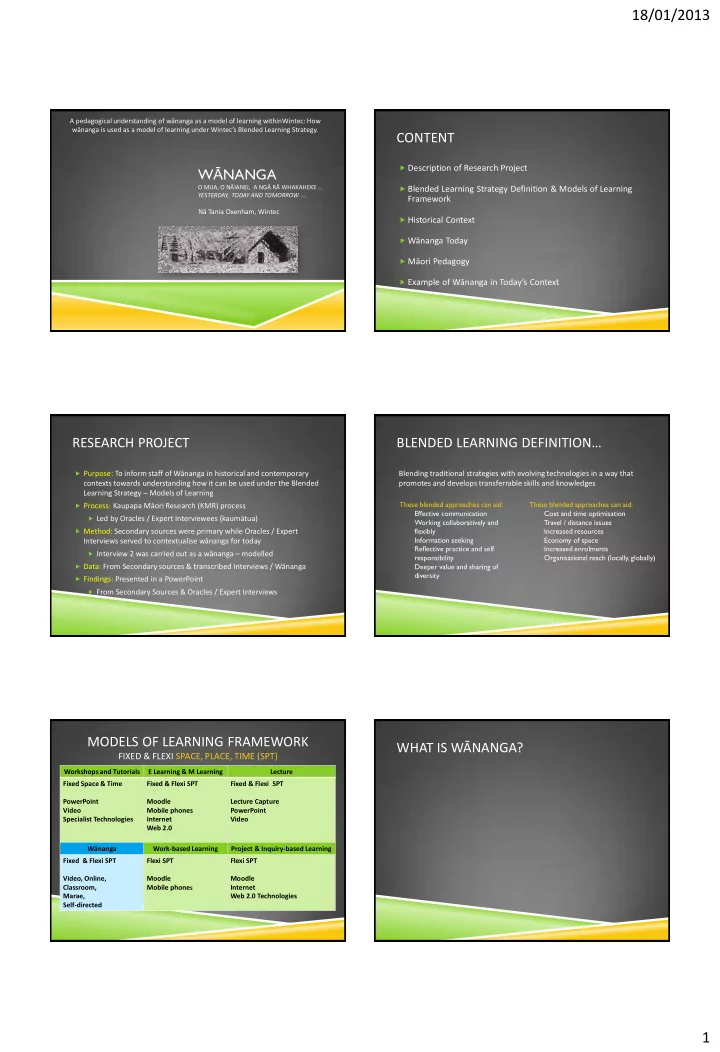
18/01/2013 A pedagogical understanding of wnanga as a model of learning withinWintec: How wnanga is used as a model of learning under Wintecs Blended Learning Strategy. CONTENT Description of Research Project W NANGA Blended


slide-1
SLIDE 1

18/01/2013 1

WĀNANGA

O MUA, O NĀIANEI, A NGĀ RĀ WHAKAHEKE … YESTERDAY, TODAY AND TOMORROW ….

Nā Tania Oxenham, Wintec A pedagogical understanding of wānanga as a model of learning withinWintec: How wānanga is used as a model of learning under Wintec’s Blended Learning Strategy.

CONTENT

 Description of Research Project  Blended Learning Strategy Definition & Models of Learning

Framework

 Historical Context  Wānanga Today  Māori Pedagogy  Example of Wānanga in Today’s Context

RESEARCH PROJECT

 Purpose: To inform staff of Wānanga in historical and contemporary

contexts towards understanding how it can be used under the Blended Learning Strategy – Models of Learning

 Process: Kaupapa Māori Research (KMR) process  Led by Oracles / Expert Interviewees (kaumātua)  Method: Secondary sources were primary while Oracles / Expert

Interviews served to contextualise wānanga for today

 Interview 2 was carried out as a wānanga – modelled  Data: From Secondary sources & transcribed Interviews / Wānanga  Findings: Presented in a PowerPoint  From Secondary Sources & Oracles / Expert Interviews

BLENDED LEARNING DEFINITION…

Blending traditional strategies with evolving technologies in a way that promotes and develops transferrable skills and knowledges

These blended approaches can aid: Effective communication Working collaboratively and flexibly Information seeking Reflective practice and self responsibility Deeper value and sharing of diversity These blended approaches can aid: Cost and time optimisation Travel / distance issues Increased resources Economy of space Increased enrolments Organisational reach (locally, globally)

MODELS OF LEARNING FRAMEWORK

FIXED & FLEXI SPACE, PLACE, TIME (SPT)

Workshops and Tutorials E Learning & M Learning Lecture Fixed Space & Time PowerPoint Video Specialist Technologies Fixed & Flexi SPT Moodle Mobile phones Internet Web 2.0 Fixed & Flexi SPT Lecture Capture PowerPoint Video Wānanga Work-based Learning Project & Inquiry-based Learning Fixed & Flexi SPT Video, Online, Classroom, Marae, Self-directed Flexi SPT Moodle Mobile phones Flexi SPT Moodle Internet Web 2.0 Technologies

WHAT IS WĀNANGA?

slide-2
SLIDE 2

18/01/2013 2

HISTORICAL WĀNANGA

(ORACLE 1, INTERVIEW 27 JULY 2012)

 E rua ngā momo wānanga:

2 types of wānanga:

 Ko te tīmatanga o te ao

1st Wānanga: from beginning times

 Ko te ao tūroa

2nd Wānanga of today

He oranga kei roto i ngā mea e rua

There is life emanating from both ...

Tīmatanga o te Ao

Beginning of Time

Te Ao Tūroa

Present Day

Kotahi te kī

One thing is spoken

Mahamaha ngā kōrero

A lot is spoken

Kotahi te whakaaro

Thought is activated

Mahamaha ngā whakaaro

There are lots of thoughts

Ka mōhio ki te tīmatanga

  • te ao, ka mōhio hoki ki

te ao tūroa

Thought begins to develop, still connected to it’s begining

Kaua e haere ki te ao tūroa rapurapu noa – kei te raru tonu

You can’t just go to this wānanga without being connected to the other

He wana, he tika, he pono

In this wānanga learning is excited, it travels right and true …

Nā te tangata kei te whati

Here, man will either do it right and true or he will bend it wrong

HISTORICAL WĀNANGA

 A space, place or time of learning

and teaching (practice):  Most wānanga were iwi-

centric and had their own experts and their own reasons for running a wānanga

 However, it was not

unheard of for groups to break away and run their

  • wn (e.g whānau, hapū)

He iwi anō me ōna tohunga me tōna whare wānanga me ana whakahaere

Smith, P. S. (1913). The lore of the whare-wānanga. Written down by H.T. Whatahoro from the teachings of Te Mātorohanga and Nepia Pohuhu, priests of the Whare-wānanga of the East Coast, New Zealand. New Plymouth, NZ: Dominion Museum.

HISTORICAL WĀNANGA

 A place, space or time of learning

and teaching: That benefited the

individual and the wider community

Where specialised arts

and knowledges were learnt and taught

…he whare nō ngā taitamariki e whakaarotia ana e ngā iwi nōna aua tamariki, e tika ana, e kakama ana ngā mahara, e ū ana hoki ngā whakaaro ki te mea I whakaua atu ai ki te ako.

Smith, P. S. (1913). The lore of the whare-wānanga. Written down by H.T. Whatahoro from the teachings of Te Mātorohanga and Nepia Pohuhu, priests of the Whare-wānanga of the East Coast, New Zealand. New Plymouth, NZ: Dominion Museum.

EXAMPLES OF WHARE WĀNANGA

space time place

 “In some cases the whare wānanga

was but a name and a system; no special house bore the name, and the knowledge pertaining to it might be taught in the open air or in any house set apart for the purpose” (p.374).

 Learning was not limited to a

timeframe, it could go on all night without rest ...

Best, E. (1934). The Māori as he was: A brief account of Māori life as it was in Pre-European days. 2nd ed. Wellington, NZ: Dominion Museum.

EXAMPLES OF WHARE WĀNANGA (LEARNING HOUSES)

space time place

 Some old whare wānanga rebuilt

e.g. Ra-wheoro at Uawa (Takitimu)

Best, E. (1934). The Māori as he was: A brief account of Māori life as it was in Pre-European days. 2nd ed. Wellington, NZ: Dominion Museum.

Miringa te Kakara -Tainui Whare Wānanga

Erected approx. 1865 at request of Chieftainess Ngāharakeke; burnt down in 1983. However, original wānanga are cited as dating as far back as far as 1682, 1788, 1887 (renovations).

HISTORICAL WĀNANGA

(ORACLE 2, INTERVIEW 23 AUG 2012)

 I ngā wā o mua: In times past:  Ka whiriwhiri te tohunga, te hapū, te rangatira ko wai ngā tauira

 It was the tohunga, hapū,

rangatira who chose only those students who were bright and able to retain information  I ngā wā o mua:

In times past:

 Nā te tohunga, te hapū, i āta

tītiro, i āta whakaaro mō te tamaiti me tona ara pai

 Tohunga and hapū would place

students into the disciplinary areas according to their observed and felt natural and learnt aptitudes and abilities

slide-3
SLIDE 3

18/01/2013 3

ATTENDEES

 Those chosen by their iwi or hapū

(from ages 4 - 10 approx.)

 Those that showed that they were

gifted

 Those that could retain or

remember knowledge through recitation

 Those that showed aptitude

towards specialised areas

 Both sexes (separate schools)

CULTURAL LOCATEDNESS

(ORACLE 2, INTERVIEW 23 AUG 2012)

 I ngēnei rā: In times past:

 Pēnei ki … Miringa te Kakara … he

rīpeka te āhua o te whare. E whā ngā kuaha; he mea mai te rāwhiti, mai te tonga, te hauauru, taitokerau. Mena nō te tonga koe, me kuhu koe ki te whare wānanga mā te kuaha o te tonga.

 Like ... Miringa te Kakara ... Whose

shape was like a cross. It had four doors facing east, west, north, south. You would enter the door according to whether you were from the north, south, etc.  I ngēnei rā:

These days:

 Kua puare ngā tatau ki ngā tō pito

katoa o te ao ... Hainamana mai, Pākehā mai, Māori mai.

 The doors of ‘wānanga’ are open to all

peoples of the world ... Chinese, Pākehā, Māori

WHY WERE WĀNANGA IMPORTANT?

To aid in the retention of traditional knowledge passed down To equip the whānau, hapū, iwi with practical skills To uphold the mana of the whānau, hapū, iwi To provide skills and labour for the economy To ensure survivability of the whānau, hapū, iwi, culture &

practices

To encourage enlightenment, creativity, potentiality, new

knowledge

WHAT WAS TAUGHT?

Kauwae Runga

(Things Celestial)

Kauwae Raro

(Things Terrestial)

Smith, P. S. (1913). The lore of the whare-wānanga. Written down by H.T. Whatahoro from the teachings of Te Mātorohanga and Nepia Pohuhu, priests of the Whare-wānanga

  • f the East Coast, New Zealand. New Plymouth, NZ: Dominion Museum.

WHAT WAS TAUGHT?

 Astrology  Cosmology  Biology (land and sea)  Genealogy  Medicine  Midwifery  Tattooing  Marine Technology  Navigation  Stone Masonary  Carving  Carpentry  Music  Monotheism / Polytheism (co-existing beliefs)  Tool making  Weaving  The Arcane (mysterious, secret)  Herbology

WĀNANGA TODAY @ WINTEC

Covered in this section: Underpinning values and practices Wintec’s use of Wānanga Essentials and negotiables Māori Pedagogy

slide-4
SLIDE 4

18/01/2013 4

UNDERPINNING VALUES

(ORACLE 1, INTERVIEW 27 JULY 2012) What is necessary for wānanga ....

 Ngā Mātāpono (Guiding Principles)

 Manaakitanga Support  Rangatiratanga Autonomy  Mana Whenua Acknowledgment  Kotahitanga One-ness  Kaitiakitanga Care of resources, learning  Ngā Whakapapa Geneology

 Ngā Mātāpono (Guiding Principles)

 Whakamana Mana giving  Ngā wawata Aspirations  Whakawhanaungatanga Sharing of self  Te reo Māori The language  Wairuatanga Spiritual connectedness  Tapu Sacredness Kia pupuke te hihiri, te mahara, te wānanga .... Increase the desire, the remembrance, the learning …

ESSENTIAL PRACTICES (NO PARTICULAR ORDER)

Pōwhiri / Whakatau Whaikōrero / Mihimihi Karakia Poroporoaki Kaiārahi / Kaitiaki Whakawhitiwhiti kōrero Whakawhanaunga Te reo me ona tikanga Tuakana / Teina

 Welcome to space (Formal/Semi-formal)  Greeting (Formal / Semi-formal)  Prayer, Blessing, Thought to unite all  Farewell / Closing  Support people (help guide process)  Shared teaching and learning (staff / student)  Sharing of Self  Māori language  Older sister/brother, younger sister/brother

NEGOTIABLE PRACTICES (NO PARTICULAR ORDER)

Karanga Kai Koha (separate to booking fee) Tikanga whakapai whare Waiata

 Welcoming call  Food  Donation (separate from booking fee)  Many hands make light work  Song

WINTEC’S USE OF WĀNANGA LEARNING AND PRACTICE

Tikanga ‘right’ practices Karakia prayer Waiata song Tapu sacredness Mauri life-force Whakapapa genealogy Wawata aspirations, hopes Whakamana enhance, uplift Tangata whenuatanga ownership Manaakitanga care, compassion, hospitality Tohungatanga expertise Ako learning, teaching and practicing Te reo Māori me ona tikanga

language development

THE PEDAGOGY OF WĀNANGA …

slide-5
SLIDE 5

18/01/2013 5

Te Pūtake Ko te pūtake koia i mea atu nei i ahu mai i whea … The pūtake is that which tells you where you come from … Topic Kaupapa Principles Mātāpono Essence Pūtake The Beginning

  • f All Things

Timatanga

Kaupapa

(Kōrari - Flower)

Pūtake Mātāpono Timatanga

PEDAGOGICAL WHAKAPAPA

(ORACLE 1, INTERVIEW 27 JULY 2012)

MĀORI PEDAGOGY …

Favours:

Relational ontology (state of being) Culturally located epistemology Culturally located axiology (values)

MĀORI PEDAGOGY …

Encourages discourses around the

primacy of the student; the student and teacher relationship; the student and the whānau, hapū, iwi; the student and the environment

Assumes holistic teaching practices

are natural and overt. (mental, physical,

spiritual, emotional, social, whānau)

MĀORI PEDAGOGY …

Starts from the premise that traditional knowledge and practices still have relevance in the teaching domain today ... This includes tribal histories, karakia and rituals such as pōwhiri and mihimihi

Paul Stucki, 2010

Stucki, P . (2010). Māori Pedagogy, Pedagogical Beliefs and Practices in a Māori Tertiary Institution (Unpublished doctorate, Massey University, New Zealand). Retrieved from http://mro.massey.ac.nz/bitstream/handle/10179/2329/02_whole.pdf?sequence=1

AKO

RECIPROCITY OF KNOWLEDGE

“… ako means both to teach and to learn. It

recognises the knowledge that both teachers and learners bring to learning interactions, and it acknowledges that new knowledge and understandings can grow

  • ut of shared learning experiences” (Ministry
  • f Education, 2010)

AKO

AS A NOTION OF ‘BEING’

Under ako, the state of ‘being’ or ‘knowing’ is a

constant activity, and gives agency to mental, physical, spiritual, emotional, social and creative formation of thought, as well as pre-existing and emergent knowledge within the student

  • Cf. Vygotsky’s Zone of Proximinal Development

Chaiklin, S. (2003). The Zone of Proximal Development in Vygotsky's analysis of learning and

  • instruction. In Kozulin, A., Gindis, B., Ageyev, V. & Miller, S. (Eds.) Vygotsky's educational

theory and practice in cultural context. 39-64. Cambridge: Cambridge University.

slide-6
SLIDE 6

18/01/2013 6

AKO

AS A NOTION OF ‘BEING’

Under ako, the state of ‘being’ or ‘knowing’ allows for

going ‘beyond’ here into the “unknowable, unrepresentable” (p. 4). This is sometimes referred to as the :

 Liminal space (place of transition, threshold)  Betwixt, Between

Bhabha, H. K. (1995). The location of culture. New York: Routledge.

AKO TEACHING & LEARNING PRACTICES

Reciprocity and Relationship:

 Teacher / Learner  Tuakana / Teina

 More capable/less capable (in a variety of forms)  Expert/Novice; Mentor/Mentee

 Teacher / Learner / Whānau  Teacher / Learner / Hapū – Iwi  Teacher / Learner / Wider community  Teacher / Learner / Environment

AKO TEACHING PRACTICES

 Manaakitanga

– supporting, trust, valued…

 Karakia, waiata

– prayers and songs …

 Whakawhanaungatanga &

Whakapapa – making connections …

AKO TEACHING PRACTICES

Purākau

– stories/case studies

Whare Tapa Whā

– holistic model of wellbeing

Whai whakaaro

– reflecting

PEDAGOGY OF WĀNANGA

(ORACLE 2, INTERVIEW 23 AUG 2012)

 I ngēnei rā: These days:

 He nui o rātou nei tikanga i te

kuhunga ki roto i te wānanga.

 There are a lot more worldviews,

principles attached to modern wānanga.  I ngēnei rā:

These days:

 Ka ako ngā tauira i ngā wā

whakaritea

Students learn in prepared spaces, places and times (e.g 3yr courses, face to face, self-directed, set timetables, set learning outcomes)  Ka tipakohia e te tauira ko tēwhea

kaupapa e pai ana mōna.

Students get to choose his/her discipline

  • ption

EXAMPLE FROM WINTEC

Tīhei Mauri Ora (TMO) Māori Stream for Bachelor of Nursing Degree Information provided by Jan Liddell – BN Tutor

slide-7
SLIDE 7

18/01/2013 7

TMO REPRESENTATION

IDENTIFICATION D Group (across the three years) CAUCASING

  • TMO
  • Mainstream

CLINICAL PLACEMENTS

  • groups/pairs
  • TMO tutor

TMO student reps TMO student forums SUPPORT NETWORKS

  • Kaumatua /Māori Director
  • TKK/SLS support services

(factored into curriculum)

Cultural Safety Paper

SELECTION PROCESS OF POTENTIAL STUDENTS

TĪHEI MAURI ORA (TMO) MAINSTREAM

  • Processed by TMO Kaiāwhina

& TMO team

  • Whakatau / Mihimihi
  • Whānau interviews
  • Involvement of:
  • Kaumatua
  • Director
  • Te Kete Kōnae Student Support

Service

  • Processed by Undergraduate

Manager

  • One on one interviews

TMO TUTOR PRACTICES …

  • Expectant that knowledge or

answers may be arrived at in more than one way

  • (e.g. whakawhitiwhiti kōrero,

pūrākau, whai whakaaro)

  • Methods used to reach learning
  • utcomes are equitable in

status

  • Other perspectives and

differences are acknowledged

 (cultural significance, cultural

capital)

  • Diversity contributes to:
  • standards of excellence
  • safety and management

TMO STUDENT EMPOWERMENT

  • Te Kete Kōnae (TKK) Student Support Services – Study wānanga and

workshops embedded in course timetable (1st Year) E.g. Hei Oranga Mōu [holistic well-being wānanga which includes academic support, mental / physical / spiritual / cultural and whānau support]

  • targeted for the 5th, 6th week of arrival (known as critical retention

point]

  • Māori Student Nurses Hui, Ngā Maia, Whārango Ruamano

[nursing bodies]

WĀNANGA IN THE FUTURE??? WĀNANGA IN THE FUTURE???

... to be part of a revisionary time, a return to the present to redescribe our cultural contemporaneity; to reinscribe

  • ur human, historical

commonality; to touch the future

  • n its hither side”

philsblogofneglect.blogspot.com Bhabha, H. K. (1995). The location of culture. New York: Routledge.

slide-8
SLIDE 8

18/01/2013 8

OTHER READING …

 Bensen, J. & Sutton, A. (2008). Facing the Challenge. Foundation Learning for Adults in Aotearoa New Zealand.

Wellington,NZ: Dunmore Publishing Ltd.

 Benseman, J., Findsen, B. & Scott, M. (1996). The Fourth Sector. Adult and Community Education in Aotearoa

New Zealand. Palmerston North, NZ:Dunmore Press Ltd.

 Bishop, R., Berryman, M. & Richardson, C. (2001). Te Toi Huawera. Wellington, NZ: Ministry of Education.  Chaiklin, S. (2003). The Zone of Proximal Development in Vygotsky's analysis of learning and instruction. In

Kozulin, A., Gindis, B., Ageyev, V. & Miller, S. (Eds.) Vygotsky's educational theory and practice in cultural context. 39-64. Cambridge: Cambridge University.

 Ministry of Education. (2010). Te Reo Māori in English-medium schools. Retrieved from

http://tereoMāori.tki.org.nz/.

 Pihama, L., Smith, K, Taki, M. & Lee, J. (2004). A literature review of kaupapa Māori and Māori education

  • pedagogy. Retrieved from http://akoaotearoa.ac.nz/node/199/group- category- resources/4920

 Royal, C. (2011). Wānanga. Monograph 4.  Stucki, P. (2010). Māori Pedagogy, Pedagogical Beliefs and Practices in a Māori Tertiary

Institution (Unpublished doctorate, Massey University, New Zealand). Retrieved from

http://mro.massey.ac.nz/bitstream/handle/10179/2329/02_whole.pdf?sequence=1