15-292 History of Computing The Internet 1 A Vision of Connecting - - PDF document

15 292 history of computing
SMART_READER_LITE
LIVE PREVIEW

15-292 History of Computing The Internet 1 A Vision of Connecting - - PDF document

2/25/20 15-292 History of Computing The Internet 1 A Vision of Connecting the World the Memex Proposed by Vannevar Bush first published in the essay "As We May Think" in Atlantic Monthly in 1945 and subsequently in Life


slide-1
SLIDE 1

2/25/20 1

15-292 History of Computing

The Internet

1

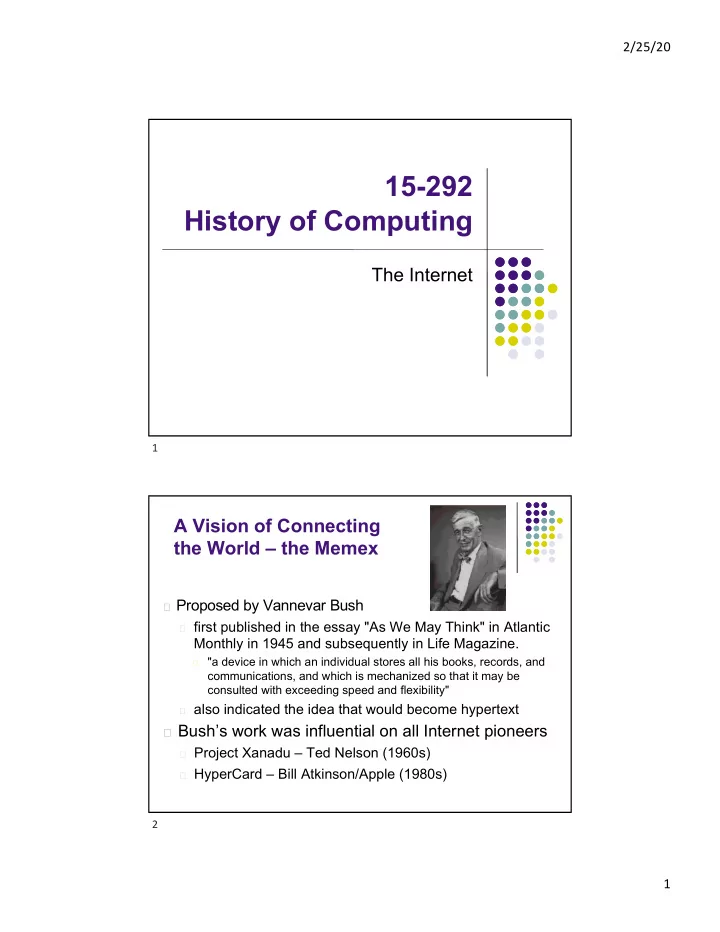
A Vision of Connecting the World – the Memex

Proposed by Vannevar Bush

first published in the essay "As We May Think" in Atlantic

Monthly in 1945 and subsequently in Life Magazine.

"a device in which an individual stores all his books, records, and

communications, and which is mechanized so that it may be consulted with exceeding speed and flexibility"

also indicated the idea that would become hypertext

Bush’s work was influential on all Internet pioneers

Project Xanadu – Ted Nelson (1960s) HyperCard – Bill Atkinson/Apple (1980s)

2

slide-2
SLIDE 2

2/25/20 2

The Memex

3

The Memex

4

slide-3
SLIDE 3

2/25/20 3

The Impetus to Act

1957 - U.S.S.R. launches Sputnik I into space 1958 - U.S. Department of Defense responds by

creating ARPA

Advanced Research Projects Agency “mission is to maintain the technological superiority of the

U.S. military”

“sponsoring revolutionary, high-payoff research that

bridges the gap between fundamental discoveries and their military use.”

Name changed to DARPA (Defense) in 1972

5

Early work

Paul Baran began working at the RAND corporation

  • n secure communications technologies in 1959

goal to enable a military communications network to

withstand a nuclear attack.

use of a decentralized network with multiple paths between

any two points (distributed computing)

devised dividing complete user messages into message

blocks before sending them into the network

Donald Davies of Britain’s National Physics Lab had

begun working on related concepts in 1965

Introduced the term “packet”

Baran (L) and Davies (R)

6

slide-4
SLIDE 4

2/25/20 4

Circuit Switching vs. Packet Switching

medium.com

7

J.C.R. Licklider (“Lick”)

Wrote Man-Computer Symbiosis in 1960

  • utlined the need for simpler interaction between computers

and users

Formulated the earliest ideas of a global computer

network at MIT in 1962

1962-1964, Licklider was head of the ARPA Information

Processing Techniques Office (IPTO)

set up ARPA research contracts with leading research

institutions (Stanford, MIT, UCLA, etc …)

proposed an “Intergalactic Computer Network“ to link the

institutions

promoted standards among the various computing facilities

8

slide-5
SLIDE 5

2/25/20 5

Bob Taylor

Director of ARPA’s IPTO

(after Licklider & Ivan Sutherland)

When he took over, the Intergalactic Computer Network

was not actually connected

He had a direct connection to ARPA computers around the

country

Different researchers used different computers that could not talk to

  • ne another

Taylor continued Licklider’s vision, proposing to link them

together in a uniform network (funded $1 million)

the U. S. government’s best return on an investment in its history? maybe the Louisiana Purchase or the purchase of Alaska

Taylor would later supervise Xerox PARC

9

Larry Roberts

Sometimes called “the father of ARPANET” Built first transcontinental network from MIT to Santa

Monica

Strong-armed by Taylor to link ARPA computers

Roberts was ARPANET’s principal architect

Used packet switching & IMPs

10

slide-6
SLIDE 6

2/25/20 6

ARPANET

The Advanced Research Projects Agency Network

(ARPANET) was the world's first operational packet switching network.

Project launched in 1968. Required development of IMPs (Interface Message

Processors) by Bolt, Beranek and Newman (BBN)

IMPs would connect to each other over leased digital lines IMPs would act as the interface to each individual host

machine

Used packet switching concepts published by Leonard

Kleinrock, most famous for his subsequent books on queuing theory

11

Len Kleinrock

Queueing theorist & engineer Really formalized packet switching research

while at MIT

Later joined ARPANET effort while at UCLA Oversaw installation of

ARPANET’s first IMP at UCLA

12

slide-7
SLIDE 7

2/25/20 7

History of the ARPANET

13

The Initial ARPANET

Initial ARPANET deployed in late 1969

with four hosts:

University of California at Los Angeles (UCLA)

(SDS Sigma 7)

Stanford Research Institute (SRI)

(SDS 940)

University of California at Santa Barbara (UCSB)

(IBM 360/75)

University of Utah

(DEC PDP-10)

14

slide-8
SLIDE 8

2/25/20 8

IMPs

Leonard Kleinrock and an Interface Message Processor Lab notebook entry for early communication

  • n ARPANET

15

ARPANET (1971)

cybergeography.org

16

slide-9
SLIDE 9

2/25/20 9

Vinton Cerf

Known as the “father of the Internet”

co-designed the TCP/IP protocol with Robert Kahn led effort for its adoption in 1980s in the mid 1980s, he led the engineering of MCI Mail,

the first commercial email service to be connected to the Internet.

Served as founding president of ISOC (Internet

Society) from 1992-1995.

In 1997, he was presented the U.S. National

Medal of Technology, along with Kahn

17

Robert Kahn

Known as the “father of the Internet”

co-designed the TCP/IP protocol with Vinton Cerf

In October 1972 he organized a large, very

successful demonstration of the ARPANET at the International Computer Communication Conference (ICCC).

This was the first public demonstration of this new

network technology to the public.

In 1997, he was presented the U.S. National

Medal of Technology, along with Cerf

18

slide-10
SLIDE 10

2/25/20 10

History of the ARPANET

19

cybergeography.org

20

slide-11
SLIDE 11

2/25/20 11

TCP/IP

Instead of the network being responsible for reliability,

as in the ARPANET, the hosts became responsible.

TCP – Transmission Control Protocol

included error-correction techniques

IP – Internet Protocol

assumed that the end host would deal with transmission errors

With the role of the network reduced to the bare

minimum, it became possible to join almost any networks together, no matter what their characteristics.

One popular saying has it that TCP/IP will run over

"two tin cans and a string".

In 1983, TCP/IP protocols became the principal

protocol of the ARPANET

21

TCP/IP

22

slide-12
SLIDE 12

2/25/20 12

cybergeography.org

23

Additional Internet Developments

Electronic mail was introduced in 1972 by Ray Tomlinson

  • f BBN.

E-mail took off as the largest network application

for over a decade.

Usenet (1979) a system of distributed discussion groups it existed even before the Internet, as an application of

Unix computers connected by telephone lines

The first nodes connected were University of North

Carolina and Duke University.

The Smiley Emoticon :-) (1982) Created at CMU by Prof. Scott Fahlman.

24

slide-13
SLIDE 13

2/25/20 13

Vint Cerf and Bob Kahn

25

Jon Postel

Part of ARPANET while at UCLA Designed domain name system

Top administrator for IANA - Internet Assigned

Numbers Authority

  • verall authority for IP Addresses & Domain Names

Credited for Postel’s Law:

Be conservative in what you send, liberal in what

you accept.

TCP/IP principle

26

slide-14
SLIDE 14

2/25/20 14

The Modern Internet emerges

In 1984, the US military portion of the ARPANet was

broken off as a separate network, the MILNET.

During the 1980s, the connections expanded to more

educational institutions and companies

The National Science Foundation (NSF), became

heavily involved in the Internet in the mid 1980s.

The NSFNet backbone, intended to connect and

provide access to a number of supercomputing centers established by the NSF, was established in 1986.

27

ARPANET out, Internet in

At the end of the 1980s, the US Department of Defense

decided the network was developed enough for its initial purposes, and decided to stop further funding of the core Internet backbone.

The ARPANET was to be gradually shut down (its last

node was turned off in 1989), and NSF took over responsibility for providing long-haul connectivity in the US.

Another NSF initiative promoted regional TCP/IP

networks that would connect with the Internet backbone

NYSERNet (New York State Education and Research Network) BARRNet (Bay Area Regional Research Network)

28

slide-15
SLIDE 15

2/25/20 15

cybergeography.org

29 30

slide-16
SLIDE 16

2/25/20 16

NSFNet and ISPs

NSFNet had restrictions: no commercial use. Other non-NSFNet networks were emerging:

BITNET, CSNET, UUCP

During the late 1980s the Internet Service Provider

companies provided access across the country

CompuServe, Prodigy, America Online

31

Commercialization & Privatization of the Internet

High Performance Computing Act of 1991 Introduced by Al Gore, signed by George H.W. Bush Led to National Information Infrastructure (NII)

and the National Research and Education Network (NREN)

Opened up Internet to new applications such as

browsers and Internet commerce

By 1994, the NSFNet lost its standing as the backbone

  • f the Internet.

The NSFNet was dropped as the main backbone, and

commercial restrictions were gone.

32