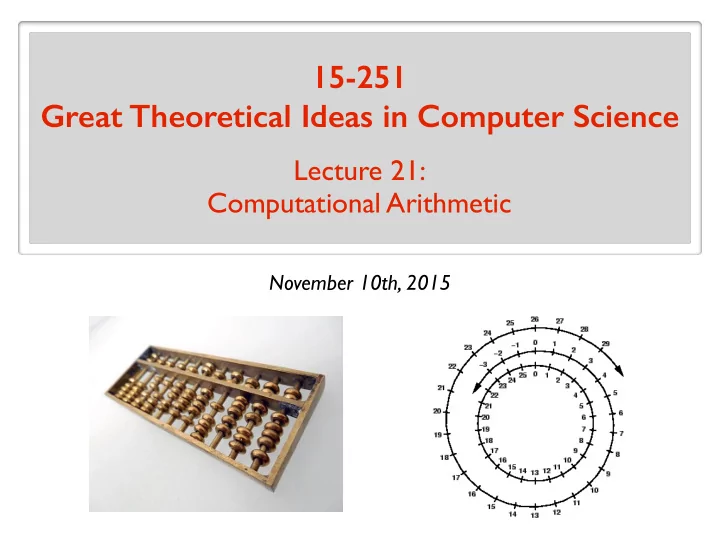
SLIDE 1
15-251 Great Theoretical Ideas in Computer Science
Lecture 21: Computational Arithmetic
November 10th, 2015
SLIDE 2
This week
Computational arithmetic (in particular, modular arithmetic) Cryptography (in particular, “public-key” cryptography)
+
SLIDE 3 Main goal of this lecture
Understanding modular arithmetic: theory + algorithms Goal: Why:
- 1. When we do addition or multiplication,
the universe is infinite (e.g. .) Z, Q, R Sometimes we prefer to restrict ourselves to a finite universe (e.g. the modular universe). And this is great for cryptography applications!
- 3. Some easy-to-do arithmetic operations in or
seem to be hard in the modular universe. Z Q
- 2. Some hard-to-do arithmetic operations in or
is easy in the modular universe. Z Q
SLIDE 4 Main goal of this lecture
Modular Universe
- How to view the elements of the universe?
- How to do basic operations:
> addition > subtraction > multiplication > division > exponentiation > taking roots > logarithm theory + algorithms (efficient (?))
SLIDE 5
The plan
Start with algorithms on good old integers. Then move to the modular universe.
SLIDE 6 Integers
3618502788666131106986593281521497110455743021169260358536775932020762686101 7237846234873269807102970128874356021481964232857782295671675021393065473695 3943653222082116941587830769649826310589717739181525033220266350650989268038 3194839273881505432422077179121838888281996148408052302196889866637200606252 6501310964926475205090003984176122058711164567946559044971683604424076996342 7183046544798021168297013490774140090476348290671822743961203698142307099664 3455133414637616824423860107889741058131271306226214208636008224651510961018 9789006815067664901594246966730927620844732714004599013904409378141724958467 7228950143608277369974692883195684314361862929679227167524851316077587207648 7845058367231603173079817471417519051357029671991152963580412838184841733782
Algorithms on numbers involve BIG numbers.
SLIDE 7 Integers
5693030020523999993479642904621911725098567020556258102766251487234031094429
B = B ≈ 5.7 × 1075 ( 5.7 quattorvigintillion ) B is roughly the number of atoms in the universe
- r the age of the universe in Planck time units.
Definition: len(B) = # bits to write B ≈ log2 B
5693030020523999993479642904621911725098567020556258102766251487234031094429
B = For len(B) = 251 (for crypto purposes, this is way too small)
SLIDE 8
Integers: Arithmetic
In general, arithmetic on numbers is not free! Think of algorithms as performing string-manipulation. Think of adding two numbers up yourself. (the longer the numbers, the longer it will take)
36185027886661311069865932815214971104 65743021169260358536775932020762686101 101928049055921669606641864835977657205
+ The number of steps is measured with respect to the length of the input numbers.
SLIDE 9
Integers: Addition
36185027886661311069865932815214971104 65743021169260358536775932020762686101 101928049055921669606641864835977657205
+ Grade school addition is linear time:
A B
C
len(A), len(B) ≤ n if number of steps to produce is C O(n)
SLIDE 10 Integers: Multiplication
36185027886661311069865932815214971104 5932020762686101
XXXXXXXXXXXXXXXXXXXXXXXXXXXXXXXXXXXXXX XXXXXXXXXXXXXXXXXXXXXXXXXXXXXXXXXXXXXX XXXXXXXXXXXXXXXXXXXXXXXXXXXXXXXXXXXXXX XXXXXXXXXXXXXXXXXXXXXXXXXXXXXXXXXXXXXX XXXXXXXXXXXXXXXXXXXXXXXXXXXXXXXXXXXXXX XXXXXXXXXXXXXXXXXXXXXXXXXXXXXXXXXXXXXX XXXXXXXXXXXXXXXXXXXXXXXXXXXXXXXXXXXXXX XXXXXXXXXXXXXXXXXXXXXXXXXXXXXXXXXXXXXX XXXXXXXXXXXXXXXXXXXXXXXXXXXXXXXXXXXXXX XXXXXXXXXXXXXXXXXXXXXXXXXXXXXXXXXXXXXX XXXXXXXXXXXXXXXXXXXXXXXXXXXXXXXXXXXXXX XXXXXXXXXXXXXXXXXXXXXXXXXXXXXXXXXXXXXX XXXXXXXXXXXXXXXXXXXXXXXXXXXXXXXXXXXXXX XXXXXXXXXXXXXXXXXXXXXXXXXXXXXXXXXXXXXX XXXXXXXXXXXXXXXXXXXXXXXXXXXXXXXXXXXXXX XXXXXXXXXXXXXXXXXXXXXXXXXXXXXXXXXXXXXX
x
214650336722050463946651358202698404452609868137425504
A B
C
# steps: O(len(A) · len(B)) = O(n2) len(A), len(B) ≤ n if
SLIDE 11 Integers: Division
36185027886661311069865932815214971104 6099949635084593037586
5932020762686101
A
B
Q
XXXXXXXXXXXXXXXXX XXXXXXXXXXXXXXXXX XXXXXXXXXXXXXXXXX XXXXXXXXXXXXXXXXX XXXXXXXXXXXXXXXXX XXXXXXXXXXXXXXXXX XXXXXXXXXXXXXXXXX XXXXXXXXXXXXXXXXX XXXXXXXXXXXXXXXXX XXXXXXXXXXXXXXXXX XXXXXXXXXXXXXXXXX XXXXXXXXXXXXXXXXX XXXXXXXXXXXXXXXXX XXXXXXXXXXXXXXXXX XXXXXXXXXXXXXXXXX XXXXXXXXXXXXXXXXX XXXXXXXXXXXXXXXXX XXXXXXXXXXXXXXXXX XXXXXXXXXXXXXXXXX
3960087002178918
R
A = Q · B + R # steps: O(len(A) · len(B)) R = A mod B
SLIDE 12 Integers: Exponentiation
Given as input , compute . B 2B
5693030020523999993479642904621911725098567020556258102766251487234031094429
B = If len(B) = 251 but ~ len(2B) 5.7 quattorvigintillion
(output length exceeds number of particles in the universe)
exponential in input length
SLIDE 13 Integers: Factorization
5693030020523999993479642904621911725098567020556258102766251487234031094429
A =
Goal: find one (non-trivial) factor of A
for B = 2, 3, 4, 5, … test if A mod B = 0. A =
It turns out:
68452332409801603635385895997250919383 83167801886452917478124266362673045163
x
Each factor ~ age of the universe in Planck time. ~ worst case: iterations. √ A exponential in input length √ A = √ 2log2 A = p 2len(A) = 2len(A)/2
SLIDE 14
Integers: Factorization
Fastest known algorithm is exponential time! That turns out to be a good thing: can break most cryptographic systems used on the internet If there is an efficient algorithm to solve the factoring problem
SLIDE 15
Integers: Primality testing
n = 2log2 n = 2len(n) Your favorite function from 15-112 exponential in input length # iterations: ~ ~ n
SLIDE 16
Integers: Primality testing
Exercise: Show that this is still exponential time.
SLIDE 17
Integers: Primality testing
Amazing result from 2002: There is a poly-time algorithm for primality testing. Agrawal, Kayal, Saxena undergraduate students at the time However, best known implementation is ~ time. O(n6) Not feasible when . n = 2048
SLIDE 18
Integers: Primality testing
So that’s not what we use in practice. Everyone uses the Miller-Rabin algorithm (1975). The running time is ~ . O(n2) It is a Monte Carlo algorithm with tiny error probability 1/2300 (say )
CMU Professor
SLIDE 19
Integers: Generating a random prime number
Suppose you need an n-bit long random prime number.
repeat: let A be a random n-bit number test if A is prime
Prime Number Theorem (informal): About 1/n fraction of n-bit numbers are prime. = ⇒expected # iterations of the above algorithm ~ O(n3). No poly-time deterministic algorithm is known!!
SLIDE 20
The plan
Start with algorithms on good old integers. Then move to the modular universe.
SLIDE 21 Main goal of this lecture
Modular Universe
- How to view the elements of the universe?
- How to do basic operations:
> addition > subtraction > multiplication > division > exponentiation > taking roots > logarithm theory + algorithms (efficient (?))
SLIDE 22
Modular universe: How to view the elements
Hopefully everyone already knows: Any integer can be reduced mod N. 1 2 3 4 5 6 7 8 9 10 11 12 Example N = 5 … 1 2 3 4 1 2 3 4 1 2 mod 5 … A mod N = remainder when you divide by A N
SLIDE 23
Modular universe: How to view the elements
We write or when . A ≡ B mod N A ≡N B A mod N = B mod N (In this case, we say is congruent to modulo .) A B N Examples 5 ≡5 100 13 ≡7 27 A ≡N B ⇐ ⇒ N divides A − B Exercise
SLIDE 24
Modular universe: How to view the elements
The universe is the finite set . View 2 ZN = {0, 1, 2, . . . , N − 1} 2 Points of View 1 2 3 4 5 6 7 8 9 10 11 12 1 2 3 4 1 2 3 4 1 2 mod 5 … … Z5 The universe is . Every element has a “mod N” representation. View 1 Z
SLIDE 25
Modular universe: Addition
Addition plays nice mod N A ≡N B A0 ≡N B0 A + A0 ≡N B + B0 = ⇒ 1 2 3 4 5 6 7 8 9 10 11 12 1 2 3 4 1 2 3 4 1 2 mod 5 … … + is always the same mod N
SLIDE 26
Modular universe: Addition
1 2 3 0 1 2 3 + 1 2 3 1 2 3 4 2 3 4 3 4 1 4 1 2 4 1 2 3 4 4 Addition table for Z5 0 is called the (additive) identity: 0 + A = A + 0 = A for any A
SLIDE 27
Modular universe: Subtraction
How about subtraction in ? What does mean? A − B It is actually addition in disguise: A + (−B) Then what does mean? −B ZN ZN Given any , we define to be the number in B −B such that . B + (−B) = 0
SLIDE 28
Modular universe: Subtraction
1 2 3 0 1 2 3 + 1 2 3 1 2 3 4 2 3 4 3 4 1 4 2 2 4 1 2 3 4 4 Addition table for Z5 −0 = 0 −1 = 4 −2 = 3 −3 = 2 −4 = 1
SLIDE 29
Modular universe: Subtraction
1 2 3 0 1 2 3 + 1 2 3 1 2 3 4 2 3 4 3 4 1 4 2 2 4 1 2 3 4 4 Addition table for Z5 Note:
i.e. every row is a permutation of .
ZN
A row contains distinct elements. This implies:
row col row col same col
For every , exists. Why? A ∈ ZN −A −A = N − A A + B A + B0 = = ⇒ B = B0 Fix row A
SLIDE 30
Modular universe: Multiplication
Multiplication plays nice mod N A · A0 ≡N B · B0 A ≡N B A0 ≡N B0 = ⇒ 1 2 3 4 5 6 7 8 9 10 11 12 1 2 3 4 1 2 3 4 1 2 mod 5 … …
.
is always the same mod N
SLIDE 31
Modular universe: Multiplication
1 2 3 0 1 2 3
.
1 2 3 2 4 1 3 1 4 4 3 2 4 3 2 1 4 4 Multiplication table for Z5 1 is called the (multiplicative) identity: 1 A = A 1 = A for any A
. .
SLIDE 32
Modular universe: Division
How about division in ? ZN What does mean? A ÷ B Then what does mean? B−1 ZN Given any , we define to be the number in B such that B−1 B · B−1 = 1. It is actually multiplication in disguise: A · B−1 A · 1 B =
SLIDE 33
Modular universe: Division
1 2 3 0 1 2 3
.
1 2 3 2 4 1 3 1 4 4 3 2 4 3 2 1 4 4 Multiplication table for Z5 0−1 = undefined 1−1 = 1 2−1 = 3 3−1 = 2 4−1 = 4
SLIDE 34
Modular universe: Division
1 2 3 0 1 2 3
.
1 2 3 2 4 3 3 4 2 4 2 0 4 4 4 Multiplication table for 0−1 = undefined 1−1 = 1 Z6 5 4 3 2 5 4 3 2 1 5 5 5−1 = 5 2−1 = undefined 3−1 = undefined 4−1 = undefined WTF?
SLIDE 35
Modular universe: Division
1 2 3 0 1 2 3
.
1 2 3 2 4 6 3 6 2 4 1 5 4 1 5 2 4 4 Multiplication table for 5 3 1 6 5 3 1 6 4 5 5 Z7 6 5 4 3 2 6 6 5 4 3 2 6 1 Every number except 0 has a multiplicative inverse.
SLIDE 36
Modular universe: Division
1 2 3 0 1 2 3
.
1 2 3 2 4 6 3 6 1 4 4 4 4 0 4 4 Multiplication table for 5 2 7 4 5 2 7 4 1 5 5 6 4 2 6 6 6 4 2 0 6 6 4 7 6 5 4 3 7 2 7 6 5 4 3 7 2 1 Z8 {1, 3, 5, 7} have inverses. Others don’t.
SLIDE 37
Modular universe: Division
Fact: exists if and only if A−1 ∈ ZN gcd(A, N) = 1. gcd(a, b) = greatest common divisor of and . a b gcd(12, 18) = 6 Examples: gcd(13, 9) = 1 gcd(1, a) = 1 ∀a gcd(0, a) = a ∀a If , we say and are relatively prime. gcd(a, b) = 1 a b
SLIDE 38
Modular universe: Division
Fact: exists if and only if A−1 ∈ ZN gcd(A, N) = 1. Definition: Z∗
N = {A ∈ ZN : gcd(A, N) = 1}.
Definition: ϕ(N) = |Z∗
N|
Note that is “closed” under multiplication, Z∗
N
i.e., A, B ∈ Z∗
N =
⇒ AB ∈ Z∗
N
(Why?)
SLIDE 39
Modular universe: Division
1 2 3 0 1 2 3
.
1 2 3 2 4 1 3 1 4 4 3 2 4 3 2 1 4 4 Z∗
5
ϕ(5) = 4
SLIDE 40
Modular universe: Division
1 2 3 1 2 3
.
1 2 3 2 4 1 3 1 4 4 3 2 4 3 2 1 4 4 Z∗
5
ϕ(5) = 4
SLIDE 41
Modular universe: Division
1 2 3 1 2 3
.
1 2 3 2 4 1 3 1 4 4 3 2 4 3 2 1 4 4 Z∗
5
P For prime, ϕ(P) = P − 1.
SLIDE 42
Modular universe: Division
1 2 3 0 1 2 3
.
1 2 3 2 4 6 3 6 1 4 4 4 4 0 4 4 5 2 7 4 5 2 7 4 1 5 5 6 4 2 6 6 6 4 2 0 6 6 4 7 6 5 4 3 7 2 7 6 5 4 3 7 2 1 Z∗
8
ϕ(8) = 4
SLIDE 43
Modular universe: Division
1 3 1 3
.
1 3 3 1 5 7 5 7 1 5 5 7 5 3 7 7 5 3 7 1 Z∗
8
ϕ(8) = 4
SLIDE 44
Modular universe: Division
1 2 4 7 1 2 4 7
.
1 2 4 7 2 4 8 14 4 8 1 13 7 14 13 4 8 1 2 11 8 1 2 11 4 8 8 11 7 14 2 13 11 7 14 2 13 1 11 11 13 11 7 1 14 8 13 13 11 7 1 14 8 13 4 14 13 11 8 7 4 14 2 14 13 11 8 7 4 14 2 1 Z∗
15
ϕ(15) = 8
SLIDE 45
Modular universe: Division
1 2 4 7 1 2 4 7
.
1 2 4 7 2 4 8 14 4 8 1 13 7 14 13 4 8 1 2 11 8 1 2 11 4 8 8 11 7 14 2 13 11 7 14 2 13 1 11 11 13 11 7 1 14 8 13 13 11 7 1 14 8 13 4 14 13 11 8 7 4 14 2 14 13 11 8 7 4 14 2 1 Z∗
15
Exercise: For distinct primes, . P, Q
ϕ(PQ) = (P − 1)(Q − 1)
SLIDE 46
Modular universe: Division
Z∗
8
1 3 1 3
.
1 3 3 1 5 7 5 7 1 5 5 7 5 3 7 7 5 3 7 1 ϕ(8) = 4
i.e. every row is a permutation of . A row contains distinct elements. This implies:
Z∗
N
For every , exists. A ∈ Z∗
N
A−1 A · B = A · B0 = ⇒ B = B0
SLIDE 47
1 2 3 1 2 3 + 1 2 3 1 2 3 2 3 1 3 1 2 1 3 5 7 1 3 5 7
.
1 3 5 7 3 1 7 5 5 7 1 3 7 5 3 1 Z4 Z∗
8
behaves nicely with respect to addition behaves nicely with respect to multiplication Summary
SLIDE 48
Modular universe: Exponentiation
We saw for integers, no hope for a poly-time algorithm. In fact, we can compute this efficiently! In the modular universe, length of output not an issue. Given Compute . A, B, N, len(A), len(B), len(N) ≤ n AB mod N
SLIDE 49 Modular universe: Exponentiation
Example Compute . 233732 mod 100 Naïve strategy: 2337 x 2337 = 5461569 2337 x 5461569 = 12763686753 2337 x 12763686753 = … . . .
(30 more multiplications later)
626727565152155511653188886668668588313475824236665607396755008905770146236635537228216696030970612828922881
SLIDE 50 Modular universe: Exponentiation
Example Compute . 233732 mod 100 2 improvements:
- Reduce mod 100 after every step.
- Don’t multiply 32 times. Square 5 times.
2337 − → 23372 − → 23374 − → 23378 − → 233716 − → 233732
(what if the exponent was 53?)
SLIDE 51
Modular universe: Exponentiation
Example Compute . 233753 mod 100 Multiply powers 32, 16, 4, 1. (53 = 32 + 16 + 4 + 1) 233732 · 233716 · 23374 · 23371 233753 = 110101 53 in binary = (what if the exponent was 53?)
SLIDE 52 Modular universe: Exponentiation
Algorithm: Running time: a bit more than . O(n2 log n) Given Compute . A, B, N, len(A), len(B), len(N) ≤ n AB mod N
- Repeatedly square , always mod .
Do this times. A n
- Multiply together the powers of
corresponding to the binary digits of A B (again, always mod ). N N
SLIDE 53
Modular universe: Exponentiation
Anything interesting we can do in the special case of Given Compute . A, B, N, len(A), len(B), len(N) ≤ n AB mod N gcd(A, N) = 1? i.e. A ∈ Z∗
N
SLIDE 54
Modular universe: Exponentiation
Euler’s Theorem: For any , . A ∈ Z∗
N
Aϕ(N) = 1 Equivalently, for and with , A N gcd(A, N) = 1 Aϕ(N) ≡ 1 mod N Fermat’s Little Theorem: Let be a prime. For any , P A ∈ Z∗
P
AP −1 = 1. Equivalently, for any not divisible by , A P AP −1 ≡ 1 mod P When N is a prime, this is known as:
SLIDE 55
Modular universe: Exponentiation
Example 1 3 5 7 1 3 5 7
.
1 3 5 7 3 1 7 5 5 7 1 3 7 5 3 1 Z∗
8
ϕ(8) = 4 3 32 33 34 35 36 37 38 1 12 13 14 15 16 17 18 5 52 53 54 55 56 57 58 7 72 73 74 75 76 77 78 1 1 1 1 1 1 1 1 3 1 3 1 3 1 3 1 5 1 5 1 5 1 5 1 7 1 7 1 7 1 7 1
SLIDE 56
Modular universe: Exponentiation
Example 1 2 3 4 1 2 3 4
.
3 32 33 34 35 36 37 38 1 12 13 14 15 16 17 18 1 1 1 1 1 1 1 1 3 4 2 1 3 4 2 1 1 2 3 2 4 1 3 1 4 4 3 2 4 3 2 1 2 22 23 24 25 26 27 28 2 4 3 1 2 4 3 1 4 42 43 44 45 46 47 48 4 1 4 1 4 1 4 1 Z∗
5
2 and 3 are called generators.
ϕ(8) = 4
SLIDE 57 Poll
What is ? 213248 mod 7
SLIDE 58
Poll Answer
Euler’s Theorem: For any , . A ∈ Z∗
N
Aϕ(N) = 1 A1 A2 A0 · · · Aϕ(N) Aϕ(N)+1 A2ϕ(N) A2ϕ(N)+1 · · · || A0 || A1 || A0 || A1 · · · In other words, the exponent can be reduced mod ϕ(N). = 2 || 1 213248 ≡7 3248 3248 ≡7 32
SLIDE 59
Poll Answer
When exponentiating elements A ∈ Z∗
N
can think of the exponent living in the universe . Zϕ(N)
SLIDE 60 Modular universe: Taking logarithms
Given such that: Find such that . A, B, P P
P
B ∈ Z∗
P
X BX ≡P A It is like we want to compute . logB A
SLIDE 61 Poll
What do you think of this algorithm:
DiscreteLog(A, B, P): for X = 0, 1, 2, …, P-2 compute B (use fast modular exponentiation) check whether P divides B - A
Find such that . X BX ≡P A
X X
- simple and efficient. love it.
- loop should go up to X = P-1
- simple but not efficient.
- I don’t understand what is going on right now.
- I don’t understand why we are checking if P divides B - A.
X
SLIDE 62 Modular universe: Taking logarithms
We don’t know how to compute this efficiently!
Given such that: Find such that . A, B, P P
P
B ∈ Z∗
P
X BX ≡P A
SLIDE 63
Modular universe: Taking roots
As an example, let’s consider taking cube roots Given such that . A, N A ∈ Z∗
N
Find such that B B3 ≡N A. We don’t know how to compute this efficiently!
SLIDE 64 Main goal of this lecture
Modular Universe
- How to view the elements of the universe?
- How to do basic operations:
> addition > subtraction > multiplication > division > exponentiation > taking roots > logarithm theory + algorithms (efficient (?))
SLIDE 65
Back to division in the modular universe (i.e. things you will prove in the homework)
😁
SLIDE 66
2 Questions remain
How do you prove: exists if and only if A−1 ∈ ZN gcd(A, N) = 1. How do you compute: A · B−1 mod N i.e., how do you compute B−1?
SLIDE 67
How to compute the multiplicative inverse
To determine if has an inverse, we need to compute B gcd(B, N) Euclid’s Algorithm finds gcd in polynomial time. Arguably the first ever algorithm. ~ 300 BC How do you compute: A · B−1 mod N i.e., how do you compute B−1?
SLIDE 68
How to compute the multiplicative inverse
gcd(A, B): if B == 0, return A return gcd(B, A mod B)
Euclid’s Algorithm Homework Why does it work? Why is it polynomial time?
SLIDE 69 Major open problem in Computer Science Is gcd computation efficiently parallelizable? i.e., is there a circuit family of
- poly(n) size
- polylog(n) depth
that computes gcd?
SLIDE 70
How to compute the multiplicative inverse
Ok, Euclid’s Algorithm tells us whether an element has an inverse. How do you find it if it exists? Definition: We say that is a miix of and if C A B C = k · A + ` · B for some k, ` ∈ Z. Examples: 2 is a miix of 14 and 10: 2 = (-2) 14 + 3 10 . . 7 is not a miix of 55 and 40: any miix would be divisible by 5. Any multiple of 2 is a miix of 14 and 10.
not a real term 😌
SLIDE 71
How to compute the multiplicative inverse
Fact: is a miix of and if and only if C A B is a multiple of . gcd(A, B) C The coefficients and can be found by slightly modifying Euclid’s Algorithm. k ` If , we can find such that gcd(B, N) = 1 k, ` ∈ Z 1 = k · B + ` · N gcd(A, B) = k · A + ` · B So || B−1 Therefore found Finding : B−1
SLIDE 72
2 Questions remain
How do you prove: exists if and only if A−1 ∈ ZN gcd(A, N) = 1. How do you compute: A · B−1 mod N i.e., how do you compute B−1?
SLIDE 73
When does the inverse exist
How do you prove: exists if and only if A−1 ∈ ZN gcd(A, N) = 1. Proof: A−1 exists ⇐ ⇒ ∃k such that k · A ≡N 1 ∃k, q such that 1 = k · A + (−q) · N ⇐ ⇒ 1 is a miix of A and N ⇐ ⇒ gcd(A, N) = 1 ⇐ ⇒ divides N k · A − 1 ⇐ ⇒ ∃k, q such that k · A − 1 = q · N
SLIDE 74 Main goal of this lecture
Modular Universe
- How to view the elements of the universe?
- How to do basic operations:
> addition > subtraction > multiplication > division > exponentiation > taking roots > logarithm theory + algorithms (efficient (?))
SLIDE 75
Next Time Cryptography