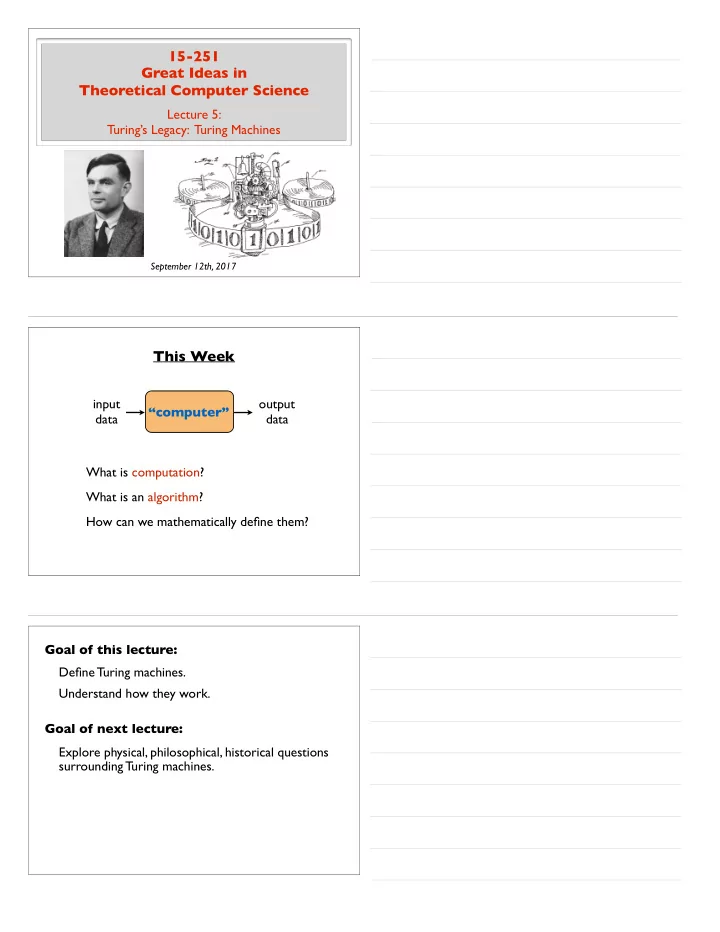
SLIDE 1 September 12th, 2017
15-251 Great Ideas in Theoretical Computer Science
Lecture 5: Turing’s Legacy: Turing Machines input data
data “computer” What is computation? What is an algorithm? How can we mathematically define them?
This Week
Goal of this lecture: Goal of next lecture: Define Turing machines. Understand how they work. Explore physical, philosophical, historical questions surrounding Turing machines.
SLIDE 2 Let’s assume two things about our world
- 1. No “universal” machines exist.
- 2. We only have machines to solve decision problems.
+
isPrime Sorting DFA |x| even?
DFA: state diagram + input tape
… 1 1 1 1 1 t t t
t
t
DFA: state diagram + input tape
… 1 1 1 1 1 t t t
t
t Decision: Accept
SLIDE 3 DFA as a programming language
1 1 1 1
input = def foo(input): i = 0; STATE 0: if (i == input.length): return False; letter = input[i]; i++; switch(letter): case ‘0’: go to STATE 0; case ‘1’: go to STATE 1; STATE 1: if (i == input.length): return True; letter = input[i]; i++; switch(letter): case ‘0’: go to STATE 2; case ‘1’: go to STATE 2;
…
machine ≈ algorithm describing it
input data
data a DFA
algorithm
input data
data “computer” What is computation? What is an algorithm? How can we mathematically define them? The properties we want from the definition:
SLIDE 4 1936 1900 2015 input data
data “computer” 2 important observations: Regular languages EvenLength . . . isPrime 0n1n Factoring . . . Solvable with any computing device
SLIDE 5
Solving 0n1n in Python
def foo(input): i = 0 j = len(input) - 1 while(j >= i): if(input[i] != ‘0’ or input[j] != ‘1’): return False i = i + 1 j = j - 1 return True
Solving 0n1n in C
int foo(char input[]) { int i = 0, j; while(input[j] != NULL) /* NULL is end-of-string character */ j++; j—; while(j >= i) { if(input[i] != ‘0’ || input[j] != ‘1’) return 0; /* Reject */ i++; j—; } return 1; /* Accept */ }
Regular languages EvenLength . . . isPrime 0n1n Factoring . . . Solvable with Python???
SLIDE 6
Should we define computable to mean what is computable by a Python function/program? Downsides as a formal definition? A totally minimal (TM) programming language such that: So what we want is: Actually TM™ stands for Turing machine. Defined by Alan Turing in a paper he wrote in 1936 while he was a PhD student.
SLIDE 7 Turing machine description
TM ~ DFA + infinite tape ~ a a b a t t
t
t t t
t t
t t t t
t t
1 2 3 4 5 6 7 8 9 10 11 12 13
Turing machine description
TM could have been defined as a sequence of instructions, where the allowed instructions are:
a a b a t t
t
t t t
t t
t t t t
t t
1 2 3 4 5 6 7 8 9 10 11 12 13
> Move the head left > Move the head right > Write a symbol a (from the alphabet) > If head is reading symbol a, GOTO step j > Halt and accept > Halt and reject
But, we want to keep the definition as simple as possible.
TM ~ DFA + infinite tape ~
Turing machine description
a a b a t t
t
t t t
t t
t t t t
t t
1 2 3 4 5 6 7 8 9 10 11 12 13
So a TM is a sequence of steps (states), each looking like:
STATE 0: switch(letter under the head): case ‘a’: write ‘b’; move Left; go to STATE 2; case ‘b’: write ‘ ’; move Right; go to STATE 0; case ‘ ’: write ‘b’; move Left; go to STATE 1;
t
t
TM ~ DFA + infinite tape ~
SLIDE 8 Turing machine description
STATE 0: switch(letter under the head): case ‘a’: write ‘b’; move Left; go to STATE 2; case ‘b’: write ‘ ’; move Right; go to STATE 0; case ‘ ’: write ‘b’; move Left; go to STATE 1;
t t
At each step, you have to:
- write a new symbol to the cell under the head
- move tape head Left or Right
- go to a new state
Don’t want to change the symbol: Want to stay put: Don’t want to change state:
Turing machine official picture
a a b a t t
t
t t t
t t
t t t
q0 qacc
qrej qa
qb
b 7! t, L
b 7! t, L a 7! t, L a 7! t, L a 7! t, R b 7! t, R t 7! t, L t 7! t, L
t 7! t, R
t
t t
Input: aaba
1 2 3 4 5 6 7 8 9 10 11 12 13
TM as a programming language
def M(input): i = 0 STATE 0: letter = input[i]; switch(letter): case ‘a’: input[i] = ‘ ’; i++; go to STATE a; case ‘b’: input[i] = ‘ ’; i++; go to STATE b; case ‘ ’: input[i] = ‘ ’; i++; go to STATE rej; STATE a: letter = input[i]; switch(letter): case ‘a’: input[i] = ‘ ’; i--; go to STATE acc; case ‘b’: input[i] = ‘ ’; i--; go to STATE rej; case ‘ ’: input[i] = ‘ ’; i--; go to STATE rej;
. . .
SLIDE 9 Poll
The machine accepts a string x if and only if:
Exercise
Let . Σ = {a, b} Draw the state diagram of a TM that accepts a string iff it starts and ends with an . a
Formal definition: Turing machine
where
- is a finite set (which we call the set of states);
Q
(which we call the start state); M A Turing machine (TM) is a 7-tuple M = (Q, Σ, Γ, δ, q0, qacc, qrej)
- (which we call the accept state);
qacc ∈ Q
(which we call the input alphabet); Σ t 62 Σ
(which we call the tape alphabet); Γ t 2 Γ Σ ⊂ Γ
- , (which we call the reject state);
qrej ∈ Q qrej 6= qacc
- is a function of the form
δ
(which we call the transition function);
δ : Q × Γ → Q × Γ × {L, R}
SLIDE 10
Formal definition: TM accepting a string
A bit more involved to define rigorously. Not too much though. See course notes.
DFAs vs TMs Definition: decidable/computable languages
What is the analog of regular languages in this setting? M We let denote the set of strings that accepts. M L(M) So, L(M) = {x ∈ Σ∗ : M(x) accepts.} Let be a Turing machine.
SLIDE 11
regular languages = decidable languages
? Turing machine that decides 0n1n
q0
qacc
qrej
q1
qdone? qleft
qright
t
1 #
# 7! R 0 7! #, R 0, 1 7! R t , # 7 ! L 0, 1 7! L 1 7! #, L , 1 7 ! L
(Omitted information defined arbitrarily. Missing transitions go to the reject state.)
Σ = {0, 1} Γ = {0, 1, #, t}
0, #
Turing machine that decides 0n1n
t
t
t t t
t t
t t t 1 1 1 Input: 00001011
SLIDE 12 Turing machine that decides 0n1n
t
t
t t t
t t
t t t 1 Input: 00001011 #
# # #
# Decision: reject
Some TM subroutines and tricks
- Shift entire input string one cell to the right
to
x1x2x3 . . . xn tx1 t x2 t x3 . . . t xn
Γ {0, 1, t}
- “Mark” cells. If , extend it to
Γ = {0, 1, t} Γ = {0, 1, 0 , 1 , t}
- Copy a stretch of tape between two marked cells
into another marked section of the tape t
- Move right (or left) until first encountered
Some TM subroutines and tricks
- Implement basic string and arithmetic operations
- Simulate a TM with 2 tapes and heads
- Implement basic data structures
- Simulate “random access memory”
- Simulate assembly language
. . .
You could prove this rigorously if you wanted to.
SLIDE 13 A totally minimal (TM) programming language such that
- it can simulate simple bytecode
So what we want is: (and therefore Python, C, Java, SML, etc…)
- it is simple to define and reason about completely
mathematically rigorously A note You could describe a TM in 3 ways: Low level description Medium level description High level description Is there a reasonable definition of “algorithm” that can compute more languages than TM-decidable ones? Is TM the right definition? Important Question
SLIDE 14
Regular languages TM-decidable EvenLength . . . isPrime 0n1n Factoring . . . Solvable with any computing device
?