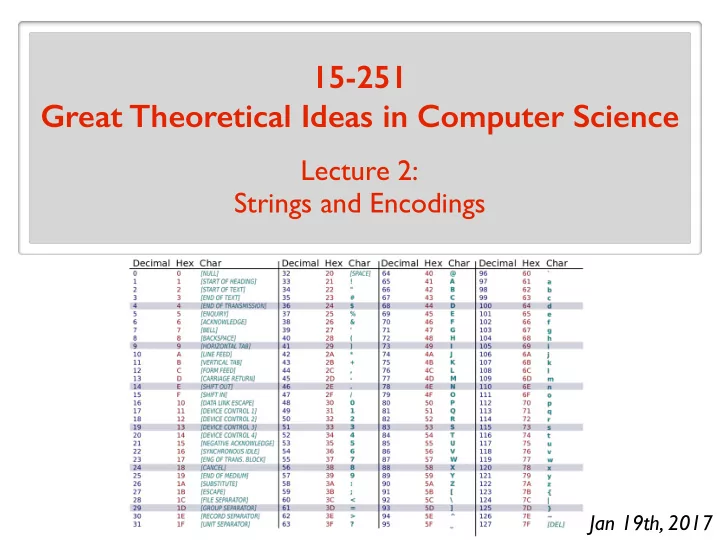
SLIDE 1
Jan 19th, 2017
15-251 Great Theoretical Ideas in Computer Science
Lecture 2: Strings and Encodings
SLIDE 2
Chessboard Puzzle
neighbors in direction N, S, W, E If a square has 2 or more infected neighbors, it becomes infected.
Question: What is the min number of infected squares needed initially to infect the whole board?
Initially, some of the squares are “infected”.
SLIDE 3
Objects/concepts we want to study and understand Mathematical model (formal, precise definitions) Mathematically/rigorously prove facts/theorems
SLIDE 4 input data
data “computer” Computation: manipulation of data. How do we mathematically/formally represent data?
SLIDE 5
We have already done it for communication purposes. Written communication: 1 2 3 “apple” “car” “happy” “three” or “3”
SLIDE 6 English alphabet Σ = {a,b,c,d,e,f,g,h,i,j,k,l,m,n,o,p,q,r,s,t,u,v,w,x,y,z} Turkish alphabet Σ = {a,b,c,¸ c,d,e,f,g,¯ g,h,ı,i,j,k,l,m,n,o,¨
s,t,u,¨ u,v,y,z} Binary alphabet Σ = {0, 1} What if we had more symbols? What if we had less symbols?
SLIDE 7
An element of an alphabet is called a symbol or character. An alphabet is a non-empty, finite set (usually denoted by ). Σ Any (usually finite) sequence of symbols from is called a string (or a word) over . Σ Σ A string is denoted by , where each a1a2a3 . . . an ai ∈ Σ. Example: Some strings over : Σ = {0, 1} ✏ 1 01 1011110101101111 Example: Some strings over : ✏ Σ = {a, b, c} a b c ca caabcccab
SLIDE 8
Given an alphabet , Σ Σ∗ denotes the set of all finite length strings over . Σ Examples:
{a}∗ = {✏, a, aa, aaa, aaaa, aaaaa, . . .}
{✏, 0, 1, 00, 01, 10, 11, 000, 001, 010, 011, 100, 101, 110, 111 . . .}
{0, 1}∗ =
Length of a string , , is the number of symbols in . s |s| s
SLIDE 9
Written English
Objects/concepts of interest String encoding
apple Σ = {a,b,c,d,e,f,g,h,i,j,k,l,m,n,o,p,q,r,s,t,u,v,w,x,y,z} car happy Does every string correspond to a valid encoding? Does every object have a corresponding encoding? Can two objects have the same encoding?
SLIDE 10
Given a set of objects, an encoding of is an injective function A A Enc : A → Σ∗ . Notation: For , denotes a ∈ A hai Enc(a). Technicality Alert: not all sets are encodable.
SLIDE 11
Examples A = N Σ = {0, 1, 2, 3, 4, 5, 6, 7, 8, 9} Σ = {1} Does affect “encodability”? Σ h36i = “36” Σ = {0, 1} h36i = “100100” h36i = “111111111111111111111111111111111111”
SLIDE 12
Examples A = Z Σ = {−, 0, 1, 2, 3, 4, 5, 6, 7, 8, 9} Σ = {0, 1} Σ = {1}? h36i = “ 36” h36i = “1100100”
SLIDE 13
Examples A = N × N Σ = {0, 1} Σ = {0, 1, 2, 3, 4, 5, 6, 7, 8, 9, #} h(3, 36)i = h3, 36i = “3#36” Idea: encode all symbols above using 4 bits (why 4?)
0 → 0000 1 → 0001 2 → 0010 3 → 0011 4 → 0100 5 → 0101 6 → 0110 7 → 0111
8 → 1000 9 → 1001 # → 1010
h3, 36i = “0011101000110110”
SLIDE 14
Examples A = all undirected graphs 1 4 5 2 3 6 G
“ ” V = {1, 2, 3, 4, 5, 6} E = {{1,2}, {2,3}, {3,4}, {1,4}, {5,6}}
hGi =
SLIDE 15
Examples A = all undirected graphs 1 4 5 2 3 6 1 1 1 1 1 1 1 1 1 1 1 2 3 4 5 6 1 2 3 4 5 6 G 010100#101000#010100#101000#000001#000010 “ ” hGi =
SLIDE 16
Examples A = all Python functions def isPrime(N): if (N < 2): return False for factor in range(2, N): if (N % factor == 0): return False return True hisPrimei =
“def isPrime(N):\n if (N < 2):\n return False\n for factor in range(2, N):\n if (N % factor == 0):\n return False\n return True”
SLIDE 17 Does matter? |Σ| Going from to : |Σ| = k |Σ0| = 2 Σ t encode every symbol of using bits, where . t = dlog2 ke A word of length n
A word of length
tn Σ0
SLIDE 18
Does matter? |Σ| Binary vs Unary 1 2 3 4 5 6 7 8 9 10 11 12 1 10 11 100 101 110 111 1000 1001 1010 1011 1100 1 11 111 1111 11111 111111 1111111 11111111 111111111 1111111111 11111111111 111111111111 ✏
SLIDE 19
Does matter? |Σ| Binary vs Unary has length in binary blog2 nc + 1 n has length in unary n n has length in base n blogk nc + 1 k Unary is exponentially longer than other bases!
SLIDE 20
Which sets are encodable? Encodability = Countability (Lecture 7)
SLIDE 21
What about uncountable sets? Approximate.
SLIDE 22 Data is represented as finite length strings
- ver some finite alphabet.
Reasoning about computation requires reasoning about strings.
SLIDE 23
Inductive Reasoning (powerful tool for understanding recursive structures)
SLIDE 24
Induction Review Domino Principle Line up any number of dominos in a row, knock the first one over and they will all fall.
SLIDE 25 Induction Review Domino Principle Line up an infinite row of dominoes,
- ne domino for each natural number.
Knock the first one over and they will all fall. Proof: Proof by contradiction: suppose they don’t all fall.
Let k be the lowest numbered domino that remains standing. Domino k-1 did fall. But then k-1 knocks over k, and k falls. So k stands and falls, which is a contradiction.
SLIDE 26 Induction Review Mathematical induction: statements proved instead of dominoes fallen Infinite sequence of dominoes Infinite sequence of statements: S0, S1, S2, … Fk = “domino k fell” Fk = “Sk proved” Establish:
- 1. F0
- 2. for all k, Fk Fk+1
= ⇒ Conclude: Fk is true for all k.
SLIDE 27 Induction Review Mathematical induction: statements proved instead of dominoes fallen Infinite sequence of dominoes Infinite sequence of statements: S0, S1, S2, … Fk = “domino k fell” Fk = “Sk proved” Establish:
- 1. F0
- 2. for all k, F0, F1,…,Fk Fk+1
= ⇒ Conclude: Fk is true for all k. “Strong” Induction
SLIDE 28
Different ways of packaging inductive reasoning Example: Every natural number > 1 can be factored into primes. Proof (by contradiction): Let n be the smallest counter-example. n cannot be prime, so n = ab, where 1 < a, b < n. Since n is the smallest counter-example, a and b must have prime factorizations. Then so does n. Contradiction. “Method of Min Counterexample”
SLIDE 29
Different ways of packaging induction proofs “Method of Min Counterexample” Let k be the min number such that Sk is not true. Show that Sk’ is not true for k’ < k. Contradiction. By contradiction. The general idea of method of min counterexample:
SLIDE 30
“Invariant Induction” Example:
At any party, at any point in time, define a person’s parity as odd/even according to the number of hands they have shaken. Statement: number of people of odd parity must be even.
Different ways of packaging induction proofs
SLIDE 31 “Invariant Induction”
Statement: number of people of odd parity must be even. Initial state: 0 hands have been shaken. 0 people have odd parity. Invariant argument:
even even
even even
t <— t-2 At an arbitrary point in the party, let t be the number # people with odd parity. t <— t+2 t <— t t <— t parity of t doen’t change. Proof:
Different ways of packaging induction proofs
SLIDE 32
“Invariant Induction” Time-varying world state: W0, W,1 W2, … Want to prove: statement S is true for all world states. Argue: Statement S is true for W0. If S is true for Wk, it remains true for Wk+1. The general idea of invariant induction: Different ways of packaging induction proofs
SLIDE 33 “Structural Induction” Induction on objects with a recursive structure. . .
- arrays/lists
- strings
- graphs
. Different ways of packaging induction proofs
SLIDE 34 “Structural Induction” Recursive definition of a string over : Σ
- the empty sequence is a string.
✏
- if is a string and , then is a string.
x a ∈ Σ ax Different ways of packaging induction proofs
SLIDE 35 “Structural Induction” Recursive definition of a rooted binary tree:
- a single node r is a binary tree with root r.
- if T1 and T2 are binary trees with roots r1 and r2,
then T which has a node r adjacent to r1 and r2 is a binary tree with root r. T1 T2 T = r1 r2 r
Every node has 0 or 2 children.
Different ways of packaging induction proofs
SLIDE 36 “Structural Induction” Recursive definition of a rooted binary tree:
- a single node r is a binary tree with root r.
- if T1 and T2 are binary trees with roots r1 and r2,
then T which has a node r adjacent to r1 and r2 is a binary tree with root r. T1 T2 T = r1 r2 r
Every node has 0 or 2 children.
leaves internal nodes
Different ways of packaging induction proofs
SLIDE 37
“Structural Induction” Example: Let T be a binary tree. Let LT = # leaves in T. Let IT = # internal nodes in T. Then LT = IT + 1. Different ways of packaging induction proofs
SLIDE 38
“Structural Induction” Proof (by structural induction): T1 T2 T = r1 r2 r Let T be an arbitrary binary tree: We know LT = LT1 + LT2 and IT = IT1 + IT2 + 1. Base case (T is a single node) is true. By IH: LT1 = IT1 + 1 and LT2 = IT2 + 1. So LT = LT1 + LT2 = IT1 + 1 + IT2 + 1 = IT + 1. Different ways of packaging induction proofs
SLIDE 39
“Structural Induction” The general idea of structural induction:
Base step: check statement true for base case(s) of def’n. Recursive/induction step: prove statement holds for new objects created by the recursive rule, assuming it holds for old objects used in the recursive rule.
Different ways of packaging induction proofs
SLIDE 40 “Structural Induction” Why is that valid? Follows from strong induction on # of applications
- f the recursive rule to create a particular object.
(even though we don’t phrase it explicitly that way)
Previous example: Could have also packaged it as strong induction on the parameter height.
Different ways of packaging induction proofs
SLIDE 41
“Structural Induction”
Be careful! What is wrong with the following argument?
Strong induction on height. Base case true. Take an arbitrary binary tree T of height h. Let T’ be the following tree of height h+1: T1 T’ = r r1 r2 blah blah blah Therefore statement true for T’ of height h+1. Different ways of packaging induction proofs
SLIDE 42 “Structural Induction” Another example with strings: Let be recursively defined as follows: L ⊆ {0, 1}∗
✏ ∈ L
x, y ∈ L 0x1y0 ∈ L Prove that for any , . w ∈ L #(0, w) = 2 · #(1, w) number of 0’s in w number of 1’s in w Different ways of packaging induction proofs
SLIDE 43
“Structural Induction” Proof (by structural induction): Base case is and w = ✏ #(0, ✏) = 2 · #(1, ✏). By IH: and #(0, x) = 2 · #(1, x) #(0, y) = 2 · #(1, y). Assume statement is true for all u ∈ L, |u| < k. Let be an arbitrary element of with . w L |w| = k So for some w = 0x1y0 x, y ∈ L, |x| < k, |y| < k. Then: #(0, w) = 2 + #(0, x) + #(0, y) = 2 + 2 · #(1, x) + 2 · #(1, y) = 2(1 + #(1, x) + #(1, y)) = 2 · #(1, w) Different ways of packaging induction proofs
SLIDE 44
Back to string encodings
SLIDE 45 input data
data “computer” What is computation? What is an algorithm? How can we mathematically define them?
First Few Weeks
SLIDE 46
Can encode/represent any kind of data (numbers, text, pairs of numbers, graphs, images, etc…) with a finite length (binary) string. Seen so far: Before we define algorithm formally, we should define computational problem formally.
SLIDE 47
An algorithm solves a computational problem. Example description of a computational problem: Given a natural number N, output True if N is prime, and output False otherwise. Example algorithm solving it:
def isPrime(N): if (N < 2): return False for factor in range(2, N): if (N % factor == 0): return False return True
SLIDE 48 input data
data
isPrime
Instance Solution No 1 No 2 Yes 3 Yes 4 No . . . . . . 251 Yes . . . . . .
SLIDE 49 input data
data
+
Instance Solution 0, 0 0, 1 1 1, 1 2 2, 2 4 2, 3 5 10, 1 11 100, 99 199 . . . . . .
SLIDE 50 input data
data
Sorting
[“vanilla”, “mind”, “Anil”, “yogurt”, “doesn’t”] Instance Solution [“Anil”, “doesn’t”, “mind”, “vanilla”, “yogurt”]
SLIDE 51
A computational problem is a function f : A → B . A = B = set of possible input objects (called instances) set of possible output objects (called solutions) But in TCS, we don’t deal with arbitrary objects, we deal with strings (encodings). f 0 : Σ⇤ → Σ⇤ f : A → B
Enc
Technicality: What if does not correspond to an encoding of an instance? w ∈ Σ∗
SLIDE 52
f : Σ∗ → Σ∗ Definition: A computational problem is a function . Definition: A decision problem is a function . f : Σ∗ → {0, 1}
No, Yes False, True Reject, Accept
IMPORTANT DEFINITIONS Definition: A subset is called a language. L ⊆ Σ∗
SLIDE 53
IMPORTANT RELATIONSHIP There is a one-to-one correspondence between decision problems and languages.
Instance Solution ✏ 1 1 1 1 00 1 01 10 11 1 000 1 001 . . . . . .
L ⊆ Σ∗ {✏, 0, 1, 00, 11, 000, . . .} L =
SLIDE 54 Our focus will be on languages! (decision problems)
- Convenient restriction.
- Usually “without loss of generality”.
(more on this next lecture)
SLIDE 55
Are all languages computable/decidable? How can we prove that a language is not decidable? How do we measure complexity of algorithms deciding languages? P = NP? How do we classify languages according to resources needed to decide them? INTERESTING QUESTIONS WE WILL EXPLORE ABOUT COMPUTATION