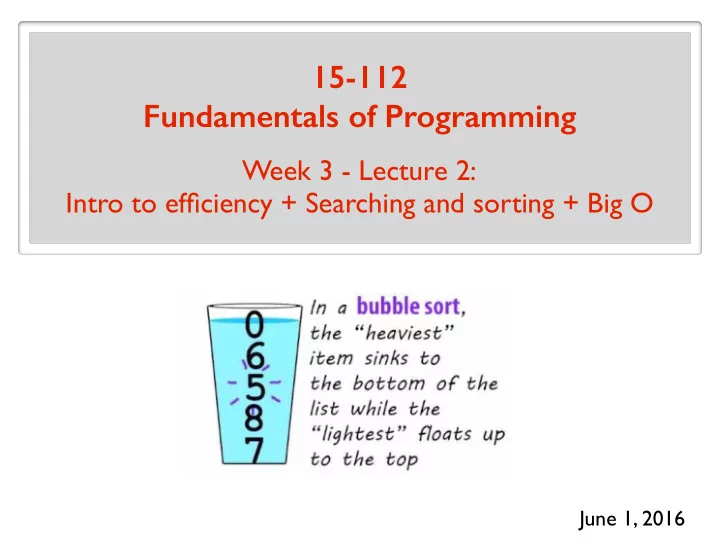
SLIDE 1
June 1, 2016
15-112 Fundamentals of Programming
Week 3 - Lecture 2: Intro to efficiency + Searching and sorting + Big O
SLIDE 2
Principles of good programming
Correctness Maintainability Efficiency In terms of running time and memory space used. Your program does what it is supposed to. Handles all cases (e.g. invalid user input). Readability, clarity of the code. Reusability for yourself and others (proper use of functions/methods and objects) programs that are easy to handle and debug.
SLIDE 3
Why care about efficiency?
multiplying two integers protein structure prediction factoring integers sorting a list computing Nash Equilibria of games simulating quantum systems building AI proving theorems
SLIDE 4 The Plan > Searching a given list > How to properly measure running time > Sorting a given list
- Linear search
- Binary search
- Selection sort
- Bubble sort
> Big-Oh notation
SLIDE 5
Motivating example: searching a list
Given a list of integers, and an integer, determine if the integer is in the list. 3 1 9 4 8 7 6 2 5 6 How many steps in the algorithm?
SLIDE 6
Motivating example: searching a list
3 1 9 4 8 7 6 2 5 6 How many steps in the algorithm? Given a list of integers, and an integer, determine if the integer is in the list.
SLIDE 7
Motivating example: searching a list
1 6 6 How many steps in the algorithm? Given a list of integers, and an integer, determine if the integer is in the list.
SLIDE 8 Motivating example: searching a list
1 6 6 How many steps in the algorithm? running time of an algorithm depends on:
- size of input (e.g., size of the list)
- the values in the input
Given a list of integers, and an integer, determine if the integer is in the list.
SLIDE 9 Measuring running time
running time of an algorithm depends on:
- size of input (e.g., size of the list)
- the values in the input
SLIDE 10 Measuring running time
running time of an algorithm depends on:
- size of input (e.g., size of the list)
- the values in the input
size of the list: Want to know running time with respect to any list size. N = list size Measure running time as a function of N.
SLIDE 11 Measuring running time
running time of an algorithm depends on:
- size of the list (size of input)
- the values in the input
the values in the input: Measure running time with respect to worst input. worst input = input that leads to most number of steps
SLIDE 12 Measuring running time
- for strings: = number of characters
N
- for lists: = number of elements
N
- for ints: = number of digits
N > Running time is a function of . N > Look at worst-case scenario/input of length . N > Count algorithmic steps. > Ignore constant factors. (e.g. ) N 2 ≈ 3N 2 How to properly measure running time (use Big-Oh notation) > Input length/size denoted by (and sometimes by ) N n
SLIDE 13 The Plan > Searching a given list > How to properly measure running time > Sorting a given list
- Linear search
- Binary search
- Selection sort
- Bubble sort
> Big-Oh notation
SLIDE 14
Searching for an element in a list
N steps Can’t do better (in the worst case) How many steps does this take? This algorithm is called Linear Search. Given a list of integers, and an integer, determine if the integer is in the list.
SLIDE 15
Searching for an element in a sorted list
8 1 2 4 5 5 6 9 9 50 running time: N steps Can we do better? 99 How would you search for a name in a phonebook? 60 50 Given a sorted list of integers, and an integer, determine if the integer is in the list.
SLIDE 16
Searching for an element in a sorted list
8 1 2 4 5 5 6 9 9 50 Binary Search Start in the middle 99 60 50
SLIDE 17
Searching for an element in a sorted list
8 1 2 4 5 5 6 9 9 50 Binary Search Start in the middle 99 If (element > middle), can ignore left half of the list. If (element < middle), can ignore right half of the list. Repeat process on the remaining half. 60 50
SLIDE 18
Searching for an element in a sorted list
8 1 2 4 5 5 6 9 9 50 Binary Search 99 60 50 Start in the middle If (element > middle), can ignore left half of the list. If (element < middle), can ignore right half of the list. Repeat process on the remaining half.
SLIDE 19
Searching for an element in a sorted list
8 1 2 4 5 5 6 9 9 50 Binary Search 60 50 99 Start in the middle If (element > middle), can ignore left half of the list. If (element < middle), can ignore right half of the list. Repeat process on the remaining half.
SLIDE 20
Searching for an element in a sorted list
8 1 2 4 5 5 6 9 9 50 Binary Search 60 50 99 Start in the middle If (element > middle), can ignore left half of the list. If (element < middle), can ignore right half of the list. Repeat process on the remaining half.
SLIDE 21
Searching for an element in a sorted list
8 1 2 4 5 5 6 9 9 50 Binary Search 60 50 99 Start in the middle If (element > middle), can ignore left half of the list. If (element < middle), can ignore right half of the list. Repeat process on the remaining half.
SLIDE 22
Searching for an element in a sorted list
8 1 2 4 5 5 6 9 9 50 Binary Search How many steps does this take (in the worst case)? 60 50 99 When is this 1? ∼ log2 N At each step we halve the list.
N → N 2 → N 4 → N 8 → · · · → 1
After k steps: elements left.
N 2k
SLIDE 23
N vs log N
How much better is log N compared to N ? N log N 2 1 8 3 128 7 1024 10 1,048,576 20 1,073,741,824 30 1,152,921,504,606,846,976 60 ~ 1 quintillion
SLIDE 24
n vs log n
SLIDE 25
Linear search vs Binary search
Linear Search Takes steps. Works for both sorted and unsorted lists. ∼ N Binary Search Takes steps. Works for only sorted lists. ∼ log2 N
SLIDE 26
Linear search code
def linearSearch(L, target): for index in range(len(L)): if(L[index] == target): return True return False
How many steps in the worst case?
SLIDE 27
Binary search code
def binarySearch(L, target): start = 0 end = len(L) - 1 while(start <= end): middle = (start + end)//2 if(L[middle] == target): return True elif(L[middle] > target): end = middle-1 else: start = middle+1 return False
How many steps in the worst case?
SLIDE 28 The Plan > Searching a given list > How to properly measure running time > Sorting a given list
- Linear search
- Binary search
- Selection sort
- Bubble sort
> Big-Oh notation
SLIDE 29
O(·)
The CS way to compare functions:
≤
means , ignoring constant factors and small values of n f(n) ≤ g(n) ≡ f(n) = O(g(n)) f(n) is O(g(n))
SLIDE 30
O(·)
The CS way to compare functions:
≤
means , ignoring constant factors and small values of n 10n + 25 = O(n) 10n + 25 is O(n) ≡ 10n + 25 ≤ n
SLIDE 31
Big Oh Notation
A notation to ignore constant factors and small n.
2n is O(n) 3n is O(n) 1000n is O(n) 0.0000001n is O(n) 2 log2 n is O(log n) 3 log2 n is O(log n) 1000 log2 n is O(log n) 0.0000001 log2 n is O(log n) log9 n is O(log n)
Running time of linear search is O(N) Running time of binary search is O(log N)
0.0000001n2 is not O(n) n is O(n2) n log7 n + 100 is not O(n)
SLIDE 32 Big Oh Notation
Why ignore constant factors and small n?
- Technology independent. Language independent.
- We want to capture the essence of an
algorithm/problem.
a really fundamental difference.
SLIDE 33
Big Oh Notation
Ignoring constant factors means ignoring lower order additive terms.
n2 + 100n + 500 is O(n2) 601n2 = n2 + 100n2 + 500n2 > n2 + 100n + 500 n2 + 100n + 500 n2 = 1 + 100n n2 + 500 n2
Lower order terms don’t matter! − → 1 Also:
SLIDE 34
Big Oh Notation
SLIDE 35
Big Oh Notation
SLIDE 36
Important Big Oh Classes
Again, not much interested in the difference between and .
n n/2
We are very interested in the differences between log n <<< √n << n << n2 << n3 <<< 2n
SLIDE 37
Important Big Oh Classes
Common function families: Constant:
O(1)
Logarithmic:
O(log n)
Square-root:
O(√n) = O(n0.5)
Linear:
O(n)
Loglinear:
O(n log n)
Quadratic:
O(n2)
Exponential:
O(kn)
SLIDE 38
Important Big Oh Classes
SLIDE 39
Exponential running time
If your algorithm has exponential running time e.g. ∼ 2n No hope of being practical.
SLIDE 40
n vs 2n
2n n 2 1 8 3 128 7 1024 10 1,048,576 20 1,073,741,824 30 1,152,921,504,606,846,976 60
SLIDE 41 Exponential running time example
Given a list of integers, determine if there is a subset
- f the integers that sum to 0.
- 3
- 2
7 99 5 1 4
SLIDE 42 Exponential running time example
Given a list of integers, determine if there is a subset
- f the integers that sum to 0.
Exhaustive Search Try every possible subset and see if it sums to 0. Number of subsets is 2N So running time is at least 2N
7 99 5 1 4
SLIDE 43 The Plan > Searching a given list > How to properly measure running time > Sorting a given list
- Linear search
- Binary search
- Selection sort
- Bubble sort
> Big-Oh notation
- 1. Algorithm
- 2. Running time
- 3. Code
SLIDE 44
Selection Sort: Algorithm
Sort a given list of integers (from small to large). 8 2 7 99 5 4 Find the minimum element. Put it on the left. Repeat process on the remaining n-1 elements. Selection Sort
SLIDE 45
Selection Sort: Algorithm
Sort a given list of integers (from small to large). 8 2 7 99 5 4 Selection Sort
SLIDE 46
Selection Sort: Algorithm
Sort a given list of integers (from small to large). 8 2 7 99 5 4 Current min: 4 Selection Sort
SLIDE 47
Selection Sort: Algorithm
Sort a given list of integers (from small to large). 8 2 7 99 5 4 Current min: 4 Selection Sort
SLIDE 48
Selection Sort: Algorithm
Sort a given list of integers (from small to large). 8 2 7 99 5 4 Current min: 4 Selection Sort
SLIDE 49
Selection Sort: Algorithm
Sort a given list of integers (from small to large). 8 2 7 99 5 4 Current min: 2 Selection Sort
SLIDE 50
Selection Sort: Algorithm
Sort a given list of integers (from small to large). 8 2 7 99 5 4 Current min: 2 Selection Sort
SLIDE 51
Selection Sort: Algorithm
Sort a given list of integers (from small to large). 8 2 7 99 5 4 Current min: 2 Selection Sort
SLIDE 52
Selection Sort: Algorithm
Sort a given list of integers (from small to large). 8 2 7 99 5 4 Current min: 2 Selection Sort
SLIDE 53
Selection Sort: Algorithm
Sort a given list of integers (from small to large). 8 2 7 99 5 4 Current min: 2 Selection Sort
SLIDE 54
Selection Sort: Algorithm
Sort a given list of integers (from small to large). 8 2 7 99 5 4 Current min: 0 Selection Sort
SLIDE 55
Selection Sort: Algorithm
Sort a given list of integers (from small to large). 8 2 7 99 5 4 Swap current min with first element of the array Selection Sort
SLIDE 56
Selection Sort: Algorithm
Sort a given list of integers (from small to large). 8 2 7 99 5 4 Swap current min with first element of the array Selection Sort
SLIDE 57
Selection Sort: Algorithm
Sort a given list of integers (from small to large). 8 2 7 99 5 4 Selection Sort
SLIDE 58
Selection Sort: Algorithm
Sort a given list of integers (from small to large). 8 2 7 99 5 4 Current min: 8 Selection Sort
SLIDE 59
Selection Sort: Algorithm
Sort a given list of integers (from small to large). 8 2 7 99 5 4 Current min: 8 Selection Sort
SLIDE 60
Selection Sort: Algorithm
Sort a given list of integers (from small to large). 8 2 7 99 5 4 Current min: 2 Selection Sort
SLIDE 61
Selection Sort: Algorithm
Sort a given list of integers (from small to large). 8 2 7 99 5 4 Current min: 2 Selection Sort
SLIDE 62
Selection Sort: Algorithm
Sort a given list of integers (from small to large). 8 2 7 99 5 4 Current min: 2 Selection Sort
SLIDE 63
Selection Sort: Algorithm
Sort a given list of integers (from small to large). 8 2 7 99 5 4 Current min: 2 Selection Sort
SLIDE 64
Selection Sort: Algorithm
Sort a given list of integers (from small to large). 8 2 7 99 5 4 Current min: 2 Selection Sort
SLIDE 65
Selection Sort: Algorithm
Sort a given list of integers (from small to large). 8 2 7 99 5 4 Swap current min with first element of unsorted part Selection Sort
SLIDE 66
Selection Sort: Algorithm
Sort a given list of integers (from small to large). 2 8 7 99 5 4 Swap current min with first element of unsorted part Selection Sort
SLIDE 67
Selection Sort: Algorithm
Sort a given list of integers (from small to large). 2 8 7 99 5 4 Selection Sort
SLIDE 68
Selection Sort: Algorithm
Sort a given list of integers (from small to large). 2 8 7 99 5 4 Current min: 8 Selection Sort
SLIDE 69
Selection Sort: Algorithm
Sort a given list of integers (from small to large). 2 8 7 99 5 4 Current min: 8 Selection Sort
SLIDE 70
Selection Sort: Algorithm
Sort a given list of integers (from small to large). 2 8 7 99 5 4 Current min: 7 Selection Sort
SLIDE 71
Selection Sort: Algorithm
Sort a given list of integers (from small to large). 2 8 7 99 5 4 Current min: 7 Selection Sort
SLIDE 72
Selection Sort: Algorithm
Sort a given list of integers (from small to large). 2 8 7 99 5 4 Current min: 7 Selection Sort
SLIDE 73
Selection Sort: Algorithm
Sort a given list of integers (from small to large). 2 8 7 99 5 4 Current min: 5 Selection Sort
SLIDE 74
Selection Sort: Algorithm
Sort a given list of integers (from small to large). 2 8 7 99 5 4 Current min: 5 Selection Sort
SLIDE 75
Selection Sort: Algorithm
Sort a given list of integers (from small to large). 2 8 7 99 5 4 Current min: 4 Selection Sort
SLIDE 76
Selection Sort: Algorithm
Sort a given list of integers (from small to large). 2 8 7 99 5 4 Swap current min with first element of unsorted part Selection Sort
SLIDE 77
Selection Sort: Algorithm
Sort a given list of integers (from small to large). 2 4 7 99 5 8 Swap current min with first element of unsorted part Selection Sort
SLIDE 78
Selection Sort: Algorithm
Sort a given list of integers (from small to large). 2 4 7 99 5 8 Selection Sort
SLIDE 79
Selection Sort: Algorithm
Sort a given list of integers (from small to large). 2 4 7 99 5 8 Current min: 7 Selection Sort
SLIDE 80
Selection Sort: Algorithm
Sort a given list of integers (from small to large). 2 4 7 99 5 8 Current min: 7 Selection Sort
SLIDE 81
Selection Sort: Algorithm
Sort a given list of integers (from small to large). 2 4 7 99 5 8 Current min: 7 Selection Sort
SLIDE 82
Selection Sort: Algorithm
Sort a given list of integers (from small to large). 2 4 7 99 5 8 Current min: 5 Selection Sort
SLIDE 83
Selection Sort: Algorithm
Sort a given list of integers (from small to large). 2 4 7 99 5 8 Current min: 5 Selection Sort
SLIDE 84
Selection Sort: Algorithm
Sort a given list of integers (from small to large). 2 4 7 99 5 8 Swap current min with first element of unsorted part Selection Sort
SLIDE 85
Selection Sort: Algorithm
Sort a given list of integers (from small to large). 2 4 5 99 7 8 Swap current min with first element of unsorted part Selection Sort
SLIDE 86
Selection Sort: Algorithm
Sort a given list of integers (from small to large). 2 4 5 99 7 8 Selection Sort
SLIDE 87
Selection Sort: Algorithm
Sort a given list of integers (from small to large). 2 4 5 99 7 8 Current min: 99 Selection Sort
SLIDE 88
Selection Sort: Algorithm
Sort a given list of integers (from small to large). 2 4 5 99 7 8 Current min: 99 Selection Sort
SLIDE 89
Selection Sort: Algorithm
Sort a given list of integers (from small to large). 2 4 5 99 7 8 Current min: 7 Selection Sort
SLIDE 90
Selection Sort: Algorithm
Sort a given list of integers (from small to large). 2 4 5 99 7 8 Current min: 7 Selection Sort
SLIDE 91
Selection Sort: Algorithm
Sort a given list of integers (from small to large). 2 4 5 99 7 8 Swap current min with first element of unsorted part Selection Sort
SLIDE 92
Selection Sort: Algorithm
Sort a given list of integers (from small to large). 2 4 5 7 99 8 Swap current min with first element of unsorted part Selection Sort
SLIDE 93
Selection Sort: Algorithm
Sort a given list of integers (from small to large). 2 4 5 7 99 8 Selection Sort
SLIDE 94
Selection Sort: Algorithm
Sort a given list of integers (from small to large). 2 4 5 7 99 8 Current min: 99 Selection Sort
SLIDE 95
Selection Sort: Algorithm
Sort a given list of integers (from small to large). 2 4 5 7 99 8 Current min: 99 Selection Sort
SLIDE 96
Selection Sort: Algorithm
Sort a given list of integers (from small to large). 2 4 5 7 99 8 Current min: 8 Selection Sort
SLIDE 97
Selection Sort: Algorithm
Sort a given list of integers (from small to large). 2 4 5 7 99 8 Swap current min with first element of unsorted part Selection Sort
SLIDE 98
Selection Sort: Algorithm
Sort a given list of integers (from small to large). 2 4 5 7 8 99 Swap current min with first element of unsorted part Selection Sort
SLIDE 99
Selection Sort: Algorithm
Sort a given list of integers (from small to large). 2 4 5 7 8 99 Done! Selection Sort
SLIDE 100
Selection Sort: Running Time
Sort a given list of integers (from small to large). 2 4 5 7 8 99 Selection Sort How many steps does this take (in the worst case)? (As N increases, small terms lose significance.) ∼ N + (N − 1) + (N − 2) + · · · + 1 = N 2 2 + N 2 Running time is . O(N 2)
SLIDE 101
Selection Sort: Code
2 8 7 99 4 5
start len(a) - 1
Find the min position from start to len(a) - 1
min position
Swap elements in min position and start Increment start Repeat Selection sort snapshot:
SLIDE 102
Selection Sort: Code
2 8 7 99 4 5
start len(a) - 1
Find the min position from start to len(a) - 1
min position
Swap elements in min position and start for start = 0 to len(a)-1: Selection sort snapshot:
SLIDE 103
Selection Sort: Code
def selectionSort(a): Find the min position from start to len(a) - 1 Swap elements in min position and start
2 8 7 99 4 5
start len(a) - 1 min position for start = 0 to len(a)-1: for start in range(len(a)): currentMinIndex = start for i in range(start, len(a)): if(a[i] < a[currentMinIndex]): currentMinIndex = i (a[currentMinIndex], a[start]) = (a[start], a[currentMinIndex])
SLIDE 104
Bubble Sort: Algorithm
Sort a given list of integers (from small to large). 8 2 7 99 5 4 Compare each pair of adjacent items (left to right). Swap them if they are in the wrong order. Repeat until no more swaps are needed. Bubble Sort
SLIDE 105
Bubble Sort: Algorithm
Sort a given list of integers (from small to large). 8 2 7 99 5 4 Compare each pair of adjacent items (left to right). Swap them if they are in the wrong order. Repeat until no more swaps are needed. Bubble Sort
SLIDE 106
Bubble Sort: Algorithm
Sort a given list of integers (from small to large). 2 8 7 99 5 4 Compare each pair of adjacent items (left to right). Swap them if they are in the wrong order. Repeat until no more swaps are needed. Bubble Sort
SLIDE 107
Bubble Sort: Algorithm
Sort a given list of integers (from small to large). 2 8 7 99 5 4 Compare each pair of adjacent items (left to right). Swap them if they are in the wrong order. Repeat until no more swaps are needed. Bubble Sort
SLIDE 108
Bubble Sort: Algorithm
Sort a given list of integers (from small to large). 2 7 8 99 5 4 Compare each pair of adjacent items (left to right). Swap them if they are in the wrong order. Repeat until no more swaps are needed. Bubble Sort
SLIDE 109
Bubble Sort: Algorithm
Sort a given list of integers (from small to large). 2 7 8 99 5 4 Compare each pair of adjacent items (left to right). Swap them if they are in the wrong order. Repeat until no more swaps are needed. Bubble Sort
SLIDE 110
Bubble Sort: Algorithm
Sort a given list of integers (from small to large). 2 7 8 99 5 4 Compare each pair of adjacent items (left to right). Swap them if they are in the wrong order. Repeat until no more swaps are needed. Bubble Sort
SLIDE 111
Bubble Sort: Algorithm
Sort a given list of integers (from small to large). 2 7 8 5 99 4 Compare each pair of adjacent items (left to right). Swap them if they are in the wrong order. Repeat until no more swaps are needed. Bubble Sort
SLIDE 112
Bubble Sort: Algorithm
Sort a given list of integers (from small to large). 2 7 8 5 99 4 Compare each pair of adjacent items (left to right). Swap them if they are in the wrong order. Repeat until no more swaps are needed. Bubble Sort
SLIDE 113
Bubble Sort: Algorithm
Sort a given list of integers (from small to large). 2 7 8 5 99 4 Compare each pair of adjacent items (left to right). Swap them if they are in the wrong order. Repeat until no more swaps are needed. Bubble Sort
SLIDE 114
Bubble Sort: Algorithm
Sort a given list of integers (from small to large). 2 7 8 5 99 4 Compare each pair of adjacent items (left to right). Swap them if they are in the wrong order. Repeat until no more swaps are needed. Bubble Sort
SLIDE 115
Bubble Sort: Algorithm
Sort a given list of integers (from small to large). 2 7 8 5 99 4 Compare each pair of adjacent items (left to right). Swap them if they are in the wrong order. Repeat until no more swaps are needed. Bubble Sort
SLIDE 116
Bubble Sort: Algorithm
Sort a given list of integers (from small to large). 4 7 8 5 99 2 Compare each pair of adjacent items (left to right). Swap them if they are in the wrong order. Repeat until no more swaps are needed. Bubble Sort
SLIDE 117
Bubble Sort: Algorithm
Sort a given list of integers (from small to large). 4 7 8 5 99 2 Compare each pair of adjacent items (left to right). Swap them if they are in the wrong order. Repeat until no more swaps are needed. Bubble Sort
SLIDE 118
Bubble Sort: Algorithm
Sort a given list of integers (from small to large). 4 7 8 5 99 2 Compare each pair of adjacent items (left to right). Swap them if they are in the wrong order. Repeat until no more swaps are needed. Bubble Sort
SLIDE 119
Bubble Sort: Algorithm
Sort a given list of integers (from small to large). 4 7 5 8 99 2 Compare each pair of adjacent items (left to right). Swap them if they are in the wrong order. Repeat until no more swaps are needed. Bubble Sort
SLIDE 120
Bubble Sort: Algorithm
Sort a given list of integers (from small to large). 4 7 5 8 99 2 Compare each pair of adjacent items (left to right). Swap them if they are in the wrong order. Repeat until no more swaps are needed. Bubble Sort
SLIDE 121
Bubble Sort: Algorithm
Sort a given list of integers (from small to large). 4 7 5 8 99 2 Compare each pair of adjacent items (left to right). Swap them if they are in the wrong order. Repeat until no more swaps are needed. Bubble Sort
SLIDE 122
Bubble Sort: Algorithm
Sort a given list of integers (from small to large). 4 7 5 8 99 2 Compare each pair of adjacent items (left to right). Swap them if they are in the wrong order. Repeat until no more swaps are needed. Bubble Sort
SLIDE 123
Bubble Sort: Algorithm
Sort a given list of integers (from small to large). 4 7 5 8 99 2 Compare each pair of adjacent items (left to right). Swap them if they are in the wrong order. Repeat until no more swaps are needed. Bubble Sort
SLIDE 124
Bubble Sort: Algorithm
Sort a given list of integers (from small to large). 4 7 5 8 99 2 Compare each pair of adjacent items (left to right). Swap them if they are in the wrong order. Repeat until no more swaps are needed. Bubble Sort
SLIDE 125
Bubble Sort: Algorithm
Sort a given list of integers (from small to large). 4 7 5 8 99 2 Compare each pair of adjacent items (left to right). Swap them if they are in the wrong order. Repeat until no more swaps are needed. Bubble Sort
SLIDE 126
Bubble Sort: Algorithm
Sort a given list of integers (from small to large). 4 5 7 8 99 2 Compare each pair of adjacent items (left to right). Swap them if they are in the wrong order. Repeat until no more swaps are needed. Bubble Sort
SLIDE 127
Bubble Sort: Algorithm
Sort a given list of integers (from small to large). 4 5 7 8 99 2 Compare each pair of adjacent items (left to right). Swap them if they are in the wrong order. Repeat until no more swaps are needed. Bubble Sort
SLIDE 128
Bubble Sort: Algorithm
Sort a given list of integers (from small to large). 4 5 7 8 99 2 Compare each pair of adjacent items (left to right). Swap them if they are in the wrong order. Repeat until no more swaps are needed. Bubble Sort
SLIDE 129
Bubble Sort: Algorithm
Sort a given list of integers (from small to large). 4 5 7 8 99 2 Compare each pair of adjacent items (left to right). Swap them if they are in the wrong order. Repeat until no more swaps are needed. Bubble Sort
SLIDE 130
Bubble Sort: Algorithm
Sort a given list of integers (from small to large). 4 5 7 8 99 2 Compare each pair of adjacent items (left to right). Swap them if they are in the wrong order. Repeat until no more swaps are needed. Bubble Sort
SLIDE 131
Bubble Sort: Algorithm
Sort a given list of integers (from small to large). 4 5 7 8 99 2 Compare each pair of adjacent items (left to right). Swap them if they are in the wrong order. Repeat until no more swaps are needed. Bubble Sort
SLIDE 132
Bubble Sort: Algorithm
Sort a given list of integers (from small to large). 4 5 7 8 99 2 Compare each pair of adjacent items (left to right). Swap them if they are in the wrong order. Repeat until no more swaps are needed. Bubble Sort
SLIDE 133
Bubble Sort: Algorithm
Sort a given list of integers (from small to large). 4 5 7 8 99 2 Compare each pair of adjacent items (left to right). Swap them if they are in the wrong order. Repeat until no more swaps are needed. Bubble Sort
SLIDE 134
Bubble Sort: Algorithm
Sort a given list of integers (from small to large). 4 5 7 8 99 2 Compare each pair of adjacent items (left to right). Swap them if they are in the wrong order. Repeat until no more swaps are needed. Bubble Sort
SLIDE 135
Bubble Sort: Algorithm
Sort a given list of integers (from small to large). 4 5 7 8 99 2 Compare each pair of adjacent items (left to right). Swap them if they are in the wrong order. Repeat until no more swaps are needed. Bubble Sort
SLIDE 136
Bubble Sort: Algorithm
Sort a given list of integers (from small to large). 4 5 7 8 99 2 Compare each pair of adjacent items (left to right). Swap them if they are in the wrong order. Repeat until no more swaps are needed. Bubble Sort
SLIDE 137
Bubble Sort: Algorithm
Sort a given list of integers (from small to large). 4 5 7 8 99 2 Compare each pair of adjacent items (left to right). Swap them if they are in the wrong order. Repeat until no more swaps are needed. Bubble Sort
SLIDE 138
Bubble Sort: Algorithm
Sort a given list of integers (from small to large). 4 5 7 8 99 2 Compare each pair of adjacent items (left to right). Swap them if they are in the wrong order. Repeat until no more swaps are needed. Bubble Sort
SLIDE 139
Bubble Sort: Algorithm
Sort a given list of integers (from small to large). 4 5 7 8 99 2 Compare each pair of adjacent items (left to right). Swap them if they are in the wrong order. Repeat until no more swaps are needed. Bubble Sort
SLIDE 140
Bubble Sort: Algorithm
Sort a given list of integers (from small to large). 2 4 5 7 8 99 Compare each pair of adjacent items (left to right). Swap them if they are in the wrong order. Repeat until no more swaps are needed. Bubble Sort
SLIDE 141
Bubble Sort: Algorithm
Sort a given list of integers (from small to large). 2 4 5 7 8 99 Compare each pair of adjacent items (left to right). Swap them if they are in the wrong order. Repeat until no more swaps are needed. Bubble Sort Large elements “bubble up”
SLIDE 142
Bubble Sort: Running Time
Sort a given list of integers (from small to large). 2 4 5 7 8 99 How many steps does this take (in the worst case)? Bubble Sort O(N 2)
SLIDE 143
Bubble Sort: Code
repeat until no more swaps: for i = 0 to end: if a[i] > a[i+1], swap a[i] and a[i+1] decrement end Bubble sort snapshot 4 7 5 8 99 2
end a[i] a[i+1]
SLIDE 144
Bubble Sort: Code
4 7 5 8 99 2
end a[i] a[i+1] repeat until no more swaps: for i = 0 to end: if a[i] > a[i+1], swap a[i] and a[i+1] decrement end def bubbleSort(a): swapped = True end = len(a)-1 while(swapped): swapped = False for i in range(end): if(a[i] > a[i+1]): (a[i], a[i+1]) = (a[i+1], a[i]) swapped = True end -= 1
SLIDE 145
Comparison: Selection Sort vs Bubble Sort
How about best case? Bubble sort: If your list is close to being sorted, bubble sort can be better. Selection sort: Is there a better way? Worst case both take steps. O(N 2) O(N 2) O(N)
SLIDE 146
Exercise Write the code yourself: linear search binary search selection sort bubble sort