10/29/2008 Run-time storage layout Representation of int, bool, - - PDF document

10 29 2008
SMART_READER_LITE
LIVE PREVIEW

10/29/2008 Run-time storage layout Representation of int, bool, - - PDF document

10/29/2008 Run-time storage layout Representation of int, bool, etc. arrays, records, etc. The Backend (continued) procedures Placement of global variables David Notkin local variables Autumn 2008 parameters


slide-1
SLIDE 1

10/29/2008 1

The Backend (continued)

David Notkin Autumn 2008

Run-time storage layout

  • Representation of

– int, bool, etc. – arrays, records, etc. – procedures

  • Placement of

– global variables – local variables – parameters – results

CSE401 Au08 2

Storage allocation strategies

  • Given layout of data structure, where in memory to

allocate space for each instance?

  • Key issue: what is the lifetime (dynamic extent) of a

variable/data structure? – Whole execution of program (e.g., global variables)

  • Static allocation

– Execution of a procedure activation (e.g., locals)

  • Stack allocation

– Variable (dynamically allocated data)

  • Heap allocation

CSE401 Au08 3

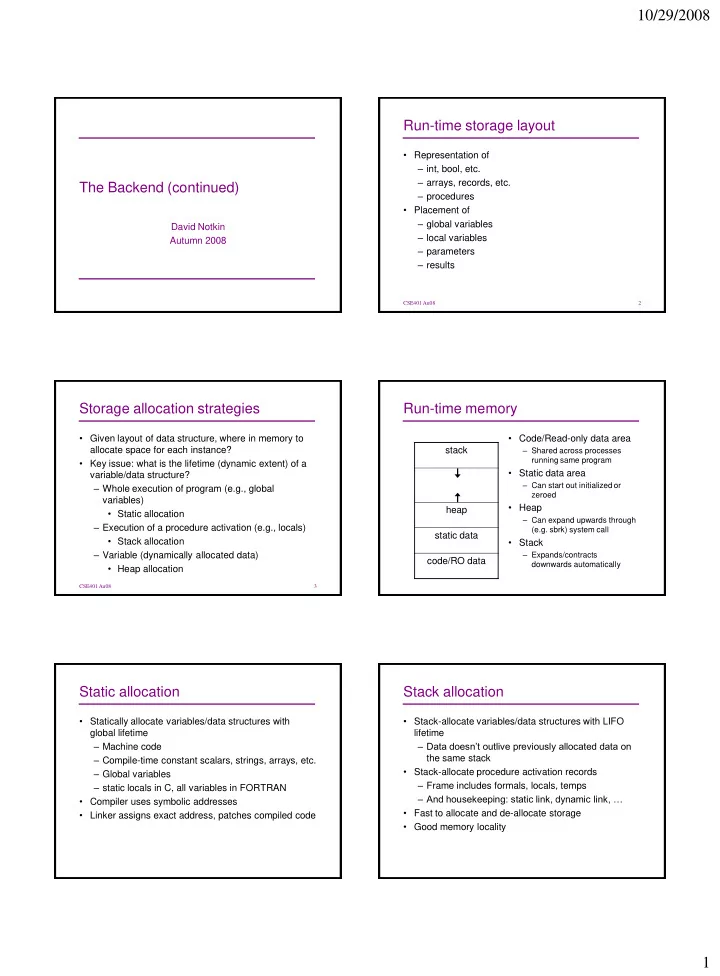
Run-time memory

  • Code/Read-only data area

– Shared across processes running same program

  • Static data area

– Can start out initialized or zeroed

  • Heap

– Can expand upwards through (e.g. sbrk) system call

  • Stack

– Expands/contracts downwards automatically

stack heap static data code/RO data

Static allocation

  • Statically allocate variables/data structures with

global lifetime – Machine code – Compile-time constant scalars, strings, arrays, etc. – Global variables – static locals in C, all variables in FORTRAN

  • Compiler uses symbolic addresses
  • Linker assigns exact address, patches compiled code

Stack allocation

  • Stack-allocate variables/data structures with LIFO

lifetime – Data doesn’t outlive previously allocated data on the same stack

  • Stack-allocate procedure activation records

– Frame includes formals, locals, temps – And housekeeping: static link, dynamic link, …

  • Fast to allocate and de-allocate storage
  • Good memory locality
slide-2
SLIDE 2

10/29/2008 2

Stack allocation II

  • What about

variables local to nested scopes within one procedure?

procedure P() {

int x; for(int i=0; i<10; i++){

double x; …

} for(int j=0; j<10; j++){

double y; …

}

}

Stack allocation: constraints I

  • No references to stack-

allocated data allowed after returns

  • This is violated by

general first-class functions

proc foo(x:int): proctype(int):int; proc bar(y:int):int; begin return x + y; end bar; begin return bar; end foo; var f:proctype(int):int; var g:proctype(int):int; f := foo(3); g := foo(4);

  • utput := f(5);
  • utput := g(6);

Stack allocation: constraints II

  • Also violated if

pointers to locals are allowed

proc foo (x:int): *int; var y:int; begin y := x * 2; return &y; end foo; var w,z:*int; z := foo(3); w := foo(4);

  • utput := *z;
  • utput := *w;

Heap allocation

  • For data with unknown lifetime

– new/malloc to allocate space – delete/free or garbage collection to de-allocate

  • Heap-allocate activation records of first-class

functions

  • Relatively expensive to manage
  • Can have dangling reference, storage leaks

– Garbage collection reduces (but may not eliminate) these classes of errors

Stack frame layout

  • Formals, locals, housekeeping

– Dynamic and static link – Saved registers, …

  • Dedicate registers to support stack access

– FP - frame pointer: ptr to start of stack frame (fixed) – SP - stack pointer: ptr to end of stack (can move)

Key property

  • All data in stack frame is at a fixed, statically

computed offset from the FP

  • This makes it easy to generate fast code to access

the data in the stack frame – And lexically enclosing stack frames

  • Can compute these offsets solely from the symbol

tables – Based also on the chosen layout approach

slide-3
SLIDE 3

10/29/2008 3

...caller's frame... formal N formal N-1 ... formal 1 static link return address dynamic link saved registers local N local N-1 ... local 1 FP stack grows down high addresses low addresses

  • ne stack frame

Stack Layout Accessing locals

  • If a local is in the same stack frame then

– t := *(fp + local_offset)

  • If in lexically-enclosing stack frame

– t := *(fp + static_link_offset) t := *(t + local_offset)

  • If in a further enclosing block

– t := *(fp + static_link_offset) t := *(t + static_link_offset) … t := *(t + local_offset)

At compile-time need to calculate

  • Difference in nesting depth of use and definition
  • Offset of local in defining stack frame
  • Offsets of static links in intervening frames

Calling conventions

  • Define responsibilities of caller and callee

– To make sure the stack frame is properly set up and torn down

  • Some things can only be done by the caller
  • Other things can only be done by the callee
  • Some can be done by either
  • So, we need a protocol

Typical calling sequence

Caller

  • Evaluate actual args

– Order?

  • Push onto stack

– Order? – Alternative: First k args in registers

  • Push callee's static link

– Or in register? Before or after stack arguments?

  • Execute call instruction

– Hardware puts return address in a register

Callee

  • Save bookkeeping information
  • n stack
  • Allocates space for locals,
  • ther data

– sp := sp - size_of_locals -

  • ther_data

– Locals stored in what order?

  • Set up new frame pointer

(fp := sp)

  • Start executing callee’s code

Typical return sequence

Callee

  • Deallocate space for

local, other data

– sp := sp + size_of_locals +

  • ther_data
  • Restore caller’s frame

pointer, return address &

  • ther regs, all without

losing addresses of stuff still needed in stack

  • Execute return instruction

Caller

  • Deallocate space for

callee’s static link, args

– sp := fp

  • Continue execution in

caller after call