10/29/19 Presenter Disclosures Academic-Practice Partnerships - - PDF document

10 29 19
SMART_READER_LITE
LIVE PREVIEW

10/29/19 Presenter Disclosures Academic-Practice Partnerships - - PDF document

10/29/19 Presenter Disclosures Academic-Practice Partnerships Audrey Snyder, PhD, RN for an Interdisciplinary Rural (1) The following personal financial relationships with Adult-Gerontology Acute Care commercial interests relevant to this


slide-1
SLIDE 1

10/29/19 1

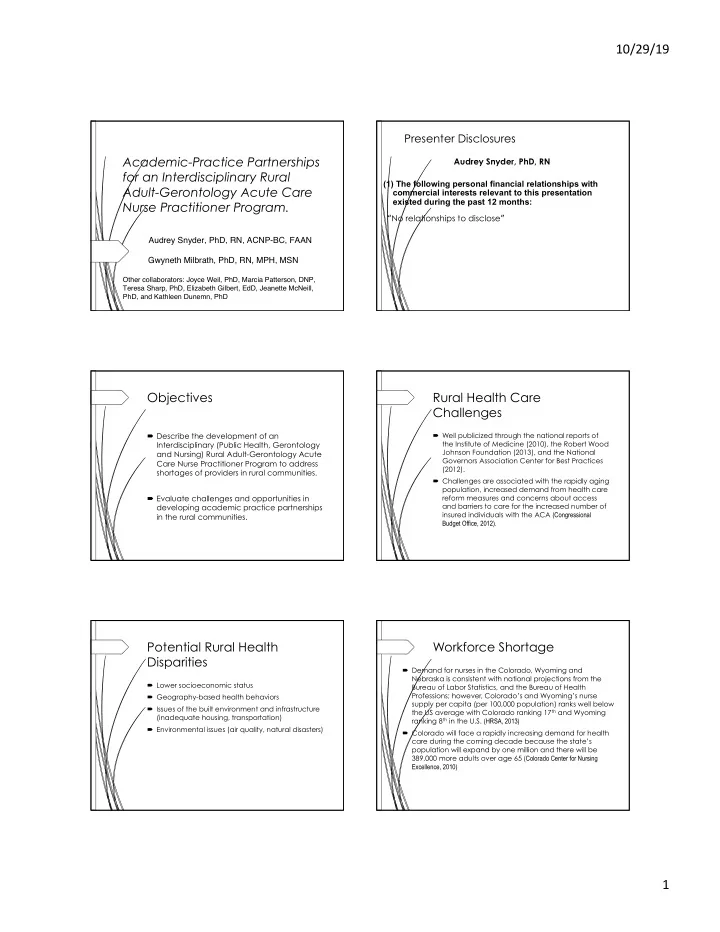
Academic-Practice Partnerships for an Interdisciplinary Rural Adult-Gerontology Acute Care Nurse Practitioner Program.

Audrey Snyder, PhD, RN, ACNP-BC, FAAN Gwyneth Milbrath, PhD, RN, MPH, MSN

Other collaborators: Joyce Weil, PhD, Marcia Patterson, DNP, Teresa Sharp, PhD, Elizabeth Gilbert, EdD, Jeanette McNeill, PhD, and Kathleen Dunemn, PhD

Presenter Disclosures

(1) The following personal financial relationships with commercial interests relevant to this presentation existed during the past 12 months: Audrey Snyder, PhD, RN “No relationships to disclose”

Objectives

´ Describe the development of an Interdisciplinary (Public Health, Gerontology and Nursing) Rural Adult-Gerontology Acute Care Nurse Practitioner Program to address shortages of providers in rural communities. ´ Evaluate challenges and opportunities in developing academic practice partnerships in the rural communities.

Rural Health Care Challenges

´ Well publicized through the national reports of the Institute of Medicine (2010), the Robert Wood Johnson Foundation (2013), and the National Governors Association Center for Best Practices (2012). ´ Challenges are associated with the rapidly aging population, increased demand from health care reform measures and concerns about access and barriers to care for the increased number of insured individuals with the ACA (Congressional Budget Office, 2012).

Potential Rural Health Disparities

´ Lower socioeconomic status ´ Geography-based health behaviors ´ Issues of the built environment and infrastructure (inadequate housing, transportation) ´ Environmental issues (air quality, natural disasters)

Workforce Shortage

´ Demand for nurses in the Colorado, Wyoming and Nebraska is consistent with national projections from the Bureau of Labor Statistics, and the Bureau of Health Professions; however, Colorado’s and Wyoming’s nurse supply per capita (per 100,000 population) ranks well below the US average with Colorado ranking 17th and Wyoming ranking 8th in the U.S. (HRSA, 2013) ´ Colorado will face a rapidly increasing demand for health care during the coming decade because the state’s population will expand by one million and there will be 389,000 more adults over age 65 (Colorado Center for Nursing Excellence, 2010)

slide-2
SLIDE 2

10/29/19 2

Rural community outcomes

´ Rural Coloradoans have lower income, education, and health-care access with generalists in rural communities handling specialty care and high patient-to-practitioner ratios (Marshall & VanRaemdonck, 2012) ´ Higher rates of chronic disease (e.g. heart disease, diabetes), negative health behaviors (e.g., smoking, diet/obesity), and less access to health and preventative services (Hash, Krout, & Jurkowski, 2015) ´ Lower numbers of medical specialists and reduced life expectancies with this gap widening (Singh, 2014)

Older adults

´ Rural older adults have greater rates of physical impairment, more frailty (Prasad, Dunn, Hillier, McAiney, Warren & Rutherford, 2014), and less mobility than their non-rural counterparts. ´ Younger generations are leaving rural areas, and

  • lder persons experience higher rates of isolation

and are often “left behind” in settings absent of geriatricians and geriatric care (Mattson, 2011)

Implications

´ Rural-urban health disparities are well documented and are due in part, to inadequate health personnel and facilities. ´ With the aging of America and a projected doubling of the population age 65 and older by 2050 there is a need for healthcare providers who specialize in the care of the elderly and manage multiple co-morbid conditions. ´ Place matters with identified unique needs of elders residing in the rural environment. ´ Part of the efforts to improving patient access to high-quality care is to the increase in the number of Advanced Practice Nurses who practice in rural and/or underserved areas. ´ Health professions trained in rural training tracks are more likely to practice in a rural area (Rosenthal, 2000).

Development of ideas

´ Nursing, Community and Public Health, and Gerontology faculty: Dr. Sharp and Dr. Gilbert (Public health), Dr. McNeill and Dr. Snyder (nursing) discussed the development of a community based course crossing community health, nursing and geriatrics. Dr. Weil (Gerontology) and Dr. Dunemn, Dr. Milbrath and Dr. Patterson (Nursing) joined the discussions. ´ An internal grant proposal i@UNC was developed. ´ An Advanced Nursing Education Proposal was submitted(HRSA- 15-046) February 2015 based on the i@UNC proposal: Rural Care Transitions: Creating an Interdisciplinary Adult-Gerontology Acute Care Nurse Practitioner program.

Purpose

The purpose of the Advanced Nursing Education (HRSA- 15-046) grant call was to create multifaceted innovative proposals that included:

  • Creating innovative academic-clinical partnerships.
  • Instituting a clinical training model for graduate nursing students to

provide safe, quality care within complex practice-based environments.

  • Establishing at least one new partnership/or enhancement of an

existing partnership between an academic institution and rural/ underserved clinical practice site(s).

  • Improving the quality of preceptor training.
  • Promoting graduate nursing student readiness to practice in the

rural environment.

slide-3
SLIDE 3

10/29/19 3

Logic Model

Program: An Academic-Practice Partnership to train AGACNPs to improve care of rural adults across the transitions of care Participation Expert Faculty AGACNP Students HRSA Funding Strengthen professional relationships between academia and clinical practice Centennial Area Health Education Consortium (CAHEC) Practitioners in the rural setting New community partnerships Academic- Practice Partnership Trained Preceptors Establish clinical sites including hospitals, rehabilitation, palliative care, hospice, and long- term care facilities Provide preceptor training through new collaborations with practice and community partners Assumptions: Full support of program by the University of Colorado; motivated and engaged students; preceptor cooperation from clinical sites; enriching clinical experiences at rural clinical sites; larger rural health provider work force will improve care in the rural environment External Factors: Student enrollment and financial support; policy changes; program

  • fferings from other local universities; lack of

control over what patients present for care Enhance academic - practice partnerships between UNC and rural health facilities Improved acute adult and geriatric care for patients living in areas with low access and accessibility Develop and implement an innovative academic- practice partnership that will support the program. Expand a community- based partnership to improve preceptor training and promote retention of practitioners in the rural environment. Graduate AGACNPs with a focus in rural health Adult and elderly patients in rural areas Enroll qualified students in rural areas into UNC AGACNP program Expose students to the unique challenges of rural practice and care transistions in rural environments Inputs Outcomes Activities Short Medium Long Outputs Implement a hybrid AGACNP program with a focus on rural healthcare needs Innovative, interdisciplinary cirriculum with nursing, gerontology, and public health Improve rural access to care for adults and elders across the transitions of care. Recruit more AGACNP- trained faculty and obtain medical simulation equipment Graduate Master's and Doctorally Prepared AGACNPs ready to provide safe, quaity care in the rural environment Preceptors that are current practitioners working in Colorado, Western Nebraska, and Wyoming Partner Health Facilities University of Northern Colorado (UNC) faculty and facilities in nursing, gerontology and public health Improved medical simulation Sustainable hybrid AGACNP program at UNC with a focus

  • n rural populations

Timing

´ Institutional need for growth, desire for additional graduate students ´ Market analysis - practice based master’s degrees ´ Healthcare systems needs, feedback from area facilities ´ Community need for APNs ´ Aging population ´ Lack of providers in rural environment ´ Ideal grant call with rural priority ´ Lack of regional AGACNP programs

Plan

´ The Adult Gerontology Acute Care Nurse Practitioner Program prepares graduates to work with clients from adolescents through the frail elderly with a focus on the rural/frontier environment and transitions of care with an understanding of aging in place whether this is home, a rehabilitation center, assisted living or nursing home. ´ The AGACNP program focuses on understanding of rural culture, resources in the rural environment and coordination of care and collaboration to help prevent hospital readmissions.

Program Details

´ A predominantly on-line program with a focus on recruiting BSN prepared nurses from rural areas or who work with patients from the rural area (recruitment areas: northern Colorado, Wyoming and western Nebraska) and continue to work in their current position while in graduate school. ´ Two required summer intensives at UNC for health assessment check

  • ff, advanced practice skills, competencies, simulation, and a

community engagement project.

Program Options

´ Post-Master’s AGACNP certificate for those nurses already with a MSN ´ Traditional MSN degree with a focus on AGACNP ´ BSN-DNP with a focus on AGACNP

Expanded partnerships

slide-4
SLIDE 4

10/29/19 4

RCQI process

´ Based on student, faulty and consultant feedback, and information

  • btained at the AACN conference, revisions to the curriculum
  • ccurred.

´ The DNP section as the plan of study was approved initially as full- time only. Students have stated it would be easier with a part-time plan of study. It was changed to a part-time option with an increase in enrollment. ´ DNP and MSN curriculum tracking occurred to ensure quality standards. ´ Revision to the MSN and DNP programs allowed students to complete MSN requirements in the first three years of part-time study and take their boards with a seamless transition to the DNP with 2 years of part-time study following the MSN to complete the DNP. ´ Based upon feedback from preceptors the clinical component was removed from health assessment course and a one credit lab with simulation was added with the goal to better prepare students for their first clinical experience.

Program data

´ 35 AGACNP students were accepted for the inaugural class Fall 2015 in all three pathways (Post-Master’s Certificate, MSN, and BNS-DNP) ´ The program was accredited in 2017 ´ 130 students have participated in the program with 42 graduates in the 4 years of operation (90% retention) ´ 49 continuing and 17 new students enrolled in Fall 2019 at UNC ´ Currently, 39% of graduates and 30% of enrollees self report currently living in a rural area ´ Since Typhon was used starting in 2017 for student data tracking, 47%

  • f patients cared for by AGACNP students were over the age of 65.

Barriers Challenges OPPORTUNITIES

This Photo by Unknown Author is licensed under CC BY-NC

Technology and On-line learning

Digital Native 17 63% Digital Immigrant 10 37%

Childhood Experience w/ Computers

Digital Native: Someone that has used computers and the internet since childhood. Digital Immigrant: Someone that learned to use First online class 9 33% 1-3 previous 5 19% 3-6 previous 7 26% Complete d a program 6 22%

Experience in Online Learning

Student status and Nursing experience

Full Time 4 15% Part Time 23 85%

Enrolled in Classes

Less than 5 years 1 4% 5-10 years 11 41% 10-15 years 6 22% 15-20 years 5 18% More than 20 years 4 15%

Years of Experience

Technology Requirements Stressed for future classes

´ Computer ´ MAC users must have Word ppt, excel ´ Internet access, 2 back ups ´ Computer repair options

slide-5
SLIDE 5

10/29/19 5

Barriers Encountered with Preceptors and Students

Preceptor-Based

´ Time-constraints, negative impact on productivity ´ Provider shortages ´ Inexperience; new to role ´ Over-commitment ´ Job change or LoA ´ Setting or acuity not appropriate for student ´ Concerns about distance learning

Student-Based

´ Inadequate planning, no clinical contacts ´ Putting all eggs in one basket, preconceived notions about settings ´ Reliance on informal approval from preceptor ´ Unable or unwilling to travel distance to site

Barriers Encountered within Sites and Systems

´ Hospital closures, health system mergers, and buy-

  • uts*

´ Changes in leadership and/or philosophy* ´ No defined process for NP student placement ´ EHR training requirements ´ Staff turnover ´ Competition with PA and medical students* ´ Complex and onerous approval process ( e.g.,

  • indp. bkground checks

and health screenings by hosp.) ´ Difficulty negotiating affiliation agreements ´ Physician oversight requirements ´ Medical staff resistance ´ Use of locum-tenens* ´ State BoN requirements

Major Challenge Identified

´ Distance learning has evolved rapidly and changed the way NP students are placed and cleared ´ Community-based educational programs becoming outdated; sites and institutions are saturated with students enrolled in various online programs ´ As a result, sites and preceptors seem to have allegiance to the student/employee and not as much to the local university

This Photo by Unknown Author is licensed under CC BY-SA

Opportunities to improve preceptor support

´ Partnered with NP Coalition for preceptor incentive when they were members ´ State-level tax credit for rural preceptors Colorado HB 1142-2016 Rural and Frontier Health Care preceptor Tax Credit

Summary

´ Through this HRSA ANE and i@ UNC supported project, an interdisciplinary AGACNP program was developed with nursing, public health, and gerontology collaboration ´ Academic-clinical partnerships were expanded to support APN capacity to provide a workforce that is competent to meet the critical, acute and chronic illness needs of residents ´ This is the first program of its kind in the country: this interdisciplinary AGACNP program has a unique focus, particularly the aging populations in rural environments, specifically, to improve transitions of care for adults across the lifespan living in a rural and frontier environment ´ The program reduced geographic disparities by

  • vercoming barriers that typically prevent rural nurses from

completing graduate education

Disclaimer

This project is was supported by a University

  • f Northern Colorado i@UNC grant and the

Health Resources and Services AdministraIon (HRSA) of the U.S. Department of Health and Human Services (HHS) under grant number DO9HP28677-01-00 Advanced Nursing

  • EducaIon. This informaIon or content and

conclusions are those of the author and should not be construed as the official posiIon or policy of, nor should any endorsements be inferred by HRSA, HHS or the U.S. Government.”

slide-6
SLIDE 6

10/29/19 6

Questions and Discussion

This Photo by Unknown Author is licensed under CC BY-SA

REFERENCES

American Association of Colleges of Nursing. (2015). Re-envisioning the clinical education of advanced practice registered nurses. [White paper]. Retrieved from http://www.aacnnursing.org/Portals/42/News/White-Papers/APRN-Clinical-Education.pdf CO Center for Nursing Excellence. (2010). Quick Facts on Nursing Supply and Demand. http://www.coloradonursingcenter.org/documents/Quick%20facts%20for%20nursing%20educators%20062010.pdf Hash, K. M., Krout, J. A., & Jurkowski, E. T. (2015). Aging in Rural Places: Policies, Programs, and Professional Practice. New York, NY: Springer Publishing Company, LLC. (p.124). HRSA (2013). The U.S. Nursing Workforce: Trends in Supply and Education. Health Resources and Services Administration Bureau of Health Professions National Center for Health Workforce Analysis. http://bhpr.hrsa.gov/healthworkforce/reports/nursingworkforce/nursingworkforcefullreport.pdf Marshall, J. & VanRaemdonck. (2012). “Rural public health systems: A vewi from Colorado.” (pp. 95-114.) in Crosby, R. A., Wendel, M. L., Vanderpool, R. C., & Casey, B. R., (Eds.). Rural Populations and health: Determinants, disparities, and solutions. San Francisco: Josses-Bass. Mattson, J. W. (2011). Aging and mobility in rural and small urban areas: A survey of North Dakota. Journal of Applied Gerontology, 30(6), 700-718. Prasad, S., Dunn, W., Hillier, L. M., McAiney, C. A., Warren, R., & Rutherford, P. (2014). Rural geriatric glue: A nurse Practitioner–Led model of care for enhancing primary care for frail older adults within an ecosystem approach. Journal of the American Geriatrics Society, 62(9), 1772-1780. Rosenthal, L.D. & Guerrasio, J. (2011). ACP as Hospitalist: Role Description. AACN Adv Crit Care, 20, 133-136. Sharp, T, Weil, J, Snyder, A., Dunemn, K., Milbrath, J, McNeill, J, GIlbert, E. (2019). Partnership Integration for Rural Health Resource Access, submitted to Rural and Remote Health. Singh, Gopal K. (02/01/2014). Widening Rural-Urban Disparities in Life Expectancy, US, 1969-2009. American journal of preventive medicine. 46(2), p.e19 - e29. U.S. Census (2013). 2010 Census Urban and Rural Classification and Urban Area Criteria. Weil, J., Milbrath, G., Sharp, T., McNeill, J., Dunemn, K., Gilbert, E., Patterson, M., Snyder, A.(2018). Interdisciplinary partnerships for rural older adults’ transitions of care. Quality in Ageing and Older Adults (Invited as Part of a Rural Aging Symposium Group Special Issue), 2017, 1-11.-

Contact Information

´ Audrey Snyder, PhD, RN, ACNP-BC, FAAN asnyde2@uncg.edu ´ Gwyneth Milbrath, PhD, RN, MPH, MSN gwyneth@uic.edu