10/27/2009 Why hypothermia? Nathan Ruch, MD FACEP How does it work? - - PDF document

10 27 2009
SMART_READER_LITE
LIVE PREVIEW

10/27/2009 Why hypothermia? Nathan Ruch, MD FACEP How does it work? - - PDF document

10/27/2009 Why hypothermia? Nathan Ruch, MD FACEP How does it work? Who can we help? h h l ? What is the pre hospital experience? Unknown ECG tracings. 74yo male with funny feeling in his chest while shopping for shoes


slide-1
SLIDE 1

10/27/2009 1

Nathan Ruch, MD FACEP

 Why hypothermia?  How does it work?

h h l ?

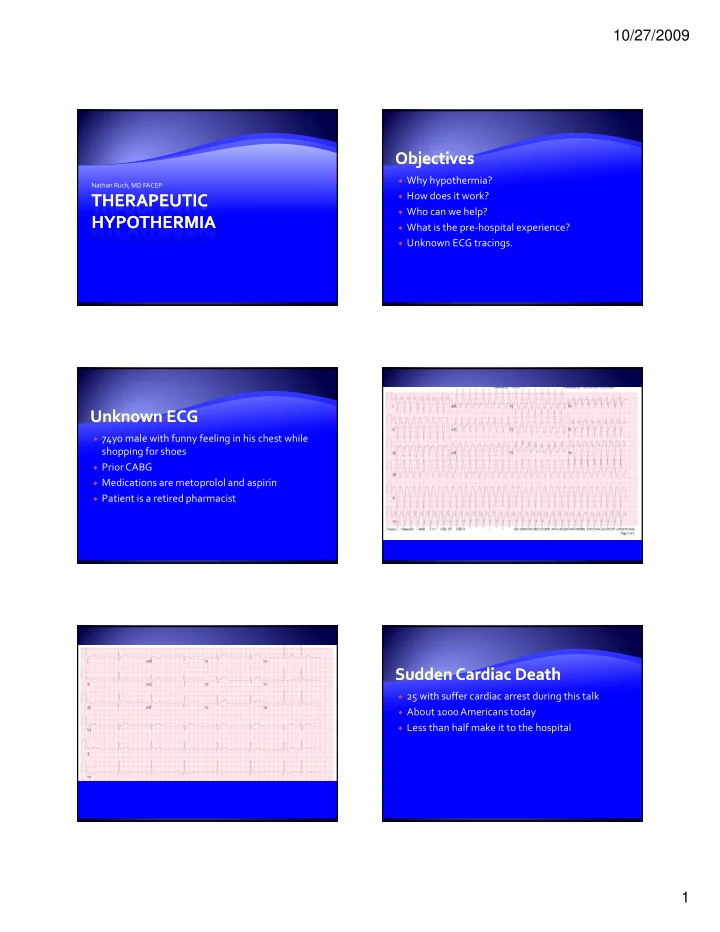
 Who can we help?  What is the pre‐hospital experience?  Unknown ECG tracings.  74yo male with funny feeling in his chest while

shopping for shoes

 Prior CABG  Prior CABG  Medications are metoprolol and aspirin  Patient is a retired pharmacist  25 with suffer cardiac arrest during this talk  About 1000 Americans today

h h lf k h h l

 Less than half make it to the hospital

slide-2
SLIDE 2

10/27/2009 2

 Cardiac arrest

 Greater than 90% mortality rate  No significant decline over past few decades despite g p p new drugs and improved access to electrical defibrillation

 Return of spontaneous circulation (ROSC)

 Many patients go on to die during subsequent hospitalization  Neurologic impairment often remains as a lasting morbidity

 450,000 sudden deaths per year in the US  <10% discharged from the hospital

h h l

 Many who “survive” have poor neurologic

  • utcome

 First reported 50 years ago  Decreased core temp reduces metabolic demand

b d d d d

 Abandoned due to resource requirements and

lack of proven benefit

 49 year old with pain in right arm that began

while spreading mulch

 No past medical history  No past medical history

slide-3
SLIDE 3

10/27/2009 3

 Mild Hypothermia

 90‐95F (32‐35C)

Moderate H pothermia

 Moderate Hypothermia

 82‐89F (28‐32C)

 Severe Hypothemia

 <82 (<28C)

 Nobody really knows  Reduced basal cellular energy requirements

d d f d l d

 Reduced free radical production  Improved cell membrane stability  Improved immune function  Decreased cytokine production  73yo woman with palpitations  Some left chest pain and dizziness

slide-4
SLIDE 4

10/27/2009 4

 77 patients

 43 Hypoothermia  34 Normothermia  34 Normothermia

 Results

 49% good outcome with hypothermia  26% good outcome with normothermia

 AHA – 2005 Guidelines  ILCOR – 2002 Consensus statement  Unconscious adults with ROSC after out of

hospital cardiac arrest should be cooled to 32‐ 34C for 12‐24 hours when the initial rhythm is VF 34C for 12 24 hours when the initial rhythm is VF

 Such cooling may be useful for other rhythms

and in hospital cardiac arrest

slide-5
SLIDE 5

10/27/2009 5

Yes 13% No 87%

 Duration on non‐perfusing rhythm  Bystander CPR

l d f b ll

 Early defibrillation – AED’s  Quality of CPR  Age  Therapeutic hypothermia  One out of 5 hospital deaths is sudden cardiac

arrest.

 Overall survival in US is 5 8%  Overall survival in US is 5‐8%  Good neurologic outcome in 3% of out of

hospital arrests.

slide-6
SLIDE 6

10/27/2009 6

 Surface cooling (cooling blankets/ice bags)  Endovascular catheters

C l fl d

 Cool IV fluids  Cardiopulmonary bypass  Cooling caps/helmets  Rectal  Esophageal  Tympanic  Oral  PA catheter  Bladder  Axilla

slide-7
SLIDE 7

10/27/2009 7

 Unintentional overcooling <32C  Coagulopathy

l h h

 Ventricular arrhythmias  Increased risk of infection  Below 30C defibrillation may not be effective  Optimal duration unknown  12‐24 hours

Sh

 Shivering  Active rewarming 1C/HR  Heating blanket  Warm IV fluids  May help overcome institutional inertia  May aid in directing post arrest patient to most

capable hospitals capable hospitals

 Pre‐hospital protocols mitigate hospital delays  Improves outcome  Requires minimal equipment and training  82yo woman who slipped and struck her head

while reaching for a pot in the kitchen

 Triage heart rate of 58  Triage heart rate of 58  Patient denies syncope or other symptoms  ECG done by tech with no order from MD

slide-8
SLIDE 8

10/27/2009 8

www.wakeems.com/saem

 Wake County/Raleigh, NC:

 Single, 3rd service EMS System with 65,000 calls/year  Reliable firefighter first response  Reliable firefighter first response  Resident population of ~825,000 (add 100 per day)  Post‐resuscitation patients are selectively transported to one of 2 high volume PCI centers

 All calls receive EMD from a single, high‐volume

center

 Fire first response with AED and compressions  Fire first response with AED and compressions  Paramedic response with transport ambulances  Supervisory response at paramedic level  Baseline [Jan 2004‐Apr 2005]: Traditional CPR,

focus on airway

 New CPR [Apr 2005‐Apr 2006]: Continuous  New CPR [Apr 2005 Apr 2006]: Continuous

compressions, delayed intubation for VF/VT

 Impedance Threshold Device (ITD) [Apr 2006‐Oct

2006]

 Induced Hypothermia [Oct 2006‐Oct 2007]  ROSC after cardiac arrest not related to trauma

  • r hemorrhage

 Age 16 years or greater  Age 16 years or greater  Female without obviously gravid uterus  Initial temperature >34 C  Patient is intubated (no RSI)  Patient remains comatose without purposeful

response to pain

slide-9
SLIDE 9

10/27/2009 9

 All EMS records are maintained in an electronic

database

 Records with any of the following characteristics  Records with any of the following characteristics

are reviewed to determine if cardiac arrest

  • ccurred:

 EMS Patient Disposition = cardiac arrest  CPR procedure is recorded  Defibrillation is recorded

 Age less than 16  Obvious traumatic origin of arrest

S d

 EMS witnessed arrest  Arrest not in EMS control

 Prison facilities  Out‐of‐system intercept  Arrests under direction of non‐EMS physician

 Data were analyzed using logistic regression  Covariates offered for the regression:

A  Age  Gender  Response time for the first defibrillator  Witnessed status  Location

 Primary outcome was the proportion of OOH‐CA

patients for whom resuscitation was attempted that survived to discharge in baseline vs. hypothermia g yp phases

 Secondary outcomes include (by phase):

 Pulse at emergency department, survival to admission, neurological intact survival to discharge

 Additionally, results were stratified by initial rhythm  3124 OOH‐CA occurred during the study period  1442 obvious deaths (no resuscitation attempted)  1682 attempted resuscitations  484 of 1682 were excluded due to:

 119 not under EMS control/not a code  109 obvious traumatic origin  70 under the age of 16  206 EMS witnessed

 1198 met inclusion criteria

Total OOH-CA N= 1198 Baseline N = 372 New CPR N= 319 New CPR N= 319 ITD N= 148 Hypothermia N= 359
slide-10
SLIDE 10

10/27/2009 10

Mean Age 65 Percent male 58% Private Residence 81% Witnessed Status 36% Bystander CPR 36% Mean Defibrillator Response 5.3 – 6.1 mins Initially VF/VT 26%

NOTE: no statistically significant difference between study periods

10 12 14 16

7.3% 8.2% 11.6%

P<0.05*

2 4 6 8

Baseline New CPR ITD Hypo

4.6%

* when compared with baseline

20 25 30 35 40 Percent survival

12% 22% 29% 37% P<0.05*

5 10 15 survival Baseline New CPR ITD Hypo Treatment Period

12% * When compared with baseline 4 5 6 7 8 Neuro 4 4% 6.2% 7.8% P <0.05* 1 2 3 4 Intact Baseline New CPR ITD Hypo Treatment Period 1.9% 4.4% * When compared with baseline 20 25 30 35 Neuro 20% 28% P<0.05 * 5 10 15 eu o Intact Baseline New CPR ITD Hypo Treatment Period 10% 17% 20% * When compared with baseline 25 30 35

* *

5 10 15 20 Pulse @ ED Admit D/C Neuro Baseline Hypo * P <0.05 when compared with baseline

* *

slide-11
SLIDE 11

10/27/2009 11

 Confounders

 Removal of stacked defibrillations  Protocol driven pre and post resuscitation cardiac  Protocol‐driven pre‐ and post‐resuscitation cardiac arrest care  Improvement with procedures due to repetition

 Hawthorne effect  Intention‐to‐treat analysis  Induced hypothermia is not experimental

therapy

 Part of standard therapy post arrest (IIb/Ilb)  Few complications  Not expensive  Time sensitive  Impacts outcome (NNT 8)  14 yo girl with palpitations  Takes verapamil 240mg

S l d h

 Similar episodes in the past

slide-12
SLIDE 12

10/27/2009 12