
10/15/2012 1
Critical Factors Characterizing Projects and Lifecycle Models
30th Pacific NW Software Quality Conference (PNSQC) October 8-10, 2012 Kal Toth, kalmanctoth@gmail.com Herman Migliore, herm@cecs.pdx.edu
10/8/2012 PNSQC 2012 Critical Factors Characterizing Projects and Lifecycle Models, presented by Kal Toth 1
Context (1)
Methodologists / proponents of development lifecycles:
Boost their favorite approaches … often with built-in bias Rarely a balanced perspective i.e. both benefits and challenges Rarely discuss which problems they are best suited to solve or why
Assertion: A given lifecycle is not “best” for every project!
10/8/2012 PNSQC 2012 Critical Factors Characterizing Projects and Lifecycle Models, presented by Kal Toth 2
Waterfall Incremental Evolutionary Spiral Agile Project W Project X Project Y Project Z ?
Context (2)
Prudent engineering manager should seek objective evidence:
Which life-cycle process(es) best support the project’s unique needs? Which … yield positive ROI given core competencies? What are the risks of project overrun and downstream failures?
Should we take the project? retrain? pass?
10/8/2012 PNSQC 2012 Critical Factors Characterizing Projects and Lifecycle Models, presented by Kal Toth 3
Aim of this Paper
Advance the discovery of a process that will select [most] appropriate lifecycle for the planned project
Assumption: Certain critical factors characterize lifecycles & projects Hypothesis: a practical characterization matching process exists
Preliminary Remarks:
Herein postulating and describing a possible approach Encourage motivated practitioners to explore this problem further Hopeful side-effects of this paper:
- Recognition that any given lifecycle is not suitable for all projects
- Practitioners should consider adapting & combining lifecycles
10/8/2012 PNSQC 2012 Critical Factors Characterizing Projects and Lifecycle Models, presented by Kal Toth 4
Flow of this Paper (contents)
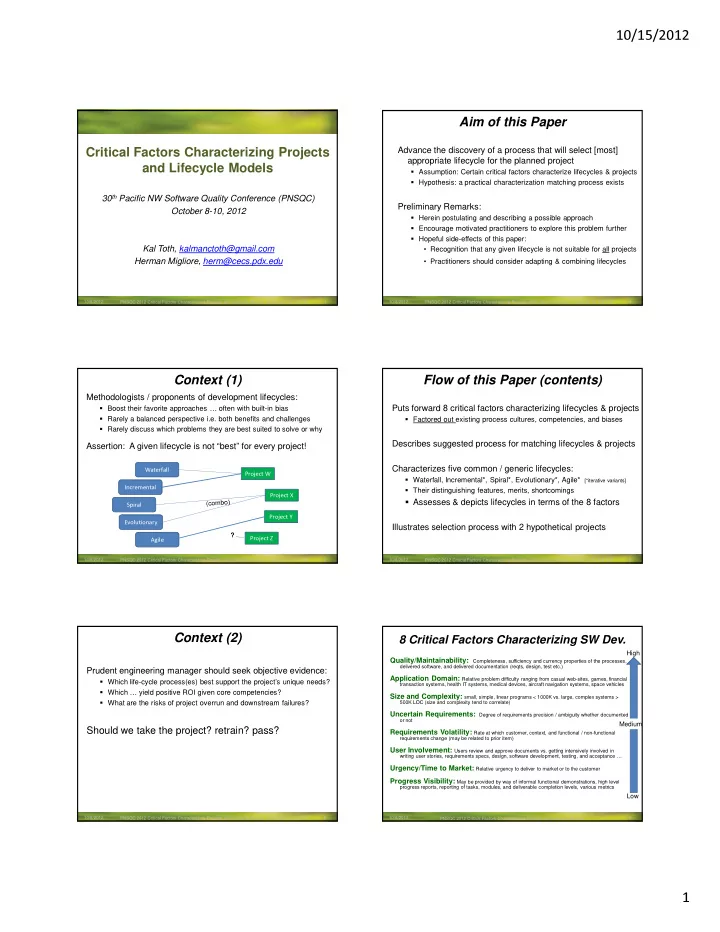
Puts forward 8 critical factors characterizing lifecycles & projects
Factored out existing process cultures, competencies, and biases
Describes suggested process for matching lifecycles & projects Characterizes five common / generic lifecycles:
Waterfall, Incremental*, Spiral*, Evolutionary*, Agile* [*iterative variants] Their distinguishing features, merits, shortcomings
Assesses & depicts lifecycles in terms of the 8 factors Illustrates selection process with 2 hypothetical projects
10/8/2012 PNSQC 2012 Critical Factors Characterizing Projects and Lifecycle Models, presented by Kal Toth 5
8 Critical Factors Characterizing SW Dev.
Quality/Maintainability:
Completeness, sufficiency and currency properties of the processes, delivered software, and delivered documentation (reqts, design, test etc.)
Application Domain: Relative problem difficulty ranging from casual web-sites, games, financial
transaction systems, health IT systems, medical devices, aircraft navigation systems, space vehicles
Size and Complexity: small, simple, linear programs < 1000K vs. large, complex systems >
500K LOC (size and complexity tend to correlate)
Uncertain Requirements: Degree of requirements precision / ambiguity whether documented
- r not
Requirements Volatility: Rate at which customer, context, and functional / non-functional
requirements change (may be related to prior item)
User Involvement: Users review and approve documents vs. getting intensively involved in
writing user stories, requirements specs, design, software development, testing, and acceptance …
Urgency/Time to Market: Relative urgency to deliver to market or to the customer Progress Visibility: May be provided by way of informal functional demonstrations, high level
progress reports, reporting of tasks, modules, and deliverable completion levels, various metrics
10/8/2012 6 PNSQC 2012 Critical Factors Characterizing Projects and Lifecycle Models, presented by Kal Toth
High Low Medium