1 What is an Agent? LECTURE 2: INTELLIGENT AGENTS The main point - - PowerPoint PPT Presentation

1 what is an agent lecture 2 intelligent agents
SMART_READER_LITE
LIVE PREVIEW

1 What is an Agent? LECTURE 2: INTELLIGENT AGENTS The main point - - PowerPoint PPT Presentation

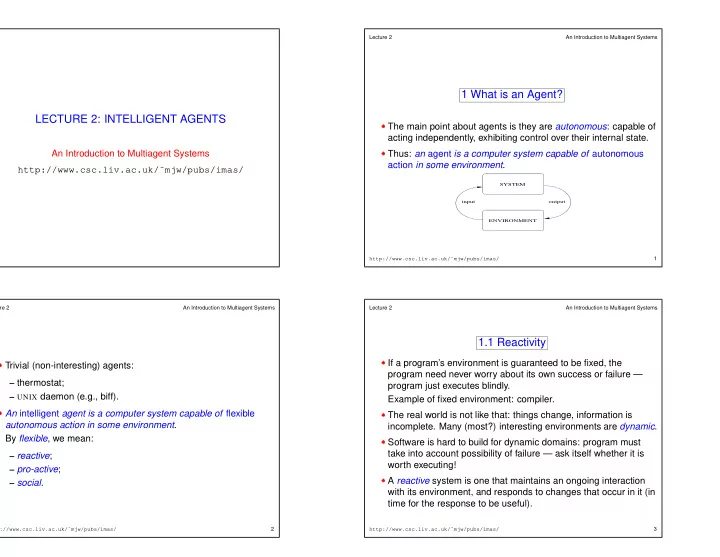
Lecture 2 An Introduction to Multiagent Systems 1 What is an Agent? LECTURE 2: INTELLIGENT AGENTS The main point about agents is they are autonomous : capable of acting independently, exhibiting control


slide-1
SLIDE 1

LECTURE 2: INTELLIGENT AGENTS

An Introduction to Multiagent Systems http://www.csc.liv.ac.uk/˜mjw/pubs/imas/

Lecture 2 An Introduction to Multiagent Systems

1 What is an Agent?

  • The main point about agents is they are autonomous: capable of

acting independently, exhibiting control over their internal state.

  • Thus: an agent is a computer system capable of autonomous

action in some environment.

ENVIRONMENT SYSTEM

  • utput

input http://www.csc.liv.ac.uk/˜mjw/pubs/imas/ 1 Lecture 2 An Introduction to Multiagent Systems

  • Trivial (non-interesting) agents:

– thermostat; – UNIX daemon (e.g., biff).

  • An intelligent agent is a computer system capable of flexible

autonomous action in some environment. By flexible, we mean: – reactive; – pro-active; – social.

http://www.csc.liv.ac.uk/˜mjw/pubs/imas/ 2 Lecture 2 An Introduction to Multiagent Systems

1.1 Reactivity

  • If a program’s environment is guaranteed to be fixed, the

program need never worry about its own success or failure — program just executes blindly. Example of fixed environment: compiler.

  • The real world is not like that: things change, information is
  • incomplete. Many (most?) interesting environments are dynamic.
  • Software is hard to build for dynamic domains: program must

take into account possibility of failure — ask itself whether it is worth executing!

  • A reactive system is one that maintains an ongoing interaction

with its environment, and responds to changes that occur in it (in time for the response to be useful).

http://www.csc.liv.ac.uk/˜mjw/pubs/imas/ 3

slide-2
SLIDE 2

Lecture 2 An Introduction to Multiagent Systems

1.2 Proactiveness

  • Reacting to an environment is easy (e.g., stimulus

response rules).

  • But we generally want agents to do things for us.
  • Hence goal directed behaviour.
  • Pro-activeness = generating and attempting to achieve goals; not

driven solely by events; taking the initiative.

  • Recognising opportunities.

http://www.csc.liv.ac.uk/˜mjw/pubs/imas/ 4 Lecture 2 An Introduction to Multiagent Systems

1.3 Social Ability

  • The real world is a multi-agent environment: we cannot go

around attempting to achieve goals without taking others into account.

  • Some goals can only be achieved with the cooperation of others.
  • Similarly for many computer environments: witness the

INTERNET.

  • Social ability in agents is the ability to interact with other agents

(and possibly humans) via some kind of agent-communication language, and perhaps cooperate with others.

http://www.csc.liv.ac.uk/˜mjw/pubs/imas/ 5 Lecture 2 An Introduction to Multiagent Systems

2 Other Properties

  • Other properties, sometimes discussed in the context of agency:

– mobility: the ability of an agent to move around an electronic network; – veracity: an agent will not knowingly communicate false information; – benevolence: agents do not have conflicting goals, and that every agent will therefore always try to do what is asked of it; – rationality: agent will act in order to achieve its goals, and will not act in such a way as to prevent its goals being achieved — at least insofar as its beliefs permit; – learning/adaption: agents improve performance over time.

http://www.csc.liv.ac.uk/˜mjw/pubs/imas/ 6 Lecture 2 An Introduction to Multiagent Systems

2.1 Agents and Objects

  • Are agents just objects by another name?
  • Object:

– encapsulates some state; – communicates via message passing; – has methods, corresponding to operations that may be performed on this state.

http://www.csc.liv.ac.uk/˜mjw/pubs/imas/ 7

slide-3
SLIDE 3

Lecture 2 An Introduction to Multiagent Systems

  • Main differences:

– agents are autonomous: agents embody stronger notion of autonomy than objects, and in particular, they decide for themselves whether or not to perform an action on request from another agent; – agents are smart: capable of flexible (reactive, pro-active, social) behavior, and the standard object model has nothing to say about such types of behavior; – agents are active: a multi-agent system is inherently multi-threaded, in that each agent is assumed to have at least one thread of active control.

http://www.csc.liv.ac.uk/˜mjw/pubs/imas/ 8 Lecture 2 An Introduction to Multiagent Systems

Objects do it for free. . .

  • agents do it because they want to;
  • agents do it for money.

http://www.csc.liv.ac.uk/˜mjw/pubs/imas/ 9 Lecture 2 An Introduction to Multiagent Systems

2.2 Agents and Expert Systems

  • Aren’t agents just expert systems by another name?
  • Expert systems typically disembodied ‘expertise’ about some

(abstract) domain of discourse (e.g., blood diseases).

  • Example: MYCIN knows about blood diseases in humans.

It has a wealth of knowledge about blood diseases, in the form of rules. A doctor can obtain expert advice about blood diseases by giving

MYCIN facts, answering questions, and posing queries.

http://www.csc.liv.ac.uk/˜mjw/pubs/imas/ 10 Lecture 2 An Introduction to Multiagent Systems

  • Main differences:

– agents situated in an environment:

MYCIN is not aware of the world — only information obtained

is by asking the user questions. – agents act:

MYCIN does not operate on patients.

  • Some real-time (typically process control) expert systems are

agents.

http://www.csc.liv.ac.uk/˜mjw/pubs/imas/ 11

slide-4
SLIDE 4

Lecture 2 An Introduction to Multiagent Systems

2.3 Intelligent Agents and AI

  • Aren’t agents just the AI project?

Isn’t building an agent what AI is all about?

  • AI aims to build systems that can (ultimately) understand natural

language, recognise and understand scenes, use common sense, think creatively, etc — all of which are very hard.

  • So, don’t we need to solve all of AI to build an agent. . . ?

http://www.csc.liv.ac.uk/˜mjw/pubs/imas/ 12 Lecture 2 An Introduction to Multiagent Systems

  • When building an agent, we simply want a system that can

choose the right action to perform, typically in a limited domain.

  • We do not have to solve all the problems of AI to build a useful

agent: a little intelligence goes a long way!

  • Oren Etzioni, speaking about the commercial experience of

NETBOT, Inc:

We made our agents dumber and dumber and dumber . . . until finally they made money.

http://www.csc.liv.ac.uk/˜mjw/pubs/imas/ 13 Lecture 2 An Introduction to Multiagent Systems

3 Environments

  • Accessible vs inaccessible.

An accessible environment is one in which the agent can obtain complete, accurate, up-to-date information about the environment’s state. Most moderately complex environments (including, for example, the everyday physical world and the Internet) are inaccessible. The more accessible an environment is, the simpler it is to build agents to operate in it.

http://www.csc.liv.ac.uk/˜mjw/pubs/imas/ 14 Lecture 2 An Introduction to Multiagent Systems

  • Deterministic vs non-deterministic.

As we have already mentioned, a deterministic environment is

  • ne in which any action has a single guaranteed effect — there

is no uncertainty about the state that will result from performing an action. The physical world can to all intents and purposes be regarded as non-deterministic. Non-deterministic environments present greater problems for the agent designer.

http://www.csc.liv.ac.uk/˜mjw/pubs/imas/ 15

slide-5
SLIDE 5

Lecture 2 An Introduction to Multiagent Systems

  • Episodic vs non-episodic.

In an episodic environment, the performance of an agent is dependent on a number of discrete episodes, with no link between the performance of an agent in different scenarios. Episodic environments are simpler from the agent developer’s perspective because the agent can decide what action to perform based only on the current episode — it need not reason about the interactions between this and future episodes.

http://www.csc.liv.ac.uk/˜mjw/pubs/imas/ 16 Lecture 2 An Introduction to Multiagent Systems

  • Static vs dynamic.

A static environment is one that can be assumed to remain unchanged except by the performance of actions by the agent. A dynamic environment is one that has other processes

  • perating on it, and which hence changes in ways beyond the

agent’s control. The physical world is a highly dynamic environment.

http://www.csc.liv.ac.uk/˜mjw/pubs/imas/ 17 Lecture 2 An Introduction to Multiagent Systems

  • Discrete vs continuous.

An environment is discrete if there are a fixed, finite number of actions and percepts in it. Russell and Norvig give a chess game as an example of a discrete environment, and taxi driving as an example of a continuous one.

http://www.csc.liv.ac.uk/˜mjw/pubs/imas/ 18 Lecture 2 An Introduction to Multiagent Systems

4 Agents as Intentional Systems

  • When explaining human activity, it is often useful to make

statements such as the following: Janine took her umbrella because she believed it was going to rain. Michael worked hard because he wanted to possess a PhD.

  • These statements make use of a folk psychology, by which

human behaviour is predicted and explained through the attribution of attitudes, such as believing and wanting (as in the above examples), hoping, fearing, and so on.

  • The attitudes employed in such folk psychological descriptions

are called the intentional notions.

http://www.csc.liv.ac.uk/˜mjw/pubs/imas/ 19

slide-6
SLIDE 6

Lecture 2 An Introduction to Multiagent Systems

  • The philosopher Daniel Dennett coined the term intentional

system to describe entities ‘whose behaviour can be predicted by the method of attributing belief, desires and rational acumen’.

  • Dennett identifies different ‘grades’ of intentional system:

‘A first-order intentional system has beliefs and desires (etc.) but no beliefs and desires about beliefs and desires. . . . A second-order intentional system is more sophisticated; it has beliefs and desires (and no doubt

  • ther intentional states) about beliefs and desires (and
  • ther intentional states) — both those of others and its
  • wn’.
  • Is it legitimate or useful to attribute beliefs, desires, and so on, to

computer systems?

http://www.csc.liv.ac.uk/˜mjw/pubs/imas/ 20 Lecture 2 An Introduction to Multiagent Systems

  • McCarthy argued that there are occasions when the intentional

stance is appropriate:

‘To ascribe beliefs, free will, intentions, consciousness, abilities, or wants to a machine is legitimate when such an ascription expresses the same information about the machine that it expresses about a person. It is useful when the ascription helps us understand the structure of the machine, its past or future behaviour, or how to repair or improve it. It is perhaps never logically required even for humans, but expressing reasonably briefly what is actually known about the state of the machine in a particular situation may require mental qualities or qualities isomorphic to them. Theories of belief, knowledge and wanting can be constructed for machines in a simpler setting than for humans, and later applied to humans. Ascription of mental qualities is most straightforward for machines of known structure such as thermostats and computer operating systems, but is most useful when applied to entities whose structure is incompletely known’.

http://www.csc.liv.ac.uk/˜mjw/pubs/imas/ 21 Lecture 2 An Introduction to Multiagent Systems

  • What objects can be described by the intentional stance?
  • As it turns out, more or less anything can. . . consider a light

switch: ‘It is perfectly coherent to treat a light switch as a (very cooperative) agent with the capability of transmitting current at will, who invariably transmits current when it believes that we want it transmitted and not otherwise; flicking the switch is simply our way of communicating our desires’. (Yoav Shoham)

  • But most adults would find such a description absurd!

Why is this?

http://www.csc.liv.ac.uk/˜mjw/pubs/imas/ 22 Lecture 2 An Introduction to Multiagent Systems

  • The answer seems to be that while the intentional stance

description is consistent, . . . it does not buy us anything, since we essentially understand the mechanism sufficiently to have a simpler, mechanistic description of its behaviour. (Yoav Shoham)

  • Put crudely, the more we know about a system, the less we need

to rely on animistic, intentional explanations of its behaviour.

  • But with very complex systems, a mechanistic, explanation of its

behaviour may not be practicable.

  • As computer systems become ever more complex, we need

more powerful abstractions and metaphors to explain their

  • peration — low level explanations become impractical.

The intentional stance is such an abstraction.

http://www.csc.liv.ac.uk/˜mjw/pubs/imas/ 23

slide-7
SLIDE 7

Lecture 2 An Introduction to Multiagent Systems

  • The intentional notions are thus abstraction tools, which provide

us with a convenient and familiar way of describing, explaining, and predicting the behaviour of complex systems.

  • Remember: most important developments in computing are

based on new abstractions: – procedural abstraction; – abstract data types; – objects. Agents, and agents as intentional systems, represent a further, and increasingly powerful abstraction.

  • So agent theorists start from the (strong) view of agents as

intentional systems: one whose simplest consistent description requires the intentional stance.

http://www.csc.liv.ac.uk/˜mjw/pubs/imas/ 24 Lecture 2 An Introduction to Multiagent Systems

  • This intentional stance is an abstraction tool — a convenient way
  • f talking about complex systems, which allows us to predict and

explain their behaviour without having to understand how the mechanism actually works.

  • Now, much of computer science is concerned with looking for

abstraction mechanisms (witness procedural abstraction, ADTs,

  • bjects, . . . )

So why not use the intentional stance as an abstraction tool in computing — to explain, understand, and, crucially, program computer systems?

  • This is an important argument in favour of agents.

http://www.csc.liv.ac.uk/˜mjw/pubs/imas/ 25 Lecture 2 An Introduction to Multiagent Systems

  • Other 3 points in favour of this idea:

Characterising Agents

  • It provides us with a familiar, non-technical way of understanding

& explaing agents.

Nested Representations

  • It gives us the potential to specify systems that include

representations of other systems. It is widely accepted that such nested representations are essential for agents that must cooperate with other agents.

http://www.csc.liv.ac.uk/˜mjw/pubs/imas/ 26 Lecture 2 An Introduction to Multiagent Systems

Post-Declarative Systems

  • This view of agents leads to a kind of post-declarative

programming: – in procedural programming, we say exactly what a system should do; – in declarative programming, we state something that we want to achieve, give the system general info about the relationships between objects, and let a built-in control mechanism (e.g., goal-directed theorem proving) figure out what to do; – with agents, we give a very abstract specification of the system, and let the control mechanism figure out what to do, knowing that it will act in accordance with some built-in theory

  • f agency (e.g., the well-known Cohen-Levesque model of

intention).

http://www.csc.liv.ac.uk/˜mjw/pubs/imas/ 27

slide-8
SLIDE 8

Lecture 2 An Introduction to Multiagent Systems

An aside. . .

  • We find that researchers from a more mainstream computing

discipline have adopted a similar set of ideas. . .

  • In distributed systems theory, logics of knowledge are used in

the development of knowledge based protocols.

  • The rationale is that when constructing protocols, one often

encounters reasoning such as the following: IF process i knows process j has received message m

THEN process i should send process j the message m

.

  • In DS theory, knowledge is grounded — given a precise

interpretation in terms of the states of a process; return to this

  • later. . . we’ll examine this point in detail later.

http://www.csc.liv.ac.uk/˜mjw/pubs/imas/ 28 Lecture 2 An Introduction to Multiagent Systems

5 Abstract Architectures for Agents

  • Assume the environment may be in any of a finite set E of

discrete, instantaneous states: E

☎ ✆

e

e

✞ ✝ ✟ ✟ ✟ ✠ ✟
  • Agents are assumed to have a repertoire of possible actions

available to them, which transform the state of the environment. Ac

☎ ✆☛✡ ✝ ✡ ✞ ✝ ✟ ✟ ✟ ✠
  • A run, r, of an agent in an environment is a sequence of

interleaved environment states and actions: r

e

✌✎✍ ✏ ✑ ✁

e

✂ ✍ ✒ ✑ ✁

e

✄✓✍ ✔ ✑ ✁

e

✕✎✍ ✖ ✑ ✁ ✗ ✗ ✗ ✍

u

✘ ✒ ✑ ✁

eu

http://www.csc.liv.ac.uk/˜mjw/pubs/imas/ 29 Lecture 2 An Introduction to Multiagent Systems

  • Let:

be the set of all such possible finite sequences (over E and Ac); –

Ac be the subset of these that end with an action; and

E be the subset of these that end with an environment state.

http://www.csc.liv.ac.uk/˜mjw/pubs/imas/ 30 Lecture 2 An Introduction to Multiagent Systems

State Transformer Functions

  • A state transformer function represents behaviour of the

environment:

✚ ☞ ✙

Ac

✁ ✛ ✜

E

  • Note that environments are. . .

– history dependent. – non-deterministic.

  • If
✚ ✜

r

✢ ☎ ✣

, then there are no possible successor states to r. In this case, we say that the system has ended its run.

  • Formally, we say an environment Env is a triple Env
☎ ✤

E

e

✌ ✝ ✚ ✥

where: E is a set of environment states, e

✌ ✦

E is the initial state; and

is a state transformer function.

http://www.csc.liv.ac.uk/˜mjw/pubs/imas/ 31

slide-9
SLIDE 9

Lecture 2 An Introduction to Multiagent Systems

Agents

  • Agent is a function which maps runs to actions:

Ag

☞ ✙

E

Ac An agent makes a decision about what action to perform based

  • n the history of the system that it has witnessed to date. Let
✧ ★

be the set of all agents.

http://www.csc.liv.ac.uk/˜mjw/pubs/imas/ 32 Lecture 2 An Introduction to Multiagent Systems

Systems

  • A system is a pair containing an agent and an environment.
  • Any system will have associated with it a set of possible runs; we

denote the set of runs of agent Ag in environment Env by

✙ ✜

Ag

Env

.

  • (We assume
✙ ✜

Ag

Env

contains only terminated runs.)

http://www.csc.liv.ac.uk/˜mjw/pubs/imas/ 33 Lecture 2 An Introduction to Multiagent Systems

  • Formally, a sequence

e

✌ ✝ ✡ ✌ ✝

e

✂ ✝ ✡ ✂ ✝

e

✄ ✝ ✟ ✟ ✟ ✢

represents a run of an agent Ag in environment Env

☎ ✤

E

e

✌ ✝ ✚ ✥

if:

  • 1. e

is the initial state of Env 2.

✡ ✌ ☎

Ag

e

✌ ✢

; and

  • 3. for u
✩ ✪

, eu

✦ ✚ ✜ ✜

e

✌ ✝ ✡ ✌ ✝ ✟ ✟ ✟ ✝ ✡

u

✫ ✂ ✢ ✢

where

u

Ag

✜ ✜

e

✌ ✝ ✡ ✌ ✝ ✟ ✟ ✟ ✝

eu

✢ ✢

http://www.csc.liv.ac.uk/˜mjw/pubs/imas/ 34 Lecture 2 An Introduction to Multiagent Systems

6 Purely Reactive Agents

  • Some agents decide what to do without reference to their history

— they base their decision making entirely on the present, with no reference at all to the past.

  • We call such agents purely reactive:

action

E

Ac

  • A thermostat is a purely reactive agent.

action

e

✢ ☎ ✬ ✭ ✭ ✮ ✭ ✭ ✯
  • ff if e = temperature OK
  • n otherwise.

http://www.csc.liv.ac.uk/˜mjw/pubs/imas/ 35

slide-10
SLIDE 10

Lecture 2 An Introduction to Multiagent Systems

7 Perception

  • Now introduce perception system:

ENVIRONMENT action AGENT see

http://www.csc.liv.ac.uk/˜mjw/pubs/imas/ 36 Lecture 2 An Introduction to Multiagent Systems

  • The see function is the agent’s ability to observe its environment,

whereas the action function represents the agent’s decision making process.

  • Output of the see function is a percept:

see

E

Per which maps environment states to percepts, and action is now a function action

Per

✰ ✁

A which maps sequences of percepts to actions.

http://www.csc.liv.ac.uk/˜mjw/pubs/imas/ 37 Lecture 2 An Introduction to Multiagent Systems

8 Agents with State

  • We now consider agents that maintain state:

action see next

state

AGENT ENVIRONMENT http://www.csc.liv.ac.uk/˜mjw/pubs/imas/ 38 Lecture 2 An Introduction to Multiagent Systems

  • These agents have some internal data structure, which is

typically used to record information about the environment state and history. Let I be the set of all internal states of the agent.

  • The perception function see for a state-based agent is

unchanged: see

E

Per The action-selection function action is now defined as a mapping action

I

Ac from internal states to actions. An additional function next is introduced, which maps an internal state and percept to an internal state: next

I

Per

I

http://www.csc.liv.ac.uk/˜mjw/pubs/imas/ 39

slide-11
SLIDE 11

Lecture 2 An Introduction to Multiagent Systems

8.1 Agent control loop

  • 1. Agent starts in some initial internal state i

.

  • 2. Observes its environment state e, and generates a percept

see

e

.

  • 3. Internal state of the agent is then updated via next function,

becoming next

i

✌ ✝

see

e

✢ ✢

.

  • 4. The action selected by the agent is action

next

i

✌ ✝

see

e

✢ ✢ ✢

. This action is then performed.

  • 5. Goto (2).

http://www.csc.liv.ac.uk/˜mjw/pubs/imas/ 40 Lecture 2 An Introduction to Multiagent Systems

9 Tasks for Agents

  • We build agents in order to carry out tasks for us.
  • The task must be specified by us. . .
  • But we want to tell agents what to do without telling them how to

do it.

http://www.csc.liv.ac.uk/˜mjw/pubs/imas/ 41 Lecture 2 An Introduction to Multiagent Systems

9.1 Utilities Functions over States

  • One possibility: associate utilities with individual states — the

task of the agent is then to bring about states that maximise utility.

  • A task specification is a function

u

E

IR which associated a real number with every environment state.

http://www.csc.liv.ac.uk/˜mjw/pubs/imas/ 42 Lecture 2 An Introduction to Multiagent Systems

  • But what is the value of a run. . .

– minimum utility of state on run? – maximum utility of state on run? – sum of utilities of states on run? – average?

  • Disadvantage: difficult to specify a long term view when

assigning utilities to individual states. (One possibility: a discount for states later on.)

http://www.csc.liv.ac.uk/˜mjw/pubs/imas/ 43

slide-12
SLIDE 12

Lecture 2 An Introduction to Multiagent Systems

9.2 Utilities over Runs

  • Another possibility: assigns a utility not to individual states, but to

runs themselves: u

☞ ✙ ✁

IR

  • Such an approach takes an inherently long term view.
  • Other variations: incorporate probabilities of different states

emerging.

  • Difficulties with utility-based approaches:

– where do the numbers come from? – we don’t think in terms of utilities! – hard to formulate tasks in these terms.

http://www.csc.liv.ac.uk/˜mjw/pubs/imas/ 44 Lecture 2 An Introduction to Multiagent Systems

Utility in the Tileworld

  • Simulated two dimensional grid environment on which there are

agents, tiles, obstacles, and holes.

  • An agent can move in four directions, up, down, left, or right, and

if it is located next to a tile, it can push it.

  • Holes have to be filled up with tiles by the agent. An agent

scores points by filling holes with tiles, with the aim being to fill as many holes as possible.

  • TILEWORLD changes with the random appearance and

disappearance of holes.

  • Utility function defined as follows:

u

r

✢✳✲ ☎

number of holes filled in r number of holes that appeared in r

http://www.csc.liv.ac.uk/˜mjw/pubs/imas/ 45 Lecture 2 An Introduction to Multiagent Systems

9.3 Expected Utility & Optimal Agents

  • Write P

r

Ag

Env

to denote probability that run r occurs when agent Ag is placed in environment Env. Note:

r

✶ ✷ ✸

Ag

Env

P

r

Ag

Env

✢ ☎ ✻ ✟
  • Then optimal agent Agopt in an environment Env is the one that

maximizes expected utility: Agopt

☎ ✼ ✽ ✾ ✿ ✼ ❀

Ag

✶❁ ❂ ✵

r

✶ ✷ ✸

Ag

Env

u

r

P

r

Ag

Env

✢ ✟

(1)

http://www.csc.liv.ac.uk/˜mjw/pubs/imas/ 46 Lecture 2 An Introduction to Multiagent Systems

9.4 Bounded Optimal Agents

  • Some agents cannot be implemented on some computers

(A function Ag

☞ ✙

E

Ac may need more than available memory to implement.)

  • Write
✧ ★

m to denote the agents that can be implemented on

machine (computer) m:

✧ ★

m

☎ ✆

Ag

Ag

✦ ✧ ★

and Ag can be implemented on m

✠ ✟
  • We can replace equation (1) with the following, which defines the

bounded optimal agent Agopt: Agopt

☎ ✼ ✽ ✾ ✿ ✼ ❀

Ag

✶❁ ❂

m

r

✶ ✷ ✸

Ag

Env

u

r

P

r

Ag

Env

✢ ✟

(2)

http://www.csc.liv.ac.uk/˜mjw/pubs/imas/ 47

slide-13
SLIDE 13

Lecture 2 An Introduction to Multiagent Systems

9.5 Predicate Task Specifications

  • A special case of assigning utilities to histories is to assign 0

(false) or 1 (true) to a run.

  • If a run is assigned 1, then the agent succeeds on that run,
  • therwise it fails.
  • Call these predicate task specifications.
  • Denote predicate task specification by

. Thus

❃ ☞ ✙ ✁ ✆ ✪ ✝ ✻ ✠

.

http://www.csc.liv.ac.uk/˜mjw/pubs/imas/ 48 Lecture 2 An Introduction to Multiagent Systems

9.6 Task Environments

  • A task environment is a pair

Env

✝ ❃ ✥

, where Env is an environment, and

❃ ☞ ✙ ✁ ✆ ✪ ✝ ✻ ✠

is a predicate over runs. Let

❄ ❅

be the set of all task environments.

  • A task environment specifies:

– the properties of the system the agent will inhabit; – the criteria by which an agent will be judged to have either failed or succeeded.

http://www.csc.liv.ac.uk/˜mjw/pubs/imas/ 49 Lecture 2 An Introduction to Multiagent Systems

  • Write
✙ ❆ ✜

Ag

Env

to denote set of all runs of the agent Ag in environment Env that satisfy

:

✙ ❆ ✜

Ag

Env

✢ ☎ ✆

r

r

✦ ✙ ✜

Ag

Env

and

❃ ✜

r

✢ ☎ ✻ ✠ ✟
  • We then say that an agent Ag succeeds in task environment

Env

✝ ❃ ✥

if

✙ ❆ ✜

Ag

Env

✢ ☎ ✙ ✜

Ag

Env

http://www.csc.liv.ac.uk/˜mjw/pubs/imas/ 50 Lecture 2 An Introduction to Multiagent Systems

The Probability of Success

  • Let P

r

Ag

Env

denote probability that run r occurs if agent Ag is placed in environment Env.

  • Then the probability P
✜ ❃ ✴

Ag

Env

that

is satisfied by Ag in Env would then simply be: P

✜ ❃ ✴

Ag

Env

✢ ☎ ✵

r

✶ ✷ ❇ ✸

Ag

Env

P

r

Ag

Env

http://www.csc.liv.ac.uk/˜mjw/pubs/imas/ 51

slide-14
SLIDE 14

Lecture 2 An Introduction to Multiagent Systems

Achievement & Maintenance Tasks

  • Two most common types of tasks are achievement tasks and

maintenance tasks:

  • 1. Achievement tasks Are those of the form “achieve state of

affairs

”.

  • 2. Maintenance tasks Are those of the form “maintain state of

affairs

”.

http://www.csc.liv.ac.uk/˜mjw/pubs/imas/ 52 Lecture 2 An Introduction to Multiagent Systems

  • An achievement task is specified by a set G of “good” or “goal”

states: G

E. The agent succeeds if it is guaranteed to bring about at least one

  • f these states (we do not care which one — they are all

considered equally good).

  • A maintenance goal is specified by a set B of “bad” states: B

E. The agent succeeds in a particular environment if it manages to avoid all states in B — if it never performs actions which result in any state in B occurring.

http://www.csc.liv.ac.uk/˜mjw/pubs/imas/ 53 Lecture 2 An Introduction to Multiagent Systems

10 Agent Synthesis

  • Agent synthesis is automatic programming: goal is to have a

program that will take a task environment, and from this task environment automatically generate an agent that succeeds in this environment: syn

☞ ❄ ❅ ✁ ✜ ✧ ★ ❋ ✆❍● ✠ ✢ ✟

(Think of

  • as being like null in JAVA.
  • Synthesis algorithm is:

– sound if, whenever it returns an agent, then this agent succeeds in the task environment that is passed as input; and – complete if it is guaranteed to return an agent whenever there exists an agent that will succeed in the task environment given as input.

http://www.csc.liv.ac.uk/˜mjw/pubs/imas/ 54 Lecture 2 An Introduction to Multiagent Systems

  • Synthesis algorithm syn is sound if it satisfies the following

condition: syn

✜ ✤

Env

✝ ❃ ✥ ✢ ☎

Ag implies

✙ ✜

Ag

Env

✢ ☎ ✙ ❆ ✜

Ag

Env

✢ ✟

and complete if:

Ag

✦ ✧ ★

s.t.

✙ ✜

Ag

Env

✢ ☎ ✙ ❆ ✜

Ag

Env

implies syn

✜ ✤

Env

✝ ❃ ✥ ✢ ❏ ☎

http://www.csc.liv.ac.uk/˜mjw/pubs/imas/ 55