1 THIS DOCUMENT AND INCLUDED COMMENTS ARE INTENDED TO BE OF - - PDF document

1 this document and included comments are intended to be
SMART_READER_LITE
LIVE PREVIEW

1 THIS DOCUMENT AND INCLUDED COMMENTS ARE INTENDED TO BE OF - - PDF document

THIS DOCUMENT AND INCLUDED COMMENTS ARE INTENDED TO BE OF ASSISTANCE IN PREPARING THE FORM AND IDENTIFYING THE RULES THAT AFFECT THE NOTED PORTIONS OF THE DOCUMENT. THEY ARE NOT INTENDED TO BE COMPLETE OR APPLICABLE TO EVERY SITUATION THAT MAY


slide-1
SLIDE 1

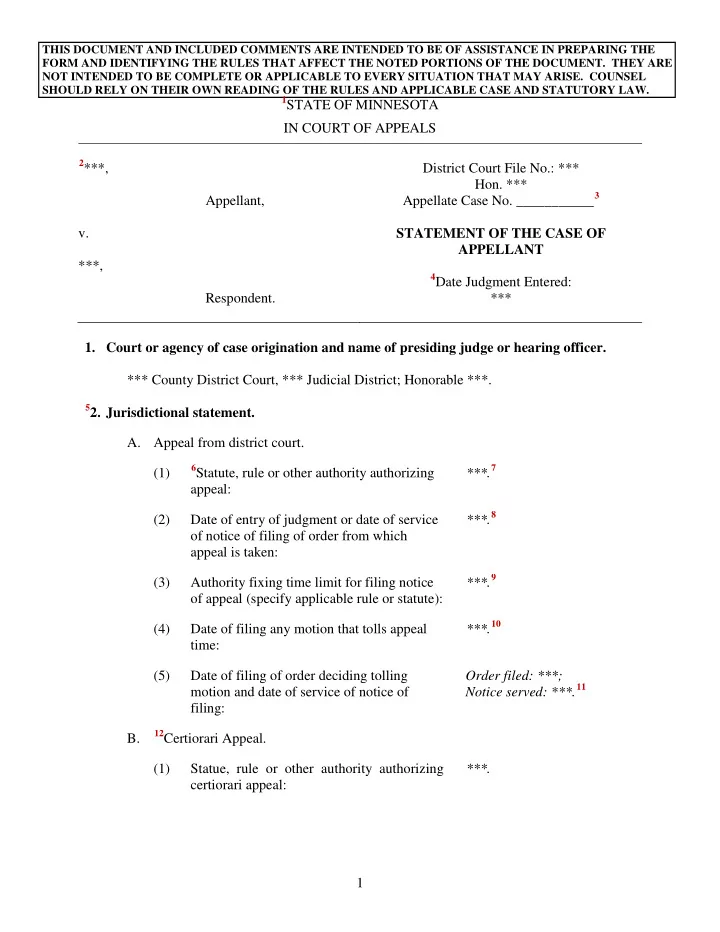
THIS DOCUMENT AND INCLUDED COMMENTS ARE INTENDED TO BE OF ASSISTANCE IN PREPARING THE FORM AND IDENTIFYING THE RULES THAT AFFECT THE NOTED PORTIONS OF THE DOCUMENT. THEY ARE NOT INTENDED TO BE COMPLETE OR APPLICABLE TO EVERY SITUATION THAT MAY ARISE. COUNSEL SHOULD RELY ON THEIR OWN READING OF THE RULES AND APPLICABLE CASE AND STATUTORY LAW.

1

1STATE OF MINNESOTA

IN COURT OF APPEALS

2***,

Appellant, v. ***, Respondent. District Court File No.: ***

  • Hon. ***

Appellate Case No. ___________3 STATEMENT OF THE CASE OF APPELLANT

4Date Judgment Entered:

***

  • 1. Court or agency of case origination and name of presiding judge or hearing officer.

*** County District Court, *** Judicial District; Honorable ***.

  • 52. Jurisdictional statement.
  • A. Appeal from district court.

(1)

6Statute, rule or other authority authorizing

appeal: ***.7 (2) Date of entry of judgment or date of service

  • f notice of filing of order from which

appeal is taken: ***.8 (3) Authority fixing time limit for filing notice

  • f appeal (specify applicable rule or statute):

***.9 (4) Date of filing any motion that tolls appeal time: ***.10 (5) Date of filing of order deciding tolling motion and date of service of notice of filing: Order filed: ***; Notice served: ***.11 B.

12Certiorari Appeal.

(1) Statue, rule or other authority authorizing certiorari appeal: ***.

slide-2
SLIDE 2

THIS DOCUMENT AND INCLUDED COMMENTS ARE INTENDED TO BE OF ASSISTANCE IN PREPARING THE FORM AND IDENTIFYING THE RULES THAT AFFECT THE NOTED PORTIONS OF THE DOCUMENT. THEY ARE NOT INTENDED TO BE COMPLETE OR APPLICABLE TO EVERY SITUATION THAT MAY ARISE. COUNSEL SHOULD RELY ON THEIR OWN READING OF THE RULES AND APPLICABLE CASE AND STATUTORY LAW.

2 (2) Authority fixing time limit for obtaining certiorari review (cite statutory section and date of event triggering appeal time, e.g., mailing of decision, receipt of decision, or receipt of other notice): ***. C.

13Other appellate proceedings:

(1) Statute, rule or other authority authorizing appellate proceeding: (2) Authority fixing time limit for appellate review (cite statutory section and date of event triggering appeal time, e.g., mailing decision, receipt of decision, or receipt of

  • ther notice):

***. ***. D.

14Finality of order or judgment.

(1) Does the judgment or order to be reviewed dispose of all claims by and against all parties, including attorneys' fees? ***. (a) If yes, provide date of order/judgment: ***. (b) If no, did the district court order entry of a final partial judgment for immediate appeal pursuant to Minn. R. Civ. App. P. 101.01? ***. (i) If yes, provide date of order: ***. (ii) If no, is the order or judgment appealed from reviewable under any exception to the finality rule? ***. E.

15Criminal Only

(1) Has a sentence been imposed or imposition

  • f sentence stayed?

***. (a) If no, cite statute or rule authorizing interlocutory appeal. ***.

slide-3
SLIDE 3

THIS DOCUMENT AND INCLUDED COMMENTS ARE INTENDED TO BE OF ASSISTANCE IN PREPARING THE FORM AND IDENTIFYING THE RULES THAT AFFECT THE NOTED PORTIONS OF THE DOCUMENT. THEY ARE NOT INTENDED TO BE COMPLETE OR APPLICABLE TO EVERY SITUATION THAT MAY ARISE. COUNSEL SHOULD RELY ON THEIR OWN READING OF THE RULES AND APPLICABLE CASE AND STATUTORY LAW.

3 3.

16 State type of litigation and designate any statutes at issue.

4.

17Brief description of claims, defenses, issues litigated and result below. For criminal

cases, specify whether conviction was for a misdemeanor, gross misdemeanor, or felony offense. 5.

18List specific issues proposed to be raised on appeal.

A. B. 6.

19Related appeals.

  • A. List all prior or pending appeals arising from the

same action as this appeal. If none, so state. ***.

  • B. List any known pending appeals in separate actions

raising similar issues to this appeal. If none known, so state. ***. 7. Contents of record.

  • A. Is a transcript necessary to review the issues on

appeal? ***.20 (1) If yes, full or partial transcript? ***. (2) Has the transcript already been delivered to the parties and filed with the trial court administrator? ***.21 (3) If not, has it been ordered from the court reporter? ***.

  • B. If a transcript is unavailable, is a statement of the

proceedings under Rule 110.03 necessary? ***.

  • C. Is a transcript necessary to review the issues on

appeal? ***. 8. Is oral argument requested? *** .

slide-4
SLIDE 4

THIS DOCUMENT AND INCLUDED COMMENTS ARE INTENDED TO BE OF ASSISTANCE IN PREPARING THE FORM AND IDENTIFYING THE RULES THAT AFFECT THE NOTED PORTIONS OF THE DOCUMENT. THEY ARE NOT INTENDED TO BE COMPLETE OR APPLICABLE TO EVERY SITUATION THAT MAY ARISE. COUNSEL SHOULD RELY ON THEIR OWN READING OF THE RULES AND APPLICABLE CASE AND STATUTORY LAW.

4

  • A. If so, is argument requested at a location other than

that provided in Rule 134.09, subd. 2? ***. (1) If yes, state where argument is requested:

  • 9. 22Identify the type of brief to be filed.
  • A. Formal brief under Rule 128.02

( )

  • B. Informal brief under Rule 128.01, subd. 1 (must be

accompanied by motion to accept unless submitted by claimant for reemployment benefits) ( )

  • C. Trial memoranda, supplemented by a short letter

argument, under Rule 128.01, subd. 2. ( )

  • 10. Names, addresses, zip codes and telephone numbers of attorneys for appellant and

respondents. [FIRM NAME] [Attorney Name] (#***) [Address] (###) ###-#### Attorneys for Appellant *** [FIRM NAME] [Attorney Name] (#***) [Address] (###) ###-####

23Attorneys for Respondent ***

Dated: ___________, 2014. [FIRM NAME] By: [Attorney Name] (#***) [Address] Telephone: (###) ###-#### Facsimile: (###) ###-#### ATTORNEYS FOR APPELLANT ***

slide-5
SLIDE 5

THIS DOCUMENT AND INCLUDED COMMENTS ARE INTENDED TO BE OF ASSISTANCE IN PREPARING THE FORM AND IDENTIFYING THE RULES THAT AFFECT THE NOTED PORTIONS OF THE DOCUMENT. THEY ARE NOT INTENDED TO BE COMPLETE OR APPLICABLE TO EVERY SITUATION THAT MAY ARISE. COUNSEL SHOULD RELY ON THEIR OWN READING OF THE RULES AND APPLICABLE CASE AND STATUTORY LAW.

5 ANNOTATIONS

1 This Statement of the Case is based on Form 133 of the Minnesota Rules of Civil Appellate Procedure. The

annotations are provided for informational purposes only. For more background on the nuances of the Statement

  • f the Case, refer to Magnuson, Herr and Hanson, Appellate Rules Annotated, 3 Minnesota Practice 725-26 (2014).

Under Rule 103.01 subd. 1, an original Statement of the Case is filed with the court of appeals, and one copy of the Statement of the Case must be served on each adverse party. This document is not sent to the district court clerk, but a courtesy copy to the judge (along with the Notice of Appeal) is generally appreciated.

2 Begin with the caption from the originating district court, but modify the party designation as necessary to

accurately reflect which party is the appellant and which is the respondent.

3 The appellate court file number remains blank. It will be completed by the clerk of the appellate courts once a

number is assigned to the file.

4 List the date the judgment being appealed from was entered. Be consistent with the date included in the Notice of

  • Appeal. The deadline for filing Notice of Appeal may be triggered by this date unless the appeals deadline was

tolled under Rule 104.01, subd. 2. It that case, it might also be helpful to list the date of service for notice of filing of the order disposing of the tolling motion.

5 As Form 133 states, “The Statement of the Case is not a jurisdictional document, but it is important to the proper

and efficient processing of the appeal by the appellate courts. The ‘jurisdictional statement’ section is intended to provide sufficient information for the appellate court to easily determine whether the order or judgment is appealable and if the appeal is timely.”

6 This document uses a two-column format with the form questions on the left and responses to the right and

  • italicized. This is different from Form 133, but it tends to make the Statement of the Case easier to review.

7 For most cases, a portion of Rule 103.03 will be the authority authorizing appeal. 8 This date is either the date judgment was entered, see Rule 104.01, subd. 1, or it is the date of service of the notice

  • f filing of a court’s order deciding any tolling motions, see Rule 104.01, subd. 2. The date listed here is typically

the one from which the deadline for filing Notice of Appeal is triggered.

9 For most cases, Rule 104.01, subd. 1 (the date judgment was entered) or subd. 2 (the date notice of an order

resolving a tolling motion is served) will be the authority fixing the time limit for filing Notice of Appeal. Other notice deadlines may be governed by statute.

10 Certain motions toll the time to appeal under Rule 104.01, subd. 2. Indicate the date of filing of any such motion. 11 Indicate both the filing date of the order deciding the tolling motion under Rule 104.01, subd. 2 and the date

notice of the filing of the order was served.

12 Rule 115 permits petitions for certiorari. Rule 115.03, subd. 1 requires a completed Statement of the Case to

accompany any such petition. For appeals from judgments and appealable orders, indicate “Not applicable” for these questions.

13 This section should be completed for an appellate proceeding that does not arise from a predefined judgment or

  • rder specified in the civil appellate rules. For the majority of appeals, this section will not apply and can be marked

“Not applicable”.

14 As the comment to Rule 104.01 indicates, “[a] judgment disposing of less than all claims against all parties

entered pursuant to an order which does not contain the express determination and directions prescribed by Rule 54.02 is not appealable until entry of the final judgment disposing of all remaining claims of all parties.”

15 This section will apply for criminal appeals only. For all civil appeals, indicate “Not applicable”. 16 Indicate the type of case (e.g., dissolution proceeding, contract dispute, criminal). Also indicate if the dispute

arises under, requires interpretation of, or involves the application of a particular statute or range of statutes.

17 Provide the court briefly with the background facts and procedure of the case. Keep in mind that this document is

primarily reviewed by the court staff and not the judges themselves. This section is intended to provide the court

slide-6
SLIDE 6

THIS DOCUMENT AND INCLUDED COMMENTS ARE INTENDED TO BE OF ASSISTANCE IN PREPARING THE FORM AND IDENTIFYING THE RULES THAT AFFECT THE NOTED PORTIONS OF THE DOCUMENT. THEY ARE NOT INTENDED TO BE COMPLETE OR APPLICABLE TO EVERY SITUATION THAT MAY ARISE. COUNSEL SHOULD RELY ON THEIR OWN READING OF THE RULES AND APPLICABLE CASE AND STATUTORY LAW.

6

staff a general understanding of the case, the basis for the appeal, and how the issues were preserved at the lower

  • court. This section also provides the opposing party notice of the appellant’s basis for appeal. Because the Statement
  • f the Case is not part of the briefing, it does not need to articulate every fact or dispute in the case.

18 Articulate the issues you intend to raise to the court. The Statement of the Case is not a jurisdictional document.

The issues listed are not binding and do not expand or limit the issues that may be raised on appeal. In re Salkin, 430 N.W.2d 13, 15 (Minn. Ct. App. 1988). A catch-all final issue can alleviate a potential problem: such other issues as are raised in the record and proceedings below by the nature and scope of the appeal.

19 Indicate any known cases before the court of appeals that either arise from the same action or contain similar

issues.

20 Whether a transcript is required for the appeal and when to order it is a strategic consideration. The briefing

schedule for an appeal is either triggered by the filing of the Notice of Appeal or by the receipt of any necessary transcripts.

21 If a transcript has not yet been ordered but will be, the following is an appropriate response: “No, but will be

  • rdered in accordance with Rule 110.02.” Rule 110.02, subd. 1 requires a transcript to be ordered within 10 days of

filing Notice of Appeal. The certificate as to transcript signed by the ordering counsel and the court reporter shall be filed with the appellate court within ten days of the date the transcript was ordered. Rule 110.02, subd. 2(a). The court reporter can take as long as 60 additional days to complete the order and file the transcript with the trial court administrator and counsel of record. The court reporter must also file a certificate of filing and delivery with the clerk of the appellate courts. Rule 110.02, subd. 2(b).

22 The requirements for formal and informal briefs are governed by Rule 128. When read together with Rule 130 and

Rule 132, these rules specify the technical requirements for briefs and appendices.

23 Unless otherwise specified in a governing statute or rule, the attorney of record shall receive service on behalf of a

party under Rule 125.02.