1. procedure BITONIC SORT ( label , d ) 2. begin 3. for i := 0 to - - PDF document

1 procedure bitonic sort label d 2 begin 3 for i 0 to d 1
SMART_READER_LITE
LIVE PREVIEW

1. procedure BITONIC SORT ( label , d ) 2. begin 3. for i := 0 to - - PDF document

1. procedure BITONIC SORT ( label , d ) 2. begin 3. for i := 0 to d 1 do 4. for j := i downto 0 do if ( i + 1 ) st bit of label = j th bit of label then 5. 6. comp exchange max(j) ; 7. else 8. comp exchange min(j) ; 9. end BITONIC


slide-1
SLIDE 1

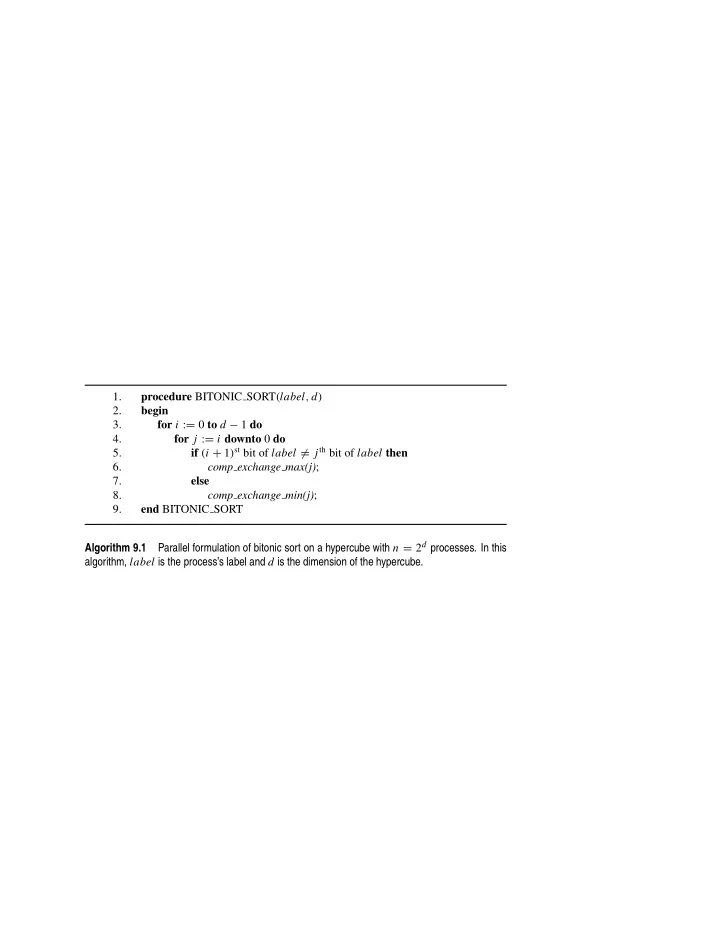
1. procedure BITONIC SORT(label, d) 2. begin 3. for i := 0 to d − 1 do 4. for j := i downto 0 do 5. if (i + 1)st bit of label = jth bit of label then 6. comp exchange max(j); 7. else 8. comp exchange min(j); 9. end BITONIC SORT Algorithm 9.1 Parallel formulation of bitonic sort on a hypercube with n = 2d processes. In this algorithm, label is the process’s label and d is the dimension of the hypercube.

slide-2
SLIDE 2

1. procedure BUBBLE SORT(n) 2. begin 3. for i := n − 1 downto 1 do 4. for j := 1 to i do 5. compare-exchange(a j, a j+1); 6. end BUBBLE SORT Algorithm 9.2 Sequential bubble sort algorithm.

slide-3
SLIDE 3

1. procedure ODD-EVEN(n) 2. begin 3. for i := 1 to n do 4. begin 5. if i is odd then 6. for j := 0 to n/2 − 1 do 7. compare-exchange(a2 j+1, a2 j+2); 8. if i is even then 9. for j := 1 to n/2 − 1 do 10. compare-exchange(a2 j, a2 j+1); 11. end for 12. end ODD-EVEN Algorithm 9.3 Sequential odd-even transposition sort algorithm.

slide-4
SLIDE 4

1. procedure ODD-EVEN PAR(n) 2. begin 3. id := process’s label 4. for i := 1 to n do 5. begin 6. if i is odd then 7. if id is odd then 8. compare-exchange min(id + 1); 9. else 10. compare-exchange max(id − 1); 11. if i is even then 12. if id is even then 13. compare-exchange min(id + 1); 14. else 15. compare-exchange max(id − 1); 16. end for 17. end ODD-EVEN PAR Algorithm 9.4 The parallel formulation of odd-even transposition sort on an n-process ring.

slide-5
SLIDE 5

1. procedure QUICKSORT (A, q, r) 2. begin 3. if q < r then 4. begin 5. x := A[q]; 6. s := q; 7. for i := q + 1 to r do 8. if A[i] ≤ x then 9. begin 10. s := s + 1; 11. swap(A[s], A[i]); 12. end if 13. swap(A[q], A[s]); 14. QUICKSORT (A, q, s); 15. QUICKSORT (A, s + 1, r); 16. end if 17. end QUICKSORT Algorithm 9.5 The sequential quicksort algorithm.

slide-6
SLIDE 6

1. procedure BUILD TREE (A[1 . . . n]) 2. begin 3. for each process i do 4. begin 5. root := i; 6. parenti := root; 7. leftchild[i] := rightchild[i] := n + 1; 8. end for 9. repeat for each process i = root do 10. begin 11. if (A[i] < A[parenti]) or (A[i] = A[parenti] and i <parenti) then 12. begin 13. leftchild[parenti] := i; 14. if i = leftchild[parenti] then exit 15. else parenti := leftchild[parenti]; 16. end for 17. else 18. begin 19. rightchild[parenti] := i; 20. if i = rightchild[parenti] then exit 21. else parenti := rightchild[parenti]; 22. end else 23. end repeat 24. end BUILD TREE Algorithm 9.6 The binary tree construction procedure for the CRCW PRAM parallel quicksort formulation.

slide-7
SLIDE 7

1. procedure ENUM SORT (n) 2. begin 3. for each process P1, j do 4. C[ j] := 0; 5. for each process Pi, j do 6. if (A[i] < A[ j]) or (A[i] = A[ j] and i < j) then 7. C[ j] := 1; 8. else 9. C[ j] := 0; 10. for each process P1, j do 11. A[C[ j]] := A[ j]; 12. end ENUM SORT Algorithm 9.7 Enumeration sort on a CRCW PRAM with additive-write conflict resolution.

slide-8
SLIDE 8

1. procedure RADIX SORT(A, r) 2. begin 3. for i := 0 to b/r − 1 do 4. begin 5.

  • ffset := 0;

6. for j := 0 to 2r − 1 do 7. begin 8. flag := 0; 9. if the ith least significant r-bit block of A[Pk] = j then 10. flag := 1; 11. index := prefix sum(flag) 12. if f lag = 1 then 13. rank := offset + index; 14.

  • ffset := parallel sum(flag);

15. endfor 16. each process Pk send its element A[Pk] to process Prank; 17. endfor 18. end RADIX SORT Algorithm 9.8 A parallel radix sort algorithm, in which each element of the array A[1 . . . n] to be sorted is assigned to one process. The function prefix sum() computes the prefix sum of the flag variable, and the function parallel sum() returns the total sum of the flag variable.

slide-9
SLIDE 9

1. procedure HYPERCUBE QUICKSORT (B, n) 2. begin 3. id := process’s label; 4. for i := 1 to d do 5. begin 6. x := pivot; 7. partition B into B1 and B2 such that B1 ≤ x < B2; 8. if ith bit is 0 then 9. begin 10. send B2 to the process along the ith communication link; 11. C := subsequence received along the ith communication link; 12. B := B1 ∪ C; 13. endif 14. else 15. send B1 to the process along the ith communication link; 16. C := subsequence received along the ith communication link; 17. B := B2 ∪ C; 18. endelse 19. endfor 20. sort B using sequential quicksort; 21. end HYPERCUBE QUICKSORT Algorithm 9.9 A parallel formulation of quicksort on a d-dimensional hypercube. B is the n/p- element subsequence assigned to each process.