1 IACP workshop: Yes, we have unbundled services! - Tropicalizing the - - PowerPoint PPT Presentation

1
SMART_READER_LITE
LIVE PREVIEW

1 IACP workshop: Yes, we have unbundled services! - Tropicalizing the - - PowerPoint PPT Presentation

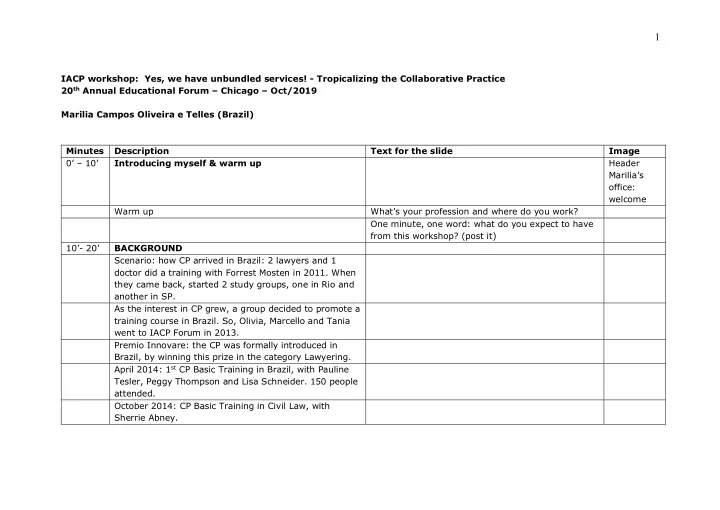
1 IACP workshop: Yes, we have unbundled services! - Tropicalizing the Collaborative Practice 20 th Annual Educational Forum Chicago Oct/2019 Marilia Campos Oliveira e Telles (Brazil) Minutes Description Text for the slide Image 0


slide-1
SLIDE 1

1

IACP workshop: Yes, we have unbundled services! - Tropicalizing the Collaborative Practice 20th Annual Educational Forum – Chicago – Oct/2019 Marilia Campos Oliveira e Telles (Brazil) Minutes Description Text for the slide Image 0’ – 10’ Introducing myself & warm up Header Marilia’s

  • ffice:

welcome Warm up What’s your profession and where do you work? One minute, one word: what do you expect to have from this workshop? (post it) 10’- 20’ BACKGROUND Scenario: how CP arrived in Brazil: 2 lawyers and 1 doctor did a training with Forrest Mosten in 2011. When they came back, started 2 study groups, one in Rio and another in SP. As the interest in CP grew, a group decided to promote a training course in Brazil. So, Olivia, Marcello and Tania went to IACP Forum in 2013. Premio Innovare: the CP was formally introduced in Brazil, by winning this prize in the category Lawyering. April 2014: 1st CP Basic Training in Brazil, with Pauline Tesler, Peggy Thompson and Lisa Schneider. 150 people attended. October 2014: CP Basic Training in Civil Law, with Sherrie Abney.

slide-2
SLIDE 2

2

Brazilian professionals were trained to become CP trainers. October 2014, IACP Forum in Vancouver: 06 Brazilian professionals attended. Visit to the Vancouver Collaborative Center and the desire of starting one in Brazil. We had more CP trainings in Brazil and started to offer those services in our offices. New study groups in different Brazilian cities and lives on Facebook. Brazil’s map ADR methods are relatively new in Brazil, so CP is almost unknown. Legal resolution system in Brazil “Mediation Act” and New Civil Procedure Law encouraged the development of non-adversarial methods (2015) 20’ – 30’ SCENARIO *Exercise: think and write down on a postit. If a couple want to hire only one lawyer and they actually want to have an amicable good-faith negotiation, what would you do? Brazilian law system presents new possibilities to use Collaborative Practice in a different culture. The essence

  • f CP is solving disputes respectfully having the dialogue

as its core method and tool. As collaborative professionals we’re entitled to let the clients know all the

  • ptions they have to deal with their legal conflicts. Not
  • nly we have the duty to teach the clients, we have to

show the advantages of having an interdisciplinary team to support them. Folder Marilia (hand out) Informed consent Informed consent US: Participation Agreement is a guarantee and couples have to hire two lawyers. (chart with the ≠)

slide-3
SLIDE 3

3

Brazilian law predicts a joint representation for a divorcing couple settle an agreement. But sometimes the clients imagine that having two lawyers is a synonym for fighting. Half of divorce litigants who self-represent could afford attorneys but choose not to have them because they feel that lawyers will make the family dynamics worse [“Self-representation in Divorce Cases, 1993] The idea of shark lawyers is very present. Cartoon: sharks Paradigm shift not only for professionals, but also for the clients and the society Paradigm shift not only for professionals, but also for the clients and the society 31’- 35’ Reading the postits. What did you think about the case? 36’- 60’ COLLABORATIVE PRACTICE AND UNBUNDLED SERVICES IN BRAZIL Why Brazilians have to do unbundled services? To deal with that we start offering the possibility of having an interdisciplinary team attending the family, although with only one lawyer – which would be more accurately defined as an “unbundled” service then a Collaborative Practice. Above all, the Collaborative Ethics rescues the idea of the lawyer as an effective problem solver that works having the focus on the benefits for the family, more than in his clients. “Even if I work solo on a case, collaborative practice creates opportunities for teamwork with mental health and financial professionals, who educate lawyers like me in vital disciplines that were not part

  • f our law school curriculum”. David Hoffman.

Carol and John example: disbalance of information. She took care of their children, he took care of their money. Diagram

slide-4
SLIDE 4

4

They refused the idea of having two lawyers, imagining that they’d go to court if they did so. With the help of

  • ne coach and one neutral financial, in 4 months it was

possible to develop an agreement. To show the importance of a multidisciplinary team, we’re offering different services. Unbundled Services – strategies for disseminating collaborative practices 1) Couple hires a lawyer, lawyer offers 3 sessions with a coach. 2) “Low cost retainer agreement”: couple hires a full team (we provide the team, from the practice group) 3) Pro bono services in institutions 4) Partnership Defensoria Pública + IBPC (Rio) Adapting the procedure to our culture, mixing with unbundling services. 5) The collaborative attorney is willing to participate in amicable good faith negotiation and will refrain to continue if they don’t reach an agreement. We make it clear to the other lawyers in the very first meeting. The point is to get more opportunities to apply our training and to help divorcing families, by enhancing our skills and being tolerant to different models, willing to adapt to the needs of the parties, while spreading the idea of Collaborative Practice. 60’ – 85’ Discussion groups: challenges “Dare or dare” 5’each case + 5’each group talk about 1 case Case 1: Anna is a civil/ business lawyer and wants to represent herself, while Peter hired a collaborative lawyer. Case 2: Mary and Paul hired 2 lawyers, signed the Participation Agreement but say they don’t need

slide-5
SLIDE 5

5

coaches – although they are not being able to discuss a parenting plan. Case 3: Arlena is German and doesn’t speak

  • Portuguese. Andrew is Brazilian and doesn’t speak
  • German. They have a one-year-old daughter and

talk in English at home. 85’- 90’ *Exercise: feedback circle (matches?) In one word, what are you taking from this workshop? 90’ Thank you! (if possible, video from the Congress, during the break)