1 Definition of CPU execution time CPI -- Cycles per instruction - - PDF document

1
SMART_READER_LITE
LIVE PREVIEW

1 Definition of CPU execution time CPI -- Cycles per instruction - - PDF document

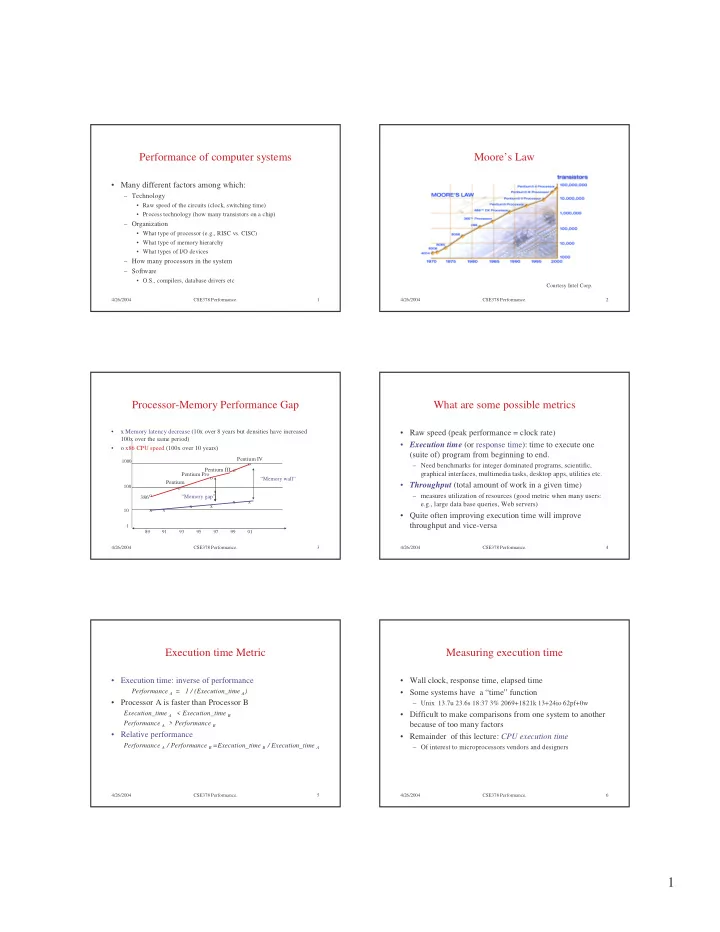
Performance of computer systems Moores Law Many different factors among which: Technology Raw speed of the circuits (clock, switching time) Process technology (how many transistors on a chip) Organization What type


slide-1
SLIDE 1

1

4/26/2004 CSE378 Performance. 1

Performance of computer systems

  • Many different factors among which:

– Technology

  • Raw speed of the circuits (clock, switching time)
  • Process technology (how many transistors on a chip)

– Organization

  • What type of processor (e.g., RISC vs. CISC)
  • What type of memory hierarchy
  • What types of I/O devices

– How many processors in the system – Software

  • O.S., compilers, database drivers etc

4/26/2004 CSE378 Performance. 2

Moore’s Law

Courtesy Intel Corp. 4/26/2004 CSE378 Performance. 3

Processor-Memory Performance Gap

10 100 1000 1 89 91 93 95 97 99 01

  • x Memory latency decrease (10x over 8 years but densities have increased

100x over the same period)

  • x86 CPU speed (100x over 10 years)

“Memory gap” “Memory wall” x x x x x x

  • 386

Pentium Pentium Pro Pentium III Pentium IV 4/26/2004 CSE378 Performance. 4

What are some possible metrics

  • Raw speed (peak performance = clock rate)
  • Execution time (or response time): time to execute one

(suite of) program from beginning to end.

– Need benchmarks for integer dominated programs, scientific, graphical interfaces, multimedia tasks, desktop apps, utilities etc.

  • Throughput (total amount of work in a given time)

– measures utilization of resources (good metric when many users: e.g., large data base queries, Web servers)

  • Quite often improving execution time will improve

throughput and vice-versa

4/26/2004 CSE378 Performance. 5

Execution time Metric

  • Execution time: inverse of performance

Performance A = 1 / (Execution_time A)

  • Processor A is faster than Processor B

Execution_time A < Execution_time B Performance A > Performance B

  • Relative performance

Performance A / Performance B =Execution_time B / Execution_time A

4/26/2004 CSE378 Performance. 6

Measuring execution time

  • Wall clock, response time, elapsed time
  • Some systems have a “time” function

– Unix 13.7u 23.6s 18:37 3% 2069+1821k 13+24io 62pf+0w

  • Difficult to make comparisons from one system to another

because of too many factors

  • Remainder of this lecture: CPU execution time

– Of interest to microprocessors vendors and designers

slide-2
SLIDE 2

2

4/26/2004 CSE378 Performance. 7

Definition of CPU execution time

CPU execution_time = CPU clock_cycles*clock cycle_time

  • CPU clock_cycles is program dependent thus

CPU execution_time is program dependent

  • clock cycle_time (nanoseconds, ns) depends on the

particular processor

  • clock cycle_time = 1/ clock cycle_rate (rate in MHz)

– clock cycle_time = 1µs, clock cycle_rate = 1 MHz – clock cycle_time = 1ns, clock cycle_rate = 1 GHz

  • Alternate definition

CPU execution_time = CPU clock_cycles / clock cycle_rate

4/26/2004 CSE378 Performance. 8

CPI -- Cycles per instruction

  • Definition: CPI average number of clock cycles per instr.

CPU clock_cycles = Number of instr. * CPI CPU exec_time = Number of instr. * CPI *clock cycle_time

  • Computer architects try to minimize CPI

– or maximize its inverse IPC : number of instructions per cycle

  • CPI in isolation is not a measure of performance

– program dependent, compiler dependent – but good for assessing architectural enhancements (experiments with same programs and compilers)

  • In an ideal pipelined processor (to be seen soon) CPI =1

– but… not ideal so CPI > 1 – could have CPI <1 if several instructions execute in parallel (superscalar processors)

4/26/2004 CSE378 Performance. 9

Classes of instructions

  • Some classes of instr. take longer to execute than others

– e.g., floating-point operations take longer than integer operations

  • Assign CPI’s per classes of inst., say CPIi

CPU exec_time = Σ (CPIi *Ci)* clock cycle_time where Ci is the number of insts. of class i that have been executed

  • Note that minimizing the number of instructions does not

necessarily improve execution time

  • Improving one part of the architecture can improve the CPI
  • f one class of instructions

– One often talks about the contribution to the CPI of a class of instructions

4/26/2004 CSE378 Performance. 10

How to measure the average CPI

CPU exec_time = Number of instr. * CPI *clock cycle_time

  • Count instructions executed in each class
  • Needs a simulator

– interprets every instruction and counts their number

  • or a profiler

– discover the most often used parts of the program and instruments

  • nly those

– or use sampling

  • Use of programmable hardware counters

– modern microprocessors have this feature but it’s limited Elapsed time: wall clock A given of the processor

4/26/2004 CSE378 Performance. 11

Other popular performance measures: MIPS

  • MIPS (Millions of instructions per second)

MIPS = Instruction count / (Exec.time * 106) MIPS = (Instr. count * clock rate)/(Instr. count *CPI * 106) MIPS = clock rate /(CPI * 106)

  • MIPS is a rate: the higher the better
  • MIPS in isolation no better than CPI in isolation

– Program and/or compiler dependent – Does not take the instruction set into account – can give “wrong” comparative results

4/26/2004 CSE378 Performance. 12

Other metric: MFLOPS

  • Similar to MIPS in spirit
  • Used for scientific programs/machines
  • MFLOPS: million of floating-point ops/second
slide-3
SLIDE 3

3

4/26/2004 CSE378 Performance. 13

Benchmarks

  • Benchmark: workload representative of what a system will be used for
  • Industry benchmarks

– SPECint and SPECfp industry benchmarks updated every few years, Currently SPEC CPU2000 – Linpack (Lapack), NASA kernel: scientific benchmarks – TPC-A, TPC-B, TPC-C and TPC-D used for databases and data mining – Other specialized benchmarks (Olden for list processing, Specweb, SPEC JVM98 etc…) – Benchmarks for desktop applications, web applications are not as standard – Beware! Compilers are super optimized for the benchmarks

4/26/2004 CSE378 Performance. 14

How to report (benchmark) performance

  • If you measure execution times use arithmetic mean

– e.g., for n benchmarks

(Σexec_timei) / n

  • If you measure rates use harmonic mean

n/ (Σ 1/ratei) = 1/(arithmetic mean)

4/26/2004 CSE378 Performance. 15

Computer design: Make the common case fast

  • Amdahl’s law (speedup)
  • Speedup = (performance with enhancement)/(performance

base case) Or equivalently, Speedup = (exec.time base case)/(exec.time with enhancement)

  • For example, application to parallel processing

– s fraction of program that is sequential – Speedup S is at most 1/s – That is if 20% of your program is sequential the maximum speedup with an infinite number of processors is at most 5