1 What is it Really? ARM Chips ARM Chips ARM Chips ARM Chips - - PDF document

1
SMART_READER_LITE
LIVE PREVIEW

1 What is it Really? ARM Chips ARM Chips ARM Chips ARM Chips - - PDF document

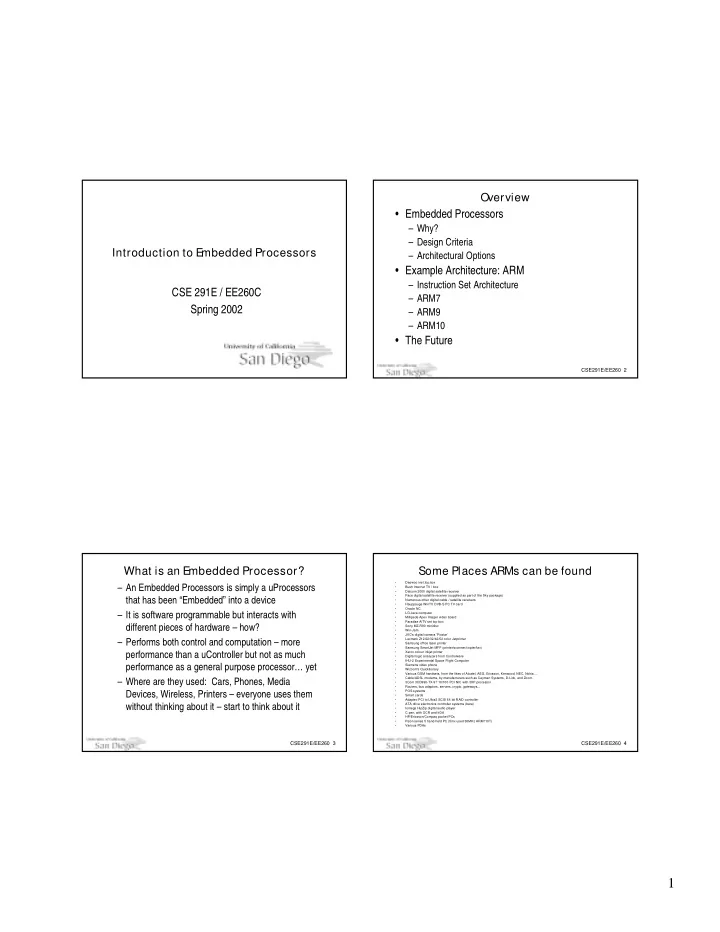
Overview Embedded Processors Why? Design Criteria Introduction to E mbedded Processors Architectural Options Example Architecture: ARM Instruction Set Architecture CSE 291E / EE260C ARM7 Spring 2002 ARM9


slide-1
SLIDE 1

1

Introduction to E mbedded Processors CSE 291E / EE260C Spring 2002

CSE291E/EE260 2

Overview

  • Embedded Processors

– Why? – Design Criteria – Architectural Options

  • Example Architecture: ARM

– Instruction Set Architecture – ARM7 – ARM9 – ARM10

  • The Future

CSE291E/EE260 3

What is an E mbedded Processor?

– An Embedded Processors is simply a uProcessors that has been “Embedded” into a device – It is software programmable but interacts with different pieces of hardware – how? – Performs both control and computation – more performance than a uController but not as much performance as a general purpose processor… yet – Where are they used: Cars, Phones, Media Devices, Wireless, Printers – everyone uses them without thinking about it – start to think about it

CSE291E/EE260 4

Some Places ARMs can be found

  • Daewoo inet.top.box
  • Bush Internet TV / box
  • Datcom 2000 digital satellite receiver
  • Pace digital satellite receiver (supplied as part of the Sky package)
  • Numerous other digital cable / satellite receivers
  • Hauppauge WinTV DVB-S PC TV card
  • Oracle NC
  • LG Java computer
  • Millipede Apex Imager video board
  • Paradise AiTV set top box
  • Sony MZ-R90 minidisc
  • Win-Jam
  • JVC's digital camera 'Pixstar'
  • Lexmark Z12/22/32/42/52 color Jetprinter
  • Samsung office laser printer
  • Samsung SmartJet MFP (printer/scanner/copier/fax)
  • Xerox colour inkjet printer
  • Digital logic analyzers from Controlware
  • IHU-2 Experimental Space Flight Computer
  • Siemens video phone
  • Wizcom's Quicktionary
  • Various GSM handsets, from the likes of Alcatel, AEG, Ericsson, Kenwood, NEC, Nokia...
  • Cable/ADSL modems, by manufacturers such as Caymen Systems, D-Link, and Zoom.
  • 3Com 3CD990-TX-97 10/100 PCI NIC with 3XP processor
  • Routers, bus adaptors, servers, crypto, gateways...
  • POS systems
  • Smart cards
  • Adaptec PCI to Ultra2 SCSI 64 bit RAID controller
  • ATA drive electronics controller systems (bare)
  • Iomega HipZip digital audio player
  • C pen, with OCR and IrDA
  • HP/Ericsson/Compaq pocket PCs
  • Psion series 5 hand-held PC (5mx used 36MHz ARM710T)
  • Various PDAs
slide-2
SLIDE 2

2

CSE291E/EE260 5

What is it Really?

– Typically an Embedded Processor is a single-issue in-order RISC processor with a little cache – It can then sold as a piece of silicon, custom layout, netlist, or architectural description – They are designed to be small, low power, and most importantly correct. – Often due to the real-time constraints of an application area they are designed to have a small deterministic worst case time per instruction – this is changing

CSE291E/EE260 6

ARM Chips ARM Chips ARM Chips ARM Chips

CSE291E/EE260 7

Why use an E mbedded Processor?

  • If I am John Q. RandomEngineer why would I

want to build a system with an embedded processor built in?

  • The main reason is simple: Cost

– Embedded processors are small – so they don’t take up much die area and thus they are cheap to fab – Embedded processors are verified – so I won’t spend a bunch of engineering man hours traking down hardware bugs so I can tape out my chip – Embedded processors run software – the key part of that is the SOFT – deal with changing specs

CSE291E/EE260 8

Design Criteria

  • How do I design an “good” embedded processor?
  • The three most important design criteria are

performance, power, and cost.

– Performance is a function of the parallelism, instruction encoding efficiency, and cycle time (or the good old NumInstr, CPI, Freq) – Power is approximately a function of the voltage, area, and switching frequency

  • Also a function execution time for leakage

– Cost is a function of both area (how many fit on a die) and the complexity of use (in terms of engineering cost)

slide-3
SLIDE 3

3

CSE291E/EE260 9

ISA Options

  • What sort of architecture do we want to design?
  • What sort of ISA should I provide (pros/cons)?

– Register-Register / Memory-Memory – RISC / CISC – Predication – Compound Instructions (MAC,PostInc) – Instruction Encoding – Registers (number and access) – VLIW / SIMD / Vector

CSE291E/EE260 10

Design Options

  • What parts should be included (pros/cons)

– Core – Instruction Cache – Data Cache – Multiplier – Scratch Pad Memory – MMU – Write Buffer – TLB – Branch Prediction

CSE291E/EE260 11

Jpeg

20 40 60 80 100 120

1.12 1.19 1.25 1.31 1.38 1.44 1.5 1.56 1.62 1.69 1.75 1.81 1.88 1.94 2

Normalized Execution Time Area

CSE291E/EE260 12

Jpeg

20 40 60 80 100 120

1.12 1.19 1.25 1.31 1.38 1.44 1.5 1.56 1.62 1.69 1.75 1.81 1.88 1.94 2

Normalized Execution Time Area Instruction Cache Data Cache Branch Predictor Multiplier Core

8kD/8kI

slide-4
SLIDE 4

4

CSE291E/EE260 13

E xample Architecture: ARM

– ARM licenses their core to companies as IP that you can drop into your SoC design – Other companies such as Intel license the ARM technology and build their own custom silicon – What are the design choices that ARM made?

  • ISA Design
  • Actual Implementation Details

– 3 ARM Processors Families in production: ARM7, ARM9, and the recently released ARM10

CSE291E/EE260 14

RISC Processor Market Share

CSE291E/EE260 15

E xample SOC

CSE291E/EE260 16

ARM ISA

  • ARM is a Load-Store RISC Architecture

– First production RISC architecture ever

  • 32-bit architecture
  • All instructions are predicated
  • 16 Registers

– r0-r14 are general purpose – r15 is the program counter

  • 32-bit instructions
slide-5
SLIDE 5

5

CSE291E/EE260 17

ARM Instructions

CSE291E/EE260 18

ARM Instructions

  • Loads

– Access can be byte, half-word, or word aligned – Lots of different indexing modes – Register indirect, Two register indirect, Register indirect with constant, Base+offset, Pre and Post increment

  • Control

– Control set up with comparison instruction (CMP) – Can be followed with a branch to a section of code – Can predicate following instructions

  • Using codes for equal, less than, overflow, carry set

CSE291E/EE260 19

Thumb E xtensions

  • First implemented in 1995 in the ARM7 core
  • Thumb is a 16–bit subset of the ARM ISA
  • It runs on a 32-bit chip so gets all of its benefits
  • 32-bit address space, registers, shifter, ALU,

memory transfer

  • Thumb code is 65% of the size of ARM code,
  • Lets software be designed for performance or

code size on the granularity of a basic block

– flexibility.

CSE291E/EE260 20

Thumb Decoder

slide-6
SLIDE 6

6

CSE291E/EE260 21

ARM7 Data Path

  • Two blocks shown,

Data and Decode paths

  • Two read port, one

write port, additional ports for r15 (PC)

  • Single cycle execute

and write back

CSE291E/EE260 22

ARM7 ARM7 ARM7 ARM7

  • Von-Neumann Architecture (8k cache)
  • Simple 3 Stage Pipeline
  • No penalty for unaligned access

– Better for embedded applications

  • In 0.13µm:

– Die size of 0.26 mm2 – Greater than 133 MHz – IPC of 0.9 – 0.06 mW/MHz

CSE291E/EE260 23

ARM9 ARM9 ARM9 ARM9

  • Harvard Architecture (8k Icache, 8k Dcache)
  • 5 Stage Pipeline
  • Improved MMU support
  • 8 entry write buffer
  • In 0.13µm:

– Die size of 3.2 mm2 – Greater than 250 MHz – IPC of 1.1 – 0.36/0.19 mW/MHz (with/without cache)

CSE291E/EE260 24

ARM10 ARM10 ARM10 ARM10

  • New 64-bit load-store architecture
  • Up to 32K instruction and data cache
  • 7 Stage pipeline
  • New DSP instruction set
  • Optional Vector Co-processor
  • In 0.13µm:

– Die size of 6.9 mm2 – Greater than 325 MHz – IPC of 1.25 – 0.6 mW/MHz

slide-7
SLIDE 7

7

CSE291E/EE260 25

F uture of E mbedded Processors

CSE291E/EE260 26

F uture of E mbedded Processors

  • Pipeline lengths are starting to get very long

– How does high performance architecture handle this – Branch prediction?

  • Intel’s XScale has branch prediction tables
  • Embedded processor designs take heavily from

high performance processor designs

– But now under different constraints

  • What else will migrate to the embedded space?

CSE291E/EE260 27

F uture of E mbedded Processors

  • VLIW processors

– Multiple issue machines – Scheduling done by the compiler

  • Customized Processors

– Such as from Tensilica – Allows more cost effective design as we now pick

  • nly what is important
  • Instruction Compaction

– Thumb is good, but we need to do better as more and more functionality moves to software