SLIDE 1
1
Common Pitfalls of Using the Cluster
Joachim Wagner 2009-07-01
Outline
Why do we need a cluster? Architecture: Machines and Properties Taskfarming Estimating Walltime Limits
Why do we need a cluster?
More efficient and less costly (than high-end desktop PCs) Avoid resource conflicts
Waiting for colleague’s job to finish Trouble, e.g. disk full
Medium-size jobs
Too big for desktop PC Too small for ICHEC
Preparation of ICHEC runs Learning
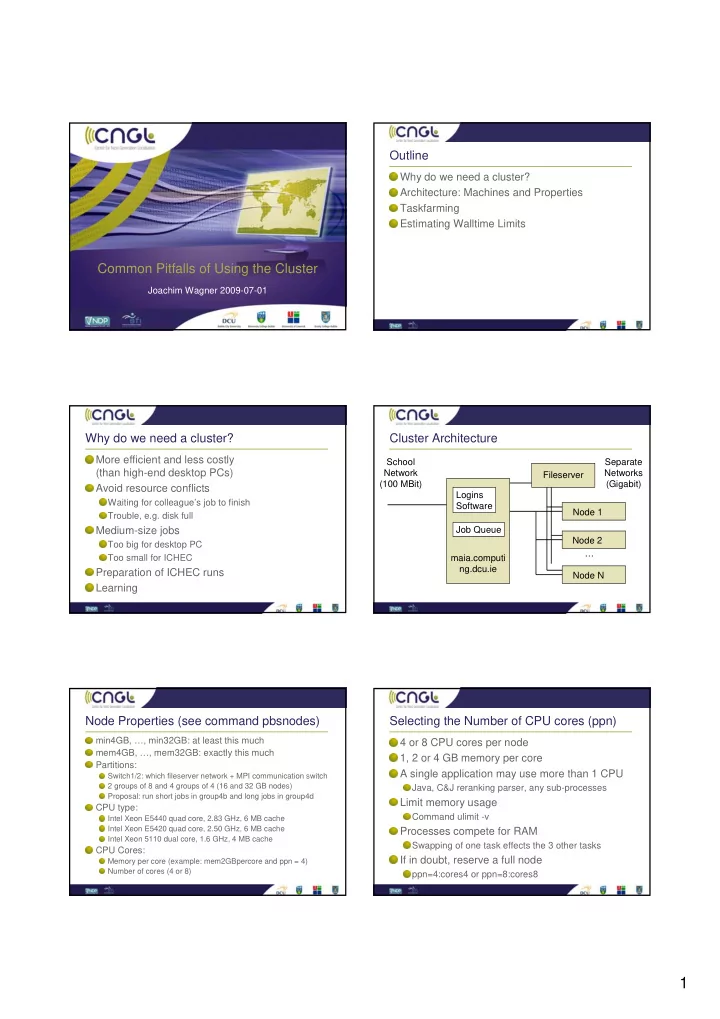
Cluster Architecture
School Network (100 MBit) maia.computi ng.dcu.ie Separate Networks (Gigabit) Logins Software Job Queue Node 1 … Node 2 Node N Fileserver
Node Properties (see command pbsnodes)
min4GB, …, min32GB: at least this much mem4GB, …, mem32GB: exactly this much Partitions:
Switch1/2: which fileserver network + MPI communication switch 2 groups of 8 and 4 groups of 4 (16 and 32 GB nodes) Proposal: run short jobs in group4b and long jobs in group4d
CPU type:
Intel Xeon E5440 quad core, 2.83 GHz, 6 MB cache Intel Xeon E5420 quad core, 2.50 GHz, 6 MB cache Intel Xeon 5110 dual core, 1.6 GHz, 4 MB cache
CPU Cores:
Memory per core (example: mem2GBpercore and ppn = 4) Number of cores (4 or 8)
Selecting the Number of CPU cores (ppn)
4 or 8 CPU cores per node 1, 2 or 4 GB memory per core A single application may use more than 1 CPU
Java, C&J reranking parser, any sub-processes
Limit memory usage
Command ulimit -v
Processes compete for RAM
Swapping of one task effects the 3 other tasks
If in doubt, reserve a full node
ppn=4:cores4 or ppn=8:cores8
SLIDE 2 2
CPU-Intensive Jobs Parallelisable, for example
Sentence by sentence processing Cross-validation runs Parameter search
Split into parts
Run each part on a different CPU core
Alternatives
Submit large number of jobs (ppn=1) Taskfarming
Taskfarming
PBS Job Description Taskfarming Executable (n instances) 1 Master n-1 Worker Task file (.tfm):
per line reading MPI or HTTP Communication Task execution child process
Taskfarming Options
Using individual PBS jobs
Can only allocate resources in multiples of 1/8 or ¼
Example: 3 GB task -> 4 GB job (ppn=2:cores8:mem16GB)
Floods job queue
MPI-based taskfarming
All tasks inside one job
Example: 3 GB task -> 5 workers per 16 GB node
Master blocks one CPU core
HTTP/XML-RPC-based taskfarming
Master runs on maia login node Workers can run in multiple jobs
Example: 3 GB tasks -> one job with 5 workers for 16 GB nodes and one job with 8 workers for 32 GB nodes
Example: Taskfarming in Action
000 CPU 1 001 002 Master: reads .tfm and distributes tasks CPU 2 CPU 3 CPU 4 003 005 004 006 time 008 007 009 010 011 012 idle
Estimating the PBS Walltime Parameter
Collect durations from test run Usually high variance of execution time
Long sentences Parameters
Don’t use #packages x avg. time per package
High risk (~50 %) that more time is needed Prefix jobname with, for example, “24h-”
Random sampling with observed package durations: /home/jwagner/tools/walltime.py
Questions
?
Contact: Joachim Wagner CNGL System Administrator jwagner@computing.dcu.ie (01) 700 6915
SLIDE 3
3
Installed Software OpenMPI SRILM MaTrEx, Moses, GIZA++ XLE, Sicstus Johnson & Charniak’s reranking parser In progress:
LFG AA, incl. function labeller
PBS Job Management
Job Queue Job Submission User: Job Description Job Execution Job Scheduler Nodes are allocated job-exclusive for the duration of the job (if ppn = #cores as recommended)
PBS Job Management Commands
qsub myjob.pbs
submits a job PBS description: shell script with #PBS commands (ignored by shell, see next slide)
qstat, qstat –f jobnumber qdel jobnumber pbsnodes –a
list all nodes with status and properties
PBS Job Description
Number of nodes #CPU cores/node Notification: end, begin and abort Maximum runtime Number of pro- cesses to start
Example: Memory-Intensive Job Taskfarming Executable
If Instance ID == 0
Run master code loop:
Read .tfm file (arg 1) Send lines to worker Exit if no more task and all worker finished
Else
Run worker loop:
Ask master for a task Execute task Exit if master has no more tasks
SLIDE 4
4
Example: Taskfarming PBS File Example: Taskfarming TFM File Example: Taskfarming Helper Script
run-package.sh
Example: Non-Terminating Task
000 CPU 1 001 002 Master: reads .tfm and distributes tasks CPU 2 CPU 3 CPU 4 003 005 004 006 (does not terminate) Killed at Walltime Limit 008 007 009 010 011 012 idle idle
Effect of Task Size
Job will wait for last task to finish (or be killed when walltime limit is reached) What if a task crashes?
Results are incomplete Next tasks is executed
What if a task does not terminate?
Results are incomplete Fewer CPUs available for remaining tasks
Overhead of starting tasks