1 Typical Review Team Software Review Guidelines Developer -- - - PDF document

1
SMART_READER_LITE
LIVE PREVIEW

1 Typical Review Team Software Review Guidelines Developer -- - - PDF document

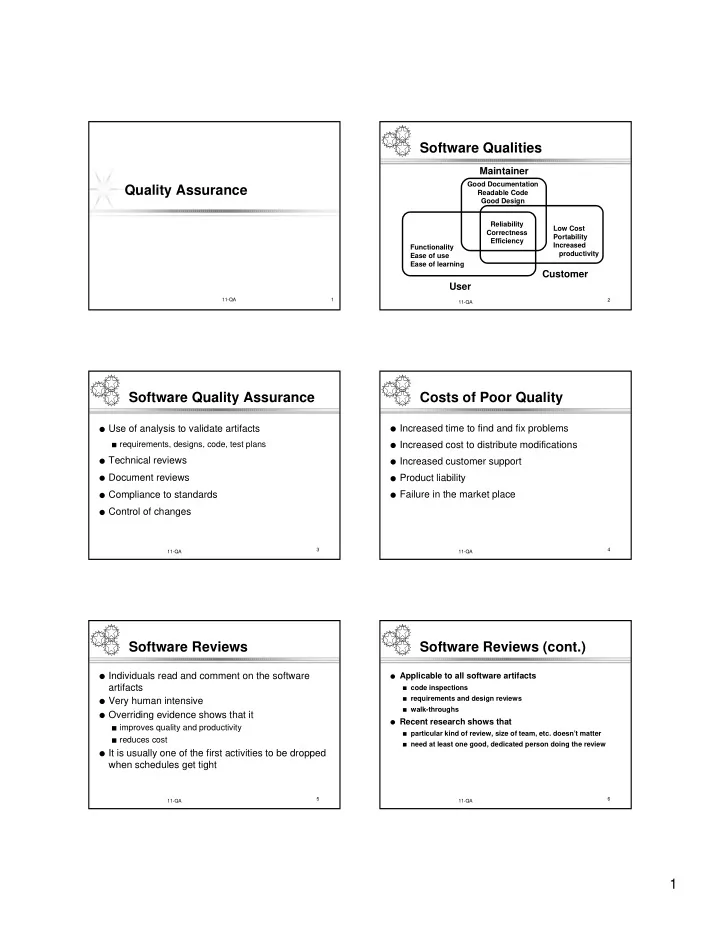
Software Qualities Maintainer Good Documentation Quality Assurance Readable Code Good Design Reliability Low Cost Correctness Portability Efficiency Increased Functionality productivity Ease of use Ease of learning Customer User


slide-1
SLIDE 1

1

11-QA 1

Quality Assurance

2 11-QA

Software Qualities

Maintainer User Customer

Good Documentation Readable Code Good Design Low Cost Portability Increased productivity Reliability Correctness Efficiency Functionality Ease of use Ease of learning

3 11-QA

Software Quality Assurance

  • Use of analysis to validate artifacts

■ requirements, designs, code, test plans

  • Technical reviews
  • Document reviews
  • Compliance to standards
  • Control of changes

4 11-QA

Costs of Poor Quality

  • Increased time to find and fix problems
  • Increased cost to distribute modifications
  • Increased customer support
  • Product liability
  • Failure in the market place

5 11-QA

Software Reviews

  • Individuals read and comment on the software

artifacts

  • Very human intensive
  • Overriding evidence shows that it

■ improves quality and productivity ■ reduces cost

  • It is usually one of the first activities to be dropped

when schedules get tight

6 11-QA

Software Reviews (cont.)

  • Applicable to all software artifacts

■ code inspections ■ requirements and design reviews ■ walk-throughs

  • Recent research shows that

■ particular kind of review, size of team, etc. doesn’t matter ■ need at least one good, dedicated person doing the review

slide-2
SLIDE 2

2

7 11-QA

Typical Review Team

  • Developer -- presents the material
  • Moderator -- keeps the review on track

■ makes sure everyone abides by the process

  • Secretary -- takes minutes, documents problems

found

  • Optionally

■ Apprentice -- learning about the project ■ Domain expert -- familiar with the domain and can verify

assumptions

8 11-QA

Software Review Guidelines

  • Review the artifact

■ don’t attack the developer

  • Stick to an agenda
  • Limit debate

■ watch out for “religious” issues ■ watch out for stylistic issues that don’t affect

maintainability

  • Identify problems, not solutions
  • Keep accurate notes
  • Establish and follow evaluation guidelines
  • Limit number of participants

9 11-QA

Technical Review Guidelines (cont.)

  • Prepare beforehand

■ both developers and reviewers

  • Allocate resources for reviews

■ people and time

  • Possible outcomes

■ accept product as is ■ reject until modified ■ reject product outright ■ accept product provisionally 10 11-QA

Sample evaluation Guidelines: Code Inspection

  • Has the design been correctly translated to code?
  • Are language features used appropriately?
  • Are coding standards followed?

■ be careful! make sure the standard makes a difference

  • Are documentation standards followed?
  • Are there misspellings or typos?
  • Are the comments accurate and unambiguous?

11 11-QA

Sample evaluation Guidelines: Code Inspection (cont.)

  • Are data types and declarations appropriate?
  • Are all constants correct?
  • Are all variables initialized before being used?
  • Are there overly complex conditions?
  • Is there unreachable code?
  • Are there obvious inefficiencies?

12 11-QA

QA Terminology

  • Correctness
  • Reliability
  • Testing
  • Debugging
  • Failure
  • Fault
  • Error
  • Verification
  • Validation
  • V&V
slide-3
SLIDE 3

3

13 11-QA

Terminology

  • Correctness: artifact is consistent with its specification

■ Specification could be wrong or incomplete ■ Rarely is software known to be correct ■ Rarely is the specification correct

  • Reliability: probability that the software is correct

■ Statistical measure based on past performance

◆ e.g., mean time to failure

14 11-QA

More terminology

  • Testing: entails executing the software on selected

test cases

■ Evaluate the results (oracle) ■ Evaluate the performance ■ Evaluate the ease of use

  • Common Wisdom: Testing reveals bugs but does

not guarantee the absence of bugs

■ How should you select test cases? ■ How do you know when to stop testing? 15 11-QA

More terminology

  • Failure: an erroneous result

■ incorrect outputs/response for given inputs/stimuli ■ fails to meet real-time constraints

  • Error: incorrect concept

■ may cause failures if not corrected

  • Fault: the cause of one or more failures

■ discovered after release 16 11-QA

More terminology

  • Debugging: the process of finding the cause of a

“bug” and a way to fix it

■ w/o introducing additional bugs!

  • Verification: process of proving, using

mathematical reasoning, that a program is “correct”

■ proofs vs. modelchecking ■ is expensive and is not always possible ■ is not foolproof

17 11-QA

More terminology

  • Validation: process associated with showing that

the software performs reasonably well

  • V & V: verification & validation?

■ more typically equated with validation

18 11-QA

Many different kinds of testing

  • Unit testing: test individual components

■ test stubs simulate called components ■ test harness simulates “outer” context and maintains stubs

  • Integration testing: combine components and test them

■ follows build plan

  • System testing: test whole system
slide-4
SLIDE 4

4

19 11-QA

More kinds of testing

  • Acceptance testing: testing to determine if the

product is acceptable

  • Regression testing: retesting after the system

has been modified

■ determine “old” test cases that must be re-executed ■ determine what new test cases are required

20 11-QA

More kinds of testing

  • Black box / functional testing:

■ testing based on specifications

  • White box / structural testing:

■ testing based on looking at the artifact

  • Both black box and white box testing are needed

21 11-QA

Testing is hard work

  • Typically 50% of software development effort

goes into testing

■ up to 85% for life-critical software

  • How to identify “good” test cases?

■ high probability of finding a new error ■ hits “boundary” conditions ■ “weirdo” cases

◆ often reveal bad assumptions and/or lack of rigor

  • Objective is to find errors

■ test case is “successful” if it finds a new error

22 11-QA

Testing is hard work (cont.)

  • Psychologically difficult for a programmer to test

his/her own code thoroughly

  • Exhaustive testing requires testing all

combinations of input values

■ Sorting an array of size 10 containing integers in the

range 1 . . 10 has 10! combinations (3,628,800 cases)

23 11-QA

Testing

  • CAN:

■ Uncover errors ■ Show specifications are met for specific test cases ■ Be an indication of overall reliability ■ Increase reliability (why??)

  • CANNOT:

■ Prove that a program is error-free ■ Serve as verification (why??)

24 11-QA

Testing Principles

  • Tests should be traceable to requirements
  • Tests should be planned long before testing begins
  • Exhaustive testing is not possible

■ 80% of all errors typically occur in 20% of the modules ■ test cases should be chosen to maximize likelihood of finding

an error

slide-5
SLIDE 5

5

25 11-QA

Testing Principles (cont.)

  • Testing should be done by someone other than

the developers

■ Developers do original testing ■ SQA does independent testing

◆ usually black box testing

  • Automated testing tools should be used

■ Reduce testing costs ■ Reduce likelihood of human error

26 11-QA

Testability

  • Simple software is easier to test

■ minimize coupling, maximize cohesion

  • Output is sufficient to determine correct behavior
  • Performs its own tests for internal errors

■ raises meaningful exceptions

  • All code is reachable
  • Independent modules can be tested in isolation
  • Documentation is complete and accurate

27 11-QA

Quality is an on-going concern

  • You can’t build quality into a system after the fact
  • Quality should be a consideration during every phase
  • f development
  • Plan for testing / validation in all phases

■ requirements -> functional test cases ■ design -> functional and structural test cases ■ code -> enhanced func & struc test cases ■ maintenance -> further enhanced func & struc test cases 28 11-QA

Debugging

  • Find the cause of a failure and fix it

■ an art, not a science

  • Debugging is difficult because

■ symptom may appear long after the fault occurs ■ symptom may be difficult to reproduce ■ symptom may be intermittent

  • Unit testing helps localize errors

29 11-QA

SQA Summary

  • U.S. software costs $200 billion/year
  • Need to

■ improve software quality ■ reduce costs

◆ V&V is over 50% of the cost

  • Improving V&V should reduce costs significantly

while improving quality

30 11-QA

Introduction to Formal Verification

Formal Mathematically based

  • d

x d d i i n i do d i + = + = ≠ = = 1 Need a way to “prove” properties in general. Proofs Model Checking How many tests do you have to do to show d=nx, always?? (or that the loop even works…)

slide-6
SLIDE 6

6

31 11-QA

Example: Proving A Loop Correct

  • d

x d d i i n i do d i + = + = ≠ = = 1

✂✁ ✄✆☎ ✝✟✞ ✠✡☎ ☛ calculates ☞✆✌ ✍ ✎ ✏ ☛✒✑✓✁ ✞✓☎ ✔ ✕ ✖ ✗ ✘ ✎ ✄✆✔✡✙✚☛ ✘ ✝ ✏ ✌

≥ n

We’ll do this using an invariant, and a theorem about loops.

32 11-QA

Weakest Precondition

) , ( P S wp

This is a predicate, (perhaps a logical expression like x>y) This is a program statement, like an IF, or DO, or assignment wp( ) is a function that produces a predicate. The predicate wp( ) produces describes a set of states. If S starts in one

  • f these states, P will be true when it finishes.

4 ) 5 1 , 1 : ( < ∧ > ≡ < ∧ > + = i i i i i i wp

Example:

33 11-QA

Loop Theorem

For an integer function t bounded by 0 , and . 1 > ⇒ ∧ t B P ) , ( . 2 k t P DO wp k t B P < ∧ ⇒ = ∧ ∧

Then:

) , ( B P DO wp P ¬ ∧ ⇒

Point 2 means P is invariant and the integer function decreases each time through the loop

OD S B DO →

The main repetition theorem is due to A.J.M. van Gasteren. 34 11-QA

Requirement #1

ix d n i P = ∧ ≤ ≤ ≡ 0 So, let P be:

This is called an “invariant”

i n t − = let And

  • d

x d d i i n i do d i + = + = ≠ = = 1

> ⇒ ∧ t B P : show to Need > − ⇒ ≠ ∧ = ∧ ≤ ≤ i n n i ix d n i

Direct substitution produces:

True i n ix d n i ≡ > ⇒ = ∧ < ≤ ≡ 0

P B t

35 11-QA

Requirement #2 / “t” part

) , ( . 2 k t P DO wp k t B P < ∧ ⇒ = ∧ ∧ ) , ( k i n P DO wp k i n n i ix d n i < − ∧ ⇒ = − ∧ ≠ ∧ = ∧ ≤ ≤

P B t=k t<k

  • d

x d d i i n i do d i + = + = ≠ = = 1 1 1 ) 1 ( + < − ⇒ < − − ⇒ < + − ⇒ = − k i n k i n k i n k i n

The loop replaces i with i+1, so that’s what we do means t must go down

36 11-QA

Requirement #2 / invariant part

loop the after true is implies loop the before that show to Need P B P ∧ ) , ( . 2 k t P DO wp k t B P < ∧ ⇒ = ∧ ∧

  • d

x d d i i n i do d i + = + = ≠ = = 1

we use the same trick again, and sub i+1 for i and d+x for d and prove P is still true.

slide-7
SLIDE 7

7

37 11-QA

Showing Invariant Holds

x i d n i ix d n i ) 1 ( 1 + = ∧ ≤ + ≤ ⇒ = ∧ ≤ ≤ n i n i ≤ + ≤ ⇒ ≤ ≤ 1 n i n i ≤ + ≤ ⇒ < ≤ 1 n i B ≠ so true, is But ix d ix d x ix x d ix d x i x d ix d = ⇒ = + = + ⇒ = + = + ⇒ = ) 1 (

38 11-QA

Payoff

theorem the by have we So ) , ( B P DO wp P ¬ ∧ ⇒ We know that we can make P true before the loop, so we have a set of states such that true. is B P ¬ ∧ n i ix d n i = ∧ = ∧ ≤ ≤ B ¬

P

nx d nx d n n = ≡ = ∧ ≤ ≤

  • d

x d d i i n i do d i + = + = ≠ = = 1

And, we are done.