1 Actor-Goal List Including lower-level goals Goals should be on - - PDF document

1
SMART_READER_LITE
LIVE PREVIEW

1 Actor-Goal List Including lower-level goals Goals should be on - - PDF document

Announcements How to Write Use Cases Read Wiki/ Piazza Projects started in earnest (regular, 2- weeks milestones) HW2 due this Fri, Jan 23 rd - submission system will go live soon Today interview with Alistair Cockburn


slide-1
SLIDE 1

1

1

How to Write Use Cases Announcements

❚ Read Wiki/ Piazza ❚ Projects started in earnest (regular, 2- weeks milestones) ❚ HW2 due this Fri, Jan 23rd ❚ - submission system will go live soon ❚ Today interview with Alistair Cockburn ❚ Missing class due to traveling to interviews/illness/emergency (FAQ on Wiki)

CS361 4-2

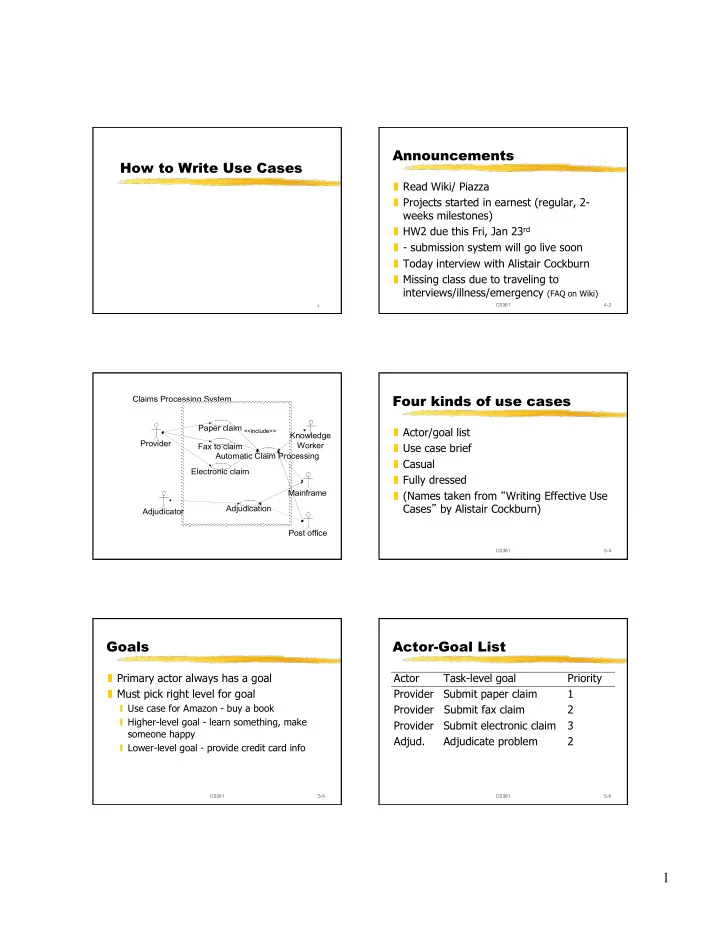
Provider Fax to claim Electronic claim Automatic Claim Processing Knowledge Worker Paper claim Claims Processing System

<<include>>

Mainframe Post office Adjudication Adjudicator

CS361 5-4

Four kinds of use cases

❚ Actor/goal list ❚ Use case brief ❚ Casual ❚ Fully dressed ❚ (Names taken from “Writing Effective Use Cases” by Alistair Cockburn)

CS361 5-5

Goals

❚ Primary actor always has a goal ❚ Must pick right level for goal

❙ Use case for Amazon - buy a book ❙ Higher-level goal - learn something, make someone happy ❙ Lower-level goal - provide credit card info

CS361 5-6

Actor-Goal List

Actor Task-level goal Priority Provider Submit paper claim 1 Provider Submit fax claim 2 Provider Submit electronic claim 3 Adjud. Adjudicate problem 2

slide-2
SLIDE 2

2

CS361 5-7

Actor-Goal List

❚ Goals should be on the same level ❚ Goal should be from point of view of primary actor ❚ Sort goals by primary actor ❚ Priority to designer of system, not to actors

CS361 5-8

Including lower-level goals

❚ Lower-level goals can improve readability

❙ Usually to reduce duplication ❙ Sometimes to shorten very long use cases

❚ To design components ❚ When user has only one goal

CS361 5-9

Actor-goal list for games

❚ Games have one use case - play game ❚ For use cases to be good requirements document, more detail is needed.

❙ Use lower-level goals

CS361 5-10

Tower game

Actor Task-level goal Priority User Create towers 1 Tower Shoot monsters 2 Monster Move toward user 2 Hoarde Create monsters 3

CS361 5-11

Use case brief

❚ 1-6 sentence description of behavior ❚ Mention only most significant behavior and failures ❚ Short enough to put many on a page Used to

❙ Estimate complexity ❙ Find components to reuse

CS361 5-12

Use case briefs

Actor Provider Provider Adjucator Goal Submit paper claim Submit fax claim Adjudicate failed claim Brief Submit claim on paper, which is converted into electronic form, and either paid or sent for adjudication Submit claim by fax, which is processed by OCR and either paid or sent for adjudication. Decide whether a questionable claim should be paid by the mainframe payment system or rejected

slide-3
SLIDE 3

3

CS361 5-13

Casual & Fully Dressed

❚ Used to tell developers what to build ❚ “Casual” consists of normal paragraphs ❚ “Fully Dressed” has labeled sections ❚ Both should emphasize “main success scenario” ❚ Both should include ways of failing ❚ Casual: one per page ❚ Fully dressed: 3-4 pages

CS361 5-14

Design scope

❚ Actor/Goal list and use case briefs help decide design scope

❙ What is in, what is out ❙ What is a use case, is not a use case

❚ Casual/fully dressed use case is given to developers so they know what to build

CS361 5-15

Brief (casual) version of Submit Fax Claim

The Provider submits a claim by fax. The claim processing system will log the image to optical disk, apply form dropout, deskewing, despeckling, and then process it using OCR. Knowledge workers will repair any fields that seem to be in error. The claim will then either be paid (using existing mainframe processing system) or sent to adjudication.

CS361 5-16

Fully dressed

❚ Primary actor ❚ Goal in context - what is the primary actor’s bigger goal? ❚ Scope - system we are designing ❚ Level - user goal, higher-level (summary), lower-level (subfunction) ❚ Stakeholders

CS361 5-17

Fully dressed

❚ Preconditions: things that must be true before this use case can happen ❚ Guarantees: things that the use case will ensure are always true ❚ Triggers: things that cause the use case to start

CS361 5-18

Main success scenario

❚ Describe trigger ❚ Give numbered list of actions leading to success ❚ Alternatives left to “extensions”

slide-4
SLIDE 4

4

CS361 5-19

Extensions

❚ Alternatives to main success scenario ❚ Special cases, failures ❚ Steps have same numbers as in main success scenario, but modified to show they are alternatives

❙ 3a instead of 3.

CS361 5-20

Detailed (fully dressed) version of Submit Fax Claim

Primary Actor: Provider Goal in context: Pay legitimate claims while rejecting bad

  • nes.

Scope: Claim system. Level: Summary Stakeholders and interests: Provider: Wants to be paid for services rendered. Company: Wants to cut costs and avoid fraud Precondition: none Minimal guarantees: Pay only certified providers, pay only for services that are covered by plan, do not pay if there are obvious mistakes

CS361 5-21

Main Success Scenario:

Trigger: Claim submitted by fax

  • 1. Provider submits claim by fax
  • 2. Claim system drops forms, deskews, despeckles, and

uses OCR to convert to electronic form

  • 3. Claim system checks claim to make sure it is legal
  • 4. Mainframe payment system pays claim

Extensions:

  • 2a. Some fields have low confidence: Knowledge worker

corrects

  • 3a. Claim is not valid: send to adjudication

CS361 5-22

Writing

❚ Use present tense ❚ Subject should be primary actor, system under design (always) and secondary actors ❚ Verb should be what actor does to successfully move the use case forward ❚ Avoid GUI: write in terms of goals, not details of the GUI

CS361 5-23

Group Writing

❚ Group better for brainstorming, reviewing ❚ Individuals better for writing ❚ Make list in a group ❚ Write use cases in ones or twos ❚ Review as a group

❙ Writers’ workshop

CS361 5-24

Discuss

❚ Use cases that you understand should have more detail than those you don’t understand ❚ What determines the level of detail?

slide-5
SLIDE 5

5 Interview with Alistair Cockburn

CS361 5-25 CS361 5-26

Next time

TDD demo Read posted reading about JUnit tests