1 The Behavior of Schools Groups of f ishes can behave almost - - PDF document

1
SMART_READER_LITE
LIVE PREVIEW

1 The Behavior of Schools Groups of f ishes can behave almost - - PDF document

Last t ime Self -Organizat ion Aut onomous Agent s Real Ant s Virt ual Ter mit es Virt ual Ant s Ant Algorit hms 23/11 - 04 Emergent Systems, Jonny Pettersson, UmU 1 Out line f or t oday Ant algorit hms (cont .)


slide-1
SLIDE 1

1

23/11 - 04 1 Emergent Systems, Jonny Pettersson, UmU

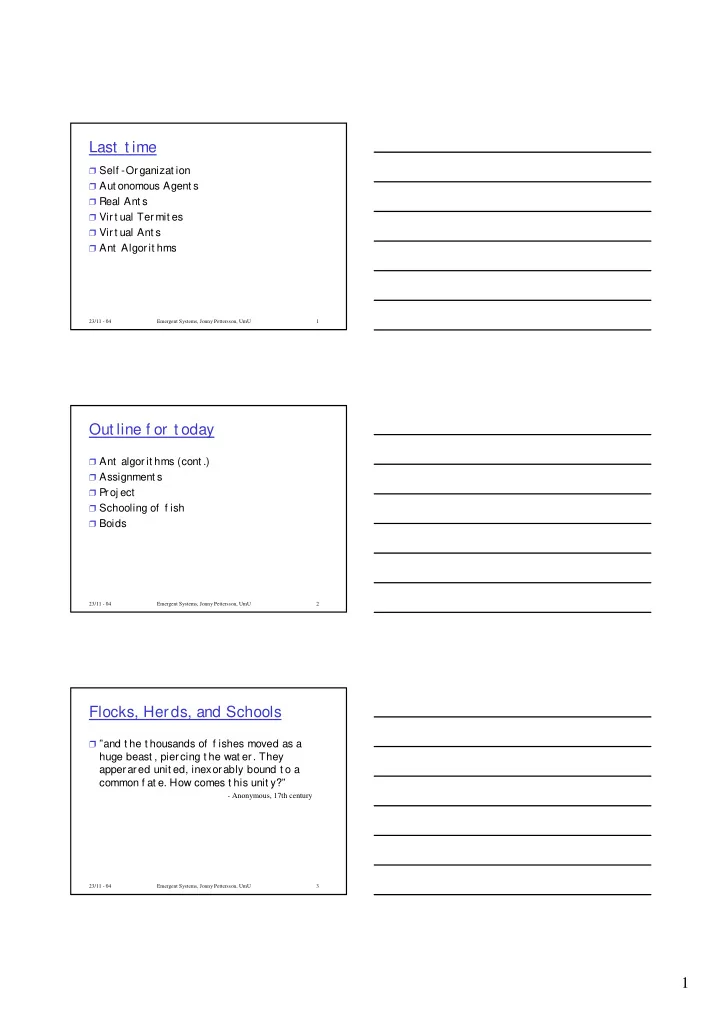
Last t ime

❒ Self -Organizat ion ❒ Aut onomous Agent s ❒ Real Ant s ❒ Virt ual Ter mit es ❒ Virt ual Ant s ❒ Ant Algorit hms

23/11 - 04 2 Emergent Systems, Jonny Pettersson, UmU

Out line f or t oday

❒ Ant algorit hms (cont .) ❒ Assignment s ❒ Proj ect ❒ Schooling of f ish ❒ Boids

23/11 - 04 3 Emergent Systems, Jonny Pettersson, UmU

Flocks, Herds, and Schools

❒ ”and t he t housands of f ishes moved as a

huge beast , piercing t he wat er. They apperared unit ed, inexorably bound t o a common f at e. How comes t his unit y?”

  • Anonymous, 17th century
slide-2
SLIDE 2

2

23/11 - 04 4 Emergent Systems, Jonny Pettersson, UmU

The Behavior of Schools

❒ Groups of f ishes can behave almost like a

single or ganism

❒ Traf algar ef f ect

❍ Rapid t r ansf er of inf ormat ion ❍ Can execut e swif t , evaisive maneuvers ❍ React ion propagat es many t imes f ast er t han

t he approach of t he pr edat or ❒ Ex: Flash expansion and t he f ount ain

ef f ect

❒ Predat ors can also coor dinat e t heir

movement s

❍ Ex: P

ar abolic f ormat ion of Giant bluef in t una

23/11 - 04 5 Emergent Systems, Jonny Pettersson, UmU

The Behavior of Schools

❒ I ndividuals rarely collide, even in f renzy of

at t ack or escape

❒ Shape of school is charact erist ic of

species, but f lexible

❍ Herring 3:3:1 (rat io of lengt h: widt h: dept h) ❍ Pollack 6:3:1 ❍ Cod 10:4:1 t o 2:4:1

❒ Arrangement wit hin schools is also

charact erist ic of species

❍ Depend also on t he size and t he speed of t he

school

23/11 - 04 6 Emergent Systems, Jonny Pettersson, UmU

Adapt ive Signif icance

❒ Prey avoiding predat ion

❍ Saf et y in number s ❍ Unit ed err at ic maneouver s ❍ Pat t ern of body colorat ion ❍ Group breaking behaviors ❍ Compact aggr egat ion – pr edat or r isks inj ur y by

at t acking

slide-3
SLIDE 3

3

23/11 - 04 7 Emergent Systems, Jonny Pettersson, UmU

Adapt ive Signif icance

❒ Bet t er predat ion

❍ Coordinat ed movement s – t una ❍ More ef f icient pr edat ion

  • Killer whales encircle dolphins
  • Take t urns eat ing

❒ Schooling may increase hydrodynamic

ef f iciency

❍ Endurance may be incr eased up t o 6 t imes

❒ V-f ormat ion of geese

❍ Range incr ease 70%

❒ Lobst er line up

❍ Move 40% f ast er – decr eased hydr odynamic

drag

23/11 - 04 8 Emergent Systems, Jonny Pettersson, UmU

Behavior of I ndividuals wit hin t he School

❒ A balance bet ween at t ract ion and repulsion ❒ Sensory input s

❍ Vision – at t ract ion and alignment ❍ The lat er al line syst em – r epulsion and speed

mat ching ❒ Weight ing of inf or mat ion coming

simult aneously f rom several f ishes

❍ Most st rongly inf luenced by near est neighbor s

23/11 - 04 9 Emergent Systems, Jonny Pettersson, UmU

Alt ernat ives t o Self -Organizat ion

❒ Templat es

❍ No evidence t hat wat er current s, light ,

chemicals guide collect ive movement ❒ Leaders

❍ No evidence f or leader s ❍ Those in f ront changes ❍ Each adj ust s t o several neighbors

❒ Blueprint or recipe

❍ I mplausible f or coor dinat ion of lar ge schools

slide-4
SLIDE 4

4

23/11 - 04 10 Emergent Systems, Jonny Pettersson, UmU

Self -Organizat ion Hypot hesis

❒ Simple rules generat e schooling behavior

❍ Posit ive f eedback – br ings individuals t oget her

(at t ract ion)

❍ Negat ive f eedback – but not t o close (r epulsion)

❒ Only local inf or mat ion

❍ P

  • sit ions and headings of a f ew near by f ish

❍ No leader, no global plan

23/11 - 04 11 Emergent Systems, Jonny Pettersson, UmU

Hut h and Wissel (1992) Model – Basic Assumpt ions

❒ Each f ish f ollows t he same rules ❒ Each f ish uses some f or m or weight ed

average of t he posit ion and orient at ion of it s nearest neighbors

❒ Each f ish responds t o it s neighbors in a

probabilist ic manner

❍ I mperf ect inf ormat ion gat her ing ❍ I mperf ect execut ion of act ions

❒ No ext ernal inf luenses af f ect ing t he f ish

❍ No curr ent s, obst acles...

23/11 - 04 12 Emergent Systems, Jonny Pettersson, UmU

Hut h and Wissel (1992) Model – Behaviors

❒ Repulsion ❒ At t ract ion ❒ Parallel orient at ion ❒ Searching ❒ Ranges of t he basic behavior pat t erns ❒ How t o int egrat e and evaluat e inf ormat ion

f rom dif f erent neighbors?

❍ Decision models ❍ Averaging models

slide-5
SLIDE 5

5

23/11 - 04 13 Emergent Systems, Jonny Pettersson, UmU

Hut h and Wissel (1992) Model – Limit at ions

❒ No adressing of ext ernal inf luences ❒ No obst acle avoidance ❒ No avoidance behaviors such as:

❍ Flash expansion ❍ Fount ain ef f ect

❒ Recent work (1997 – 2000) has adressed

some of t hese issues

23/11 - 04 14 Emergent Systems, Jonny Pettersson, UmU

Boids

❒ Craig Reynolds ❒ Flocks, Her ds, and Schools: A Dist ribut ed

Behavioral Model

23/11 - 04 15 Emergent Systems, Jonny Pettersson, UmU

Boids – Separat ion

slide-6
SLIDE 6

6

23/11 - 04 16 Emergent Systems, Jonny Pettersson, UmU

Boids - Alignment

23/11 - 04 17 Emergent Systems, Jonny Pettersson, UmU

Boids - Cohesion

23/11 - 04 18 Emergent Systems, Jonny Pettersson, UmU

Boids - Neighborhood

slide-7
SLIDE 7

7

23/11 - 04 19 Emergent Systems, Jonny Pettersson, UmU

Summar y

❒ Ant algorit hms (cont .) ❒ Assignment s ❒ Proj ect ❒ Schooling of f ish ❒ Boids

23/11 - 04 20 Emergent Systems, Jonny Pettersson, UmU

Next t ime

❒ Swarm algorit hms