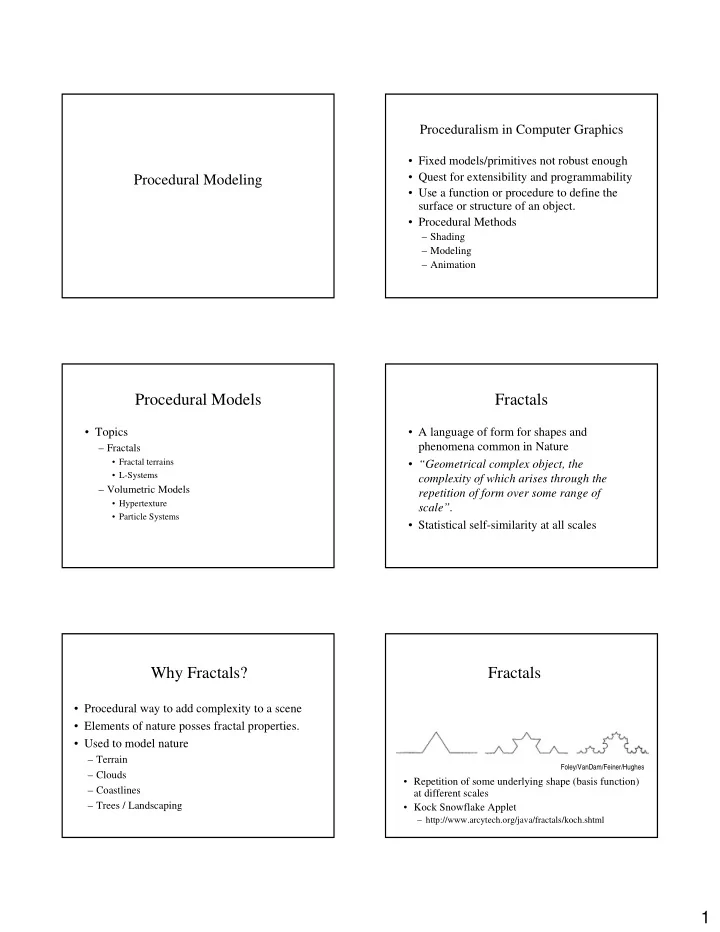
1 Fractals - Mandelbrot Set Fractals The Mandelbrot Set Plot of - - PDF document

1
SMART_READER_LITE
LIVE PREVIEW

1 Fractals - Mandelbrot Set Fractals The Mandelbrot Set Plot of - - PDF document

Proceduralism in Computer Graphics Fixed models/primitives not robust enough Quest for extensibility and programmability Procedural Modeling Use a function or procedure to define the surface or structure of an object.


slide-1
SLIDE 1

1

Procedural Modeling

Proceduralism in Computer Graphics

  • Fixed models/primitives not robust enough
  • Quest for extensibility and programmability
  • Use a function or procedure to define the

surface or structure of an object.

  • Procedural Methods

– Shading – Modeling – Animation

Procedural Models

  • Topics

– Fractals

  • Fractal terrains
  • L-Systems

– Volumetric Models

  • Hypertexture
  • Particle Systems

Fractals

  • A language of form for shapes and

phenomena common in Nature

  • “Geometrical complex object, the

complexity of which arises through the repetition of form over some range of scale”.

  • Statistical self-similarity at all scales

Why Fractals?

  • Procedural way to add complexity to a scene
  • Elements of nature posses fractal properties.
  • Used to model nature

– Terrain – Clouds – Coastlines – Trees / Landscaping

Fractals

  • Repetition of some underlying shape (basis function)

at different scales

  • Kock Snowflake Applet

– http://www.arcytech.org/java/fractals/koch.shtml

Foley/VanDam/Feiner/Hughes

slide-2
SLIDE 2

2

Fractals – The Mandelbrot Set

Fractals - Mandelbrot Set

  • Plot of a recursive mathematical function in the complex plane

– Zn = Zn- 1

2 + C

  • For each complex number, the function will:

– Move quickly to infinity (outside of the set) – Move slowly to infinity (on the border of the set) – Remain near the origin (inside the set)

  • Create image by coloring based on how many iterations it

takes to indicate divergence towards infinity.

  • Function is self-similar as we zoom into different areas of the

plot on the complex plane.

Fractals

  • Fractals - Mandelbrot Set

– Fractint

Fractal Terrain

  • Fractals -- a simple example

Foley/VanDam/Feiner/Hughes

Fractal Terrain

  • Fractals - a simple example

[Fournier82]

Fractal Terrain

  • Fractals - extend to 2d

Foley/VanDam/Feiner/Hughes

slide-3
SLIDE 3

3 Fractal Terrain

  • Paul Bourke

Fractal Terrain Fractal Terrain

Fractal Terrain -Vol Libre Ridge

Foley/VanDam/Feiner/Hughes

Fractal Terrain

  • my favorite fractal landscape

[F. Kenton Musgrave]

Fractals

  • Fractal comes from fractal dimension

a.b

a = Euclidean dimension b = fraction of filling up next dimension

slide-4
SLIDE 4

4 Fractal Modeling

  • Fractal modeling

– Like Mandelbrot set, can zoom infinitely – Render at resolution that is most appropriate – Instant anti-aliasing. – Can model a whole planet procedurally

Fractal Modeling

[Musgrave]

Fractals

“If one assumes that a certain error (e.g., pixel-sized) in the ray-surface intersection is acceptable, one can directly ray-trace a procedurally-defined height field with essentially perfect level of detail.”

  • - Ken Musgrave

Gaea Zoom

[Musgrave]

Fractal Modeling

  • http://www.pandromeda.com

– Explore fractal worlds on-line – Mojo World

F.K. Musgrave

Fractals

  • For more info:

– [Fournier82] – Pietgen, The Science of Fractal Images – Pietgen, The Beauty of Fractals – Ebert, et al, Modeling & Texturing...

slide-5
SLIDE 5

5 Grammar Based Systems

  • Building of models based on formal language

grammars

  • Method for creating fractals
  • Grammar consists of:

– Set of characters – Productions rules – Starting word

Grammar Based Systems - Example

Characters: {A, B,[, ]} Rules: A -> AA B->A[B]AA[B] Start word B Iterations: 0: B 1: A[B]AA[B] 2: AA[A[B]AA[B]]AAAA[A[B]AA[B]]

Grammar Based Systems

  • But how does this help us create models?
  • Assign a drawing action to each character:
  • L-System (Lindenmeyer) used to create tree-like

structures:

– F move forward and draw – f move forward and do not draw – + increase angle with angle increment – - decrease angle by angle increment – [ push state (i.e. branch) – ] pop state (i.e finish branch)

Grammar Based Systems

  • L-Systems

– F=F[+F]F[-F]F – Applet

  • http://www-sfb288.math.tu-

berlin.de/vgp/javaview/vgp/tuto r/lsystem/PaLSystem.html

L-System Ferns Grammar Based Systems

  • L-Systems

– Note that structures created using L-Systems are fractal like in the sense that they are self- similar at different levels – Self-similarity achieved by repeatedly applying production rules

slide-6
SLIDE 6

6 Grammar Based Systems

  • Koch curve as an L-system

– F=F+F- -F+F – http://www.arcytech.org/java/fractals/lsystems.shtml

Foley/VanDam/Feiner/Hughes

L-Systems - Trees

Foley/VanDam/Feiner/Hughes

L-System Trees

Foley/VanDam/Feiner/Hughes

Grammar-Based Systems

  • For more info:

– Prusinkiewicz, Lindenmayer systems, fractals, and plants – Prusinkiewicz and Lindenmeyer, The Algoritmic Beauty of Plants

  • Questions?

Volumetric Models

  • Not all objects are “solid” models

– water – fire – clouds – Rain

  • Objects exists in a volume

– Hypertexture – Particle Systems

Hypertexture [Perlin89]

  • Extension of procedural textures
  • Between surface + texture, i.e., spatial

filling/volumetric

  • Objects modeled as distribution of density

– hard region - objects completely solid – soft region - object shape is malleable using a toolkit of shaping functions and CSG style

  • perators to combine shapes
slide-7
SLIDE 7

7 Hypertexture Uses

  • Model shapes that don’t have a well-defined

boundary surface

– Fur/hair – Fire/clouds/smoke

  • Complex surface volumetics

– Fluid flow – Erosion effects

Hypertexture

  • D(x) - Object Density Function over R3

– D (x) for all points x in 3D space [0,1] – Density of 3D shape – D (x) = 0 for all points outside the surface – D (x) = 1 for hard region of the object – 0 < D (x) < 1 for soft region of the object (fuzzy region)

Hypertexture

  • Toolbox of base DMFs

– Bias – up / down control – Gain – controls gradiant – Noise (controlled randomness)

  • Won Ken an Academy Award!

– Turbulence

  • Sum of noise at variety of frequencies

– Mathematical functions

Hypertexture Noise Examples

2* frequency, 1/2 amplitude

[Perlin89]

High Amplitude, Noisy Sphere Noisy Fractal, noise - Σ many f’s

Hypertexture Example - Fire

))) ( 1 ( ) ( x turbulence sphere(x x D + =

[Perlin89] Red = low density Yellow = high

Hypertexture Example - Fur/Hair

[Perlin89]

Tribble

Here noise displaces x before projecting; uses variable to control curliness

slide-8
SLIDE 8

8

Animated Hypertexture – Pyroclastic

[Musgrave]

Animated Hypertexture – Fireball1

[Musgrave]

Animated Hypertexture – Cloud Dog

[Musgrave]

Hypertexture

  • Further Reading

– [Perlin89] – Ebert, et. al,Texturing & Modeling: A Procedural Approach.

Particle Systems [Reeves83]

  • Another volumetric modeling technique
  • Abstraction provides control of animation and specification of
  • bjects
  • Good for modeling volumetric natural phenomena:

– water – fire – clouds – Rain – Snow – Grass – Trees

What are Particle Systems?

  • A collection of geometric particles
  • Algorithms governing creation, movement

and death

  • Attributes
  • AND, randomness … can be applied to any
  • f the above!
slide-9
SLIDE 9

9 Attributes of Particles

  • Initial Position
  • Movement (velocity, rotation, acceleration, etc.)
  • Color and Transparency
  • Shape
  • Volume
  • Density
  • Mass
  • Lifetime (for particles)

Particle Systems

  • The first example of particle systems was in

the movie Star Trek II: The Wrath of Khan

  • Particle systems were used to represent a

wall of fire.

Particle Systems - The Wrath Of Kahn

[Reeves 83]

Particle Systems - The Wrath Of Kahn

[Reeves 83]

Why use Particle Systems?

  • Excellent way to model complex natural
  • bjects.
  • Allow us to model detailed man-made
  • bjects.
  • Provides a solution to fuzzy object

modeling problem.

Application of Particle Systems

slide-10
SLIDE 10

10 Particle Systems - Fireworks

[Reeves 83]

Particle Systems - Plants: White Sand

[Reeves 83] Fire and Smoke Andreason & Zucca, CG2 -19962 Comet Andreason & Zucca, CG2 -19962 Water Andreason & Zucca, CG2 -19962 Death Star Andreason & Zucca, CG2 -19962

slide-11
SLIDE 11

11 Procedural Models

  • Summary

– Use of a function to define objects – Types

  • Fractals/L-Systems
  • Volumetric Models

– Hypertexture – Particle Systems

– Good for

  • Natural objects
  • Landscapes
  • Non-solid type objects