
SLIDE 1
1
William Stallings Data and Computer Communications 7th Edition
Chapter 9 Spread Spectrum
Spread Spectrum
- Analog or digital data
- Analog signal
- Spread data over wide bandwidth
- Makes jamming and interception harder
- Frequency hoping
— Signal broadcast over seemingly random series of frequencies
- Direct Sequence
— Each bit is represented by multiple bits in transmitted signal — Chipping code
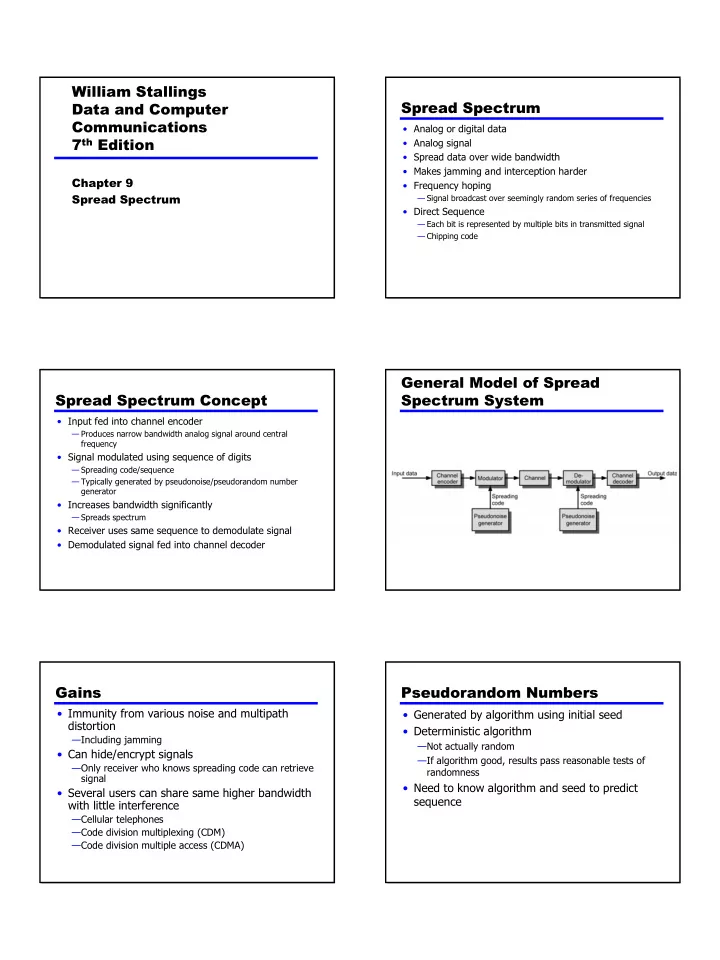
Spread Spectrum Concept
- Input fed into channel encoder
— Produces narrow bandwidth analog signal around central frequency
- Signal modulated using sequence of digits
— Spreading code/sequence — Typically generated by pseudonoise/pseudorandom number generator
- Increases bandwidth significantly
— Spreads spectrum
- Receiver uses same sequence to demodulate signal
- Demodulated signal fed into channel decoder
General Model of Spread Spectrum System Gains
- Immunity from various noise and multipath
distortion
—Including jamming
- Can hide/encrypt signals
—Only receiver who knows spreading code can retrieve signal
- Several users can share same higher bandwidth
with little interference
—Cellular telephones —Code division multiplexing (CDM) —Code division multiple access (CDMA)
Pseudorandom Numbers
- Generated by algorithm using initial seed
- Deterministic algorithm
—Not actually random —If algorithm good, results pass reasonable tests of randomness
- Need to know algorithm and seed to predict