1 Store Stages in Dynamic Execution Load Bypassing and Memory - - PDF document

1
SMART_READER_LITE
LIVE PREVIEW

1 Store Stages in Dynamic Execution Load Bypassing and Memory - - PDF document

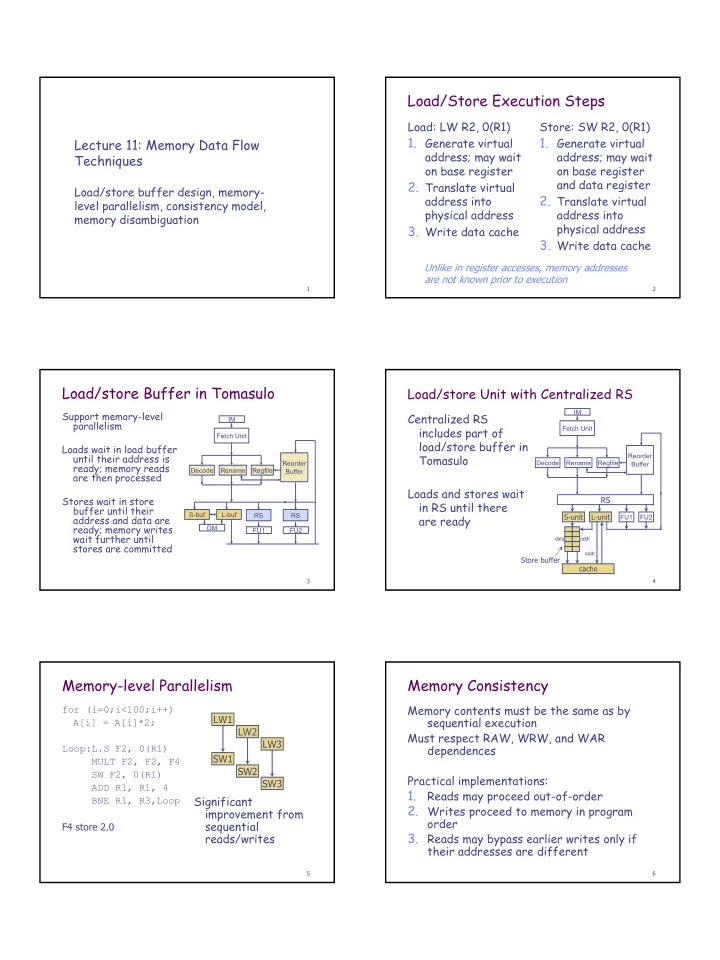
Load/Store Execution Steps Load: LW R2, 0(R1) Store: SW R2, 0(R1) 1. Generate virtual 1. Generate virtual Lecture 11: Memory Data Flow address; may wait address; may wait Techniques on base register on base register and data register 2.


slide-1
SLIDE 1

1

1

Lecture 11: Memory Data Flow Techniques

Load/store buffer design, memory- level parallelism, consistency model, memory disambiguation

2

Load/Store Execution Steps

Load: LW R2, 0(R1)

  • 1. Generate virtual

address; may wait

  • n base register
  • 2. Translate virtual

address into physical address

  • 3. Write data cache

Store: SW R2, 0(R1)

  • 1. Generate virtual

address; may wait

  • n base register

and data register

  • 2. Translate virtual

address into physical address

  • 3. Write data cache

Unlike in register accesses, memory addresses are not known prior to execution

3

Load/store Buffer in Tomasulo

Support memory-level parallelism Loads wait in load buffer until their address is ready; memory reads are then processed Stores wait in store buffer until their address and data are ready; memory writes wait further until stores are committed

Reorder Buffer Decode FU1 FU2 RS RS Fetch Unit Rename L-buf S-buf DM Regfile IM

4

Load/store Unit with Centralized RS

Centralized RS includes part of load/store buffer in Tomasulo Loads and stores wait in RS until there are ready

Reorder Buffer Decode FU1 FU2 Fetch Unit Rename

S-unit

Regfile IM

RS

cache L-unit

data addr addr

Store buffer

5

Memory-level Parallelism

for (i=0;i<100;i++) A[i] = A[i]*2; Loop:L.S F2, 0(R1) MULT F2, F2, F4 SW F2, 0(R1) ADD R1, R1, 4 BNE R1, R3,Loop F4 store 2.0 LW1 SW1 LW2 SW2 LW3 SW3

Significant improvement from sequential reads/writes

6

Memory Consistency

Memory contents must be the same as by sequential execution Must respect RAW, WRW, and WAR dependences Practical implementations:

1.

Reads may proceed out-of-order

  • 2. Writes proceed to memory in program
  • rder
  • 3. Reads may bypass earlier writes only if

their addresses are different

slide-2
SLIDE 2

2

7

Store Stages in Dynamic Execution

1.

Wait in RS until base address and store data are available (ready)

2.

Move to store unit for address calculation and address translation

3.

Move to store buffer (finished)

4.

Wait for ROB commit (completed)

5.

Write to data cache (retired) Stores always retire in for WAW and WRA Dep.

Source: Shen and Lipasti, page 197

finished completed

D-cache RS

Store unit Load unit

8

Load Bypassing and Memory Disambiguation To exploit memory parallelism, loads have to bypass writes; but this may violate RAW dependences Dynamic Memory Disambiguation: Dynamic detection of memory dependences Compare load address with every older store addresses

9

Load Bypassing Implementation

1 2 D-cache RS

Store unit

1 2

Load unit

3

  • 1. address calc.
  • 2. address trans.
  • 3. if no match, update

dest reg Associative search for matching

match

addr data data addr Assume in-order execution

  • f load/stores

in-order

10

Load Forwarding

Load Forwarding: if a load address matches a

  • lder write address,

can forward data If a match is found, forward the related data to dest register (in ROB) Multiple matches may exists; last one wins 1 2 D-cache

Store unit

1 2

Load unit

3

match

addr data data addr

To dest. reg

RS

in-order

11

In-order Issue Limitation

Any store in RS station may blocks all following loads When is F2 of SW available? When is the next L.S ready? Assume reasonable FU latency and pipeline length for (i=0;i<100;i++) A[i] = A[i]/2; Loop:L.S F2, 0(R1) DIV F2, F2, F4 SW F2, 0(R1) ADD R1, R1, 4 BNE R1, R3,Loop

12

Speculative Load Execution

1 2 D-cache RS

Store unit

1 2

Load unit

3

match

addr data data

  • ut-order

addrdata

Finished load buffer

Match at completion

If match: flush pipeline Forwarding does not always work if some addresses are unknown No match: predict a load has no RAW on older stores Flush pipeline at commit if predicted wrong

slide-3
SLIDE 3

3

13

Alpha 21264 Pipeline

14

Alpha 21264 Load/Store Queues

Addr ALU Int ALU Int ALU Addr ALU

Int issue queue fp issue queue

FP ALU FP ALU Int RF(80) Int RF(80) FP RF(72)

D-TLB L-Q S-Q AF Dual D-Cache 32-entry load queue, 32-entry store queue

15

Load Bypassing, Forwarding, and RAW Detection

commit

match

D-cache D-cache

If match: mark store-load trap to flush pipeline (at commit) If match: forwarding

IQ IQ

completed

Load/store? ROB

Load: WAIT if LQ head not completed, then move LQ head Store: mark SQ head as completed, then move SQ head

LQ SQ

16

Speculative Memory Disambiguation

1024 1-bit entry table

Fetch PC

Renamed inst int issue queue 1

  • When a load is trapped at commit, set stWait bit in the

table, indexed by the load’s PC

  • When the load is fetched, get its stWait from the

table

  • The load waits in issue queue until old stores are issued
  • stWait table is cleared periodically

Load forwarding

17

Architectural Memory States

Memory request: search the hierarchy from top to bottom

L1-Cache L2-Cache Memory Disk, Tape, etc. L3-Cache (optional) Completed entries

LQ SQ Committed states

18

Summary of Superscalar Execution

Instruction flow techniques

Branch prediction, branch target prediction, and instruction prefetch

Register data flow techniques

Register renaming, instruction scheduling, in-order commit, mis-prediction recovery

Memory data flow techniques

Load/store units, memory consistency Source: Shen & Lipasti