
1 IPv6, MPLS IPv6
History
Next generation IP (AKA IPng)
Intended to extend address space and routing limitations of IPv4
Requires header change
Attempted to include everything new in one change
IETF moderated
Based on Simple Internet Protocol Plus (SIPP)
IPv6
Wish list
128-bit addresses
Multicast traffic
Mobility
Real-time traffic/quality of service guarantees
Authentication and security
Autoconfiguration for local IP addresses
End-to-end fragmentation
Protocol extensions
Smooth transition!
Note
Many of these functionalities have been retrofit into IPv4
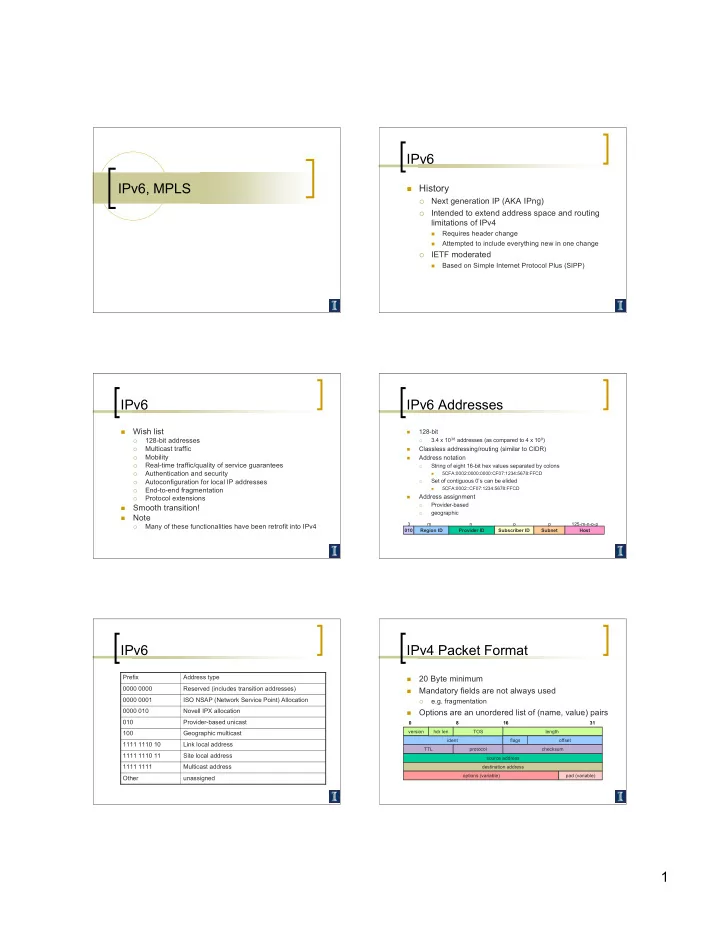
IPv6 Addresses
128-bit
3.4 x 1038 addresses (as compared to 4 x 10⁹)
Classless addressing/routing (similar to CIDR)
Address notation
String of eight 16-bit hex values separated by colons
5CFA:0002:0000:0000:CF07:1234:5678:FFCD
Set of contiguous 0’s can be elided
5CFA:0002::CF07:1234:5678:FFCD
Address assignment
Provider-based
geographic
010 Region ID Provider ID Subscriber ID Subnet Host 3 m n
- p
125-m-n-o-p
IPv6
unassigned Other Multicast address 1111 1111 Site local address 1111 1110 11 Link local address 1111 1110 10 Geographic multicast 100 Provider-based unicast 010 Novell IPX allocation 0000 010 ISO NSAP (Network Service Point) Allocation 0000 0001 Reserved (includes transition addresses) 0000 0000 Address type Prefix
IPv4 Packet Format
20 Byte minimum
Mandatory fields are not always used
e.g. fragmentation
Options are an unordered list of (name, value) pairs
TTL source address destination address
- ptions (variable)
version length
- ffset
ident 8 16 31 hdr len TOS flags checksum protocol pad (variable)